travel-decisions
Is Prague Budapest Too Tiring for Low-Walking Travelers?
A friction-first look at whether Prague and Budapest suit low-walking, older, or slow travelers, with concrete stairs, cobblestone, and crowd data.
Quick Verdict
Prague and Budapest are not automatically too tiring for low-walking travelers, but they are not automatically fine either. The honest answer depends on how you move through each city, not on which city you pick.
Choose this combination if: you are willing to use trams, accessible metro lines, and elevators as your primary way of covering distance, you can accept skipping a few sights that only work on foot, and you are traveling at a pace of one or two "anchor" sights per day rather than a checklist.
Skip or heavily modify this combination if: your itinerary already has both cities packed into three or four days, you expect to walk from sight to sight the way most guides describe, or you have significant difficulty with uneven pavement, since Prague's Old Town rewards no wheeled mobility aid gently.
Strong fit: low-to-moderate walking limits, flexible pacing, willingness to ride rather than walk between anchor sights. Weak fit: severe mobility limits combined with a short, sight-dense schedule that assumes constant walking.
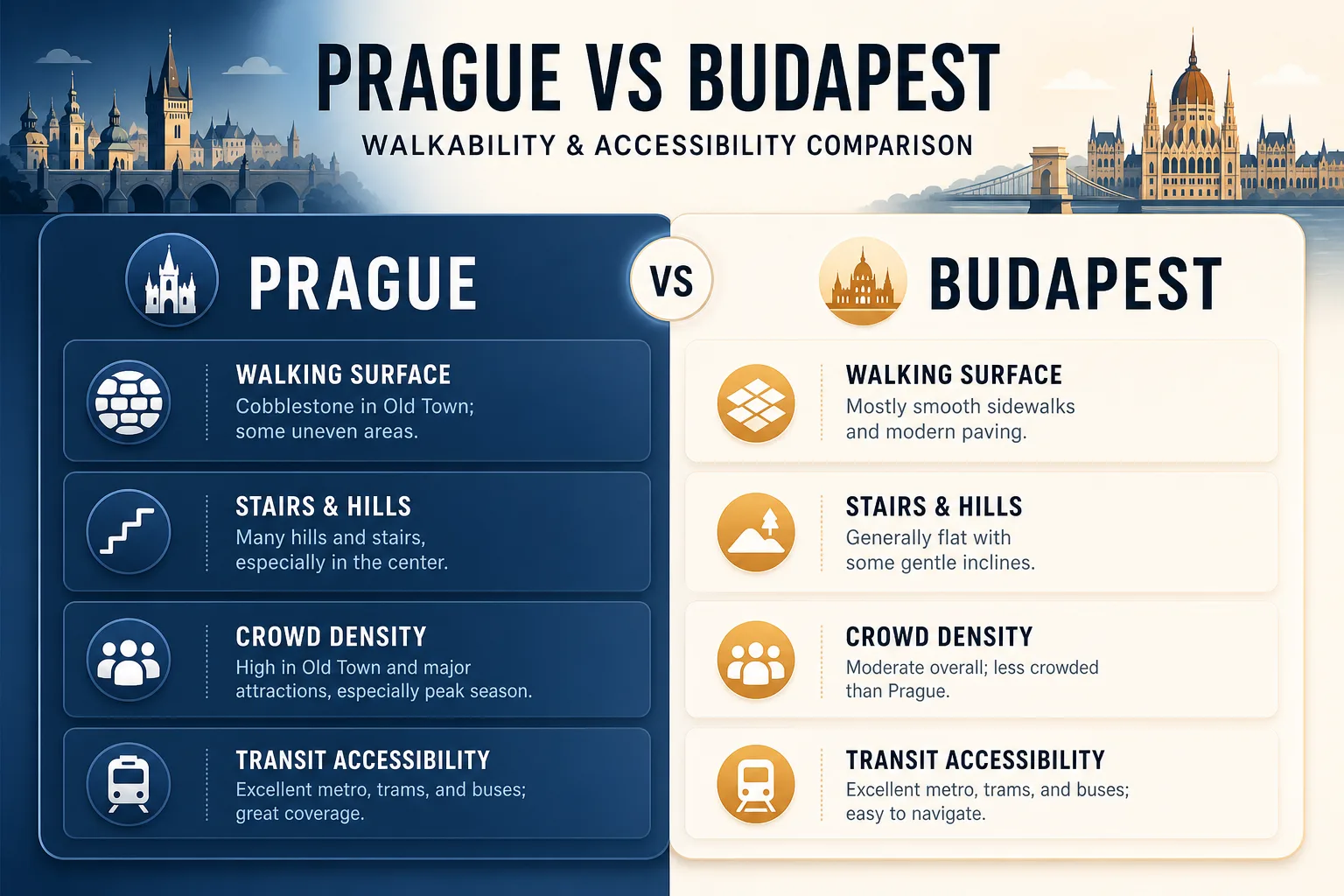 Editorial illustration: A simple side-by-side data comparison layout with two columns labeled Prague and Budapest.
Main Friction Problem
The core problem is not that Prague and Budapest are hilly or sprawling in the way some cities are. It is that each city has a specific, narrow kind of physical friction that guidebooks tend to underplay.
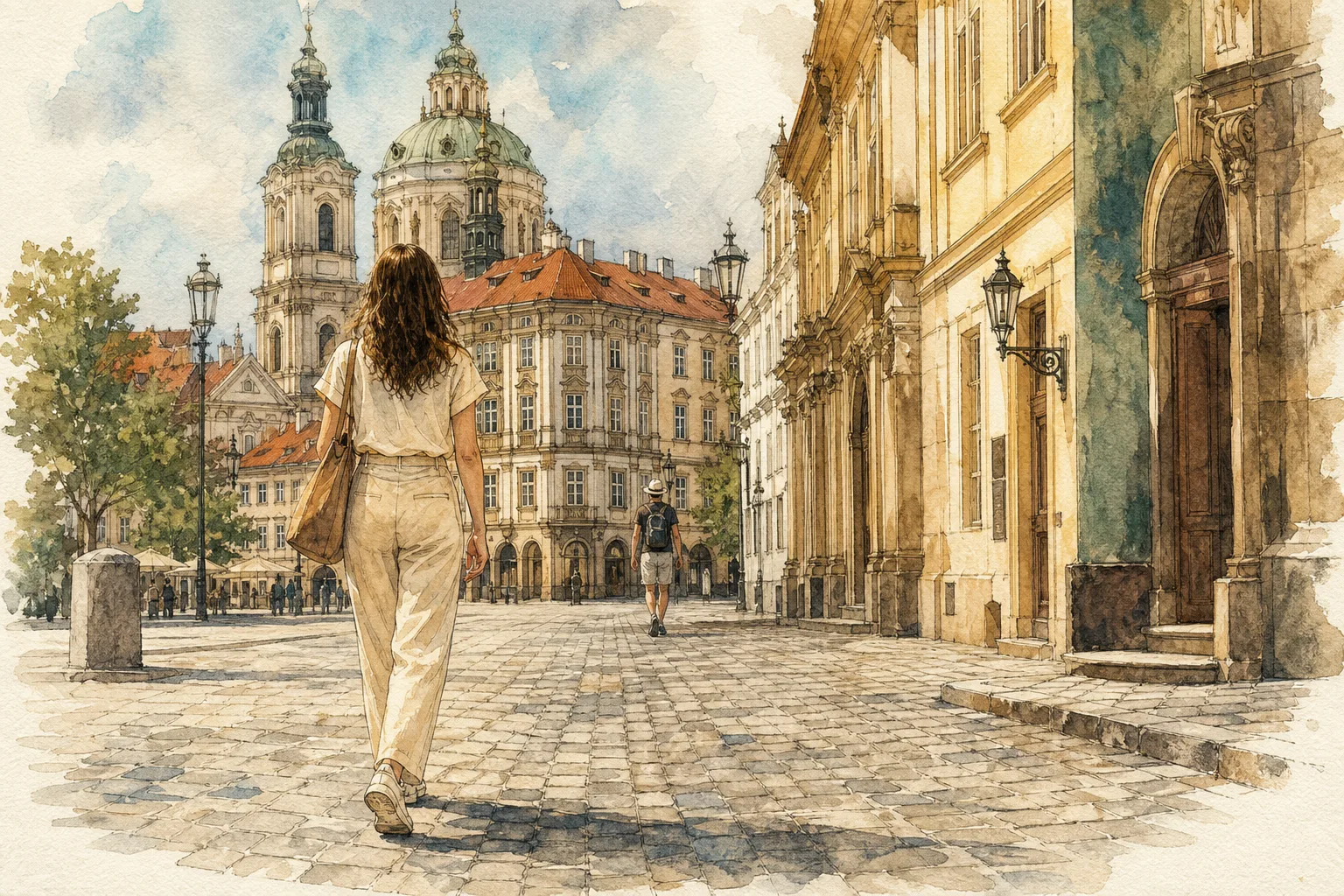
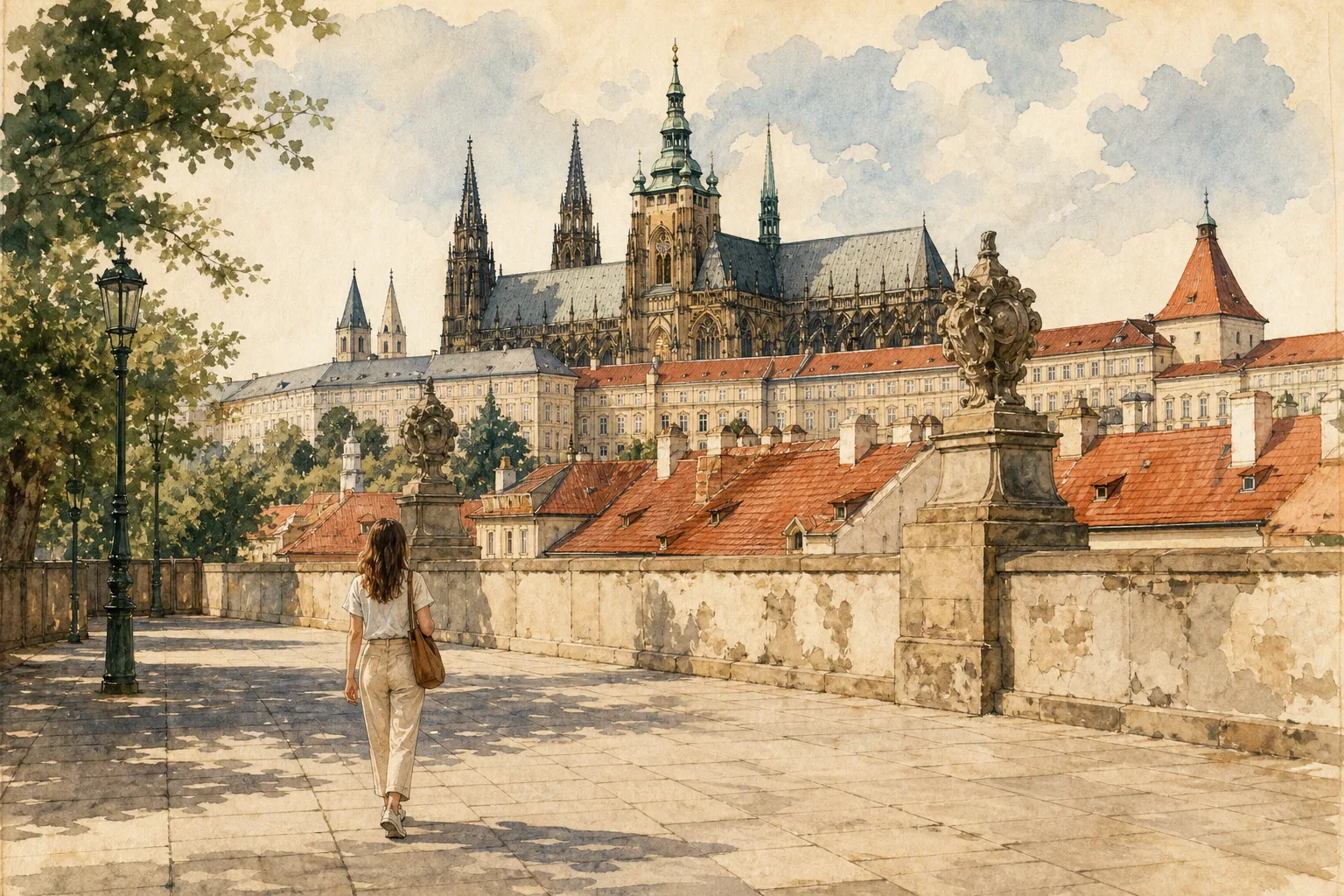
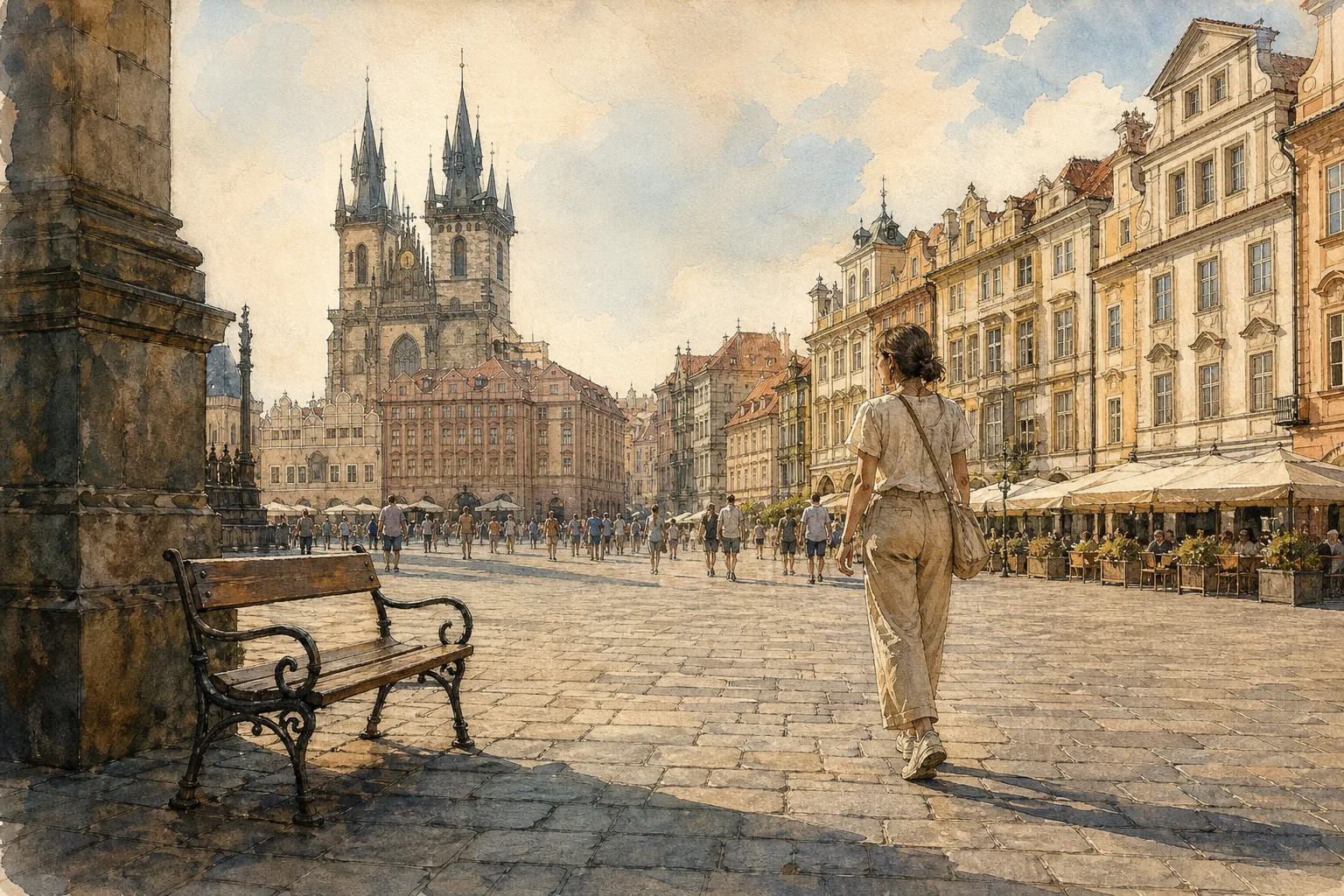
Walking fatigue. Prague's Old Town square to Charles Bridge is only about 1.1 km, roughly 12 to 15 minutes of walking. That sounds trivial until you add the fact that most of that ground, and most of the Old Town generally, is paved in uneven granite set blocks rather than smooth stone. Flat does not mean easy on the feet or ankles when every step lands slightly off-level. Multiply that by a full day of sightseeing and low-stamina travelers feel it by early afternoon, not evening.
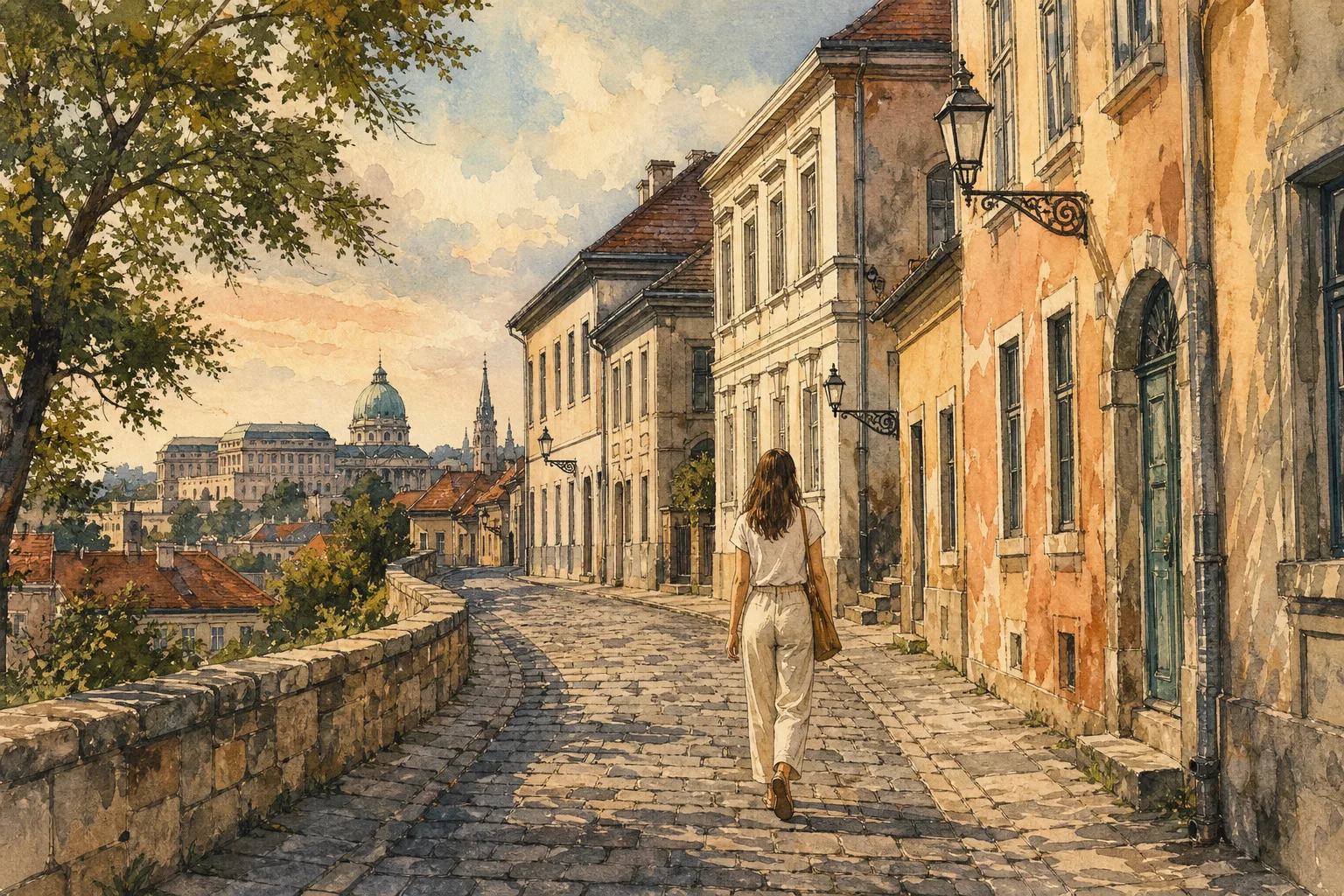
Stairs or bridges. The Royal Route from Prague's Powder Tower up to Prague Castle covers 4.5 km and needs 4 to 5 hours of walking endurance once you account for the steep hill and normal sightseeing stops. In Budapest, Castle Hill has a genuine incline, though the walk between Matthias Church and Fisherman's Bastion once you're up there is under 200 meters, so the climb is the real barrier, not the wandering at the top.
Crowd pressure. Charles Bridge sees up to 30,000 crossings a day in summer, with extreme pedestrian density between 10:00 AM and 6:00 PM. For a low-walking traveler, a crowd is not just an inconvenience, it is a physical hazard: you cannot set your own pace, you cannot stop to rest without being jostled, and you cannot lean on a railing without being in someone's way.
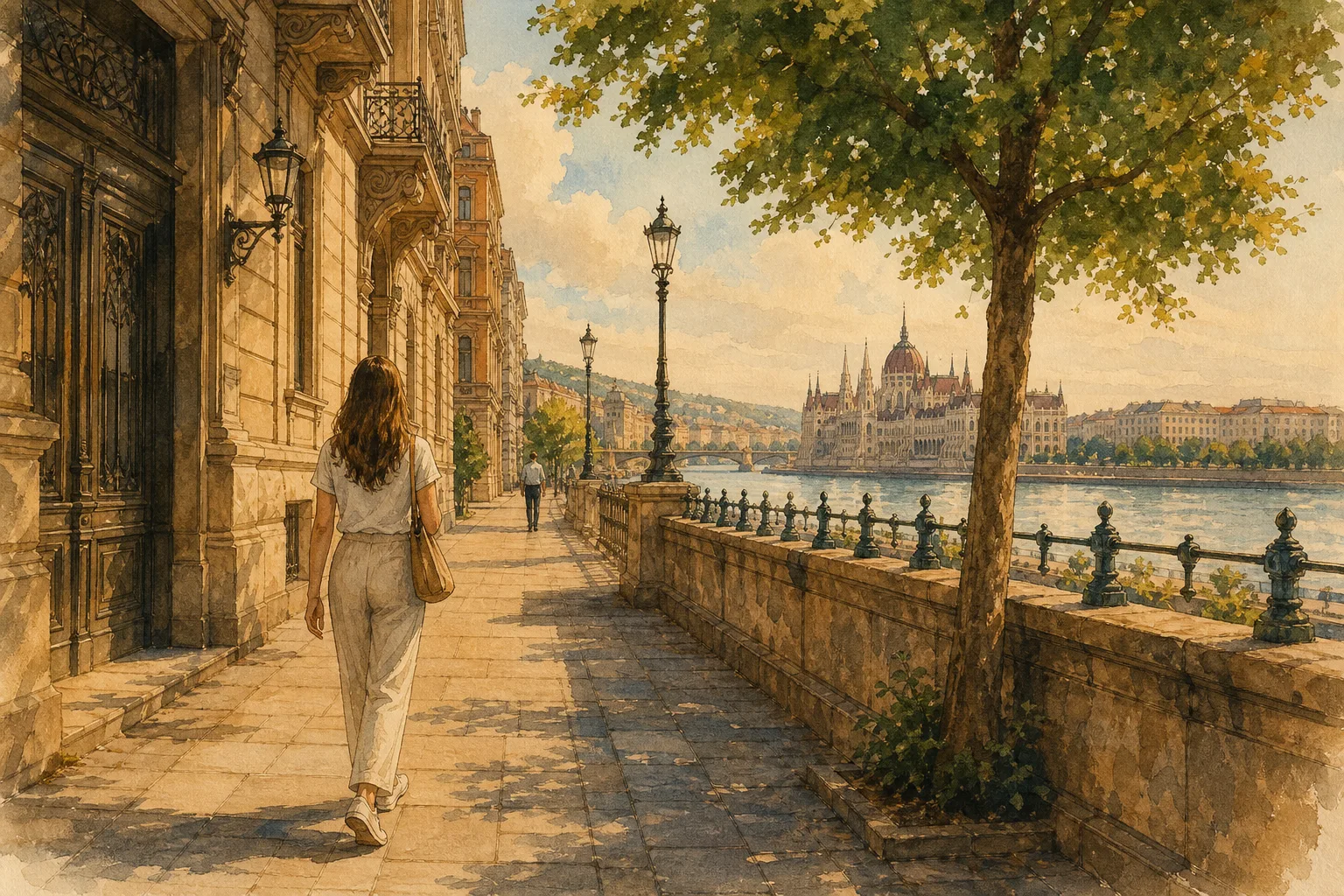
Transit stress. Neither city's transit system is uniformly accessible. Prague's metro has 48 of 61 stations barrier-free, which means 13 are not. Budapest's newer Metro Lines M4 and the reconstructed M3 have lift access at every station, but the historic M1 line requires stairs at every stop. Guessing wrong on which line or station you need can turn a five-minute transit hop into an unplanned stair climb.
None of these four frictions are disqualifying on their own. Stacked together across a single day, without a specific plan to route around them, they add up to genuine exhaustion by the second or third day of a trip.
Friction Table
The friction in Prague and Budapest comes from different sources, and knowing which one applies to which sight changes how you plan around it.
| Friction variable | Prague | Budapest | Practical tradeoff |
|---|---|---|---|
| Walking surface | Old Town is flat but uneven granite set blocks | Castle Hill area has smoother paving at the top | Prague tires ankles and feet even on short flat walks; Budapest's surface is kinder once you're up the hill |
| Stairs or hills | Royal Route to Prague Castle: 4.5 km, 4-5 hours of walking endurance | Castle Hill is steep, but 5 free public elevators connect riverside to hilltop | Budapest's elevators remove the climb entirely; Prague's Tram 22 bypasses the climb but you still walk once there |
| Crowd density | Up to 30,000 crossings a day on Charles Bridge, worst 10 AM to 6 PM | Fisherman's Bastion and Matthias Church draw dense midday crowds in a compact 200m footprint | Prague's crowd problem is a linear chokepoint; Budapest's is a concentrated cluster you can time around more easily |
| Transit access | 48 of 61 metro stations are barrier-free; Tram 22 reaches Castle directly | M4 and M3 are fully lift-accessible; M1 requires stairs at every stop; Bus 16 is a low-floor accessible route to Buda Castle | Both cities have a reliable step-free route to their main hilltop sight, but only if you know which line or tram to pick |
| Cost of comfort | Average hotel about $241/night; mid-range $154-$217/night | Not verified in this data set, describe as generally comparable mid-range pricing | Paying for a well-located hotel near a step-free transit stop reduces walking load more than any packing choice |
Who Will Feel It Most
Older travelers with joint pain will feel the granite pavement in Prague's Old Town before they feel anything about hills. It is a slow, cumulative ache rather than a single hard climb, and it is easy to underestimate because the terrain looks flat on a map.
Travelers who rely on a cane, walker, or other wheeled support will feel Prague's Old Town more acutely than Budapest's Castle Hill, because uneven granite blocks are a constant surface challenge, while Budapest's elevators solve the vertical problem outright once you find them.
Slow travelers who prefer to linger rather than march through a checklist will actually do better here than fast-paced sightseers, because the frictions above mostly punish speed and density, not slowness itself. The traveler most at risk is someone with a compressed schedule (two or three days trying to see both cities' major sights) who also has real walking limits. That combination, not the cities themselves, is what produces a genuinely exhausting trip.
Travelers who get anxious in dense crowds will feel Prague's Charles Bridge more than almost anything else on this list. It is not just physically taxing, it is mentally taxing to be boxed into a slow-moving human current with no easy exit.
How to Reduce the Friction
Each of the four frictions has a specific workaround, not a generic "take it slow" fix.
Walking fatigue: Break sightseeing into two shorter blocks with a seated rest in between, rather than one long walking stretch. Choose a hotel within a short, flat walk of a tram or metro stop so the first and last legs of each day are not the tiring part.
Stairs or bridges: In Prague, take Tram 22 from Lesser Town Square directly to the Prague Castle stop instead of climbing Nerudova Street. In Budapest, use one of the five free public elevators (Iskola Street, Murad, Castle Garden Bazaar, Granit, or Szchnyi National Library) to reach Castle Hill instead of the stairs.
Crowd pressure: Cross Charles Bridge before 10:00 AM or after 6:00 PM to avoid the worst of the day's up to 30,000 crossings. In Budapest, visit Fisherman's Bastion and Matthias Church early or late rather than midday, since the walkable area between them is compact and fills quickly.
Transit stress: Before you travel, confirm which specific metro stations on your route are barrier-free. In Prague, 48 of 61 stations qualify; the other 13 do not. In Budapest, plan around M4 and M3, both fully lift-accessible, and avoid relying on M1, which requires stairs at every stop. Bus 16 is a reliable low-floor option from Deak Ferenc ter to Buda Castle if you want to skip the metro question entirely.
Quick pre-trip checklist
- Confirm your hotel is near a step-free tram, bus, or metro stop, not just "central"
- Map which metro stations on your planned route are barrier-free before you go
- Build in a seated rest block between major sights, not just at the end of the day
- Plan Charles Bridge and Fisherman's Bastion visits outside 10 AM to 6 PM
- Identify the nearest Buda Castle elevator and the Tram 22 stop for Prague Castle before arrival
- Do not schedule both cities' castle-hill sights on the same day
Better Alternatives
If your walking limits are severe, or your schedule is already tight, a few adjustments produce a noticeably easier trip without giving up the core experience.
Consider stretching the trip by an extra two or three days rather than compressing Prague and Budapest into a short window. The physical strain in both cities comes from stacking sights close together, not from the cities themselves, so a longer, slower schedule directly removes the biggest risk factor.
Consider picking one city as the primary stay and treating the other as a shorter, lighter visit, rather than splitting time evenly. This matters most if your stamina is unpredictable day to day, since it gives you a home base with fewer transit unknowns.
Consider a guided small-group or private transit-first tour for the hilltop sights specifically (Prague Castle and Buda Castle), since a driver or guide who already knows the accessible entry points removes the guesswork that causes most of the fatigue described above.
If uneven pavement is your primary limiter rather than distance or stairs, a city with smoother historic-center paving may be a better first choice than Prague specifically, even if Budapest or a modified Prague plan would still work for other travelers in your situation.
Decision Checklist
Use this before you commit to booking Prague and Budapest together.
- Your trip length allows at least one rest day or half-day between major sightseeing days
- Your hotel choice in each city is confirmed to be near a step-free tram, bus, or metro stop
- You have identified the specific accessible route to Prague Castle (Tram 22) and Buda Castle (one of the five elevators)
- You have checked which metro stations on your planned route are barrier-free versus stairs-only
- Your itinerary times Charles Bridge and Fisherman's Bastion outside peak crowd hours
- You are comfortable skipping at least one walking-only sight in exchange for lower fatigue
- Nobody in your group has a mobility need that uneven granite pavement would make unsafe
If you can check most of these before booking, Prague and Budapest is a reasonable choice for a low-walking traveler. If you cannot, the itinerary needs to change before the trip does.
FAQ
Is Prague Budapest doable for someone who cannot walk long distances? Yes, but only with real modifications. Both cities have step-free transit options that reach the major sights, but you have to plan around them deliberately rather than wandering. Without that planning, a standard three-day itinerary in either city will overload a low-stamina traveler by day two.
Which city is harder for low-walking travelers, Prague or Budapest? Prague is harder in a different way than Budapest. Prague's Old Town is flat but its granite-block pavement is uneven and tiring on the feet and ankles, and the walk up to Prague Castle is a genuine hill. Budapest's Castle Hill is steeper but has five free public elevators that remove the climb entirely, so Budapest can actually be easier if you know where the elevators are.
Do I need to give up Prague Castle or Buda Castle if I have limited stamina? No. Prague Castle is reachable by Tram 22, which stops directly at the castle gate and skips the steep Nerudova Street climb. Buda Castle has five free public elevators connecting the Danube riverside to the hilltop, so neither castle requires a forced uphill walk.
How many days should a low-stamina traveler plan for Prague and Budapest? Plan more days than a standard itinerary suggests, not fewer. Splitting sightseeing across a longer stay with built-in rest blocks between major sights reduces cumulative fatigue far more than trying to compress both cities into a short, sight-heavy trip.
Are Prague and Budapest safe for older travelers to navigate alone? Both cities are generally manageable to navigate alone, but the friction is physical fatigue and crowd density rather than personal safety. The bigger risk is overestimating stamina on a packed itinerary, not safety on the street.