travel-decisions
Can You Visit Prague Castle Comfortably If You Suffer from Knee Pain or Limited Mobility?
A friction-first guide to visiting Prague Castle with knee pain or limited mobility: which routes are step-free, which streets to avoid, and what to check before you go.
Quick Verdict
Yes, you can visit Prague Castle comfortably with knee pain or limited mobility, but only if you choose your approach route deliberately and accept that some interior sections will stay off-limits.
Choose this option if:
- You can walk short, flat distances (around 100 to 300 meters) without major pain, even if stairs are a problem
- You are willing to plan your tram stop and entrance in advance rather than following the first signposted path
- You are satisfied seeing the courtyards, cathedral nave, and Old Royal Palace, and do not need to climb every tower
Skip it, or scale back hard, if:
- You cannot tolerate any incline or uneven cobblestone, even for a few minutes, and the tram routes are disrupted on your travel dates
- Your trip depends on seeing the towers, the panoramic viewpoints, or Golden Lane's upper corridors, all of which are stairs-only
- You are relying on a single day with no flexibility to reroute if a stop is closed or a queue runs long
The rubric here is simple: strong fit if you can manage a short flat walk and accept partial access, weak fit if you need full access to every part of the complex or cannot handle any unplanned walking at all.
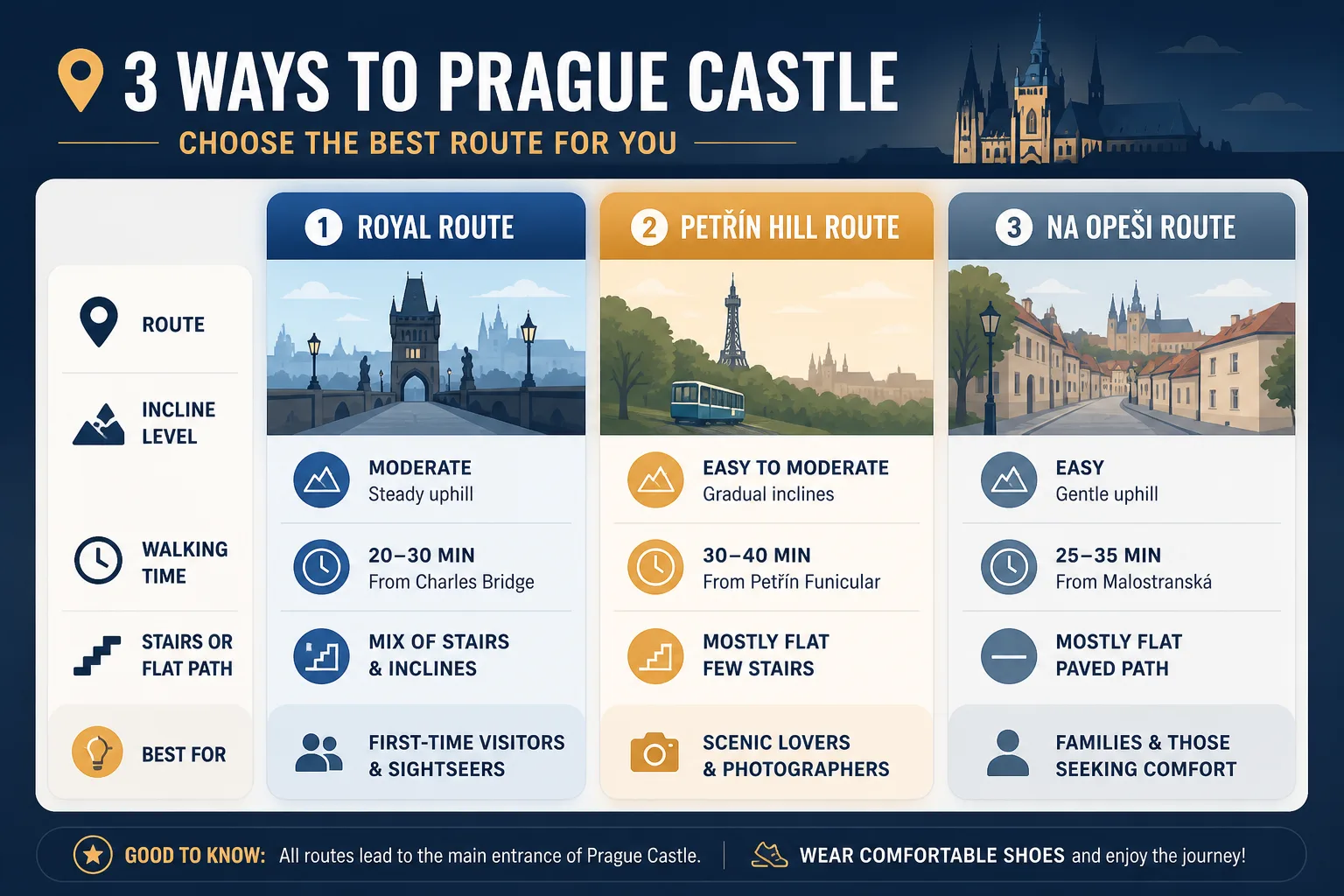 Editorial illustration: A simple comparison chart or table graphic showing three labeled routes into Prague Castle side by side.
The Main Friction Problem
Prague Castle's reputation as a difficult site for anyone with knee pain is only half accurate. The friction is real, but it is concentrated in specific places, not spread evenly across the whole visit.
Walking fatigue is the first issue. The castle complex is large, and once you are inside, you will cover ground between the courtyards, the cathedral, the Old Royal Palace, and Golden Lane. None of that internal walking is steep, but it adds up over an hour or two, and cobblestones throughout the complex are harder on knees than flat pavement.
Transit and station friction is the second, and arguably bigger, issue. How you arrive changes the entire experience. Arrive via Malostransk metro station and you will face the Old Castle Stairs (Star zmeck schody), a route that is heavily stepped and steep. Arrive via Nerudova Street and you will climb a 12% incline over cobblestones. Arrive via the correct tram stop instead, and the walk in can be nearly flat. The station and route you pick before you leave your hotel matters more than your general fitness level.
Expectation mismatch is the third issue, and it is the one that catches people off guard. Many visitors picture "visiting Prague Castle" as touring every tower and corridor. In reality, several of the most photographed features, the Cathedral's South Tower, the White Tower, Daliborka Tower, and the upper corridors above Golden Lane, are stairs-only with no accessible alternative. If your mental image of the visit includes climbing a tower for a panoramic shot, that part of the plan needs to change now, not at the entrance gate.
Friction Table: Where the Difficulty Actually Comes From
The three friction points above do not affect every part of the visit equally. This table breaks down the real decision variables so you can see where the tradeoffs actually sit.
| Decision variable | Easy path | Hard path | What it means for knee pain |
|---|---|---|---|
| Arrival route | Tram to Prask hrad stop, then flat 100m walk (3-5 min) | Malostransk metro, then Old Castle Stairs (steep, heavily stepped) | Route choice, not fitness, determines how hard arrival feels |
| Alternate tram stops | Pran most stop, mostly level, at least 13 min walk | Pohoelec stop, downhill 10 min walk (downhill can strain knees more than flat) | Pran most is gentler on joints despite being the longer walk |
| Interior sights | St. Vitus main nave, Old Royal Palace, Vladislav Hall, St. George's Basilica, Story of Prague Castle exhibition: all step-free | South Tower, White Tower, Daliborka Tower, Golden Lane upper corridors: stairs only | You can see the headline interior sights without stairs, but not the towers |
| Cost of comfort | Outer courtyards and gardens: free entry | Basic Tour ticket: 450 CZK (300 CZK with printed disability documentation) | You can experience the castle for free if you skip the paid interior |
| Queue friction | Off-peak arrival, fewer people at security | Peak-hour security checkpoint: 15 to 30 minute wait | A slow-moving queue is its own fatigue cost for someone already managing pain |
| Seasonal transit risk | Any date outside March 21 to July 17, 2026 | March 21 to July 17, 2026: tram suspended between Chotkovy sady and Brusnice, closing Prask hrad and Krlovsk letohrdek stops | The easiest stops are unavailable for a four-month window in 2026 |
Who Will Feel This Most
Not every mobility limitation reacts to Prague Castle the same way, and the difference matters when you are deciding whether to go.
Travelers with chronic knee pain but decent overall stamina tend to do fine here, because the main obstacle for them is incline and stairs, not distance. Once they are routed around the Old Castle Stairs and Nerudova Street, the flat internal courtyards are manageable.
Travelers with low stamina but no acute joint pain feel the opposite problem. Stairs are not the enemy, but the total distance covered inside the complex, plus standing in security queues, plus walking back down afterward, adds up to real fatigue by the early afternoon. For this group, the fix is less about route selection and more about pacing and rest breaks.
Travelers using a wheelchair or unable to manage any stairs at all have the narrowest but still real window: the flat tram approach plus the four step-free interior sights represent a genuine visit, not just a consolation version of one. But they should mentally write off the towers before arrival, not discover it at the ticket counter.
Travelers visiting during the 2026 tram suspension window (March 21 to July 17) are the group most likely to be caught off guard, because the two easiest access points close during exactly the months many people travel to Prague. Anyone in this window needs a backup plan before booking, not after arriving.
How to Reduce the Friction
Each of the three friction points has a concrete workaround. None of them require heroic effort, just planning before you leave the hotel.
For walking fatigue:
- Break the visit into two shorter blocks rather than one long push. See the courtyards and cathedral first, rest at a bench or cafe within the free areas, then decide whether to continue.
- Wear real walking shoes, not sandals or flats. The cobblestones throughout the complex are unforgiving on joints regardless of route.
- Treat the visit as roughly half a day, not a quick one-hour stop. Rushing to compress it increases strain, not comfort.
For transit and station friction:
- Check whether your travel dates fall inside the March 21 to July 17, 2026 tram suspension before choosing a hotel neighborhood or booking transit passes.
- If trams are running, prioritize the Prask hrad stop for the flattest approach, or the Pran most stop as a longer but still mostly level backup.
- Avoid the Malostransk metro plus Old Castle Stairs combination entirely if stairs are a limiting factor. It is the most scenic route in guidebooks and the worst one for knee pain.
For expectation mismatch:
- Decide before you go which sights are must-see and confirm in advance whether they are step-free. St. Vitus's main nave, the Old Royal Palace, Vladislav Hall, St. George's Basilica, and the Story of Prague Castle exhibition are; the towers and Golden Lane's upper level are not.
- If a panoramic photo from a tower was the main draw, look for a viewpoint reachable by flat or gently graded paths elsewhere in the city instead of assuming the castle towers are the only option.
- Bring printed disability documentation if it applies to you. It gets a reduced 300 CZK ticket, but only with a physical copy, not a photo on your phone.
Better Alternatives If This Still Doesn't Fit
If, after all of this, the honest answer is that Prague Castle's stairs, distances, and queues are still more than you want to manage, there are reasonable ways to adjust the trip rather than cancel it outright.
See it from a distance instead of up close. Several viewpoints across the Vltava River and from level ground in the Lesser Town give a strong view of the castle silhouette without requiring the climb or the courtyard walking at all. This suits travelers who want the visual payoff without the physical cost.
Limit the visit to the free outer areas only. The courtyards and gardens are free to enter and require no ticket, no security queue wait, and no commitment to the stair-heavy interior. For many travelers with limited mobility, this alone delivers most of the emotional payoff of "seeing Prague Castle."
Prioritize a flatter Prague neighborhood for the rest of the trip. If the castle district's hills and cobblestones are a strain, balance the itinerary with flatter areas like parts of the New Town, so the castle visit is the one demanding day rather than the pattern for the whole trip.
Reconsider the day's pacing, not the destination. For some travelers, the real fix isn't avoiding the castle, it's avoiding cramming it into a day that also includes another major walking-heavy site. Spacing out demanding attractions matters as much as picking accessible routes within any single one.
Decision Checklist
Before you commit to a specific day and route, run through this list.
- Confirm your travel dates against the March 21 to July 17, 2026 tram suspension window
- Identify which tram stop you will use (Prask hrad for flattest access, or Pran most as backup) and rule out the Malostransk metro plus Old Castle Stairs route
- List the specific sights you want to see and check each one against the step-free list: St. Vitus main nave, Old Royal Palace, Vladislav Hall, St. George's Basilica, Story of Prague Castle exhibition
- Accept in writing, to yourself, that towers and Golden Lane's upper corridors are off the list if stairs are a hard limit
- Decide in advance whether you are buying the 450 CZK Basic Tour ticket, the 300 CZK reduced ticket with printed documentation, or skipping paid areas and staying in the free courtyards and gardens
- Plan for a 15 to 30 minute security queue during peak hours and build that into your pacing, not as a surprise
- Choose a visit time (morning vs afternoon) based on when you have the most energy, not when it's most convenient for the rest of the day's plans
- Pack real walking shoes and consider a walking aid if cobblestones are a known problem for you
FAQ
Is Prague Castle wheelchair accessible? Parts of it are. The main nave of St. Vitus Cathedral, the Old Royal Palace including Vladislav Hall, St. George's Basilica, and the Story of Prague Castle exhibition all have barrier-free, step-free entry. The Cathedral's South Tower, the White Tower, Daliborka Tower, and the upper corridors above Golden Lane are stairs-only and cannot be adapted for wheelchair users or anyone who cannot climb stairs.
What is the easiest way to reach Prague Castle if I can't do stairs? Take the tram to the Prask hrad stop, when it is running, and walk the short, flat, smooth 100-meter path to the Second Courtyard, which takes about 3 to 5 minutes. This avoids the stepped Old Castle Stairs route from Malostransk metro and the 12% incline on Nerudova Street entirely.
Is there a discounted ticket for visitors with mobility disabilities? Yes. Visitors with physical, printed disability documentation can buy a reduced ticket for 300 CZK instead of the standard 450 CZK Basic Tour ticket. Bring physical proof, since digital-only documentation may not be accepted at the counter.
Can I skip the paid areas and still see Prague Castle? Yes. The outer courtyards and gardens are free to enter, and much of the castle's visual impact, the courtyards, the cathedral facade, the views over Prague, comes from these free areas. If stairs and long tours are too much, a free-area-only visit is a legitimate way to see the castle without paying for or walking through the stair-heavy interior sections.
Will the tram closure in 2026 affect a mobility-limited visit? Yes, significantly, if your visit falls between March 21, 2026 and July 17, 2026. During that window, tram service between Chotkovy sady and Brusnice is suspended, which closes the Prask hrad and Krlovsk letohrdek stops, the two easiest flat-access points. Outside that window, plan around the normal tram stops instead.