where-to-stay
Where to Stay in Prague on a First Trip If You Want Low Walking Stress
A decision-focused guide to choosing a low-walking-stress hotel base in Prague for first-time visitors, with area comparisons, transit facts, and a booking checklist.
Quick Answer
If reducing walking stress is your priority, stay in the flat stretch between Nmst Republiky and Old Town Square, or in Karln, a slightly farther but flatter and cheaper district with a direct 5-minute metro ride into the center.
Choose this approach if you:
- Tire on long walking days or have joint, back, or foot pain
- Are traveling with an older companion or are an older traveler yourself
- Want a predictable, low-effort route between your hotel and the main sights
- Would rather ride two metro stops than climb one steep street
Do not choose a "closest dot on the map" strategy if you:
- Want to be steps from Prague Castle or the top of Mal Strana specifically
- Are comfortable with hills, stairs, and uneven cobblestones as part of the experience
- Plan to be out late and prioritize nightlife proximity over flat terrain (also worth knowing: organized pub crawls are banned in Prague 1 between 10 PM and 6 AM, so that tradeoff matters less than it used to)
The core mistake first-time visitors make is booking based on distance-in-centimeters on a map, not on whether the actual route is flat, paved evenly, and served by a step-free metro stop. In Prague those two things are not the same, and the gap between them is where most walking-stress regret comes from.
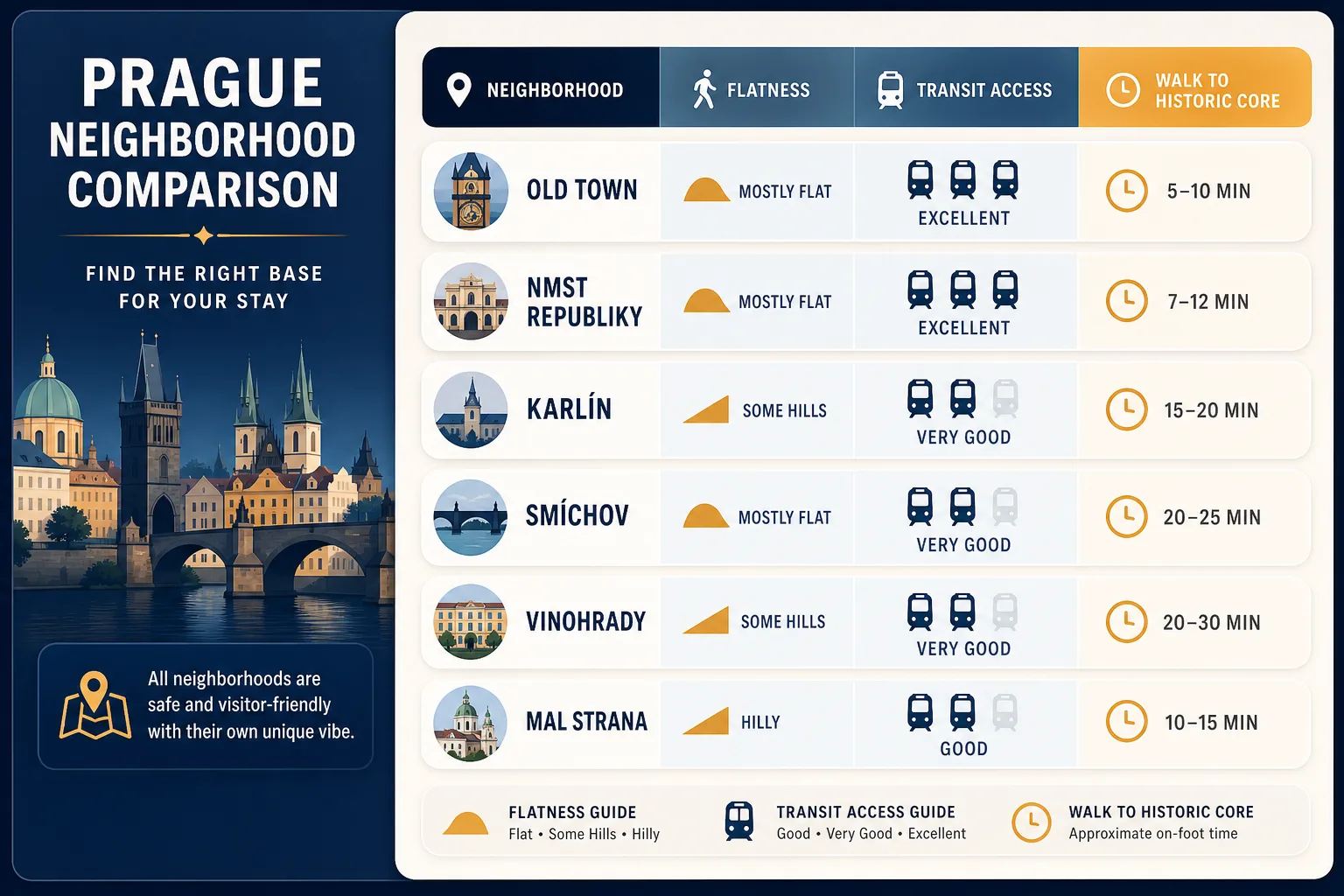 Editorial illustration: A simple comparison table graphic listing Prague neighborhoods (Old Town.
Hotel Location Risk Summary
Prague's Old Town looks compact and walkable in photos, which creates a specific risk: travelers assume "close to the center" automatically means "easy to walk." It does not. The risk breaks down into three separate variables, and a hotel can fail on any one of them even if it nails the other two.
| Risk variable | What actually causes stress | Why it is easy to miss when booking |
|---|---|---|
| Terrain | Hills and centuries-old uneven stone paving, not just distance | Map distance looks short; the incline and surface do not show up in listings |
| Transit step-freedom | Whether the nearest metro stop has elevators or only stairs/escalators | Listings mention "metro nearby" but never mention step-free access |
| Route directness | Whether the walking path is flat and continuous or winds through stairs and slopes | Photos show the destination, not the actual walking route from the door |
The neighborhoods most likely to create silent walking stress are Hradany, Upper Mal Strana, Vinohrady, and ikov, all of which involve steep inclines and uneven stone surfaces as a baseline feature of the area, not an exception. That does not make them bad neighborhoods; it makes them a bad match for a low-stamina trip unless you are prepared for the terrain.
On the transit side, the practical detail most guides skip: Mstek and Muzeum metro stations have full elevator access from street to platform, while Staromstsk, Nmst Mru, and Hradansk on Line A do not. If your hotel search leans on "near a metro stop" as a proxy for accessibility, that proxy fails unless you check which stop.
Best Areas at a Glance
Here is how the realistic candidate areas compare on the three variables that actually determine walking stress, not just proximity to landmarks.
| Area | Terrain | Transit access | Walk to Old Town Square | Best for |
|---|---|---|---|---|
| Nmst Republiky / Old Town edge | Flat | Elevator access at nearby central stations | About 650m, 8 minutes, flat | First-timers who want minimal walking and maximum sightseeing efficiency |
| Karln | Flat | 5-minute direct metro from Kikova to center | Requires the metro ride, not a walk | Budget-conscious, low-stamina travelers willing to use transit once each way |
| Smchov | Mostly flat | Metro and low-floor trams (9, 12, 15, 20) to lower Mal Strana in under 10 minutes | Requires transit | Travelers who want value plus a step-free route toward the castle side |
| Lower Mal Strana (riverside) | Flat near the river | Connects via tram to Smchov and center | Moderate, flat along the river | Travelers who want castle-district atmosphere without the uphill climb |
| Upper Mal Strana / Hradany | Steep, uneven | No step-free metro directly serving this elevation | Short distance but steep climb | Travelers comfortable with hills, not a low-walking-stress pick |
| Vinohrady / ikov | Hilly, uneven | Mixed; some stops not step-free | Moderate, but hilly | Travelers who want a local, residential feel and can handle inclines |
The pattern worth noticing: the areas that look most "central" on a map (Upper Mal Strana, Hradany) are the ones that create the most physical strain, while areas that look slightly farther out (Karln, Smchov, the Nmst Republiky edge of Old Town) are flatter and, in Karln's case, usually cheaper too.
Best Area by Traveler Type
First-time visitors who want to sightsee efficiently without overthinking logistics should default to the Nmst Republiky to Old Town Square corridor. It is flat, the walk to the main historic sights is short and level, and the nearby central metro stations offer step-free transfers. This is the lowest-decision-effort option: you will not need to double-check terrain before booking a specific street.
Low-walking or low-stamina travelers who want to keep total daily steps down should weigh Karln more seriously than its distance-on-a-map suggests. It trades a short, direct metro ride for meaningfully flatter streets and typically lower hotel rates. The tradeoff is one extra transit step at the start and end of each day, in exchange for less walking overall and a quieter base to recover in.
Older travelers, especially those traveling with a companion who has mobility limitations, benefit most from combining the flat-terrain criterion with the free-transit fact: seniors aged 65 and older ride Prague's public transit free with valid ID, which removes the cost friction from choosing a flatter but slightly farther base like Karln or Smchov. For this group, the Nmst Republiky corridor and Karln are both reasonable, with the deciding factor being whether the traveler prefers zero transit use (Nmst Republiky) or a short, step-free-adjacent ride (Karln, via Kikova to central stations).
Across all three traveler types, the same rule holds: prioritize flat terrain and step-free metro stops over raw distance to a specific landmark. A hotel 500 meters from Old Town Square up a steep, uneven lane is a worse pick than one 1.5km away connected by a flat street and an elevator-equipped metro stop.
Areas to Be Careful With
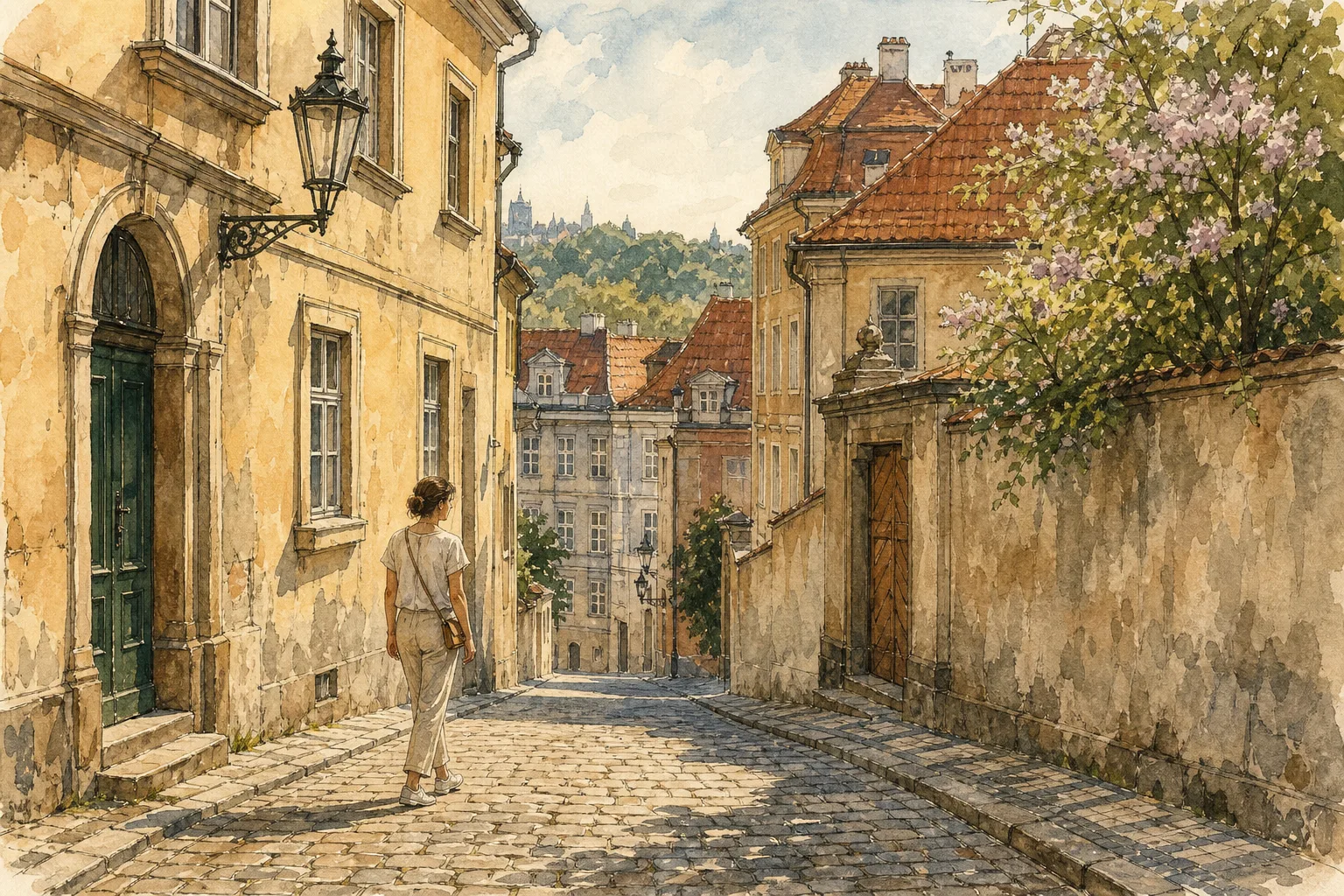
The most common regret pattern is booking a hotel in Upper Mal Strana or near Hradany because it looks close to Prague Castle in photos, then discovering the actual walking route involves a sustained steep climb over uneven, centuries-old cobblestones. This is not a minor inconvenience for a low-stamina traveler; it is a daily, unavoidable obstacle between the hotel and everything else, since the surrounding streets share the same terrain.
A related trap: travelers assume the Petn Funicular offers an easy workaround for the Castle-district hills. It does not right now. The funicular is closed for track reconstruction and slope stabilization, with reopening scheduled for September 2026, so anyone booking a stay in this period should not plan around it as a walking-stress reliever.
A second, quieter risk shows up on Line A of the metro. Travelers who assume "any metro stop nearby" solves accessibility often end up at Staromstsk, Nmst Mru, or Hradansk, none of which are step-free. If you are managing joint pain, traveling with luggage, or supporting a companion who cannot manage stairs or long escalators, a hotel that only connects to one of these three stations effectively has a hidden accessibility gap that will not show up in a typical listing description.
Third, Vinohrady and ikov are frequently recommended in general "best neighborhoods" content for their local character and food scene, which is fair on its own terms. But that recommendation is not built for a low-walking-stress trip: both districts are genuinely hilly with uneven surfaces, and picking one because a general guide called it "charming and local" without checking the terrain is a common source of trip regret for exactly this traveler profile.
Budget vs Convenience Tradeoff
The instinct to book the closest hotel to Old Town Square in order to minimize walking often backfires financially without actually minimizing walking, because "close" and "flat and step-free" are not the same thing. The better framing is: pay for flatness and step-free transit, not for proximity alone.
Practically, that means:
- A flat, well-connected room in Karln or Smchov at a lower nightly rate, plus one short metro ride each way, usually produces less total walking stress than a pricier "steps from the square" room that turns out to sit on an incline.
- Booking transit passes through the PID Ltaka app rather than paper tickets saves about 10 percent, which is worth doing regardless of area since most low-walking-stress plans will involve at least some metro or tram use.
- The 50 CZK per person, per night local accommodation fee applies at most Prague hotels regardless of area, so it should not factor into your area decision, but do include it when comparing final per-night costs across options.
- If you are traveling with someone 65 or older, free transit for that companion changes the math in favor of areas like Karln or Smchov that require a short ride, since the "convenience cost" of using transit is only time, not money, for that traveler.
The tradeoff is not really budget versus convenience in the traditional sense. It is closeness-on-a-map versus actual physical ease, and in Prague's case, spending slightly more time on a flat metro ride is consistently a better trade than spending less time on a steep, uneven walk.
Hotel Location Checklist
Before booking, verify these points using the hotel's exact address, not just its neighborhood name:
- Look up the street view of the actual block, not just the neighborhood photos in the listing
- Check whether the route from the hotel to the nearest metro stop is flat or involves an incline
- Confirm which metro station serves the hotel, and check whether it is step-free (Mstek and Muzeum are; Staromstsk, Nmst Mru, and Hradansk are not)
- If the listing mentions proximity to Prague Castle or upper Mal Strana, assume a steep walk unless you independently confirm otherwise
- Do not plan around the Petn Funicular before its September 2026 reopening
- Add the 50 CZK per person, per night accommodation fee to your per-night cost comparison across candidate hotels
- If traveling with a senior companion, factor in free transit access when comparing a slightly farther, flatter area against a closer, hillier one
- Set up the PID Ltaka app before arrival if you expect to use transit, for the lower digital ticket price
- Ask the hotel directly whether the building itself has an elevator, since older Prague buildings often do not, independent of neighborhood terrain
Final Recommendation
For a first-time visitor prioritizing low walking stress, the Nmst Republiky to Old Town Square corridor is the safest default: flat, short, and backed by step-free metro access at nearby central stations. Choose this if you want to minimize both walking distance and decision-making, and you are willing to pay a typical central-Prague rate for that convenience.
Choose Karln instead if you are more cost-conscious and comfortable with one short, direct metro ride (5 minutes from Kikova) in each direction. It offers comparable or lower walking stress at a generally lower price, at the cost of slightly more planning around transit timing.
Do not choose this low-walking-stress approach at all if your priority is being embedded in the atmosphere of Mal Strana's upper streets or Hradany, or if hills and cobblestones are part of what you want from a Prague trip rather than something to avoid. In that case, a hilltop or castle-adjacent stay may be the better fit, but it should be a deliberate choice made with full knowledge of the terrain, not a default based on map distance alone.
The underlying decision rule to carry into booking: verify flatness and step-free transit at the exact address, not the neighborhood name, and treat metro access as a variable that changes street by street, not district by district.
FAQ
What is the single flattest area to stay in Prague for a first trip? The stretch between Nmst Republiky and Old Town Square is the most consistently flat, walkable base for first-time visitors. It is about 650 meters, roughly an 8-minute walk, on level ground, and it sits near a metro station with elevator access.
Is Mal Strana a good choice if I cannot handle hills or stairs? Only the lower, flatter part of Mal Strana near the river is a safe choice. The upper section toward Prague Castle involves steep, uneven cobblestone climbs, and the Petn Funicular that some travelers rely on to avoid that climb is closed for reconstruction until at least September 2026.
Can I rely on the Prague metro if I have joint pain or use a cane? Partly. Mstek and Muzeum stations have step-free elevator access from street to platform, which makes them dependable transfer points. But Staromstsk, Nmst Mru, and Hradansk on Line A are not step-free and require stairs or long escalators, so avoid basing your trip around those stops if stairs are a problem.
Is staying farther out in Karln or Smchov a bad idea for a first-time visitor? No, and it can actually reduce walking stress. Karln connects to central stations in a direct 5-minute metro ride from Kikova, and Smchov connects to the flatter part of Mal Strana in under 10 minutes by metro or low-floor tram. Both are flatter and often cheaper than the historic core.
Do I need to budget for anything beyond the room rate in Prague? Yes. Prague hotels add a local accommodation fee of 50 CZK (about 2 euro) per person per night for guests 18 and older, and it is usually charged separately from the booking price. It is a small amount, but factor it into your per-night comparison.