where-to-stay
Buda Castle District vs Jewish Quarter: Which Budapest Base Saves You from Steep Hills and Noise?
A decision-focused comparison of Buda Castle District and the Jewish Quarter for Budapest travelers weighing steep hills, late-night noise, and transit access before booking.

Quick Answer
If steep terrain and joint strain are your main worry, book the Jewish Quarter. It is completely flat, sits close to Astoria metro station and the Deak Ferenc ter transit hub, and lets you wheel luggage or a stroller without navigating a hill. If late-night noise is your main worry and you can tolerate limited night transit and a funicular or bus climb, Buda Castle District is quieter and calmer after dark. Budapest does not force a perfect base here. It forces you to choose which friction you would rather absorb with your body.
Choose Buda Castle District if you are:
- A light sleeper who wants minimal street and bar noise after 10 p.m.
- Traveling with older adults who can manage occasional stairs or a bus ride but not sustained noise
- Prioritizing atmosphere over easy nightlife access
Do not choose Buda Castle District if you are:
- Managing knee, hip, or mobility limitations that make hills or funicular queues difficult
- Traveling with a stroller and expect to move around the neighborhood on foot after arrival
- Planning to return to your hotel after midnight regularly, since only the hourly 916 night bus serves the hill then
Choose the Jewish Quarter if you are:
- Traveling with a stroller, heavy luggage, or reduced mobility and need flat ground
- Prioritizing fast transit access over quiet streets
- Comfortable using earplugs or requesting a courtyard-facing room to manage weekend noise
Do not choose the Jewish Quarter if you are:
- A light sleeper without noise mitigation plans, especially near the ruin bar cluster
- Looking for a low-stimulation, quiet evening base
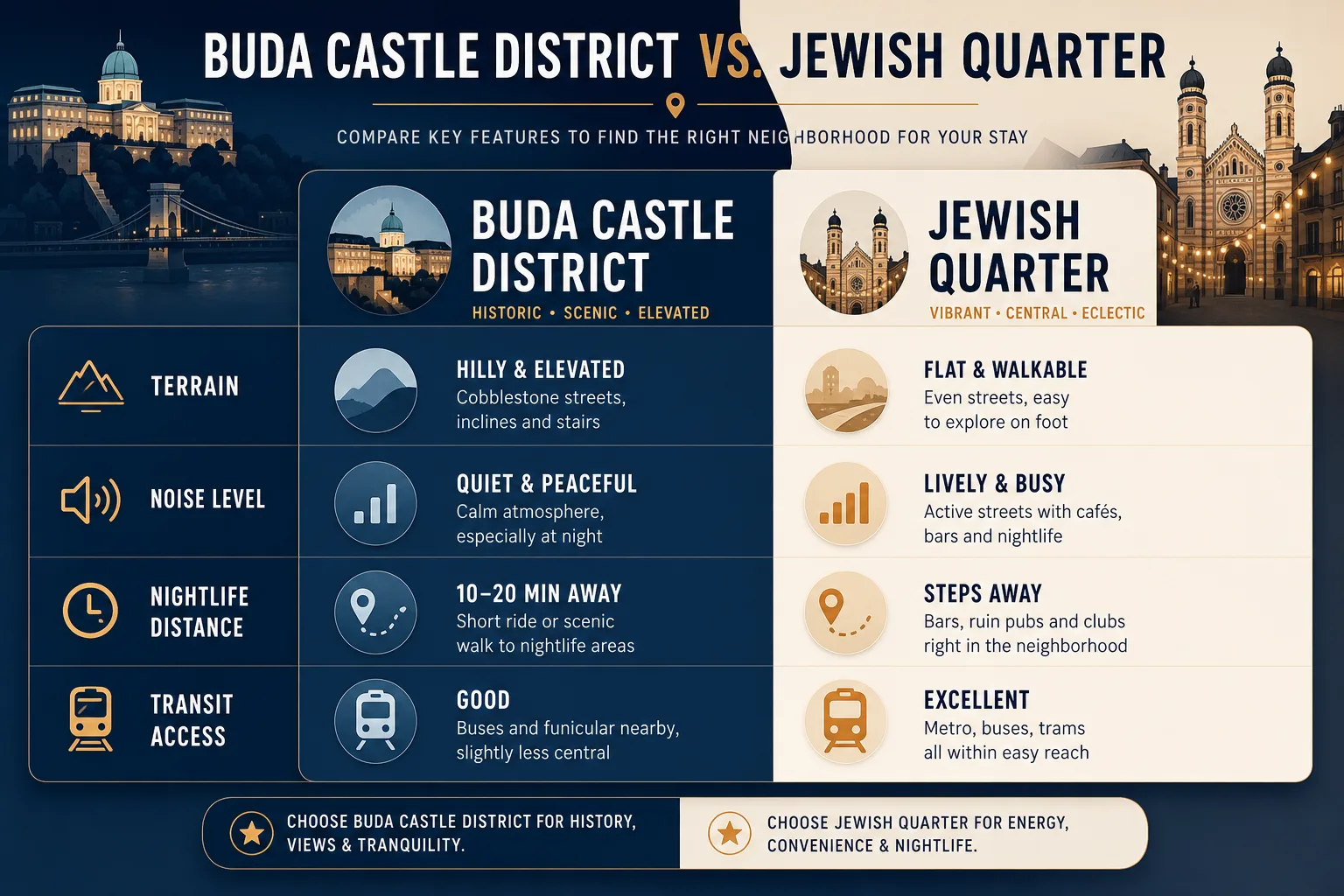 Editorial illustration: A simple comparison table graphic listing Buda Castle District and Jewish Quarter side by side with short labeled rows for terrain.
Hotel Location Risk Summary
The two districts create opposite risk profiles, and the wrong pick shows up on your body or in your sleep, not on a map.
Buda Castle District risk: the terrain itself. Castle Hill rises nearly 50 meters above the Danube. Getting to and from your hotel means one of four options: the paid funicular (HUF 4,500 one-way, HUF 5,500 return in 2026, not covered by the Budapest Card, closed on Mondays of odd-numbered weeks), one of five free public lifts or escalators, a low-floor bus (16, 16A, or 116, every 10 minutes), or walking uphill on cobbled, sloped streets. None of these are fast at 11 p.m. after a full day of sightseeing, and after midnight your only transit option is the hourly 916 night bus. The regret pattern here is underestimating how tiring the daily climb becomes by day three.
Jewish Quarter risk: noise, not terrain. The district is flat and well connected, with Astoria metro station about 200 meters from Dohany Street Synagogue and Deak Ferenc ter roughly a 10-minute walk away. But this is Budapest's ruin bar district, and hotel rooms facing the street can carry real weekend noise well past midnight. The regret pattern here is booking on price and location convenience, then losing sleep for several nights in a row.
Neither district is objectively "safer" from a crime standpoint for this comparison; the practical risk in both cases is physical (hills, congestion) and environmental (noise), not personal safety. The wrong booking usually reveals itself by day two, when the hill starts compounding or the sleep debt starts compounding.
Best Areas at a Glance
| Factor | Buda Castle District | Jewish Quarter |
|---|---|---|
| Terrain | Hilltop, rises nearly 50m above the Danube; cobbled, sloped streets | Completely flat; narrow, sometimes congested sidewalks |
| Noise level at night | Low; little late-night dining or bar activity | High on weekends near the ruin bar cluster |
| Transit access | Funicular (paid), 5 free lifts/escalators, buses 16/16A/116 every 10 min; only hourly night bus 916 after midnight | Astoria metro (M2) ~200m from Dohany Street Synagogue; Deak Ferenc ter hub ~10 min walk |
| Luggage/stroller practicality | Difficult; requires lift, funicular, or bus even for short trips | Easy; flat ground to a major transit hub |
| Typical mid-range price (2025/2026) | EUR 70 to 120/night; boutique/luxury EUR 130 to 250+ | EUR 80 to 150/night; hostels EUR 10 to 25; luxury EUR 180 to 370+ |
| Best for | Quiet sleepers, atmosphere-focused stays, shorter climbs tolerated | Families, older adults with mobility limits, transit-dependent travelers, nightlife access |
The real tradeoff is not "which area is better." It is whether your body handles hills better than your ears handle noise. Budget alone will not tell you this; a family with a stroller and a solo light sleeper on a budget can both spend the same nightly rate and end up in the wrong place.
Best Area by Traveler Type
Light sleepers: Buda Castle District is the stronger default. Its lack of late-night bar traffic and lower foot traffic after dark reduces the two most common noise sources travelers report: street chatter and bar overflow. The tradeoff is accepting slower, less frequent transit if you want to go out at night yourself. If you choose the Jewish Quarter instead, book a room facing an interior courtyard, not the street, and confirm this at booking rather than assuming reception can switch you on arrival.
Families with strollers: The Jewish Quarter is the more practical base. Flat terrain removes the daily problem of hauling a stroller up or down Castle Hill, and proximity to Astoria metro and Deak Ferenc ter means fewer transfers when moving between sights. The tradeoff is noise management: request upper floors or courtyard rooms, and expect weekend evenings to carry more ambient sound than a typical family hotel stay.
Older adults or travelers with joint or mobility concerns: This split by mobility level. If you can manage a bus ride or occasional lift use but not sustained noise, Buda Castle District's calm outweighs its terrain, especially if you plan fewer, slower outings per day. If joint pain or balance is the bigger constraint, the Jewish Quarter's flat ground and short walk to Astoria metro reduce daily physical strain more reliably than any noise-avoidance strategy in the Jewish Quarter can reduce sleep disruption.
Areas to Be Careful With
The clearest regret pattern is picking Buda Castle District for its views and quiet reputation, then discovering the daily transit friction outweighs the peace. A traveler who books a hilltop hotel expecting a quick walk to dinner in Pest each night will instead face a funicular queue and fee, a bus wait, or a genuinely steep walk down and, more painfully, back up. This is a bigger problem for anyone planning multiple outings per day, since each round trip adds real time and physical effort that does not show up in a map screenshot.
The mirror-image mistake is booking the Jewish Quarter purely for its transit convenience and low mid-range prices, then being surprised by weekend noise. Street-facing rooms near Kazinczy utca or Kiraly utca sit close to a dense cluster of ruin bars, and city noise there can run well past midnight on Friday and Saturday. A family or older traveler who assumed "central and flat" meant "quiet" is the one most likely to end up frustrated here.
A third, less obvious risk: travelers assuming Airbnb-style apartments will solve either problem with more space or a quieter block. Hungary's moratorium on new short-term rental registrations, running from January 1, 2025, through December 31, 2026, means fewer new listings are entering either district, so hotel and guesthouse inventory is the more realistic planning base for 2026 stays, and it is worth confirming this shift when you compare listings.
Budget vs Convenience Tradeoff
Price alone does not separate these districts cleanly, since ranges overlap. Buda Castle District mid-range hotels run EUR 70 to 120 per night, with boutique and luxury options from EUR 130 to 250 or more. The Jewish Quarter spans a wider range, from EUR 10 to 25 for hostels up to EUR 80 to 150 for mid-range hotels and EUR 180 to 370 or more for luxury properties. Both districts add a standard 4% local tourist tax on the accommodation price, billed separately at checkout, so factor that into any rate comparison rather than treating the quoted nightly rate as final.
The more useful framing is convenience-per-euro rather than price-per-night. A EUR 100 room in the Jewish Quarter buys you flat, fast access to Astoria metro and citywide transit. A EUR 100 room in Buda Castle District buys you quiet, but you pay a recurring cost in time and effort every time you leave or return, whether that is a funicular fee, a bus wait, or a physical climb. If your itinerary involves multiple daily outings across the river, the Jewish Quarter's convenience tends to offset its higher noise risk. If your itinerary is slower-paced with fewer outings per day, Buda Castle District's quiet becomes the better use of the same budget.
Hostel-level budgets skew this further toward the Jewish Quarter by default, since Buda Castle District has little to no hostel inventory in its historic core, making it a mid-range-to-luxury district by nature rather than a budget one.
Hotel Location Checklist
Use this before confirming either booking:
- Confirm your room does not face a main street in the Jewish Quarter, especially near Kazinczy utca or Kiraly utca, if you are a light sleeper
- Check whether your Buda Castle District hotel is within walking distance of a free lift, escalator, or bus stop, not just the paid funicular
- Verify what time your last practical transit option runs if you plan to return after midnight (hourly 916 night bus is the only Castle Hill option)
- Ask the hotel directly about stroller or wheelchair access from the street to your room, since historic buildings in both districts vary widely
- Confirm the 4% local tourist tax is included or excluded from the quoted nightly rate before comparing prices across districts
- If considering a short-term rental, confirm it was registered before the 2025-2026 moratorium, since new registrations are currently banned
- Match your planned daily outing count to your tolerance for Castle Hill's transit friction versus the Jewish Quarter's noise exposure
Final Recommendation
Choose Buda Castle District if uninterrupted sleep matters more to you than daily convenience, and you can accept a funicular fee, a bus schedule, or a physical climb as the price of that quiet. It suits light sleepers, slower-paced travelers, and older adults who can manage occasional stairs or short bus rides but struggle with noise.
Choose the Jewish Quarter if flat terrain, fast transit, and easy movement with luggage or a stroller matter more than nighttime quiet. It suits families, travelers with mobility limits, and anyone whose itinerary involves multiple outings per day across the city. Manage its main risk directly: book a courtyard-facing or upper-floor room and treat weekend noise as a planning variable, not a surprise.
Do not choose based on price alone. Both districts overlap in the EUR 80 to 150 mid-range band, so the deciding factor should be which friction you can tolerate more consistently across your whole trip: a hill you climb every day, or noise you manage every night.
FAQ
Is Buda Castle District too hilly for someone with knee or joint pain? Yes, for most nightly routines. Castle Hill rises nearly 50 meters above the Danube, and the paid funicular (HUF 4,500 one-way, HUF 5,500 return in 2026) is not covered by the Budapest Card and closes on Mondays of odd-numbered weeks. Free lifts and escalators exist at five points, and buses 16, 16A, and 116 run every 10 minutes, but you still need to walk to and from those access points on sloped, cobbled streets. If stairs or inclines cause pain, plan around bus access rather than assuming you will walk up and down freely.
Which area is quieter at night, Buda Castle District or the Jewish Quarter? Buda Castle District is quieter after dark. It has little late-night dining or bar activity, and transit options thin out sharply, with only the hourly 916 night bus serving the hill after midnight. The Jewish Quarter is Budapest's ruin bar district, so streets near Kazinczy utca and Kiraly utca carry real late-night noise on weekends. Choose Castle Hill for sleep quality, and choose the Jewish Quarter only if you can tolerate or block out weekend street noise.
Is the Jewish Quarter walkable for a family with a stroller? Mostly yes, with one caveat. The district is completely flat, which is easier on strollers and joints than Castle Hill's slopes. However, sidewalks are narrow and get congested with pedestrian traffic, especially near Dohany Street Synagogue and the ruin bar cluster, so stroller maneuvering can be slow during busy afternoon and evening hours.
Does either area work well for a short layover-style visit with heavy luggage? The Jewish Quarter is the safer choice for luggage. Astoria metro station (Line M2) sits about 200 meters from Dohany Street Synagogue, and the Deak Ferenc ter transit hub is roughly a 10-minute walk away, so you can wheel luggage on flat ground to a major interchange. Buda Castle District requires either the paid funicular, a free lift or escalator, or a bus climb, all of which are slower and more effort with bags.
Are short-term rentals like Airbnb still an option in either district? Not for new listings. Hungary imposed a two-year moratorium from January 1, 2025, through December 31, 2026, banning new short-term rental registrations in Budapest. This pushes more travelers toward hotels and guesthouses in both districts, which is worth factoring into price comparisons and availability planning for 2026 stays.