travel-decisions
Is Budapest Worth It If You Want to Enjoy It More Comfortably?
A traveler-fit breakdown of whether Budapest works for people who value comfort and atmosphere over budget backpacking or landmark checklists, with specific neighborhood and pacing guidance.
Quick Verdict
Budapest is worth it for comfort-focused travelers, but only if you treat it as a city with two very different personalities and choose the right one on purpose.
Choose Budapest if: you want a slower-paced European city break with strong architecture, a real cafe culture, and the option to pay for a genuinely quiet, well-located base. Couples who want atmosphere over a landmark checklist tend to do well here, especially if they anchor their stay in District V or a similarly calm pocket of the city.
Skip or rethink Budapest if: your mental image of the city comes mainly from budget-backpacker content about ruin bars and cheap nightlife. That version of Budapest exists, it is loud, dense, and centered on District VII, and it will actively work against a comfortable trip if you end up staying inside it by accident.
The honest answer is not "Budapest is comfortable" or "Budapest is chaotic." It is that Budapest contains both, and the trip you get depends on which one you book into.
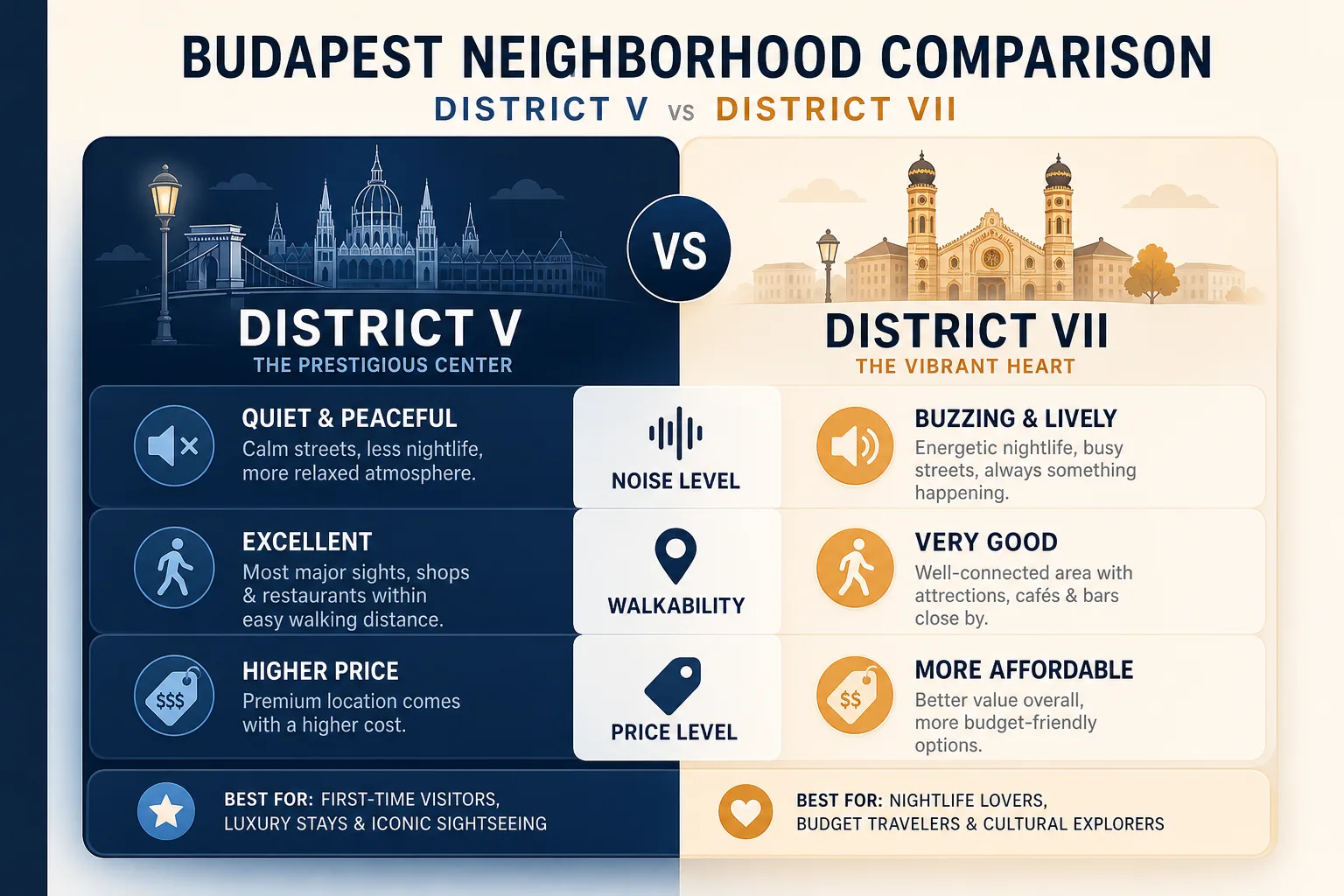 Editorial illustration: A simple decision-table style graphic comparing two Budapest neighborhood columns.
Traveler Type Table
The comfort question in Budapest is not really about the city as a whole. It is about a small number of decision variables that determine which version of Budapest you experience.
| Decision variable | Comfort-first choice | Tradeoff |
|---|---|---|
| Base neighborhood | District V (upscale, walkable, secure) | Higher hotel rates, less nightlife energy on your doorstep |
| Alternative base | District VI (still central, calmer edges) | Slightly more distance from core sights, generally cheaper |
| Avoid as a base | District VII (Jewish Quarter / ruin bars) | Heavy late-night noise and crowds even if the room itself is fine |
| Getting around Pest | Flat, walkable, e.g. Parliament to St. Stephen's Basilica is about 1.2 km, 15 minutes | Minimal, this genuinely favors comfort |
| Getting to Buda Castle District | Steep climb, Bus 16, or the funicular | Funicular closes on Mondays of odd weeks, so it needs a real plan, not a whim |
| Metro accessibility | M4 and M3 are fully step-free | M1 is not accessible at all, relevant if joint pain or a stroller is a factor |
| Thermal baths | Szchenyi with a Fast-Track private cabin ticket | Costs more (about 41 to 49 US dollars vs 36 for basic gate entry) but cuts crowd stress |
For travelers seeking comfort, the table above is really a single lesson repeated: Budapest's comfort is purchasable and locatable, but it is not the default. You have to select for it.
For couples, the same table doubles as a compatibility check. If one partner wants late-night bar-hopping and the other wants quiet dinners and a calm walk home, District VII versus District V is effectively that argument made physical.
For relaxed-pace travelers, the flat, walkable core of Pest is the single biggest point in Budapest's favor. A slow traveler can cover the Parliament-to-Basilica stretch without route planning or stamina management, which is rare among major European capitals.
Best for First-Time Visitors
First-time visitors to Budapest often arrive with one of two scripts in their head: "cheap Eastern European party city" or "hidden gem full of grand architecture." Both are partly true, which is exactly the problem, because they point to different neighborhoods and different daily rhythms.
For a comfort-seeking first-timer, the practical move is to let District V or District VI anchor the trip rather than chasing the cheapest listing near the Jewish Quarter. A first visit is also the wrong time to gamble on an unfamiliar area for the sake of a lower nightly rate, since you have no baseline for what "normal" noise or walkability looks like here yet.
Couples on a first visit benefit from the same logic doubled: pick the calmer base, then treat District VII as a place to visit for an evening, not a place to sleep. Relaxed-pace first-timers should also budget one full day for Buda separately from Pest, since the funicular's Monday closures on odd weeks can quietly wreck a tightly scheduled single-day plan.
Best for Couples
Couples get more out of Budapest than almost any other traveler type on this list, provided the trip is built around atmosphere rather than an efficiency checklist. The city's strengths, riverside walks, grand but human-scale architecture, long cafe sits, and thermal bath afternoons, are couple-friendly by nature.
The friction point for couples is usually hotel selection, not the city itself. A couple who books a well-reviewed but cheaply priced room in District VII for the sake of proximity to nightlife often ends up with a comfortable bed and an uncomfortable night, because the noise problem in that district is structural, not a matter of picking the right building.
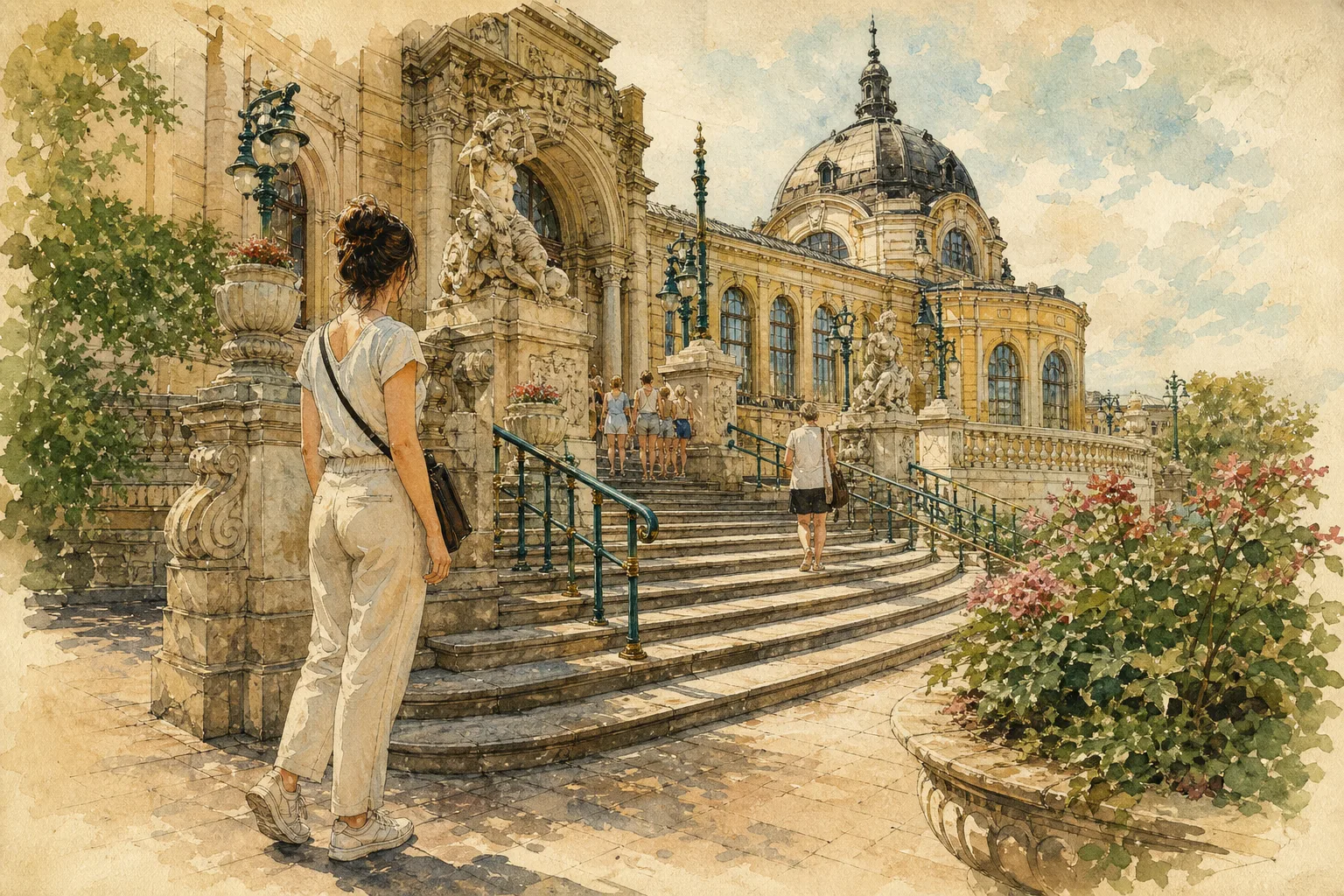
Couples planning a bath visit should also note that Szchenyi bars entry to children under 14, which is irrelevant for most couples but matters if you are traveling with extended family, and that Gellrt and Kiraly baths are both closed, so Szchenyi is effectively the main comfort-tier bath option right now. Booking the Fast-Track ticket with a private cabin is a reasonable comfort upgrade for a couple who wants the bath experience without a crowded locker room.
Best for Slow Travelers
Slow travelers, people who would rather sit in one cafe for two hours than see six sights in a day, are arguably the best-suited traveler type for Budapest as a whole. The flat Pest core rewards wandering without a map, and the distances between major landmarks are short enough that changing plans mid-walk costs almost nothing.
Where slow travelers need to adjust their instincts is Buda. The Castle District's hilltop position means "I'll just wander over" is not really available the way it is in Pest. You need to commit to Bus 16, the funicular, or a genuine uphill walk, and check whether the funicular is running that day, since it is closed on Mondays of odd weeks. A slow traveler who tries to treat Buda with the same improvisational approach that works in Pest will likely end up frustrated rather than relaxed.
The same applies to bath visits: a slow traveler who shows up at Szchenyi on a whim during peak hours may find the crowd density works against the unhurried experience they came for. Paying for the Fast-Track private cabin option, or visiting at an off-peak time, protects the slow-travel intent better than a walk-in visit does.
Best for Low-Stress Travelers
Low-stress travelers want a trip that runs on rails, minimal decision fatigue, few surprises, predictable logistics. Budapest can deliver this, but it requires slightly more upfront homework than a city with a single obvious tourist core.
The main low-stress win is the metro system: M4 and M3 are fully step-free, which removes a common source of daily friction for anyone managing luggage, a stroller, or joint pain. The main low-stress risk is the M1 line, which has no wheelchair or stroller accessibility at all, so a low-stress traveler needs to check which line a given trip actually requires before assuming the metro will just work.
Hotel choice is the other lever. A low-stress traveler in Budapest should treat District V's higher rates, roughly 110 US dollars a night at the lower end in District VI up to over 400 US dollars in District V, as a legitimate cost of reducing daily variables, not as an unnecessary splurge. Predictability is the product being purchased, not luxury for its own sake.
Common Mismatches
Some traveler patterns run into real disappointment in Budapest, and it is worth naming them plainly before booking.
- The budget-backpacker expectation, comfort-seeker booking: travelers who read general Budapest content built around cheap ruin bars, then book a comfort-tier hotel expecting a quiet trip, without realizing the loud version of the city is concentrated in District VII and will still be audible or visible nearby if they book too close to it.
- The "trendy district" assumption: assuming the most-photographed or most-recommended nightlife district is automatically the best place to stay. It is often the opposite for comfort-focused travelers, since popularity there is driven by bars and crowds, not walkability or quiet.
- Paying more without checking what it buys: upgrading hotel budget without confirming the upgrade actually buys a quieter location. A 300 US dollar room in a loud pocket of District VII does not deliver the same comfort as a 150 US dollar room in a calm stretch of District VI.
- Treating Buda like an afternoon add-on: underestimating the funicular's Monday closures on odd weeks or the steep climb, then discovering the "quick castle visit" eats far more time and effort than planned.
- Assuming all baths are open and open to everyone: planning around Gellrt or Kiraly, both currently closed, or bringing children under 14 to Szchenyi, where they are not permitted.
Final Match Recommendation
Budapest earns a genuine "worth it" for travelers who value atmosphere, comfort, and a relaxed pace, but the recommendation comes with a condition: you have to choose your neighborhood and pacing deliberately rather than following generic budget-travel advice built for a different kind of visitor.
Choose Budapest if you are a couple, a slow traveler, or a comfort-seeking first-timer willing to pay District V or District VI rates for a quieter base, plan Buda as its own deliberate outing, and treat the thermal baths as a planned activity rather than a spontaneous stop.
Do not choose Budapest, or at least reconsider the itinerary, if your travel style depends on cheap, high-energy nightlife directly outside your hotel door, since that experience and the comfortable version of the city occupy overlapping but distinct footprints, and trying to get both at once is where most disappointment in Budapest actually comes from.
FAQ
Is Budapest worth it for travelers who do not want a budget-backpacker trip? Yes, but only if you choose your base deliberately. Budapest has a real comfort tier, including District V hotels and quiet riverside streets, but it also has a loud, cheap-tourism layer concentrated in the ruin bar district. The city works well for comfort-focused travelers who actively avoid that layer rather than stumbling into it.
Which Budapest neighborhood is best for a comfortable, relaxed trip? District V is the strongest match for comfort-first travelers. It is upscale, walkable, and secure, with an easy 15-minute flat walk between major landmarks like the Parliament and St. Stephen's Basilica. District VII, the Jewish Quarter, has more nightlife energy but heavy late-night noise and crowds, which works against a relaxed pace.
Do I need to budget more than a typical Budapest itinerary suggests to enjoy it comfortably? Generally yes. Comfort-tier hotels in Budapest range from roughly 110 US dollars a night in District VI to over 400 US dollars a night in District V, which is a wider range than budget guides usually mention. Paying more only pays off if it buys a quieter location and easier logistics, not just a nicer lobby.
Are Budapest's thermal baths a good fit for a comfort-focused, low-stress trip? They can be, with planning. Szchenyi's basic weekday ticket is about 36 US dollars, while a Fast-Track ticket with a private cabin runs 41 to 49 US dollars and reduces crowd stress considerably. Note that Gellrt and Kiraly baths are currently closed for renovation, and children under 14 cannot enter Szchenyi, which matters for couples traveling with family.
Is Budapest walkable enough for slow travelers who do not want a packed itinerary? Pest is very walkable and flat, which suits a slow pace well. The Buda side is different: reaching the Castle District requires a steep climb, Bus 16, or the funicular, and the funicular closes on Mondays of odd weeks. Slow travelers should plan Buda as a separate, deliberate outing rather than something to wander into casually.