travel-decisions
Is Budapest a Good First Trip for Travelers Who Want Easy Logistics?
A decision-focused look at whether Budapest fits first-time visitors, low-stress planners, and couples who want simple arrival and easy daily navigation.

Quick Verdict
Budapest is a strong first-trip choice for travelers who want easy logistics, but only if they treat hotel location as the single most important booking decision. Its direct airport-bus option and a central Pest base can reduce arrival and daily navigation decisions, provided the traveler checks the current route for the actual hotel.
Choose Budapest if you:
- Want a capital city trip without a steep transit-learning curve
- Are willing to book a hotel in or near the historic core, even if it costs more
- Plan to walk most of the trip rather than piece together multiple transit lines daily
- Are traveling as a couple or first-timer who wants shared decisions, not shared stress
Skip Budapest, or plan more carefully, if you:
- Book hotels purely by price and end up in a district that requires transfers for everything
- Expect zero uphill walking or stair-climbing anywhere in the city
- Want a single-center city layout with no bridge-crossing decisions at all
- Need accommodation terms to be identical across every listing without checking the current property
The rubric focus here is direct: Budapest is a strong fit if the traveler prioritizes a central base and accepts one deliberate hotel-location decision. It is a weak fit if the traveler wants a zero-navigation experience or insists on the cheapest lodging regardless of the actual route.
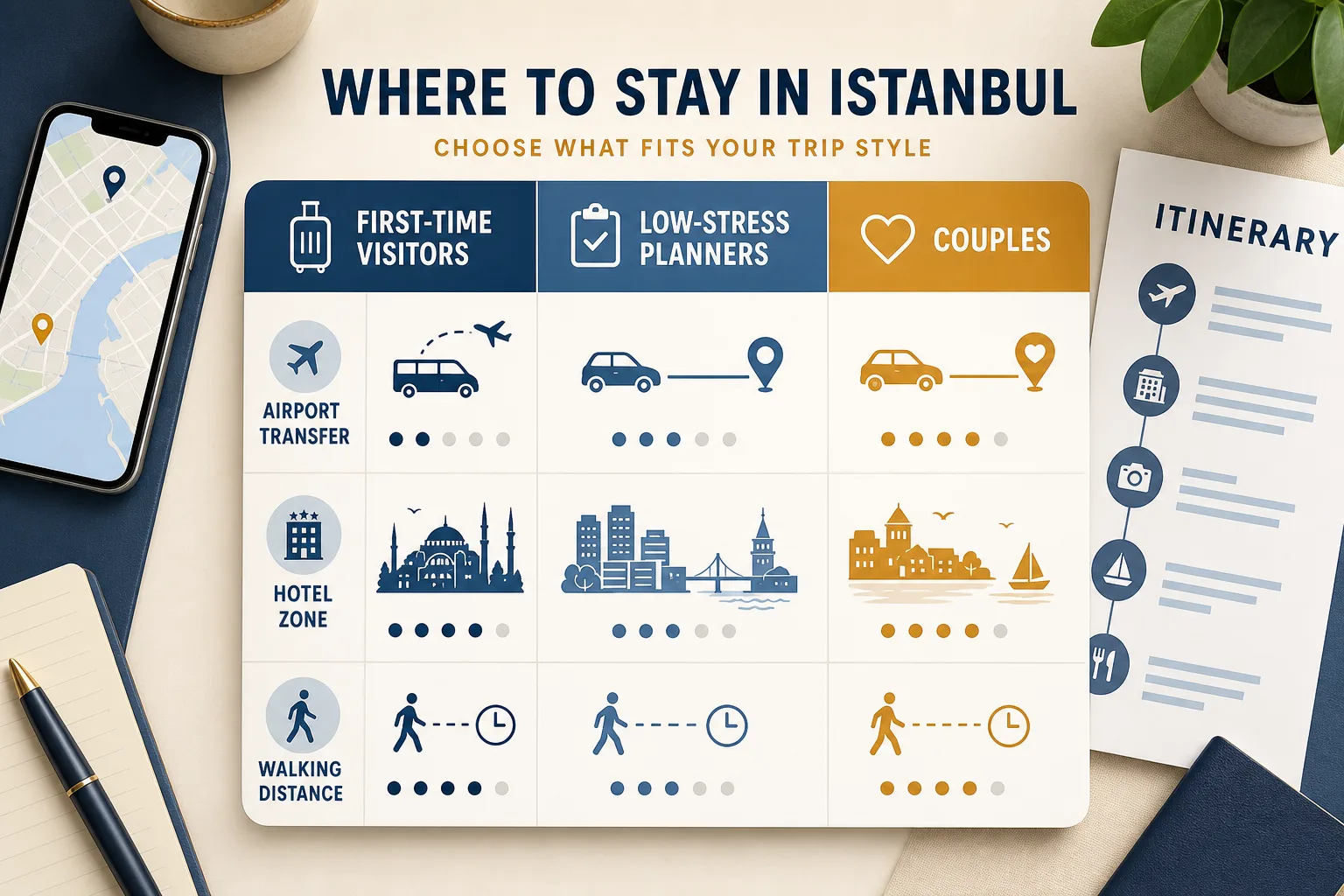 Editorial illustration: A clean simple comparison chart layout on a flat surface.
Traveler Type Table
The real decision variables for Budapest are not "is it pretty" or "is there enough to do." They are arrival friction, hotel-zone risk, and how many navigation decisions a traveler has to make per day. Here is how those variables play out for the three traveler types this article addresses.
| Decision variable | First-time visitors | Low-stress planners | Couples |
|---|---|---|---|
| Airport arrival | The 100E Airport Express Bus is a simple, well-marked option, but requires managing luggage and reading signage under jet lag; check the current fare and service details before departure | A current official taxi or transfer quote can remove the decision at a convenience premium; verify the fare, route time, and booking terms for your arrival | Compare the current total fare for the party with the current bus fare; do not assume that splitting a taxi makes it equivalent in price |
| Hotel zone risk | Compare the actual route from a central Pest hotel with any cheaper outer option | The tradeoff is walkability versus noise; check the actual street and recent property reviews | A central but slightly quieter street may matter more than proximity to nightlife |
| Daily navigation load | Save a walking route between the hotel and the first planned sight; do not infer it from the district name | Compare the actual route and walking conditions rather than relying on a fixed time estimate | Shared navigation decisions are lighter when the hotel route is agreed before arrival |
| Uphill or stair sections | Castle Hill needs a separate route and accessibility check | Compare the current walking and operator-listed access choices before relying on one | Decide in advance which current access option works if either partner has limited patience for hills |
The pattern across all three traveler types is the same: Budapest's logistics load is genuinely low, but it is not zero. The city rewards travelers who make one or two deliberate decisions upfront (hotel zone, airport transfer method) rather than travelers who prefer to improvise everything on arrival.
Best for First-Time Visitors
First-time visitors can reduce navigation load by choosing a central base, then checking the actual route from the hotel to their priority sights. The supplied evidence supports central Budapest as walkable in general, but it does not guarantee a flat or short route from a particular property.
Where first-timers get into trouble is airport arrival and hotel choice, not sightseeing. The 100E Airport Express Bus is a low-cost option, but it still requires checking the current schedule, finding the right stop, and managing luggage on a public bus after a long flight. A first-timer who wants to remove that decision should compare a current official taxi or transfer quote before booking. On lodging, a hotel chosen by price alone can add a transit leg to every outing, so check the district and actual route before booking rather than treating that risk as a citywide ranking of regrets.
The rubric focus for this group is the traveler-fit decision problem itself: does this person want to spend their first day making transit decisions, or walking directly into the sights? Budapest answers that question well for the second group and poorly for the first, unless they plan the hotel zone deliberately.
Best for Couples
Couples get a specific benefit from Budapest's low navigation load: it leaves room for the decisions that actually matter to a trip together, like where to eat or how long to linger at a viewpoint, instead of burning shared attention on figuring out which tram to take.
The practical advice for couples is to treat the hotel-zone decision as a joint budget call, not an afterthought. A room in a central, walkable district may cost more, but it can remove a recurring daily disagreement about transit versus walking. For the airport, compare the current total and per-person fares for the bus and an official taxi or transfer; a taxi is a convenience premium whose value depends on luggage, address, passenger count, and the current quote, not an automatic bus-price equivalent.
One planning note: couples who prefer apartment-style stays should confirm the current listing terms and legal status before booking rather than relying on an old review.
Best for Slow Travelers
Slow travelers, meaning those who prefer to linger and absorb a place rather than check off a list, can use a central base to reduce route decisions. Check the actual walking route instead of assuming the area is uniformly flat or compact.
A slow traveler can pick one verified route from the hotel and leave room to stop along it without a tightly timed transit window. For any sight that may add a climb or transfer, compare the current walking and operator-listed options before leaving.
Best for Low-Stress Travelers
Low-stress planners, the travelers who want a trip that runs like a well-organized errand rather than an adventure, are arguably the best-served group in this whole comparison. Budapest gives this traveler type several pre-packaged, predictable choices instead of forcing improvisation.
Airport arrival has clear options, including the 100E bus and an official taxi or transfer. Check the current fares, service hours, route time, and booking terms before deciding. Daily transit also has ticket and pass choices, but prices, validity, and purchase rules can change, so verify the current BKK information rather than carrying an old figure into the trip.
For any sight whose route includes a climb or an extra transport leg, compare the current route options before leaving the hotel. Deciding that upfront keeps an unverified access assumption from becoming an arrival-day problem.
Common Mismatches
Budapest's reputation for being an easy first trip creates a specific risk: travelers who assume "easy" means "no decisions required" and skip the two choices that actually determine how the trip feels.
- The bargain-hotel mismatch. A traveler who books the cheapest available room without checking district location can end up in an area that requires a transit transfer for every meal and sight. This is an avoidable logistics risk; check the actual route before booking rather than treating it as a proven ranking of Budapest regrets.
- The zero-effort expectation. A generally walkable center does not prove that every hotel-to-sight route is flat or short. Check the actual route when an uphill or step-free path matters.
- The improvised-arrival mismatch. Travelers who assume they will "figure out" airport transport on arrival, rather than deciding in advance between the bus and a booked transfer, are the ones most likely to feel their trip start on a stressful note. The options are simple, but only if chosen ahead of time.
- The rental-availability mismatch. Travelers assuming an old apartment listing will remain available should confirm the current listing and terms before booking.
- The single-center expectation. Travelers coming from cities with one obvious downtown can misjudge Budapest's Buda-Pest split. It is not a major complication, but it is one more navigation decision than a single-center city requires, and travelers who expected zero such decisions can feel mildly thrown off by it.
None of these mismatches has to decide the trip by itself. They are avoidable with a short planning check of the current route, fare, hotel district, and rental rules, which is exactly why Budapest still qualifies as a strong first-trip choice for most of the traveler types discussed here.
Final Match Recommendation
Budapest earns its reputation as an easy first international trip, but the reputation depends on two decisions the traveler has to make deliberately: hotel zone and airport transfer method. Get those two right, and the traveler can reduce repeated transfers by checking the actual central routes before booking.
Choose Budapest as a first trip if you are:
- A first-time visitor who wants a walkable core and clear, published transfer prices instead of ambiguity
- A low-stress planner who is comfortable making two upfront decisions (hotel zone, airport transfer) in exchange for a predictable trip afterward
- A couple who wants shared logistics decisions to be simple so energy goes toward shared experiences instead
Reconsider, or plan with extra care, if you are:
- A traveler who wants zero uphill walking anywhere in the city, since Buda Castle Hill is unavoidable if that's on your list
- A bargain-first booker who will choose a hotel by price alone without checking the district
- A traveler seeking a single-center city with no bridge-crossing or river-side decisions at all
The direct fit verdict stands: strong fit if the traveler accepts a small amount of upfront planning in exchange for a genuinely walkable, low-navigation trip. Weak fit if the traveler wants a city that requires no decisions at all, since that city does not really exist at this level of first-trip capital travel.
FAQ
The frequently asked questions for this decision are answered in the FAQ block attached to this article.