travel-decisions
Are Budapest's Thermal Baths Worth It for Travelers with Sensory Sensitivity or Mobility Limits?
A practical, friction-first look at whether Budapest's thermal baths work for neurodivergent, germ-conscious, or mobility-impaired travelers, with real accessibility limits and timing tactics.

Quick Verdict
Budapest's thermal baths are worth it for travelers with sensory sensitivity or mobility limits only if they can control timing, pick the right bath for their specific limit, and accept that at least one workaround will be needed. They are not a safe default activity the way they are often marketed.
Choose a bath day if you can arrive early to reduce crowd exposure, if you are comfortable managing your own transfers without relying on a poolside lift, or if you have already picked a bath whose access matches your actual limit rather than its reputation. Confirm the current schedule and equipment with the specific bath. This works well for low-stress planners who are willing to research one specific bath in advance instead of following a generic "must-do" list.
Skip the bath day, or replace it with a different Budapest experience, if you need a working mechanical lift to enter water and cannot confirm one at the chosen venue, if you cannot tolerate an unplanned wait in a crowded, echoing space, or if you were picturing Gellert specifically. Gellert is closed until 2028, and a quieter day cannot remove a venue-specific access barrier.
The honest fit rule: strong fit if you can be flexible on timing and specific about which bath you choose, weak fit if you need guaranteed step-free water access or cannot tolerate crowd noise at any hour.
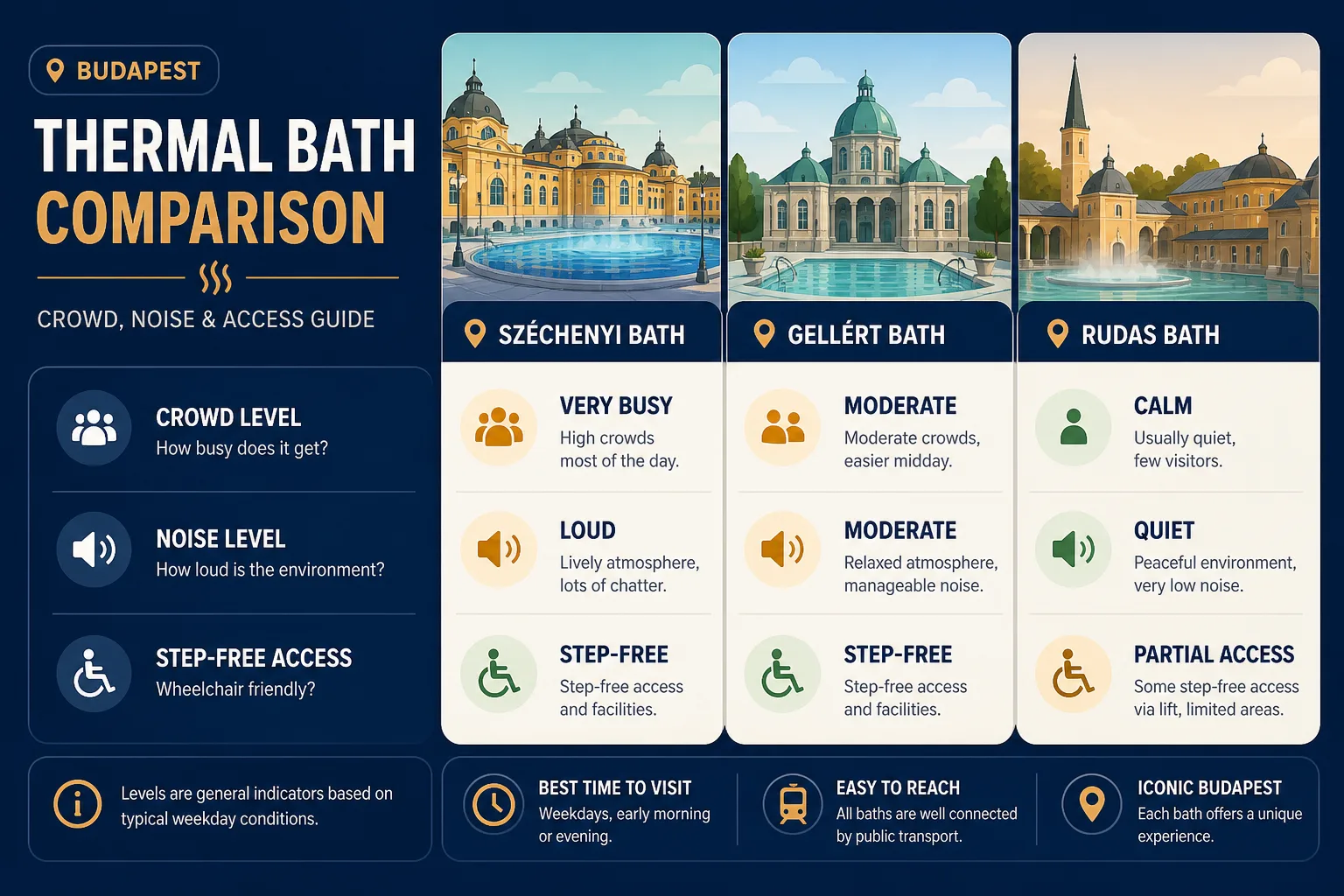 Editorial illustration: A simple decision table or comparison layout with three labeled columns representing different Budapest thermal baths.
Traveler Type Table
The baths are not one experience with varying crowd levels. They are several different buildings with different physical layouts, different current mechanical failures, and different age rules, and each of those variables hits a different traveler type differently.
| Decision variable | Neurodivergent travelers | Mobility-impaired travelers | Germ-conscious travelers |
|---|---|---|---|
| Noise and echo | An early or documented off-peak window may reduce crowd exposure, but cannot guarantee quiet | Not a primary concern, but noise can compound fatigue during a long, effortful visit | Not directly relevant, but crowded = more shared surfaces |
| Physical access | Less relevant unless sensory overload is triggered by tight changing-room queues | Critical: Szechenyi's poolside lifts are currently unreliable; verify access details and equipment at every other venue directly | Locker layout matters less than surface contact in showers and changing areas |
| Crowd density | High-crowd periods create unpredictable queue behavior and forced proximity | High crowds mean longer stands, more jostling, and less room to manage a mobility aid | Higher crowd density means more shared touchpoints on rails, lockers, and pool edges |
| Best-fit bath type | A smaller or newer facility over Szechenyi at peak hours | Investigate Pesterzsebet or Paskal first if a lift is non-negotiable, then confirm current equipment and route; Gellert is closed until 2028 | Any bath, but a quieter period may reduce crowding and shared touchpoints; conditions vary |
| Non-negotiable fact | Quiet windows exist and are documented, but only for specific bath and hours | Current accessibility must be confirmed with the chosen venue; Gellert is closed until 2028 | No public bath eliminates communal water and surface contact; this is a structural feature, not a fixable flaw |
The pattern across all three columns is the same: the baths reward travelers who narrow their choice to one specific bath and one specific time window, and punish travelers who show up expecting any bath, any time, to feel calm and manageable.
Best for First-Time Visitors
A first-time visitor to Budapest who has never used a European thermal bath before is walking in with two unknowns stacked on top of each other: the general unfamiliarity of the ritual (lockers, robes, wristbands, pool etiquette) and their own sensory or mobility profile.
For neurodivergent first-timers, the risk is not the water, it is the onboarding sequence. Entry halls, locker systems, and the initial change-room crowd are the least predictable part of the visit, and first-timers do not yet have a mental map of the building to route around the busiest points. Arriving early, preferably before 9:00 or 10:00 AM, may reduce crowd exposure, but it does not guarantee quiet.
For mobility-impaired first-timers, the biggest risk is assuming the marketing photos represent the current physical reality. Someone planning a first Budapest trip around Gellert will hit a hard stop, since it is closed until 2028. Someone assuming Szechenyi's accessible reputation guarantees pool entry will find that the poolside lifts are currently unreliable, and staff cannot manually lift guests in. If step-free water access is required, investigate Pesterzsebet or Paskal with the venue directly and confirm the current equipment before committing, rather than choosing whichever bath appears first in search results.
For germ-conscious first-timers, the first visit is where anxiety peaks, because the unfamiliar layout makes it hard to predict where crowding and surface contact will be worst. Confirming an accessible private cabin at Szechenyi rather than assuming the basement lockers will work reduces one layer of first-visit uncertainty.
Best for Couples
Couples traveling together have an advantage the other traveler types in this article do not: one partner can manage logistics while the other manages their own sensory or physical limit in real time.
For a couple where one partner is neurodivergent, splitting roles works well: one partner scouts the noise level of a given pool area before the other commits to entering it, and the couple can agree in advance on a signal to leave early without it becoming a negotiation in the moment. This turns an unpredictable environment into a semi-controlled one.
For a couple where one partner has mobility limits, a partner cannot compensate for an unverified or missing structural feature. Szechenyi is a partial option if the partner can transfer independently, since the lifts cannot be relied on, but a couple should confirm the current access arrangement before booking. Pesterzsebet or Paskal may be worth checking first, but neither the route nor equipment should be assumed to meet a specific need without a direct current confirmation.
For a germ-conscious couple, timing can help manage crowding and shared touchpoints, but it does not establish a cleaning advantage. Check the specific venue's current conditions and decide what level of communal surface contact both partners can accept.
Best for Slow Travelers
Slow travelers who prefer to spend a half day or a full day in one place rather than checklist-hopping are, in principle, well suited to bath culture, since baths reward lingering rather than rushing. But the friction points in this article do not disappear just because the pace is slower.
A neurodivergent slow traveler can use this pace to arrive early and move to a different pool or area as noise increases, rather than trying to get everything done in a tight window. The approach still needs an exit plan because an early start cannot make conditions predictable.
A mobility-impaired slow traveler gets less benefit from extra time alone, because a venue-specific access barrier does not improve with a longer visit. Extra time helps with fatigue management and rest breaks, but it does not substitute for a functioning lift or step-free layout. Choosing a bath whose current access matches the need still matters more than having more hours.
A germ-conscious slow traveler can use extra time productively by arriving early and taking unhurried time in the shower and locker areas rather than rushing. Lower crowd exposure is not evidence about cleaning cycles.
Best for Low-Stress Travelers
Low-stress travelers who want a calm, businesslike trip with minimal improvisation are, on paper, the best-matched traveler type for this decision, but only if they treat the bath visit as something to plan in advance rather than something to decide on the day.
For a neurodivergent low-stress traveler, pick one bath, check whether it currently recommends an early or less busy period, and leave enough room to exit or switch plans. An early visit may reduce crowd exposure, but it cannot guarantee low noise, short queues, or predictable changing-room conditions.
For a mobility-impaired low-stress traveler, the win condition is choosing the bath based on current accessibility documentation rather than general reputation. Pesterzsebet or Paskal may be candidates to investigate, but access paths, parking, route, and lift operation must be confirmed directly for the planned visit. Szechenyi should only be chosen if the traveler can enter water without a lift, since staff cannot manually assist right now.
For a germ-conscious low-stress traveler, the calm approach is to accept that communal bathing always carries some level of shared surface contact, decide in advance what that traveler's actual tolerance is, and then choose timing and bath accordingly, rather than trying to eliminate the risk entirely, which is not achievable in this activity.
Common Mismatches
The most common regret pattern in Budapest bath planning is not choosing the wrong bath outright, it is carrying an assumption from marketing or an old trip report into a current visit.
- Assuming Gellert is still an option. It closed October 1, 2025, and will not reopen until 2028. Any itinerary or packing list built around Gellert needs to be replaced, not adjusted.
- Assuming Szechenyi's reputation for accessibility still holds. The poolside lifts are currently unreliable, and staff cannot manually lift guests in. A wheelchair user who plans around Szechenyi because of its general reputation, rather than its current mechanical status, risks arriving and being unable to enter the water at all.
- Assuming any bath is calm at any time. Arriving early may reduce crowd exposure, but a neurodivergent traveler can still encounter the noise and queues that make a large bath a poor fit.
- Assuming a historic or centrally located bath is automatically a fallback for mobility needs. Confirm the chosen venue's current entrance, changing-room, pool, and lift arrangements directly; a partner or quieter hour cannot compensate for a missing structural feature.
- Assuming children can join a spontaneous bath visit. Several major baths restrict under-14 access, and the rule can differ by bath or pool. Check the current venue terms before treating a family visit as flexible.
- Underestimating the walk and transfer to reach the bath itself. Do not assume that a named metro line or tram is step-free for the whole journey. Check the current operator accessibility information for the specific origin, station exits, transfer, and bath entrance, then keep a fallback route if a lift is unavailable.
Final Match Recommendation
Choose a Budapest thermal bath visit if you can arrive early while accepting that quiet is not guaranteed, if you have already confirmed that the bath's current access matches your actual physical need rather than its general reputation, or if you are traveling with a partner who can help manage timing and logistics while you manage your own sensitivity or limit in the moment.
Do not choose a bath visit, or actively choose a different Budapest activity instead, if you require a working lift to enter water and cannot confirm one at the chosen venue, if you cannot tolerate an unplanned wait in a loud, crowded hall, or if your plan depends on Gellert (closed until 2028).
The strong-fit case rests on specificity: naming one bath, one time window, and one access requirement in advance. The weak-fit case is any version of "we'll figure out the baths when we're there," which is exactly the scenario where sensory overload, mobility barriers, and hygiene anxiety all compound at once.
FAQ
Is Szechenyi Bath wheelchair accessible right now? Partially, and inconsistently. Szechenyi has wheelchair-accessible private cabins, while the standard lockers are in the basement and reachable only by stairs. More importantly, the poolside mechanical lifts are currently out of order or unreliable, and staff cannot manually lift guests into the pools. Treat Szechenyi as workable for getting inside and changing, but not as a guaranteed way to actually get into the water if you need a lift.
Can I still visit Gellert Baths in 2026? No. Gellert closed on October 1, 2025, for a multi-year renovation and is scheduled to stay fully closed until 2028. Any itinerary built around Gellert needs to be rebuilt around a different bath entirely, not adjusted around reduced hours.
Are Budapest's baths a good choice for someone who gets overwhelmed by noise and crowds? Timing helps, but it is not the only variable. Arriving early, preferably before 9:00 or 10:00 AM, may reduce crowd exposure. Confirm the current schedule before visiting; conditions vary by venue and day, and a large public bath may still be a poor fit for sensory sensitivity if you cannot tolerate an unplanned wait or crowd noise.
Is there an age restriction I should know about? Several major baths restrict access for children under 14, but the exact restriction can differ by bath and pool. Families should check the chosen venue's current rule before booking.
What is the most accessible thermal bath option in Budapest for a wheelchair user or someone with limited stamina? Pesterzsebet Iodine-Salt Thermal Bath and Paskal Thermal Bath are possible candidates to investigate, but current access, route, parking, and lift conditions need to be confirmed directly with the venue. The available evidence does not support a permanent ranking or a guarantee that equipment will be working on the day. Treat any other bath, including Rudas, the same way: verify the specific entrance, changing-room, pool, and lift arrangements before relying on it for a mobility need.