travel-decisions
Is Budapest Worth It in Winter If You Hate Short Daylight And Weather Tradeoffs?
A practical, friction-first look at Budapest in winter: short daylight, cold weather risk, quiet nights, and hotel value, so you can decide if it fits your travel style.
Quick Verdict
Budapest in winter works well for travelers who want a quieter, cheaper version of the city and do not mind that the day ends early. It does not work well for anyone who plans full outdoor sightseeing days, needs consistent good light for photos, or gets low-mood from short daylight.
Choose winter Budapest if:
- You want lower hotel prices and thinner crowds outside the Christmas market weeks.
- You are fine finishing outdoor activities by mid-afternoon and shifting the rest of the day indoors (thermal baths, museums, cafes, dinner).
- You are visiting for a city-break pace, not a packed landmark checklist.
Skip winter Budapest, or shift your dates, if:
- You need long daylight for walking tours, river views, or photography.
- You are sensitive to seasonal low mood and short afternoons genuinely affect your energy.
- You want the lively outdoor ruin-bar and courtyard scene the city is known for; much of that is dormant from October through March.
The honest middle case: if you can visit in late January or February, after the Christmas markets clear out and before spring crowds return, winter Budapest is close to the best value-to-hassle ratio the city offers all year. The catch is entirely about daylight and mood, not danger or dysfunction.
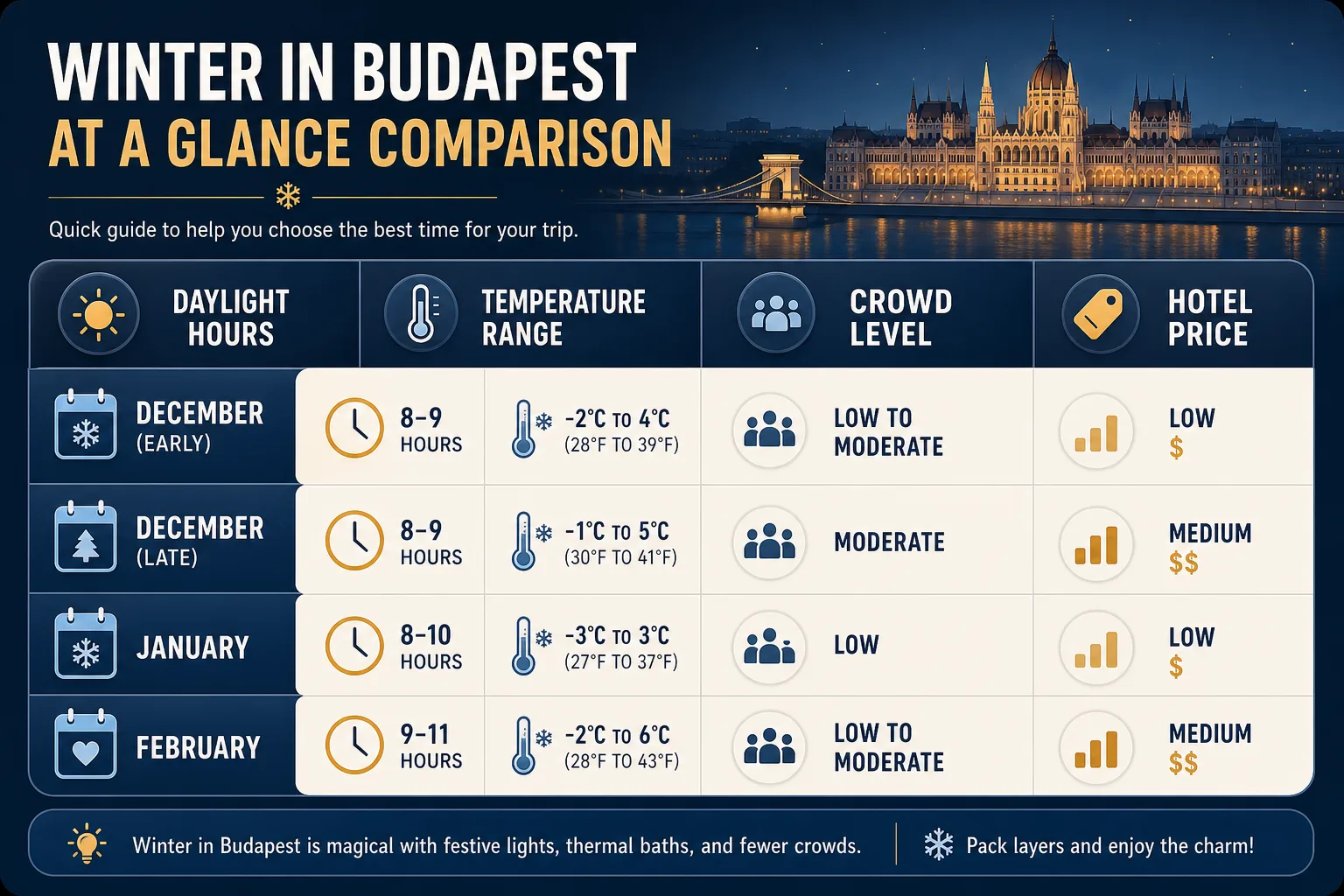 Editorial illustration: A clean comparison layout styled like a simple decision table.
Main Friction Problem
Winter Budapest does not have a crowd problem or a safety problem. It has a daylight and pacing problem, plus a nightlife problem that only affects a specific type of traveler.
Short daylight. In mid-December, the sun rises around 7:24 AM and sets around 3:53 PM. That is about 8 hours and 28 minutes of daylight, and a meaningful chunk of that is dim morning or fading afternoon light rather than strong midday sun. If your itinerary assumes long outdoor blocks, you will run out of light before you run out of plan.
Weather risk. January is the coldest month, with average highs around 37 to 38 degrees Fahrenheit (about 2.5 to 3 Celsius) and lows around 26 to 28 degrees Fahrenheit (about minus 3 to minus 2 Celsius). That is cold-but-walkable weather with the right layers, not extreme cold. The real risk is not frostbite, it is fatigue: cold plus early dark plus wind off the Danube adds up faster than the thermometer suggests.
Quiet nights. Budapest's ruin bar scene is partly seasonal. Kobuci Kert, one of the outdoor-style venues, closes for winter from October through March, and Ellt Kert closed for good in 2019. Indoor venues still run, but the sprawling, open-air, multi-courtyard nightlife that shows up in Budapest's summer reputation is thinner in winter. If that scene is a big part of why you want to visit, winter is not the season that delivers it.
Hotel value. This is winter's clearest upside. Outside the Christmas market weeks, demand drops and so do prices in the shoulder stretches of the season. But it is not a blanket discount: District V still runs 150 to 350 euros per night, District VII runs 80 to 300 euros per night, and District I runs 150 to 250 euros per night, with rates skewing toward the top of those ranges during the mid-November to January 1 market period. The value case is real, but it is strongest in the weeks after New Year's, not during the markets themselves.
Friction Table
| Decision variable | What it looks like in Budapest winter | Why it matters |
|---|---|---|
| Short daylight | Roughly 8.5 hours of daylight in mid-December; sunset before 4 PM | Outdoor sightseeing has a hard stop by mid-afternoon; itineraries need an indoor second half |
| Weather risk | Average highs near 37-38F, lows near 26-28F in January | Manageable with real winter gear, but cold plus early dark increases fatigue faster than in shoulder seasons |
| Quiet nights | Kobuci Kert closed October-March; Ellt Kert closed permanently in 2019 | The outdoor ruin-bar scene is largely paused; nightlife shifts indoors and gets quieter |
| Hotel value | District V: EUR150-350; District VII: EUR80-300; District I: EUR150-250 per night | Real savings exist in slow weeks, but market-season demand keeps prices toward the higher end of these ranges |
| Holiday crowding | Christmas markets run mid-November through January 1 | Works against a "quiet winter city" expectation; the calm window is really late January into February |
| Transit reliability | Dec 24 shifts to reduced Saturday schedule, stops around 3-4 PM; Dec 31 runs all-night metro and trams | Plan around these two specific dates if traveling during the holidays |
Who Will Feel It Most
Photographers and light-dependent travelers will feel it hardest. If your trip plan depends on good natural light for landmark photos along the Danube or Castle Hill, winter's short, often overcast daylight window will disappoint you more than the cold will. This is the single strongest reason to pick a different season.
Travelers sensitive to low mood from short days should think twice. An 8.5-hour daylight window with a lot of gray sky is a real factor for people who notice seasonal light changes in their energy or mood, independent of how cold it actually is outside.
Nightlife-focused travelers who came for the outdoor ruin-bar reputation will feel misled. The venues that built that reputation are seasonal, and winter is exactly when the outdoor ones go quiet.
Budget-focused, low-stress travelers tend to do well. If your priority is a manageable, lower-cost city break with shorter days built into a slower pace (a late breakfast, one major sight, a thermal bath, dinner), winter Budapest suits that rhythm naturally rather than fighting it.
Families with strollers and older or lower-mobility travelers should weigh the cold and shorter days against fewer crowds. Cobblestones and hills exist year-round, but icy or wet surfaces in winter add a layer of caution that spring or summer does not require.
First-time visitors chasing the classic postcard version of Budapest (long golden-hour walks, lively courtyard bars) will get a noticeably different, quieter city than the one they pictured.
How to Reduce the Friction
For short daylight: Front-load outdoor plans into the first daylight hours and treat mid-afternoon onward as indoor time by default, not as a fallback. Book timed entries for Buda Castle, museums, or thermal baths for the afternoon and evening slots so the itinerary does not depend on daylight past 4 PM. Use the free elevator near Varkert Bazar to reach the castle grounds in under a minute if you are short on time or light and want to skip the funicular queue.
For weather risk: Pack for functional cold, not fashion cold: a real insulated coat, a hat, gloves, and boots with grip for potentially wet or icy pavement. The walk between Buda Castle and the Hungarian Parliament Building is about 1.5 kilometers, roughly 20 to 25 minutes at a relaxed pace; in winter cold, budget extra time and consider splitting that walk with a transit segment rather than doing it in one push.
For quiet nights: Shift your nightlife expectations from outdoor ruin bars to indoor venues, wine bars, and thermal bath evening sessions, which run year-round and are arguably better suited to winter anyway. Do not build your trip around finding the summer courtyard scene between October and March; it will not be there in the same form.
For hotel value: Book outside the mid-November to January 1 market window if minimizing cost is a priority. Late January and February give you the lowest realistic rates across Districts V, VII, and I without holiday-season demand pushing prices toward the top of their ranges.
One quiet logistics note that affects planning either way: validate every transit ticket immediately on boarding or activate your pass in the BudapestGO app. The on-the-spot fine for not doing so is 16,000 HUF, and winter's early dusk makes it tempting to rush onto a tram without thinking about it.
Better Alternatives
If short daylight is your main objection, the honest fix is usually a different month, not a different city. Late spring (May) gives Budapest's best daylight-to-crowd ratio, with long afternoons and before the peak summer heat and price pressure arrive. Early autumn (September into early October) is a close second: daylight is still generous, the ruin bar scene is still open, and prices sit below summer peak.
If your real priority is warm-weather ruin bars and long outdoor evenings specifically, plan for June through August, and accept the tradeoffs of stronger crowds and higher prices that come with it; short daylight was never your actual constraint in that case.
If you want winter-level pricing and quiet without the darkest, coldest weeks, aim for late February into March: daylight hours are recovering, the coldest snap has typically passed, and the Christmas market crowds are long gone. This window keeps most of winter's value case while trimming its worst daylight and weather friction.
If none of these windows fit your travel calendar and winter is your only option, that is fine. Budapest in winter is not a mistake, it is a different, quieter trip. It only becomes a mistake if you plan it like a summer itinerary and expect the daylight and nightlife of a different season.
Decision Checklist
Use this before you book:
- I am comfortable with outdoor sightseeing effectively ending by mid-afternoon.
- I have checked that my visit does not depend on strong natural light for photos.
- I have realistic winter gear (insulated coat, hat, gloves, grippy footwear), not just a stylish jacket.
- I know whether my dates fall inside the mid-November to January 1 Christmas market window, and I am fine with the crowd and price tradeoffs if they do.
- I have a backup indoor plan (thermal baths, museums, cafes) for every afternoon, not just one day.
- I have checked December 24 and December 31 transit schedule changes if my trip includes those dates.
- I do not expect the outdoor ruin-bar scene to be running the way it does in summer.
- I have compared hotel rates in Districts V, VII, and I for my specific dates rather than assuming winter automatically means the cheapest option.
- I would still choose Budapest if the trip turned out shorter on daylight and nightlife than I originally pictured.
If you checked most of these honestly and are still comfortable, winter Budapest will likely deliver what you want. If several of these feel like compromises rather than acceptable tradeoffs, shift your dates instead of forcing the trip.
FAQ
Is Budapest too cold to enjoy in January? January is Budapest's coldest month, with average highs near 37 to 38 degrees Fahrenheit (about 2.5 to 3 Celsius) and lows near 26 to 28 degrees Fahrenheit (about minus 3 to minus 2 Celsius). That is cold but manageable with real winter layers; it is not the kind of cold that shuts a city down. The bigger issue for most travelers is the short daylight window, not the temperature itself.
How many daylight hours does Budapest get in winter? In mid-December, sunrise is around 7:24 AM and sunset is around 3:53 PM, giving about 8 hours and 28 minutes of daylight. That means outdoor sightseeing effectively ends by mid-afternoon, and you are planning around dusk rather than dinner.
Are Budapest's ruin bars open in winter? Not all of them. Kobuci Kert, an outdoor-style ruin bar, closes for the winter from October through March, and Ellato Kert closed permanently in 2019. Indoor ruin bars and courtyard venues still operate, but the open-air summer garden scene that Budapest is known for is largely paused in winter.
Is Budapest worth visiting around Christmas and New Year specifically? The Christmas markets, including the one at St. Stephen's Basilica, run from mid-November through January 1 and draw heavy crowds, which works against the quiet, low-crowd image some winter travelers expect. Transit also shifts to reduced schedules on December 24, while New Year's Eve runs all-night service on the metro and major tram lines. If you want a quiet winter trip, the market period is not that; the weeks just after New Year's tend to be calmer.
Is it cheaper to visit Budapest in winter than spring or summer? Often yes, especially outside the Christmas market weeks, but the discount is not guaranteed everywhere. Current 2026 hotel rates run roughly 150 to 350 euros per night in District V, 80 to 300 euros per night in District VII, and 150 to 250 euros per night in District I year-round, and well-located rooms in the cheaper bands can still sell out during market season. The best winter value shows up in the slower weeks of January and February, not the holiday weeks.