travel-decisions
Will Gyeongju Feel Too Expensive If You Care More About Experience Than Luxury?
Gyeongju's central heritage sites are free, but Bulguksa and Seokguram sit outside that free core. Here is whether the trip out is worth the friction, and how to decide before you book.
Quick Verdict
Gyeongju is a strong fit if your idea of a good trip is a free, walkable historic core, not a checklist of famous names. It is a weaker fit if you assume every headline site, including Bulguksa and Seokguram, is part of that same free, five-minute-walk experience.
Choose Gyeongju without hesitation if you are happy building your days around Daereungwon, the old town, and the Woljeong shuttle loop, and treating the outlying temple sites as optional. Plan more carefully if Bulguksa and Seokguram are non-negotiable for you, because they sit outside the free central cluster, and once you are there, moving between the two temple sites depends on bus 12, which runs only once an hour. For sightseeing and local transport, money is rarely the problem here, since the main heritage sites are fee-free. The one real cost swing to plan around is accommodation: verify the live rate for your specific dates before booking, since Korea's cherry blossom season is a documented nationwide peak-travel period, and a spike there is the one place this trip can turn expensive even though the sights themselves stay free. Beyond that, the problem is whether you budget enough time to reach the temple area and work around the bus 12 schedule between Bulguksa and Seokguram without rushing, and whether skipping them would actually bother you.
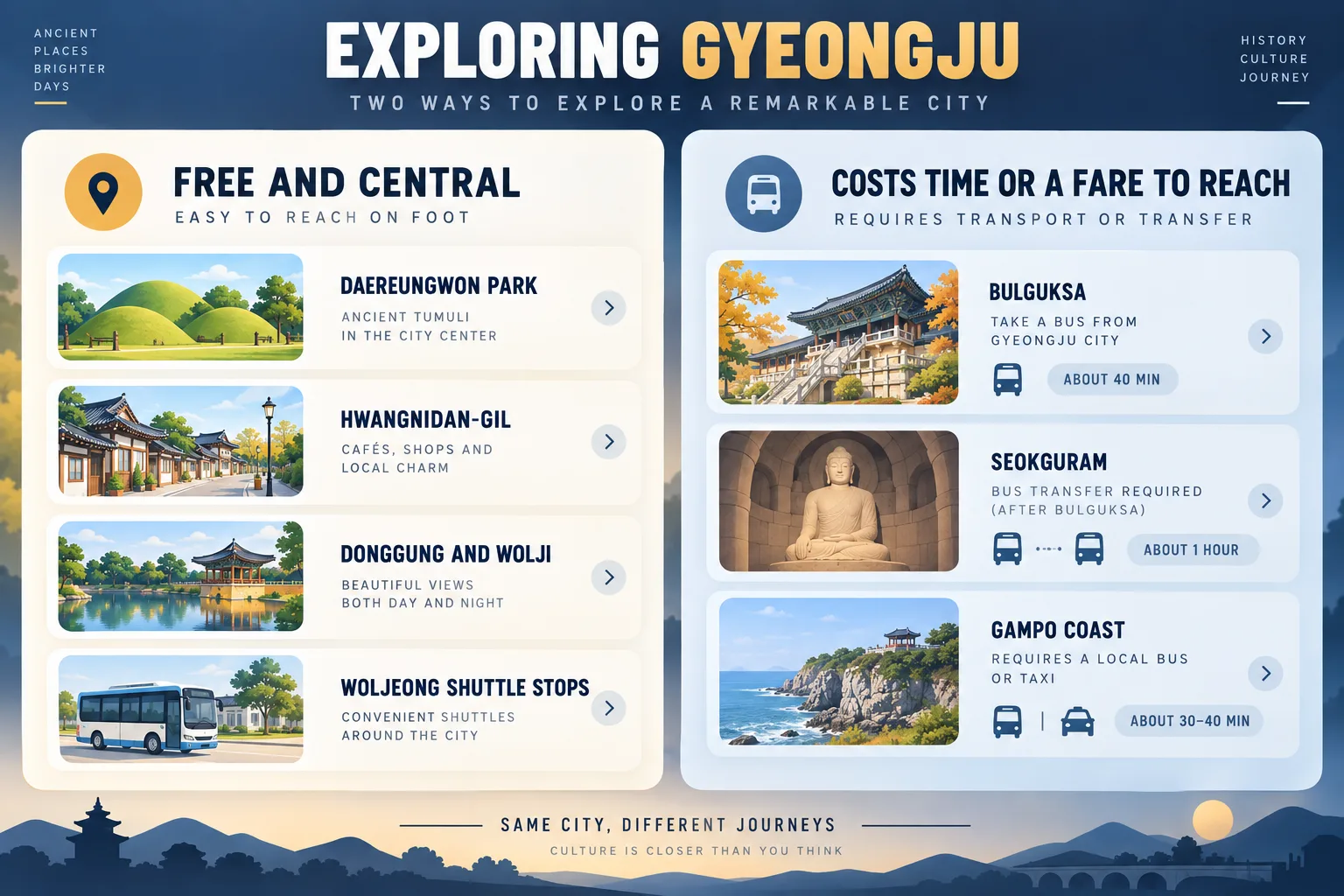 Editorial illustration: A simple two-column data comparison layout with short text labels.
Main Friction Problem
The real friction in Gyeongju is not luxury versus budget. It is geography. The city's most-quoted advantage, that admission fees for temples including Bulguksa and Seokguram have been waived since May 4, 2023, makes it easy to assume the whole experience is both free and centrally located. It is not. The free central cluster, Daereungwon, the old town streets, and the tomb parks, sits within easy walking distance of downtown. Bulguksa and Seokguram sit well outside that cluster and need their own bus trip.
Budget pressure shows up less in ticket prices and more in how you allocate a short trip. A traveler with two days has to decide whether a trip out to Bulguksa and Seokguram, where the connection between the two sites runs on a once-an-hour bus, is worth trading against more time in the free central core. That is a scheduling cost, not a cash cost, but it still functions like a budget decision because time is the limited resource.
Expectation mismatch follows directly from that. Many travelers picture Gyeongju as one compact, walkable open-air museum. In reality it is a free walkable core plus a cluster of separately located, still-free but harder-to-reach sites. Arriving without knowing that split leads to itinerary stress on day one, when the map does not match the mental picture.
Hotel value is a separate issue that layers on top, and it has nothing to do with the temple sites. Cherry blossom season is a documented nationwide peak-travel period in Korea, where prices can rise significantly; whether that translates into a specific premium at your chosen Gyeongju property on your chosen dates is something to verify directly with the listing rather than assume from Gyeongju's low-cost reputation for sights. That is a calendar and booking-verification problem, not a location or landmark problem.
Crowd-linked price inflation is a related but separate unknown. The free sites do not charge more on a peak weekend, but nationwide peak-travel periods can plausibly affect visitor volume at popular destinations. Trip Persona does not have Gyeongju-specific crowd data to confirm how strongly this applies to any single site here, so treat the possibility of a busier experience as a general seasonal risk to check for your dates rather than a confirmed local pattern.
Friction Table
| Decision variable | Free and low-friction | Where the real cost or time sits |
|---|---|---|
| Central heritage core | Daereungwon park is free to enter and walkable from downtown | Cheonmachong tomb inside the free park still charges a separate entry fee |
| Bulguksa and Seokguram | Admission has been fee-free since May 4, 2023 | Reaching both sites needs a bus transfer, and bus 12 between them runs only once an hour, not a short walk |
| City transit | Bus fare is 1,500 won cash or 1,450 won with a transit card | Missing bus 12 between Bulguksa and Seokguram means an hour's wait on the mountain |
| Linking free central sites | The Woljeong shuttle, launched January 2026, loops through the historic district connecting the free sites | The shuttle route covers the central cluster, not the Bulguksa or Seokguram trip; confirm the current fare before relying on it |
| Accommodation | Weekday and off-peak rates are typically the lowest window to book | Cherry blossom season is a known nationwide peak-travel period in Korea; verify the actual rate for your dates rather than assuming a Gyeongju-specific premium |
| Crowd exposure | No Gyeongju-specific crowd data confirms a weekday advantage | Nationwide peak-travel periods can plausibly increase visitor volume at popular sites; treat this as an unverified seasonal risk to check locally |
Who Will Feel It Most
Travelers with a tight one or two day window feel the geography friction hardest. If you only have one full day, choosing between a relaxed loop through the free central core and a trip out to Bulguksa and Seokguram, where moving between the two sites is timed around the once-an-hour bus 12, is a real tradeoff, not a minor scheduling detail. Skipping the wrong one can leave you feeling like you missed the point of the trip either way.
Couples chasing a quiet, unhurried atmosphere feel a different version of this friction. Their risk is not the bus fare or the free admission; it is landing on a date during Korea's documented nationwide peak-travel windows, when heritage sites nationally can see more visitor traffic, even though no Gyeongju-specific data confirms exactly how that plays out at any single site here. The financial cost stays low, but checking whether your specific dates fall on a national peak-travel window is worth doing before you commit to a quiet-atmosphere plan.
Value-sensitive travelers who are comfortable treating the outlying temples as optional, rather than mandatory, feel this friction the least. If you are content building your trip mostly around the free walkable core and visiting Bulguksa and Seokguram only if the schedule allows it without strain, Gyeongju's low-cost reputation holds up cleanly for you.
How to Reduce the Friction
Budget pressure around time, not money, is easiest to manage by deciding upfront whether Bulguksa and Seokguram are a must-see or a nice-to-have. If they are a must-see, check the bus schedule before you go and plan your visit around it rather than trying to fit them in as an afterthought between central-core stops.
Expectation mismatch is reduced by learning the city's actual layout before you land: one free, walkable central cluster, and a separate free-but-farther cluster around the temples. Knowing this in advance turns a confusing map into a straightforward two-zone itinerary decision.
Hotel value improves when you check your specific travel dates against Korea's documented nationwide cherry blossom travel calendar and confirm the actual quoted rate, rather than assuming Gyeongju's low-cost reputation for sights extends to lodging. If the historic-core area is quoting a premium for your dates, checking a room a short bus ride from the center is worth comparing, since the local bus network is inexpensive.
Crowd-linked price inflation is best handled by treating cherry blossom season as a documented nationwide peak-travel window in Korea, when prices can rise significantly, and choosing a weekday for the Bulguksa and Seokguram trip where your schedule allows it as a general precaution, even without Gyeongju-specific crowd data to confirm the size of the effect at these sites, since bus 12's once-an-hour schedule already limits how much flexibility you have around the crowd on any given day.
- Decide before you arrive whether Bulguksa and Seokguram are mandatory or optional for you
- If mandatory, check bus 12's once-an-hour schedule in advance and plan around it as its own trip, not a quick add-on
- Confirm your dates against known peak cherry blossom weekends before booking
- Check your specific spring dates against Korea's cherry blossom travel calendar before booking, and stay open to a short bus ride from the core
- Budget a small entry fee for Cheonmachong even though the surrounding park is free
- Default to the city bus and the Woljeong shuttle loop for the central core instead of taxis
Better Alternatives
If Bulguksa and Seokguram are the main reason you want to visit Gyeongju, and working around bus 12's once-an-hour schedule between the two sites feels like too much friction for your schedule, a shorter stopover may not do the city justice. In that case, allow an extra day rather than cutting the temple visit, since a rushed version of that trip is where most of the disappointment comes from.
If your main goal is atmosphere and a slow walk through free heritage space, and the outlying temples are not essential to you, lean fully into the central core and treat Bulguksa and Seokguram as optional rather than planning around them. That version of the trip is lower-friction, cheaper in time, and matches an atmosphere-first goal more directly than a split itinerary does.
If your main goal is a guaranteed low, flat daily budget with minimal date sensitivity, check your accommodation rate for the actual dates you are traveling before you book, since Korea's cherry blossom season is a documented nationwide peak-travel period even though Gyeongju's sights stay free or near-free year-round. Verifying the live rate for your dates, rather than assuming the sightseeing cost pattern carries over to lodging, is the more reliable way to protect a flat budget than guessing at how any one destination compares to another.
Decision Checklist
- Have you decided whether Bulguksa and Seokguram are mandatory or optional for this trip
- If mandatory, have you checked bus 12's once-an-hour schedule between Bulguksa and Seokguram and planned that leg as its own block rather than treating it as a quick stop
- Have you checked whether your travel dates fall on a peak cherry blossom weekend
- Have you priced accommodation separately from transit and admission, rather than assuming one low average
- Are you comfortable with a weekday visit to the outlying temples if it meaningfully reduces crowd pressure
- Have you budgeted a small amount for paid attractions like Cheonmachong inside free parks
FAQ
Can I have a full Gyeongju experience without ever leaving the free central core? Yes, but it is a different trip than the one most people picture. Daereungwon, the old town streets, and the Woljeong shuttle loop cover atmosphere and history well on their own. What you would miss is Bulguksa and Seokguram, which sit outside that core and are usually the two most-cited reasons people come to Gyeongju in the first place.
Is it worth the transport time to reach Bulguksa and Seokguram if admission is free? For most experience-led travelers, yes, because free admission removes the cost objection entirely. The real cost is time and a bus transfer, not money, so the decision comes down to how much of your itinerary you are willing to spend getting there and back rather than how much you are willing to pay.
Does skipping Bulguksa and Seokguram actually save money, or just time? Mostly time. Since admission at both sites was waived on May 4, 2023, the money saved by skipping them is limited to the bus fare, a few thousand won round trip. The larger tradeoff is losing the itinerary time built around the once-an-hour bus 12 connecting Bulguksa and Seokguram, not avoiding a real expense.
What is the one Gyeongju expense that surprises budget travelers most? Peak-weekend accommodation, not attraction fees. The central sights stay free or near-free regardless of season, so travelers often assume hotel rates will follow the same pattern, then get a spring-weekend quote that does not match that expectation.
Is Gyeongju a good fit if I want atmosphere more than a landmark checklist? Yes, especially if you lean into the free central core rather than treating Bulguksa and Seokguram as mandatory. A slower, walk-heavy trip through Daereungwon and the old town rewards an atmosphere-first traveler more directly than a rushed day split across outlying sites.