where-to-stay
Bomun Lake Resort vs. Downtown Gyeongju: Which Base is Best If You Have a Rental Car but Hate Searching for Parking?
Comparing Bomun Lake Resort and downtown Gyeongju for self-drive travelers who want to avoid parking stress while still reaching the historic sites easily.
Quick Answer
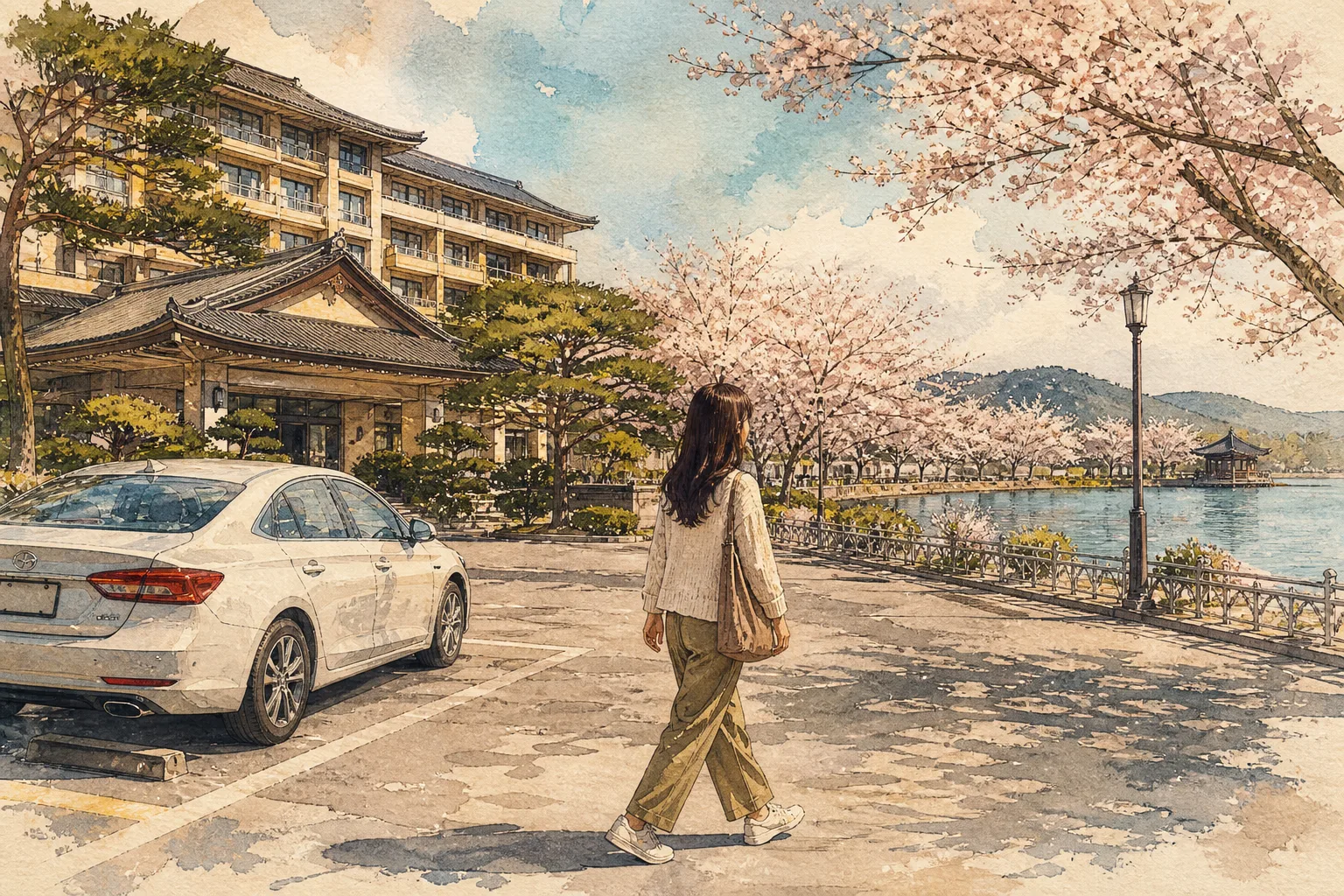
If you have a rental car and want to avoid daily parking hunts, Bomun Lake Resort is the lower-friction base. Hotels there provide free, guaranteed self-parking, and you drive into downtown once a day rather than repeatedly re-entering the same congested streets to find a spot near your hotel.
Choose Bomun if you:
- Have a rental car for the whole trip and plan to drive most days
- Are traveling with family, kids, or extra luggage and want easy load-in and load-out
- Value predictable parking over being able to walk out your door into the old town
Choose downtown Gyeongju instead if you:
- Are comfortable using the new Hwangridan-gil public parking lot or the free weekend lot and walking from there
- Want to minimize driving overall and prioritize being inside the historic atmosphere at night
- Are traveling light, without a car for at least part of the trip, or are fine relying on buses for the Bomun leg
Neither base is objectively wrong. The decision comes down to how much you actually plan to use the car once you arrive, and how much daily parking uncertainty you can tolerate.
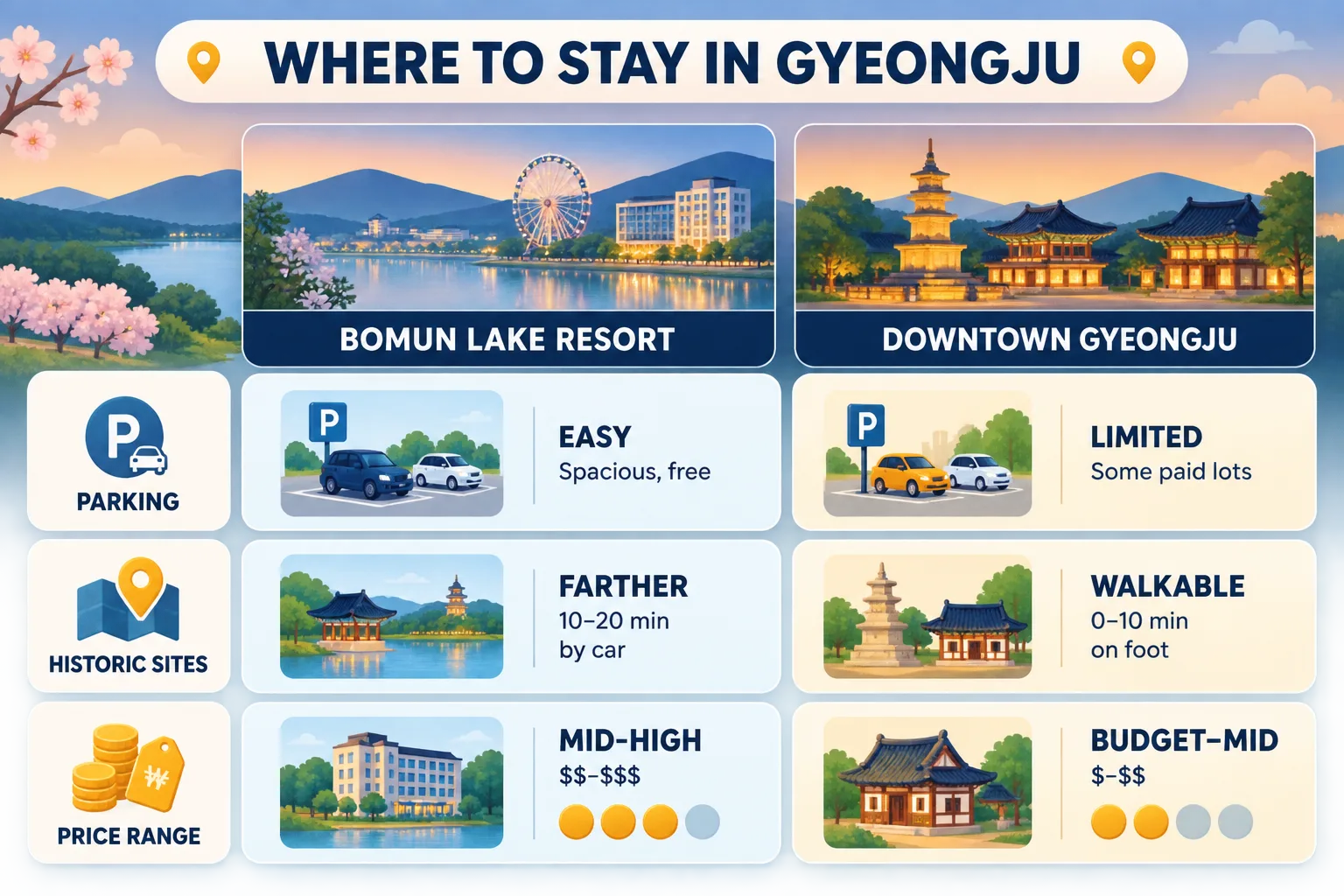 Editorial illustration: A simple comparison table graphic with two labeled columns.
Hotel Location Risk Summary
The real risk in this decision is not "which area is nicer." It's what happens the second and third time you drive back into Gyeongju with a full car.
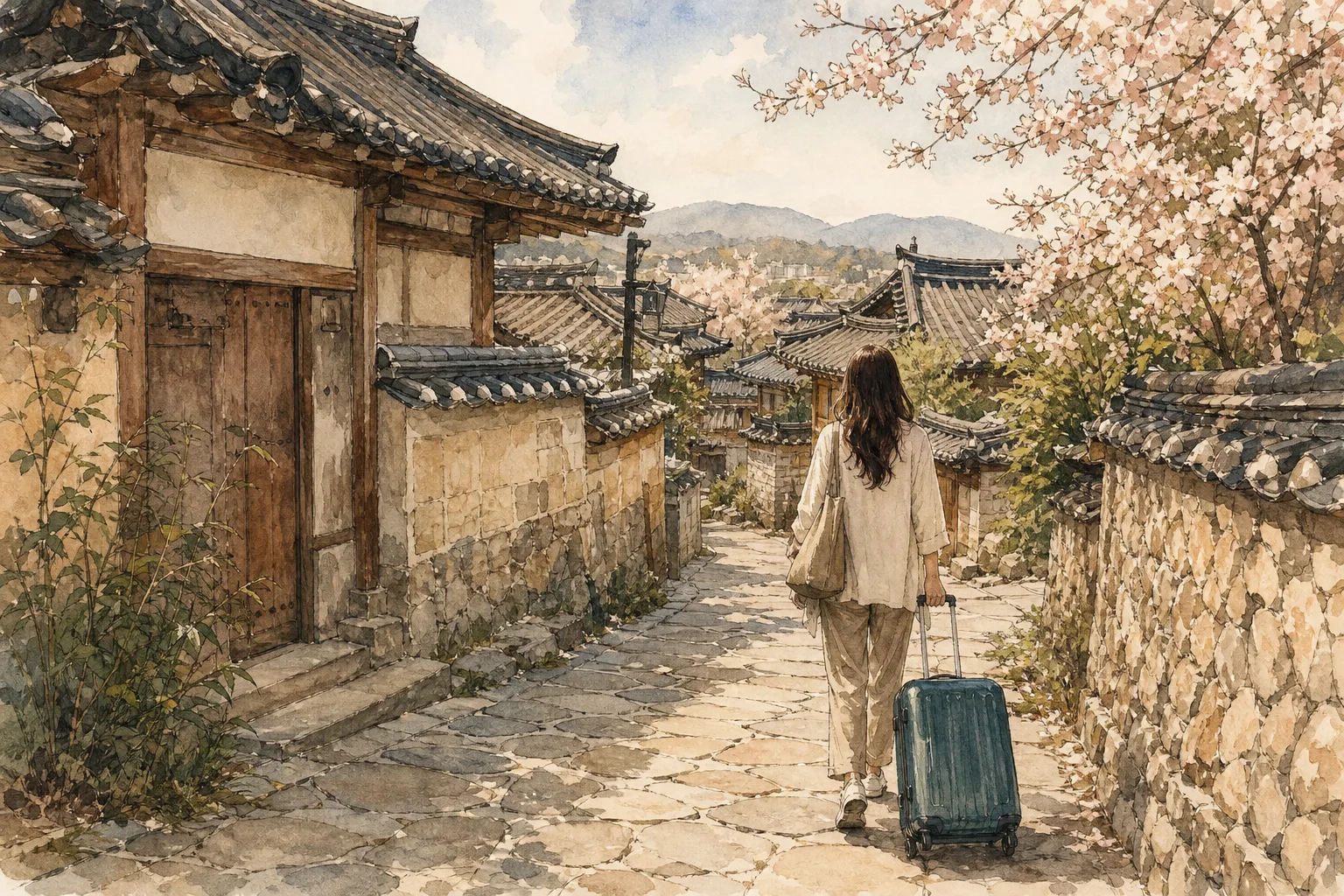
Downtown Gyeongju risk: Hanok guesthouses and small mini-hotels are woven into narrow lanes that were not built for private vehicle parking. Many properties have no dedicated lot, so guests either rely on street parking, a nearby paid lot, or the newer public options. The January 2026 opening of the Hwangridan-gil Public Parking Lot (894 spaces, free through mid-2026) has meaningfully reduced this risk compared to previous years, but it still means parking away from your hotel and walking or taking a shuttle the rest of the way, especially if your guesthouse sits deep in the old town grid.
Bomun Lake Resort risk: The parking risk is close to zero. Bomun's hotels were built as resort-style properties with on-site lots designed for cars and buses. The tradeoff shifts instead to a driving-and-distance risk: every downtown excursion is a 15 to 25 minute drive each way, so a spontaneous "let's pop back to the hotel" moment costs real time.
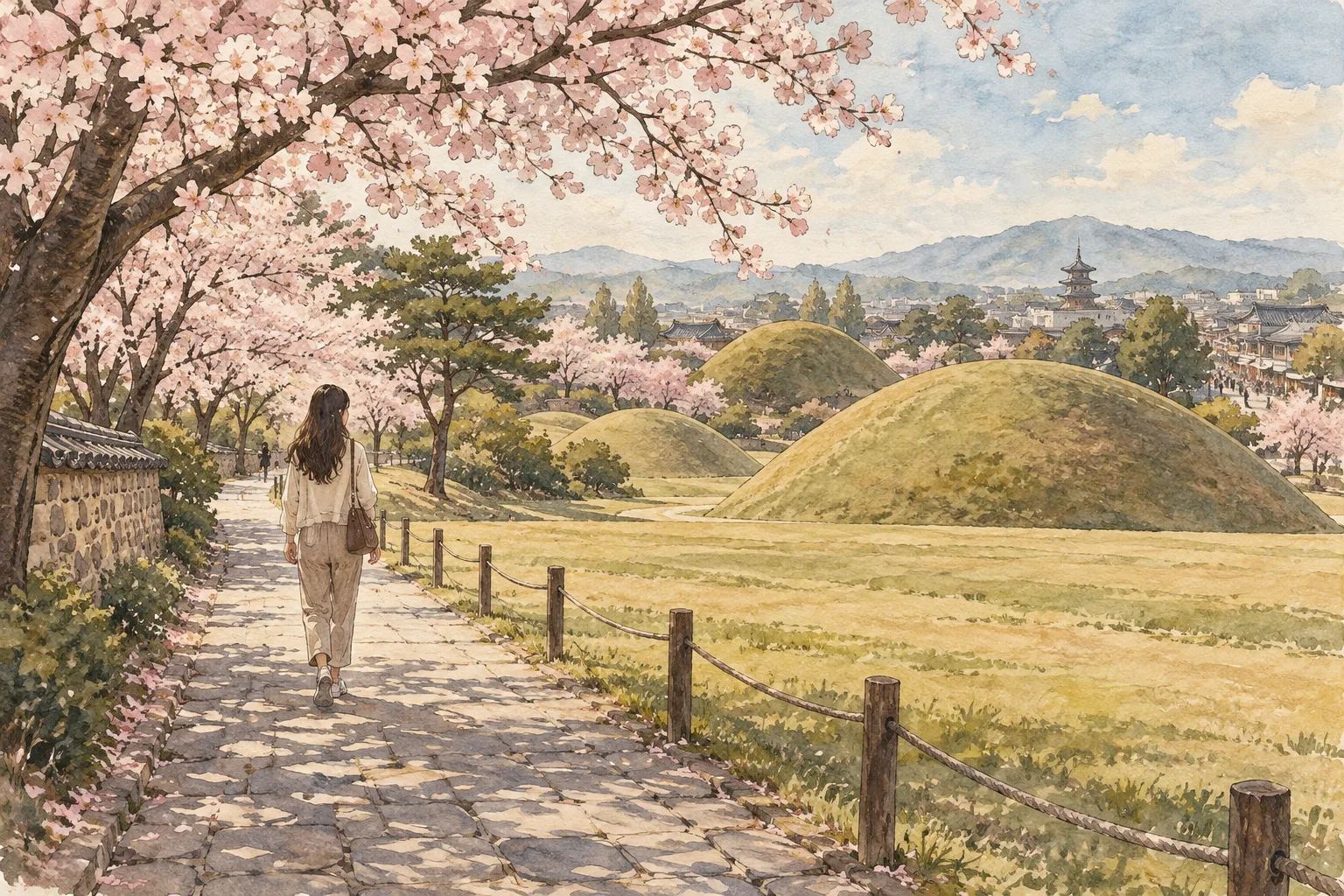
Walking and transit practicality: Downtown Gyeongju is walkable once you're parked, with most major heritage sites (Cheomseongdae, Wolji Pond, Daereungwon tomb complex) within a comfortable walking radius of the old town core. Bomun is walkable within its own lakeside loop but is not walking distance to the historic district. Bus routes No. 10 and 18 bridge the two areas in about 20 to 25 minutes if you want a car-free day.
Best Areas at a Glance
| Factor | Bomun Lake Resort | Downtown Gyeongju |
|---|---|---|
| On-site parking | Free, guaranteed at major hotels (Lahan Select, Hilton) | Limited at guesthouses; relies on public lots |
| Distance to historic core | About 10 km / 15-25 min drive | Walking distance once parked |
| Typical nightly rate | 140,000-250,000 won ($100-$190) | 50,000-150,000 won ($35-$110) |
| Best for | Drivers using the car daily, families with luggage | Drivers okay with a park-once, walk-the-rest plan |
| Main friction | Repeated 15-25 min drives for downtown activities | Finding and using public parking lots |
| Bus link between areas | Routes 10/18, about 20-25 min | Same routes, reverse direction |
The pattern is consistent: Bomun trades a longer commute into town for parking certainty, while downtown trades parking effort for proximity and generally lower room rates.
Best Area by Traveler Type
Road trippers using the car every day: Bomun Lake Resort fits better. If your itinerary includes day trips beyond Gyeongju city limits (the coast, Bulguksa, nearby national parks), having a guaranteed lot at the hotel means you're not re-solving the parking problem each time you return. The 15 to 25 minute drive into downtown is a small, predictable cost compared to circling for street parking with a full car.
Family travelers with kids or lots of luggage: Bomun again has the edge. Resort-style parking lots mean short walks from car to hotel room, which matters more with car seats, strollers, and suitcases than it does for a solo traveler with a backpack. Downtown hanok stays often involve carrying bags down narrow lanes from wherever you managed to park, which adds friction exactly when you're most loaded down.
Convenience seekers who want a smooth, low-effort trip: This group should look at how they'll actually spend their days. If most time will be in the historic core with only occasional driving, downtown paired with the new Hwangridan-gil lot or weekend Hwangnam Elementary lot is the more convenient choice: park once, walk everywhere. If the plan involves driving out to multiple areas across the day, Bomun's on-demand parking removes more repeated friction than downtown's walkability adds.
Areas to Be Careful With
Downtown mismatch pattern: Travelers who book a hanok guesthouse expecting to park "right outside" are the most common source of regret. Many hanok stays are in pedestrian-scale lanes with no vehicle access at all. If your hotel confirmation does not explicitly mention parking, assume you will need to use a public lot and walk 5 to 15 minutes with your bags, which is a bigger deal at 9pm after a full driving day than it sounds when booking.
Bomun mismatch pattern: Travelers who plan a "no car, atmosphere-first" trip should be careful about basing themselves at Bomun. The lake complex has its own resort-and-lake atmosphere, but it is not the historic old town, and depending on transit for every downtown visit adds a 20 to 25 minute bus ride each way. If your priority is soaking in the heritage district at dusk without driving back, Bomun adds a layer of transit planning that downtown avoids entirely.
Specific disappointment risk to flag: The Hwangridan-gil lot's free period is a first-half-of-2026 policy; it becomes a paid lot in the second half of 2026. If you're planning a trip for later in the year, don't assume free parking downtown without checking current signage or the city's posted rates at the time of your visit.
Budget vs Convenience Tradeoff
On pure room cost, downtown wins. A hanok guesthouse at 50,000 to 150,000 won undercuts even the lower-priced Bomun option (Lahan Select at 140,000-160,000 won), and it's well below the Hilton's 200,000-250,000 won range.
But the honest comparison isn't room rate alone, it's total friction cost:
- Downtown savings can be partly offset by time spent finding parking, walking extra distance with luggage, or paying for a private lot if the free public options are full or it's the second half of 2026 when the Hwangridan-gil lot converts to paid.
- Bomun's higher rate buys back that time and effort every single day of the trip, not just once. For a 3-4 night stay with daily driving, that adds up to real hours saved.
- EV drivers get an added incentive toward Bomun: the Lahan Select's 4 fast chargers, 14 slow chargers, and 6 Tesla Superchargers solve charging and parking in one stop, something no downtown guesthouse currently offers.
If your trip is short (1-2 nights) and centered entirely on the historic core, the downtown savings are easy to justify. If your trip is longer or involves multiple driving days, Bomun's premium functions more like a convenience fee than a luxury upgrade.
Hotel Location Checklist
Before booking either area, run through this list:
- Does the hotel or guesthouse listing explicitly mention on-site parking? If not, assume none.
- If downtown, have you checked whether the Hwangridan-gil lot's free period still applies for your travel dates?
- If downtown, does your itinerary include weekend days when the Hwangnam Elementary lot is open (9am-9pm)?
- How many total minutes per day will you realistically spend driving in and out of the historic core?
- Are you traveling with car seats, strollers, or heavy luggage that make short parking-to-room walks a priority?
- Does your itinerary include day trips beyond Gyeongju city limits that favor a car-ready base like Bomun?
- If choosing Bomun, have you budgeted the 15-25 minute drive (or 20-25 minute bus ride) into your daily schedule?
- If you have an EV, does your chosen hotel actually have compatible chargers on-site?
Final Recommendation
Choose Bomun Lake Resort if you have a rental car for most or all of your trip, you're traveling with family or heavier luggage, or your itinerary includes day trips beyond central Gyeongju. The extra 15 to 25 minutes each way into downtown is a fixed, predictable cost, and it buys you guaranteed free parking every single day.
Choose downtown Gyeongju if your trip is short, centered on the historic core, and you're comfortable using the new Hwangridan-gil public lot or the free weekend lot and walking the rest of the way. You'll save on the room rate and gain evening walkability, at the cost of a short walk or shuttle ride each time you return with the car.
Do not choose downtown if you're assuming your hanok guesthouse has its own parking without confirming it first, and do not choose Bomun if your real priority is being inside the old town atmosphere without a nightly drive back. Match the base to how you'll actually use the car, not to which area photographs better.
FAQ
Is parking actually difficult in downtown Gyeongju? It used to be a bigger problem than it is now. As of January 2026, Gyeongju City opened the Hwangridan-gil Public Parking Lot at Sajeong-dong 428, with 894 spaces across 47,248 square meters, free through the first half of 2026 and switching to paid in the second half. Four shuttle buses on three routes connect it to the main historic sites, and the old Hwangnam Elementary School playground also opens as free weekend parking. Downtown parking is more manageable than before, but it still means a walk or shuttle ride rather than parking at your hotel door.
How far is Bomun Lake Resort from the historic downtown sites? About 10 kilometers (6.2 miles) east of downtown Gyeongju. Driving between the two areas takes 15 to 25 minutes under normal traffic, and city buses No. 10 and 18 connect the Gyeongju Intercity Bus Terminal downtown to Bomun in roughly 20 to 25 minutes if you want to leave the car parked.
Do Bomun hotels charge for parking? The major properties do not charge for standard self-parking. The Lahan Select Gyeongju includes free on-site parking with 4 fast EV chargers, 14 slow chargers, and 6 Tesla Superchargers, and the Hilton Gyeongju offers free self-parking for all guests, with valet available for an extra 20,000 won if you want it.
Is downtown Gyeongju cheaper than Bomun Lake Resort? Generally yes for the room rate itself. Hanok guesthouses and mini-hotels downtown typically run 50,000 to 150,000 won ($35-$110), while Bomun's Lahan Select runs 140,000 to 160,000 won ($100-$120) and the Hilton runs 200,000 to 250,000 won ($150-$190). Downtown can save money on the room, but factor in the time and mental cost of finding parking each time you come back with the car.
Can I stay downtown and still drive to other parts of Gyeongju without parking stress? Yes, if you plan around it. Park once at the new Hwangridan-gil lot or the Hwangnam Elementary weekend lot, walk or shuttle to the historic core for the day, then drive out to farther sites like Bulguksa or the coast when you actually need the car. The stress mostly comes from repeatedly re-entering downtown streets to search for a spot near a specific guesthouse, not from driving itself.