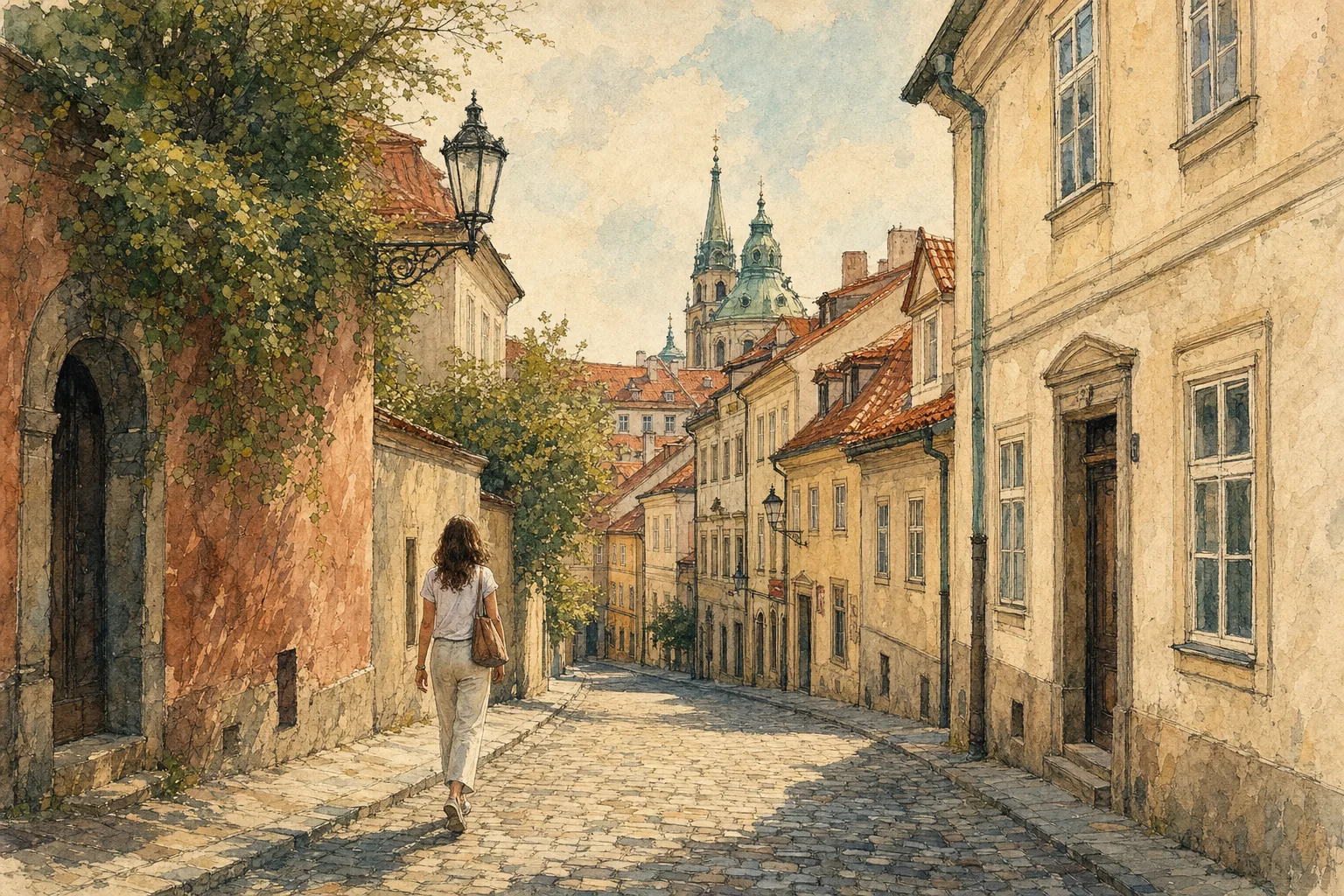
travel-decisions
Is Prague in November Too Gloomy If You Care Most About Scenic Photography?
A friction-first look at Prague in November for photographers: short daylight, overcast skies, cold, and rain risk, weighed against fewer crowds and Christmas market light, plus a real season-by-season comparison.
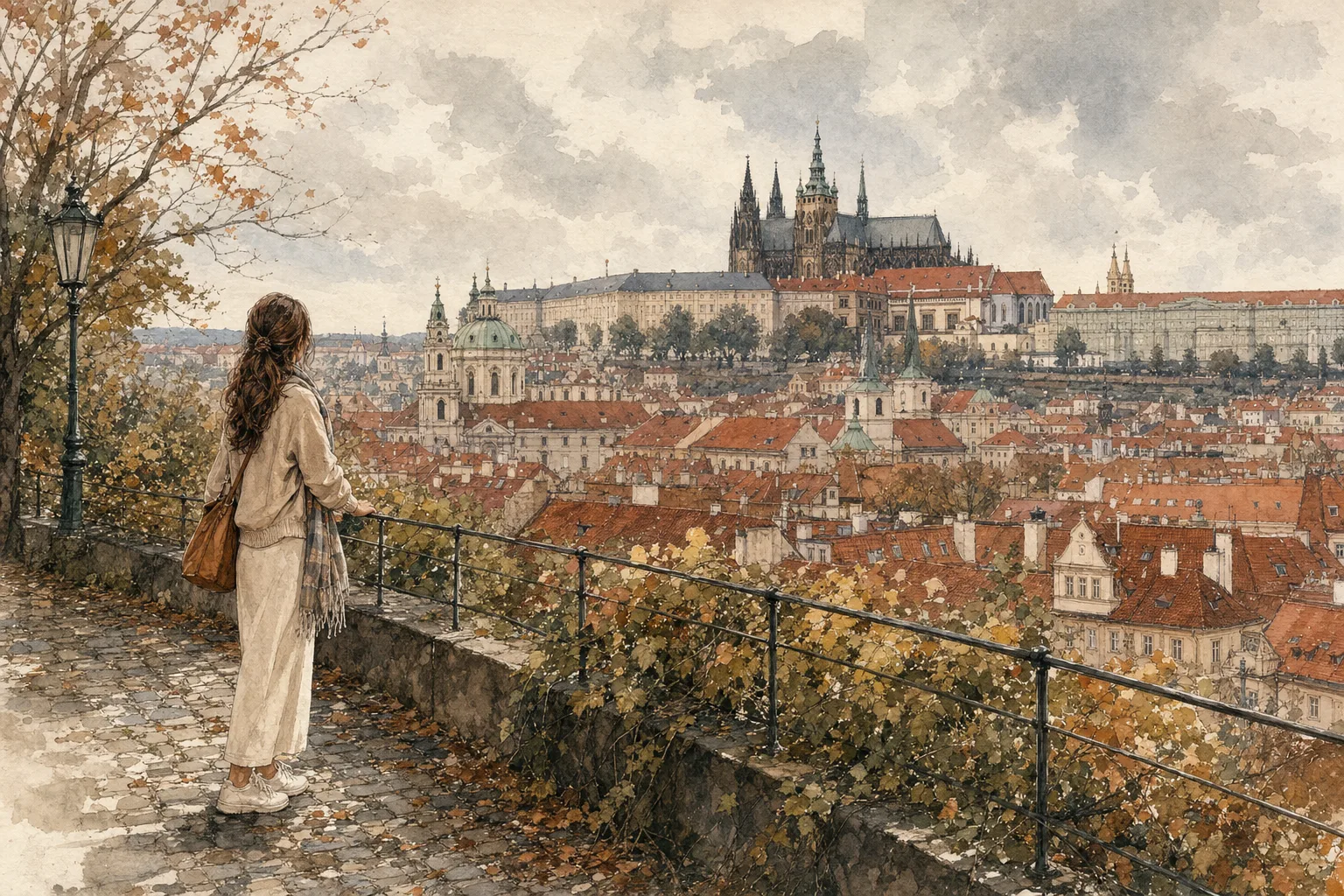
By the Trip Persona Editorial Team. Last reviewed and fact-checked July 25, 2026.
Quick Verdict
Prague in November is not too gloomy to visit, but it is a real tradeoff for anyone whose trip satisfaction depends on bright, wide, colorful scenery shots. The city still photographs well under flat light, especially for architecture, street scenes, and Christmas market glow after November 28. What you lose is the long, warm-light afternoon window that makes river panoramas and skyline shots feel dramatic.
Choose Prague in November if you want fewer crowds, lower accommodation costs, moody atmospheric compositions, and you are comfortable shooting in a compressed 9 to 9.5 hour daylight window with frequent cloud cover. This fits street photographers, mood-focused travelers, and budget-conscious visitors who do not need saturated blue-sky backdrops.
Skip November if your primary goal is bright landscape and skyline photography with strong natural light and color, especially if you are traveling specifically to capture postcard-style wide shots of the castle, river, and rooftops. That kind of photography is measurably easier to get in late spring through summer, or in the shoulder window of early autumn, both of which give you more daylight hours and warmer color temperature to work with.
The honest line: November trades scenic punch for mood and savings. If you cannot name a reason you want that trade, you probably do not.
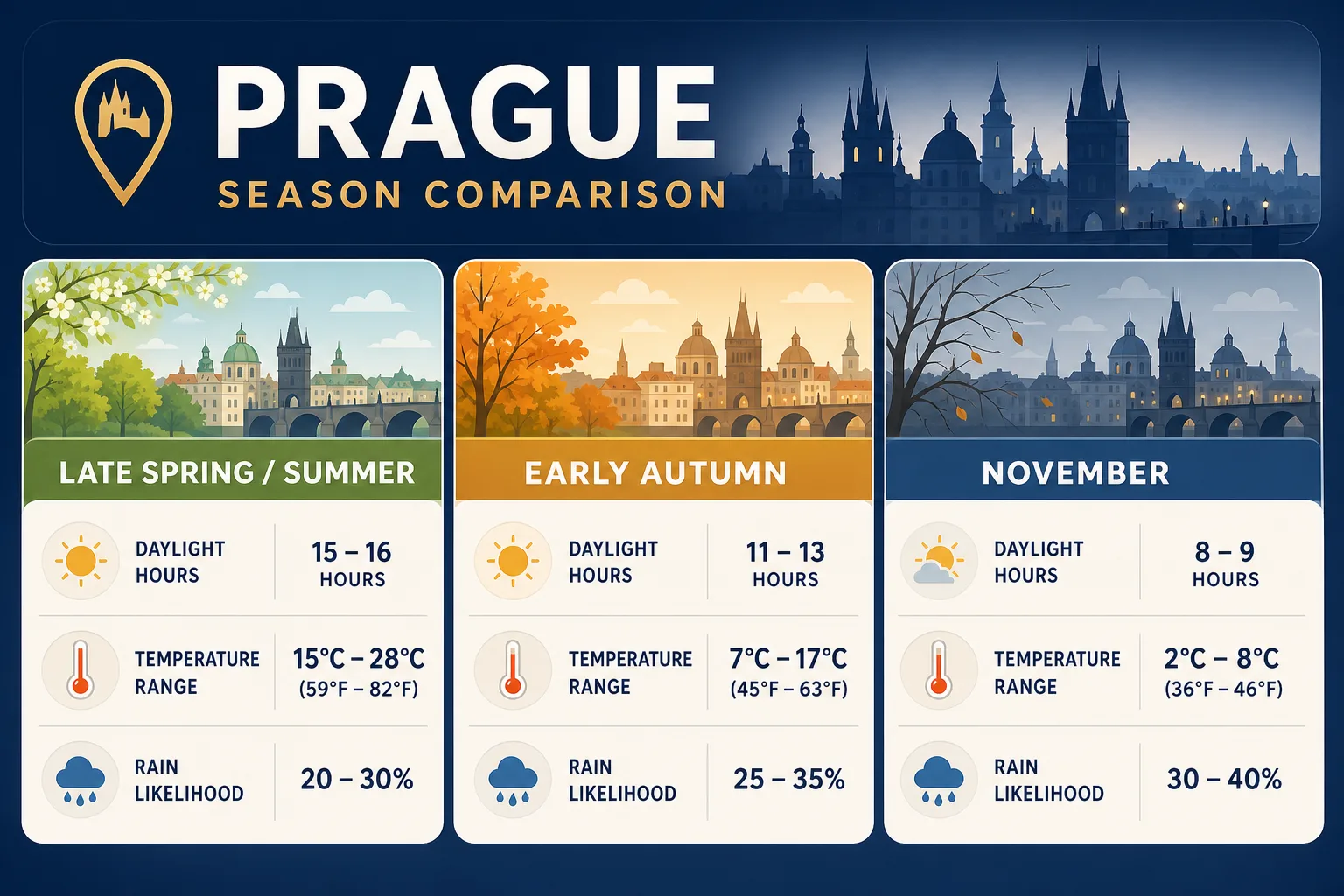 Editorial illustration: A clean simple comparison chart or table graphic with three labeled columns for late spring/summer.
Main Friction Problem
Four practical frictions stack together in November, and they compound each other rather than acting independently.
Short daylight is the first constraint. Prague gets roughly 9 to 9.5 hours of daylight in November, with sunrise between 7:13 and 7:45 AM and sunset between 4:15 and 4:20 PM. That is a much shorter working day than summer, and it means your entire outdoor shooting schedule, sightseeing, and travel between locations has to fit inside a tighter window. If you also want to sleep in or take a leisurely breakfast, the effective daylight you get for photography can shrink to 6 or 7 hours.
Cold weather is the second. Daytime highs average 7 to 8 degrees Celsius (45 to 46 Fahrenheit), and nighttime lows drop to 1 to 3 degrees Celsius (33 to 37 Fahrenheit). That is cold enough to affect camera battery life, to make you want gloves that get in the way of dial adjustments, and to shorten how long you are willing to stand still waiting for a shot at a viewpoint like Letna or the Charles Bridge towers.
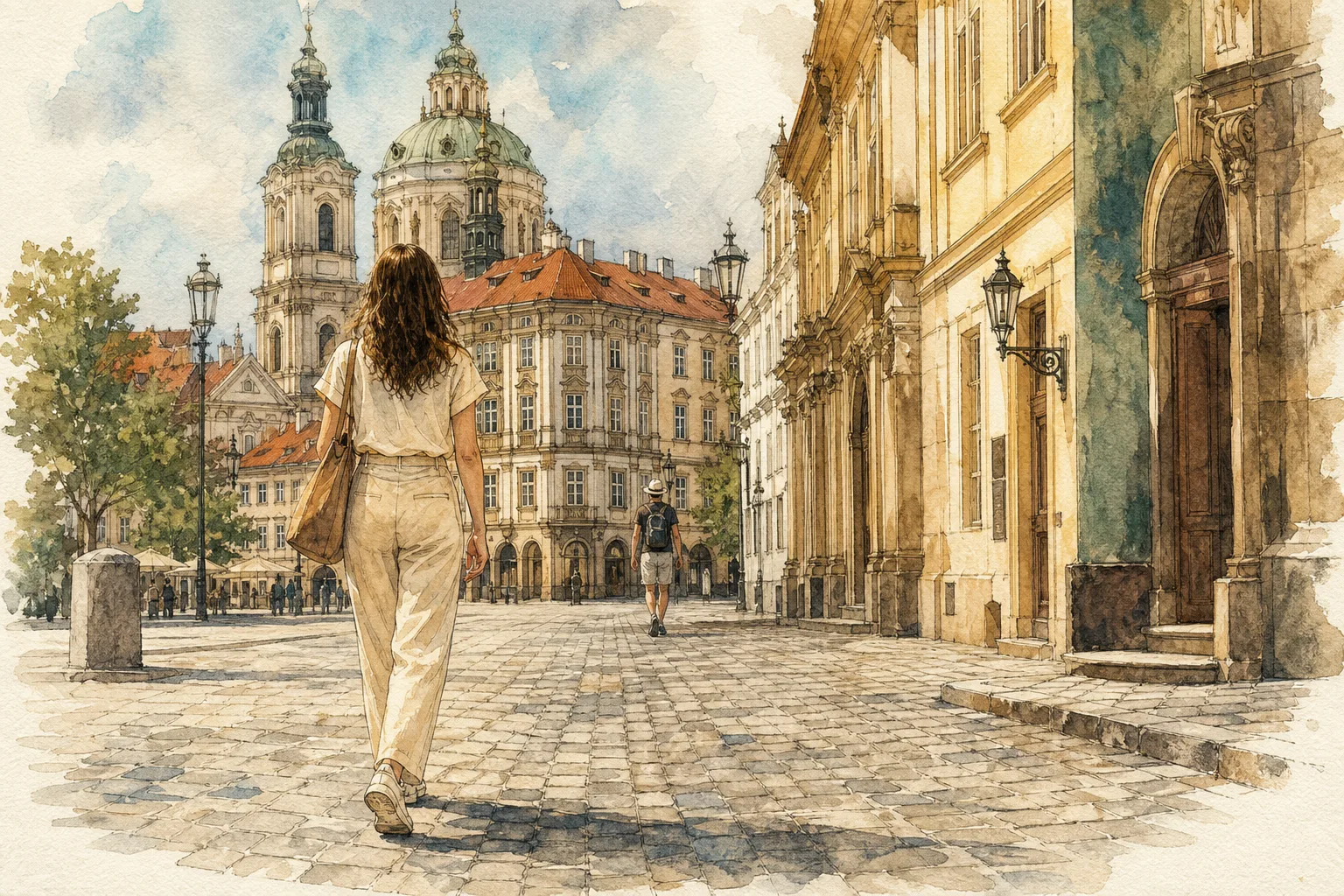
Scenic loss is the visual consequence of the first two. Overcast skies flatten contrast, mute the golden stone tones Prague is known for, and remove the long warm-light hour that photographers chase in spring and summer. Wide shots of the castle across the river, which rely on depth and light separation, tend to look flatter and greyer than the same frame shot in June.
Unpredictable rain is the fourth friction. November does not mean constant rain, but showers can appear without much warning between longer overcast stretches. That unpredictability makes it harder to plan a single dedicated golden-hour outing, since you may need to adapt on short notice or lose your one shot at a location.
None of these frictions individually rules out a trip. Together, they mean a November visit rewards photographers who adjust their goals toward mood, texture, and human scenes rather than expecting bright wide-landscape results.
Friction Table: Prague Across the Seasons
This is the comparison that actually matters for a photography-led decision: not just what November looks like on its own, but how it stacks up against the two windows most photographers ask about instead.
| Decision variable | Late Spring / Summer (May-Aug) | Early Autumn (Sep-mid Oct) | November |
|---|---|---|---|
| Daylight hours | Longest of the year, up to 16+ hours, late sunsets | Still generous, gradually shortening, roughly 11-13 hours | Shortest working window: 9-9.5 hours, sunset by 4:15-4:20 PM |
| Typical daytime temp | Warm, often 20-25 C (68-77 F) | Mild, roughly 12-18 C (54-64 F) | Cold: 7-8 C (45-46 F), nights 1-3 C (33-37 F) |
| Rain pattern | Occasional short showers, mostly predictable | Lower rain frequency, more stable skies | Unpredictable overcast and showers, low warning |
| Scenic light quality | Strong contrast, warm golden hour, saturated color | Good contrast, softer warm tones, foliage color in parks | Flat, frequently grey, muted stone tones |
| Crowd levels | Peak crowds at Charles Bridge and Old Town Square | Moderate, noticeably lighter than summer | Thinnest crowds of the three windows |
| Hotel cost | Highest rates of the year, peak-season pricing | Mid-range, below summer peak | Lowest: budget/mid-range averages 58-101 USD (early-mid Nov) |
| Best fit for | Landscape and skyline photographers wanting bright wide shots | Balance-seekers wanting good light without peak crowds | Mood/street photographers and budget-first travelers |
If you read only one row, read the daylight and light-quality rows together: this is a photographer's decision by design, not a "which month is prettier" toss-up.
Who Will Feel It Most
Photographers chasing wide, bright, high-saturation landscape shots will feel this friction the hardest. If your reference images are golden-hour panoramas of the castle over the river with a warm sky, November will consistently underdeliver, no matter how good your timing or gear is. That mismatch is about light physics, not luck, and no amount of scouting fixes a sky that will not clear.
Scenic sightseers who measure a trip's success by how the photos turned out will also feel it, especially if they are comparing their trip to social media shots taken in June. The compressed daylight window means less flexibility to wait out bad weather and try again later in the day.
Budget travelers are the group least affected by this specific friction, and in fact benefit from it. Lower hotel rates and thinner crowds are a fair trade if scenery is a nice-to-have rather than the main goal of the trip.
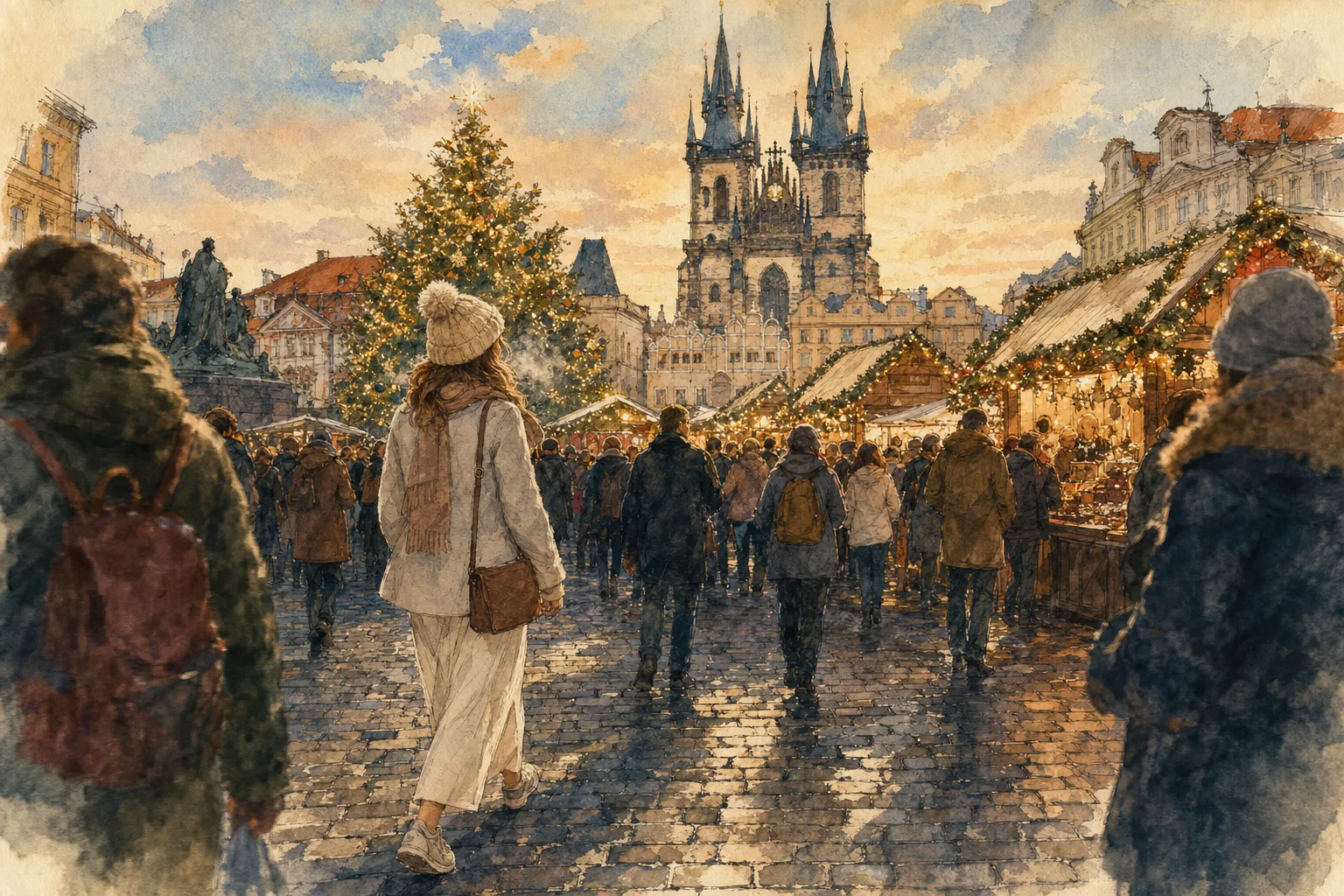
Travelers who value atmosphere over landmarks tend to do well in November. Fog over the river, warm cafe windows against grey streets, and market lights against dark early evenings after November 28 are a different kind of photogenic that rewards a mood-first mindset rather than a landmark-checklist mindset.
Anyone with a tight, single-visit itinerary (one trip, one city, no repeat chances) should weigh this seriously: if scenic photography is the entire point of the trip and you will not return to Prague again soon, a grey week can feel like a missed opportunity that is hard to fix in post-processing.
How to Reduce the Friction
For short daylight: build your day around the 9 to 9.5 hour window instead of fighting it. Get up before sunrise so you are not losing the early light to breakfast and logistics, and plan your most important shot locations for the first two hours after sunrise and the hour before sunset, when the low sun angle at least partially compensates for cloud cover. Walking from Old Town Square to Charles Bridge takes only 5 to 10 minutes and covers 500 to 600 meters, so you can move between key spots quickly rather than losing daylight to transit. The 1.1 to 1.5 km uphill walk from Charles Bridge to Prague Castle through Mala Strana takes 15 to 20 minutes; budget for that climb rather than treating it as a quick add-on when daylight is already tight.
For cold weather: dress in layers you can add and remove without breaking your shooting rhythm, and carry spare camera batteries in an inside pocket, since cold drains them faster than the indicator shows. Keep outdoor sessions shorter and more frequent rather than one long cold session that saps your patience and your batteries at the same time.
For scenic loss: shift your shot list toward what November light does well. Overcast skies are excellent for even, shadow-free portraits and architectural detail shots where you do not want harsh contrast. Fog and low cloud over the Vltava can add atmosphere that clear summer skies do not offer. Treat the muted palette as a different aesthetic goal rather than a failed version of a summer shot.
For unpredictable rain: do not schedule your single most important shoot as a one-time event with no backup slot. Build in a flexible half-day buffer so a rain shower does not cost you the whole trip's key photo. A compact rain cover for your camera and a microfiber cloth are worth the small extra weight.
For the light gap generally: if your dates are flexible, note that the Christmas markets open November 28, 2026. Visiting on or after that date adds warm light sources to offset short, grey days, which can meaningfully change your evening shooting options even though it does not fix daytime light. Also confirm the status of anything season-dependent before you build a shot list around it: the Petrin Funicular is closed for reconstruction and scheduled to reopen only in autumn 2026, and river boat tour frequency typically drops as the weather cools, so a sunset boat shot you saw online in July may not be running on your dates.
Better Alternatives
If scenic photography with strong natural light is genuinely your top priority, other timing choices serve that goal better than November, and the comparison table above is the reason why.
Late spring through summer (May to August) is Prague's peak season for daylight length and warmer light, giving photographers the longest working days and the most reliable golden-hour windows. The tradeoff is heavier crowds at Charles Bridge, Old Town Square, and Prague Castle, along with the highest hotel rates of the year.
Early autumn, roughly September through mid-October, is often the better-balanced choice for photography-first travelers who still want to avoid full summer crowds. Daylight is still generously long, temperatures are milder than November, and foliage in parks like Petrin and Letna adds color that November's bare trees do not offer.
If your main reason for choosing November specifically was budget or fewer crowds, and scenery is secondary, November remains a reasonable choice. But if scenery is the primary decision factor and you are only in November because of a fixed work or personal schedule, it is worth honestly asking whether a different month for this same trip, even by a few weeks earlier, would serve the photography goal better without sacrificing much on cost or crowds.
Decision Checklist
Use this before booking to confirm November is the right call for your specific priorities.
- My primary goal is mood and atmosphere, not bright wide-landscape shots
- I am comfortable planning around a 9 to 9.5 hour daylight window
- I have layered clothing and spare batteries for 1 to 3 C nighttime cold
- I am packing a light rain shell and lens protection for unpredictable showers
- I am comparing my trip to real November reference photos, not summer ones
- I have checked whether my dates fall before or after the November 28 Christmas market opening
- I have confirmed the Petrin Funicular's reopening status if my shot list depends on it
- Lower hotel costs (58 to 101 USD range) and thinner crowds matter enough to offset flatter light
- I have a flexible half-day buffer in case rain affects my one key shoot
- If scenery is my only goal, I have seriously weighed late spring, summer, or early autumn against this table
If you check most of these boxes, November can work well. If you are mainly checking the box on flatter light being an acceptable loss and everything else feels like a compromise, that is a signal to reconsider the timing.
FAQ
Is Prague too dark in November for photography? Not too dark to shoot, but the usable outdoor window is short. Daylight runs about 9 to 9.5 hours, with sunrise between 7:13 and 7:45 AM and sunset around 4:15 to 4:20 PM, so plan your key shots inside that window rather than assuming a long afternoon like you would get in July.
Does it rain a lot in Prague in November? Rain is unpredictable rather than constant. There is no guaranteed daily downpour, but skies are frequently overcast and showers can appear with little warning, so a light rain shell and a lens cloth are more useful packing choices than a rigid rain-day itinerary.
Is November a bad time to visit Prague for photos of the castle and bridge? The landmarks themselves do not change with the season, but color and contrast are flatter under grey November skies. If your goal is dramatic golden-hour shots of the castle over the river, November is a meaningfully weaker window than late spring, summer, or early autumn. If your goal is moody, low-crowd compositions, November can work in its favor.
Should I visit Prague in November if I only care about scenery, not Christmas markets? Weigh the tradeoff directly: you get thinner crowds and hotel rates averaging 58 to 101 USD in early to mid-November, but you lose the long warm-light afternoons that make wide river and skyline shots pop. If your dates fall before November 28, you also do not get the market lights as a light source to compensate.
When should scenic photographers actually visit Prague instead of November? Late spring through summer (May to August) is Prague's peak window for long daylight and warm light. Early autumn, roughly September through mid-October, is often the better-balanced choice: still-long days, milder cold than November, and lighter crowds than midsummer. Pick November on purpose for mood and budget, not by default.
What closes or changes in Prague specifically in November? The Petrin Funicular is currently closed for reconstruction, scheduled to reopen in autumn 2026, so check its status before planning a Petrin-hill shot list around it. River boat tour schedules also thin out as the weather cools, so treat any specific November boat departure as something to confirm locally rather than assume.