travel-decisions
Is Prague a Bad Fit If Your Flight Arrives Late at Night?
A late-night landing in Prague is not automatically a disaster, but it changes what you should book and expect. Here is how to tell if it works for your trip.

Strong Opening
A flight that lands in Prague at 11:40 p.m. or 1:15 a.m. is not a reason to cancel the trip. It is, however, a reason to stop planning Prague the way you would plan a daytime arrival in Rome or Barcelona. The mistake most travelers make is not choosing the wrong city. It is carrying a daytime-arrival plan into a nighttime-arrival situation: no transport confirmed, no clarity on hotel check-in, and no backup if something is delayed. That gap is where the regret happens, not in Prague itself.
This is a decision about fit, not a warning to avoid the city. Some travelers can land at 1 a.m. in Prague and be asleep by 2 with zero friction. Others will have a miserable first night even with the same flight time, because their trip style does not tolerate the small amount of logistics a late arrival requires. If you are not sure which type of traveler you are, our travel personality quiz can help clarify how much pre-trip logistics you actually tolerate well.
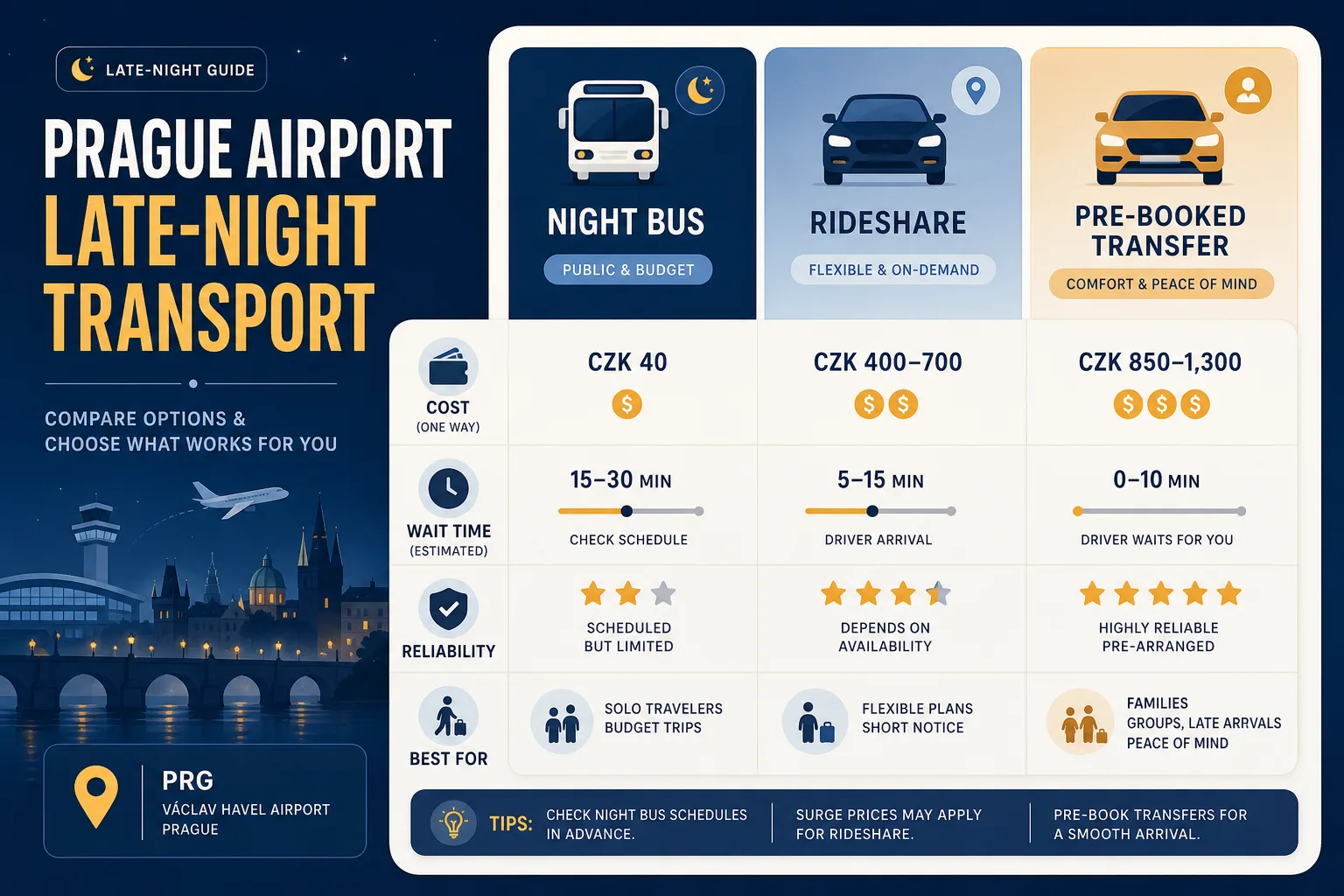 Editorial illustration: A simple comparison table graphic listing late-night Prague Airport transport options such as night bus.
Quick Verdict
Prague is a reasonable choice for a late-night flight arrival if you are willing to do three things ahead of time: confirm your transport option before you land, pick a hotel with a real answer for late check-in, and accept that your first night will be about getting to bed, not about the city.
Prague is a poor choice for a late-night arrival if you are the kind of traveler who books flights and hotels separately without checking how they connect, if you are traveling with a big group or heavy luggage and no fixed transfer plan, or if you assume every hotel has a 24-hour desk the way large chain hotels in bigger transit hubs typically do.
Who should choose this option: travelers willing to spend 10 minutes before departure locking in a transfer plan and a hotel with a documented late check-in process.
Who should not choose this option: travelers who like to "figure it out when we land," anyone relying on cash-only budget planning without a transport fallback, and groups with young kids or heavy bags landing after the metro closes with no pre-booked ride.
Who Will Probably Love It
Prague rewards travelers who treat the first night as a transition, not an experience. If your trip style is: get from the plane to the pillow with minimum decisions, Prague late arrivals actually work in your favor. The airport corridor has a functioning night bus system, a defined taxi partner at the terminal, and a compact city center where almost any hotel is a short ride from the airport, not an hour-long ordeal.
Low-stress planners and first-time visitors who do their homework tend to do well here. If you are the type who reads the hotel's check-in policy before booking and picks a place inside or near the historic core rather than the cheapest option on the edge of town, a late landing becomes a non-event. You take a night bus or a short rideshare, follow a keybox code or a late-arrival email, and start your actual sightseeing the next morning on full rest.
Travelers optimizing for value also tend to do fine, because the cheapest reliable option (public transit) still works late into the night, just on a different route than during the day.
Who Might Regret It
The mismatch shows up in three recognizable patterns.
First, the traveler who books the cheapest flight without checking arrival time against transit schedules. Landing at 12:30 a.m. is fine if you know Bus 907 or 910 is running. It is a problem if you assumed the metro or the regular airport bus would be available and only find out at the arrivals hall that it closed hours ago.
Second, the traveler who books a boutique guesthouse or budget apartment for its location and price, without confirming how check-in works after the desk closes. Discovering at 1 a.m. that there is no one to hand you a key, and that the "24-hour support" line does not pick up, is a specific and avoidable disappointment.
Third, the traveler arriving with a full itinerary starting at 8 a.m. the next morning. Even a smooth late arrival costs you sleep. If your plan has no slack for a slower first morning, the fatigue compounds and colors the rest of the trip, not because of Prague, but because of the schedule you built around it.
Mistake / Consequence Table
| Decision variable | Safer choice for late arrivals | Riskier choice | Consequence if it goes wrong |
|---|---|---|---|
| Transport from airport | Pre-booked transfer or confirmed night bus route | "I will just grab a taxi outside" with no plan | Surge pricing up to roughly 1,200 CZK, or confusion over which rideshare pickup point to use |
| Hotel check-in type | Property with confirmed keybox, app entry, or documented late check-in | Assuming a front desk is staffed 24 hours | Standing outside a locked building at midnight with no contact who answers |
| Hotel location | Central, near Old Town or within easy walking distance of transit | Cheaper option far from center with only daytime bus service | Long, complicated late-night transfer instead of a short one |
| First morning plan | Loose or late-start morning after arrival | Tours or timed tickets booked for early the next day | Overslept or exhausted start, wasted prepaid booking |
| Food and cash needs | Know one late-night food option and have small cash for the tourist fee | Assume restaurants and shops are open like during the day | Arriving hungry with nowhere open nearby except a couple of specific late spots |
Hidden Friction Points
Late arrival risk. The core friction is timing against infrastructure. Prague's metro and the standard daytime airport routes, including Trolleybus 59 and Bus 100, stop running between midnight and 5 a.m. If your flight lands in that window, the transit options change entirely, and travelers who do not know this in advance are the ones who end up stuck weighing options in the arrivals hall at 1 a.m. instead of before they ever left home.
Airport transfer stress. Night buses 907 and 910 do run through the night, roughly every 30 to 60 minutes, taking about 45 minutes to the center. That is a fine option if you know about it and have light luggage. Taxis and rideshares add a different kind of friction: Uber is the airport's official partner and can pick up directly at arrivals, but other services such as Bolt or Liftago require walking to a designated pickup lot instead of the curb outside the terminal. Not knowing this in advance means wandering a mostly empty airport at night looking for your ride.
Hotel location risk. A hotel that looks fine on a map can be a poor choice for a late arrival if it sits far from the center with no late-night transit link. The inverse is also true: paying slightly more to stay centrally, within easy walking distance of Old Town Square, means that even a stressful transfer only has to get you a short distance once you are off the bus or out of the car.
First-night fatigue. Even a perfectly executed late arrival still means less sleep than usual. This is not a Prague-specific problem, but it interacts badly with a common Prague-specific mistake: booking an early, tightly scheduled first day. The fatigue is manageable if you plan for it. It becomes a regret if you do not.
How to Make It Easier
- Match your flight time to the transit schedule before booking. If landing after midnight, check whether your arrival falls into a night bus window (roughly 00:00 to 04:30) or the gap before service resumes. This single check removes most of the uncertainty.
- Buy or plan your ticket type in advance. A 90-minute transit ticket costs 46 CZK through the PID Litacka app, 50 CZK on paper, or 55 CZK by SMS. Knowing this before landing means you are not fumbling with an unfamiliar payment system while tired.
- Decide your transport mode before you land, not after. If you want a rideshare, know that Uber can pick up directly at arrivals while others require a walk to a designated lot. If you would rather not think about it at all, a pre-booked transfer costs more but removes every unknown.
- Confirm your hotel's actual late check-in process by message, not assumption. Ask directly: is there a person, a keybox, or an app-based entry after 11 p.m.? Get the access code or instructions in writing before you fly.
- Choose a centrally located base over a cheaper outer one. A hotel a short walk from Old Town Square, roughly 1.1 to 1.5 kilometers from the main train station, keeps your worst-case walk manageable even if a transfer plan falls through. Our hotel location checklist walks through exactly what to verify before booking.
- Have a backup food and cash plan. Most kitchens close by 10 p.m., but a few options stay open late, including Lokal Dlouhaaa until 1 a.m. and U Sadu until 4 a.m., along with a couple of 24-hour spots like Roma Uno and the Masna 2 Burrito Loco. Keep some small cash on hand too, since accommodations collect a nightly tourist fee of 50 CZK per adult that is often paid on arrival.
- Give yourself a slow next morning. Do not schedule timed tickets or tours before mid-morning on day one.
Better Alternatives
If, after reading the above, you know you are the type who will not confirm a transfer plan, will not check a hotel's late check-in policy, and wants zero logistics thinking on arrival night, there are better structures than a self-planned late arrival in Prague.
One option is simply shifting the same trip's arrival time: booking a flight that lands in the early evening instead of after midnight, even if it costs slightly more or requires an overnight layover elsewhere. This keeps Prague itself unchanged but removes the entire late-arrival friction category.
Another option, if the late flight is fixed and cannot move, is booking one night at an airport-adjacent hotel with a confirmed 24-hour desk and shuttle, then transferring into central Prague the next morning when transit is running normally and you are rested. This costs an extra room night but converts a stressful unknown into two simple, well-lit steps.
If neither is possible and you still feel unsure about self-managing a night arrival, a pre-arranged private transfer booked directly with the hotel or a reputable transfer company is the lowest-effort fix: it costs more than a night bus but removes essentially all of the friction points above in one booking.
Self-Checklist
Use this before you finalize flights or hotel bookings, not after you land.
- I know whether my arrival time falls inside the metro's overnight closure window (midnight to 5 a.m.)
- I know which night bus (907 or 910) or transport option covers my arrival time
- I have decided in advance whether I am using public transit, a rideshare, or a pre-booked transfer
- If using a rideshare other than Uber, I know I may need to walk to a designated pickup lot rather than the curb
- My hotel has confirmed in writing how I check in after their desk closes, if it closes
- My hotel or apartment is centrally located or otherwise well connected to late-night transit
- I have small cash for the nightly tourist accommodation fee (50 CZK per adult)
- I know at least one place to get food if I land hungry after normal kitchen hours
- My schedule for the next morning is loose, not an early timed activity
- I have a fallback plan if my primary transport option fails or is delayed
FAQ
Is it safe to arrive in Prague late at night? Central Prague is generally calm at night, and the airport-to-city corridor is well used by night buses and rideshares, so personal safety is not the main risk. The real risk is logistical: closed metro lines, unstaffed hotel reception, and being stranded without a plan if a transfer falls through.
Does the Prague metro run all night? No. The Prague Metro and the daytime airport routes, including Trolleybus 59 and Bus 100, close between midnight and 5 a.m. Night buses 907 and 910 cover the airport-to-center route during those hours instead, running roughly every 30 to 60 minutes.
Should I just book a taxi instead of the night bus if I land after midnight? If you land close to midnight, are traveling with a lot of luggage, or your energy is already low, a pre-booked transfer or rideshare removes the guesswork. If you land in a night bus window with light luggage and know your route, the bus is a reasonable and much cheaper option.
What if my hotel does not have someone at the desk when I arrive? This is common in Prague, especially at mid-range and apartment-style properties. Confirm your check-in method before you travel: a keybox code, an app-based entry, or a specific late-arrival instruction. Do not assume a front desk will be staffed after 11 p.m. unless the listing says so explicitly.
Is Prague a bad city overall for late arrivals compared to other European capitals? Not particularly. Its main disadvantage is the metro shutdown overlapping with common long-haul and red-eye arrival times, which is common across many European cities. Prague's advantage is a compact old town where, once you are checked in, everything else is within easy walking distance the next day.