travel-decisions
Is Jeju a Good Destination for a Multigenerational Family Trip If Seniors Have Mobility Limitations?
A traveler-fit breakdown of whether Jeju works for a multigenerational trip when grandparents have walking fatigue or joint pain, with concrete tradeoffs.
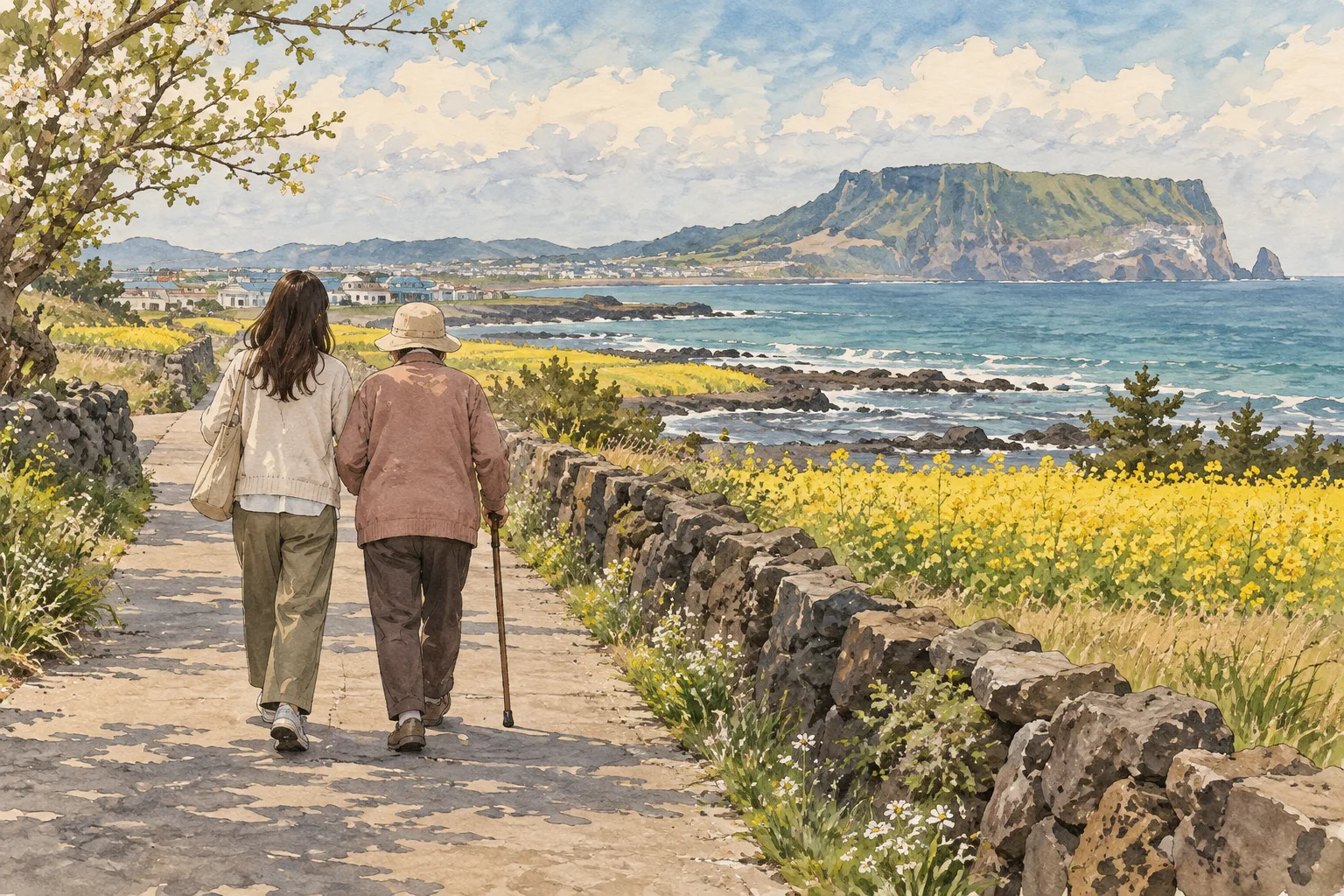
Quick Verdict
Jeju can work well for a multigenerational trip, but only with a mobility-aware itinerary. The island has a real mix of accessible and inaccessible attractions, and the difference between a good trip and an exhausting one comes down to which sites you pick and how you get between them.
Choose Jeju if your family is willing to build the itinerary around a few accessible landmarks per day, rent a private vehicle instead of relying on public transit, and treat slow pauses as part of the plan rather than a compromise. Skip Jeju, or at least this kind of trip to Jeju, if your family's expectation is a hiking-heavy, peak-bagging island tour built around Hallasan trails or long volcanic crater walks, because that itinerary assumes stamina that mobility-limited seniors do not have.
Strong fit if: your group prioritizes accessible viewing points, private transport, and a slower daily pace over covering the island's full highlight list. Weak fit if: your group expects the standard first-timer itinerary of hikes, multiple far-apart stops per day, and public transit to save on cost.
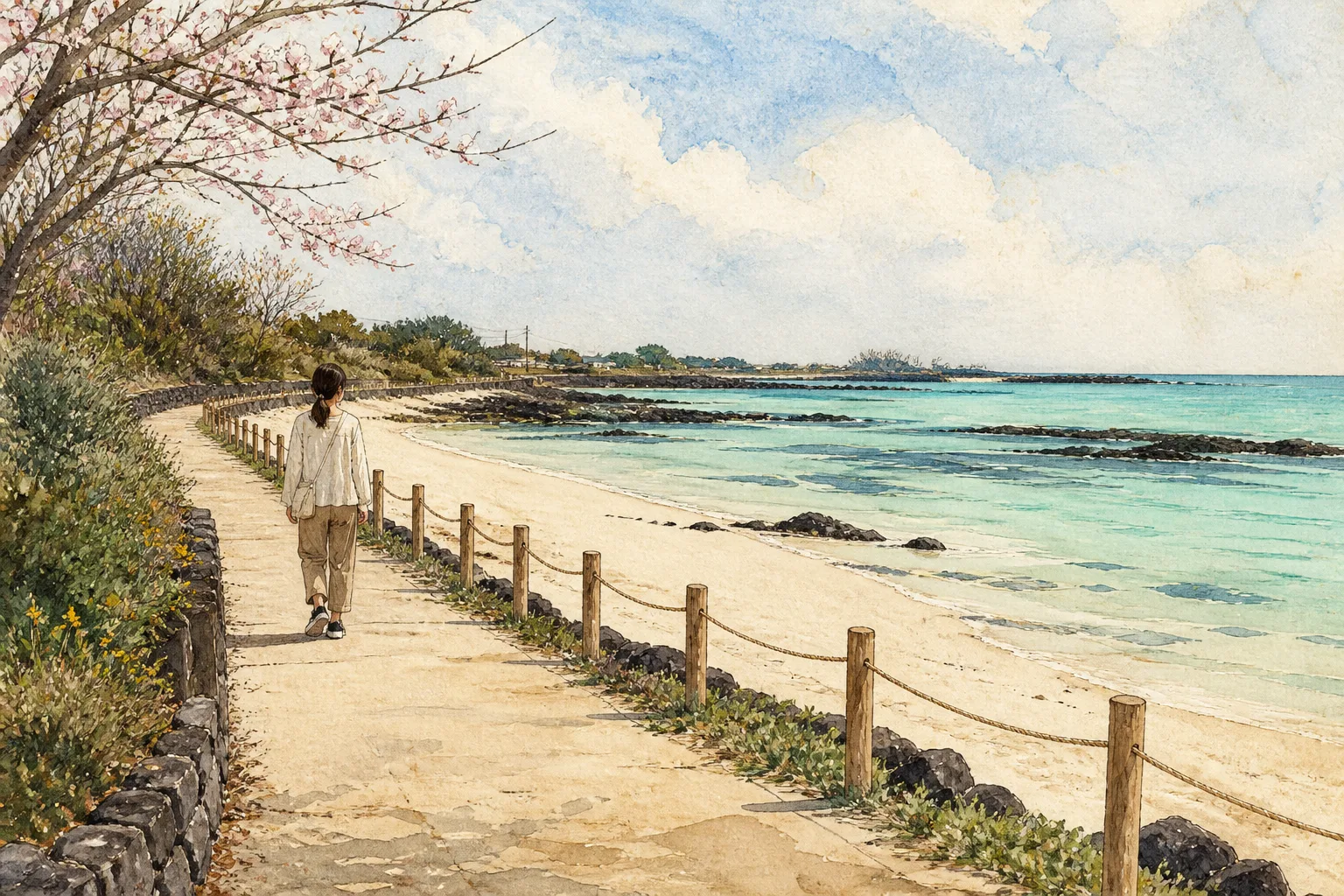
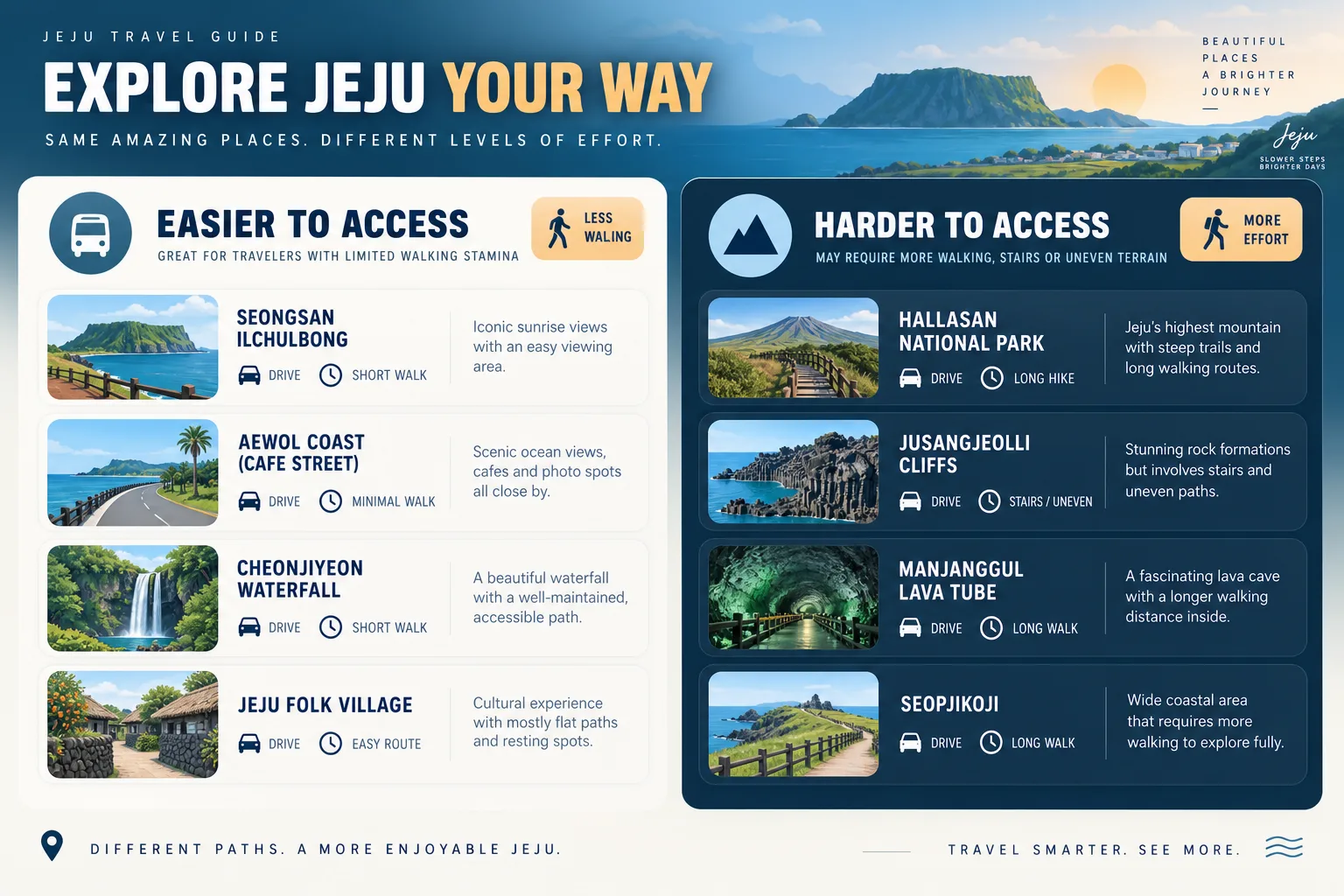 Editorial illustration: A simple two-column comparison layout with short labels showing Jeju attractions sorted into easier-to-access and harder-to-access categories for a traveler with limited walking stamina.
Traveler Type Table
The real decision variable is not age. It is walking tolerance combined with how much the group is willing to adjust the itinerary to protect it. Two families with the same 70-something grandparent can have completely different Jeju experiences depending on this.
| Decision variable | Multigenerational family (mobility-aware) | Slow traveler (any age) | First-timer chasing highlights |
|---|---|---|---|
| Daily stop count | 2 to 3 accessible sites | 1 to 2 sites, unhurried | 4 to 6 sites, packed |
| Transport choice | Private car or accessible taxi | Rental car, flexible timing | Public bus or rideshare between hotspots |
| Attraction picks | Jeju Folk Village, O'Sulloc Tea Museum, Cheonjeyeon viewing areas | Coastal cafes, quiet villages, tea fields | Hallasan trails, Seongsan Ilchulbong sunrise climb |
| Risk if mismatched | Walking fatigue, rushed transfers | Boredom if forced to rush | Frustration if slowed down by the group |
| Biggest friction point | Transit and entrance approach areas | Overplanning by other members | Expectation mismatch with slower relatives |
The tradeoff is direct: fewer stops per day means less ground covered, but it also means each stop gets a fair chance to be enjoyed instead of rushed through. A family that accepts this tradeoff upfront avoids the mid-trip friction of one person pushing to see more while another needs to stop and rest.
Best for First-Time Visitors
A first-time visitor bringing mobility-limited parents needs to drop the "see everything" instinct that usually drives a first Jeju trip. Multigenerational families new to the island often build itineraries from generic top-10 lists, which mix in hiking trails and long outdoor walks that were never designed with joint pain in mind. That approach sets up disappointment before the trip even starts.
The fix is to treat the first visit as a scouting trip rather than a complete-the-checklist trip. Pick attractions with confirmed accessible paths, like Jeju Folk Village or the O'Sulloc Tea Museum's tea fields, and treat everything else as optional. Slow travelers in the same group benefit from this shift too, since a lighter daily schedule matches their pace by default.
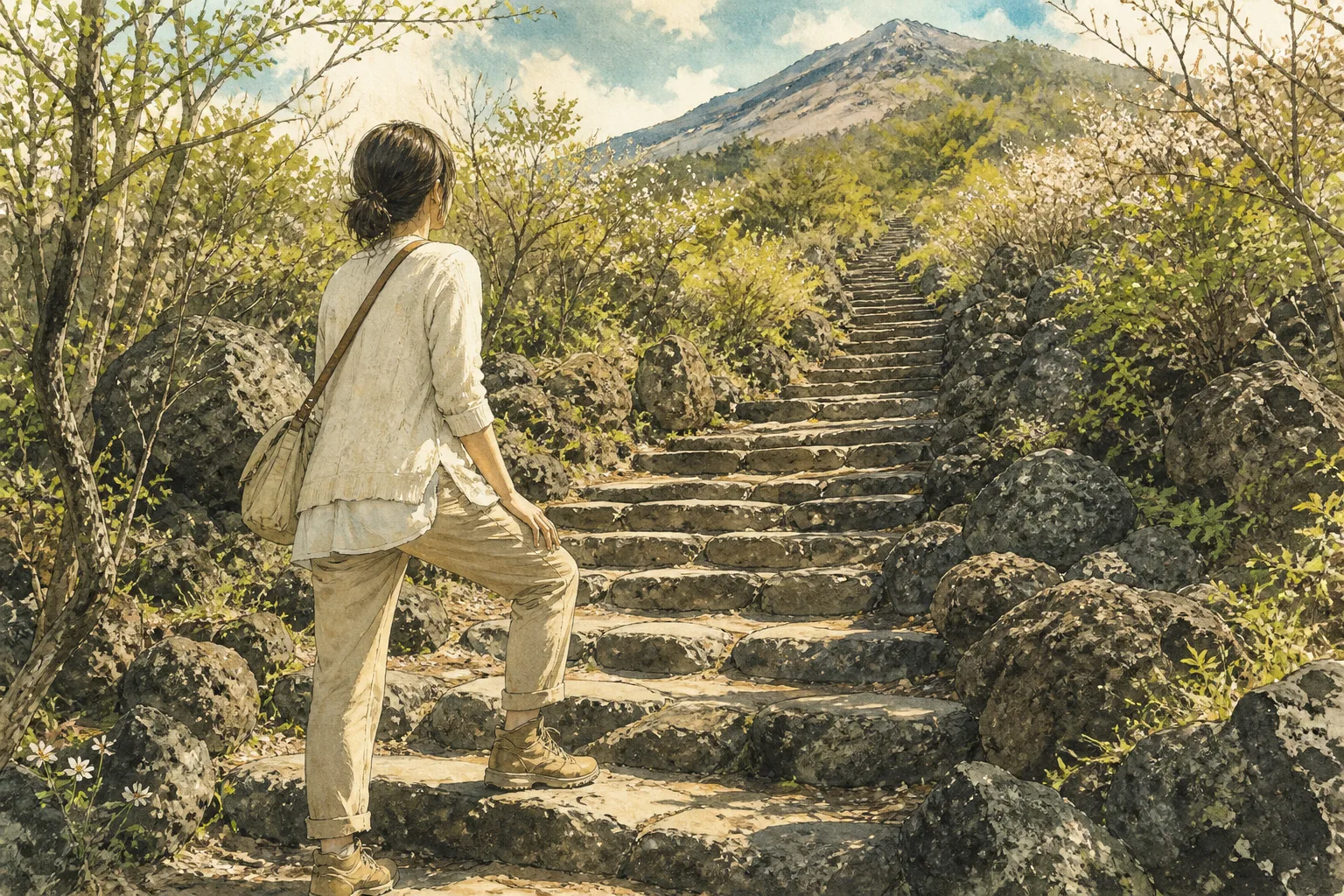
First-time visitors who insist on including Hallasan summit trails or long crater-rim walks should plan those as a separate, shorter outing for the able-bodied members only, not as a group activity.
Best for Couples
A couple within a multigenerational group, such as an adult child and their partner traveling alongside grandparents, faces a specific fit question: how much do they split off from the slower pace to do their own thing. This works best when it is planned as scheduled independence rather than a spontaneous split.
Build in a few blocks where the couple can walk a scenic trail or visit a site with more stairs while the mobility-limited relatives rest at an accessible spot nearby, like a tea house or one of the accessible viewing areas at Cheonjeyeon Waterfalls. This lets the couple get a fuller Jeju experience without forcing grandparents through unnecessary walking.
Slow travelers in the couple dynamic tend to adapt more easily here, since their baseline pace already resembles the mobility-aware plan. Couples who came expecting a fast-paced, landmark-heavy trip for themselves will feel the constraint more, so setting that expectation before booking prevents mid-trip tension.
Best for Slow Travelers
Slow travelers are, in practice, the traveler type that fits a mobility-aware Jeju trip most naturally. Their default preference for fewer stops, longer pauses, and mood over checklist overlaps almost exactly with what elderly travelers with joint pain need. A slow traveler joining a multigenerational trip rarely experiences the itinerary as a downgrade.
This alignment makes slow travelers useful as the pace-setters in a mixed-age group. If the family has one member who naturally prefers a relaxed schedule, letting that person help plan the daily route tends to produce a more realistic itinerary than defaulting to a fast-paced planner who then has to scale back.
The risk for slow travelers is the opposite of the usual mismatch: a family member with high energy may push to add stops "since we're already out," which erodes the slow pace that was protecting the mobility-limited members in the first place.
Best for Low-Stress Travelers
A low-stress, businesslike planner approaches Jeju differently than a slow traveler, but the two overlap well in a multigenerational context. Low-stress travelers want predictability: confirmed accessible sites, booked private transport, and a schedule with buffer time. That instinct directly reduces the friction that mobility limitations create.
This traveler type does well pre-booking a private vehicle or accessible taxi for the full trip rather than deciding transport day by day, since public transportation options on Jeju are limited and difficult to navigate on short notice. Multigenerational families with a low-stress planner in charge also tend to confirm hotel accessibility features, like ramp access and accessible bathrooms, before arrival instead of discovering gaps at check-in.
The mismatch risk for low-stress travelers is under-scheduling out of caution, leaving the trip feeling thin. The fix is not adding more stops, but adding more buffer and rest blocks around the same small number of accessible sites.
Common Mismatches
The most common disappointment pattern is a family that books Jeju expecting a nature-adventure island trip and only discovers the mobility gaps once they arrive. Volcanic landscape sites often look flat and manageable in photos but involve uneven terrain, long approach walks, or stairs that are not obvious from a travel brochure.
A second mismatch is assuming public transit will work like it does in a larger city. Public transportation options on Jeju are limited and can be difficult, and a family that plans to bus between attractions to save money often ends up with long waits and mobility-limited relatives standing longer than they should.
A third mismatch is treating one accessible visit as proof the whole island is easy. Manjanggul Lava Tube has a largely flat concrete interior, but the entrance approach is the hardest part of that specific visit, and that detail does not carry over to other lava tube or cave sites on the island. Checking each attraction individually, rather than generalizing from one good experience, prevents this.
Quick pre-trip checklist to catch these mismatches early:
- Confirm each planned attraction's accessibility individually, not by island-wide reputation
- Book a private vehicle or accessible taxi in advance instead of planning around public buses
- Choose a hotel that has confirmed ramp access and accessible bathrooms, not just "central location"
- Cap the daily itinerary at 2 to 3 stops for any day with the full group
- Build in a rest block after any attraction with a longer entrance approach
Final Match Recommendation
Jeju is a strong fit for a multigenerational family trip when the itinerary is built around confirmed accessible sites, private transport, and a genuinely slower daily pace. Families that treat mobility limitations as the primary planning constraint, not an afterthought, tend to come back describing the trip as calm rather than exhausting.
Jeju is a weak fit for families unwilling to give up the standard first-timer itinerary of hikes, crater climbs, and public transit hopping. That version of Jeju was not designed around joint pain or walking fatigue, and forcing it onto a mobility-limited group creates the exact disappointment pattern described above.
The deciding question for any family is simple: are you planning the trip around what the least mobile member can comfortably do, or are you hoping they can keep up with a plan built for someone else. Jeju rewards the first approach and punishes the second.
FAQ
Is Jeju wheelchair accessible? Jeju is partially accessible. Some attractions like the Jeju Folk Village and O'Sulloc Tea Museum have smooth, flat paths, while others like Manjanggul Lava Tube have a largely flat concrete surface but a harder-to-navigate entrance area. Accessibility varies by site, so check each stop rather than assuming island-wide accessibility.
Can we rely on public transportation in Jeju with an elderly traveler? Not comfortably. Public transportation options on Jeju are limited and can be difficult to use, so a wheelchair-accessible taxi or a private vehicle rental is a more reliable choice for a multigenerational group with mobility limitations.
Do Jeju hotels accommodate mobility needs? Many major hotels on Jeju meet international accessibility standards, including wide doorways, ramp access, and accessible bathrooms. Confirm these features directly with the property before booking, since standards vary by hotel size and age.
How many days should we plan for a slower-paced Jeju trip? There is no fixed number that fits every group. As a planning starting point, add at least one extra day beyond what you would book for a standard itinerary, since a mobility-aware pace covers fewer stops per day. Adjust that estimate based on your group's actual walking tolerance and the specific sites you choose, then confirm it against each site's typical visit length before booking.
What is the biggest mistake families make planning a Jeju trip for elderly relatives? Copying a first-time-visitor itinerary built around hiking trails, volcanic peaks, and multiple stops per day. That itinerary assumes strong stamina and creates walking fatigue fast; a mobility-aware plan needs fewer stops with more accessible viewing points instead.