travel-decisions
Is Jeju a Good First Trip for Travelers Who Want Easy Logistics?
Jeju looks simple on a map, but no subway and patchy bus coverage change the math. Here is who Jeju actually suits and who should book somewhere else.
Quick Verdict
Jeju is a good first trip if you are willing to either rent a car or commit to a single home base and build your itinerary around it. It is a weak first trip if you expect city-style logistics, meaning a subway, dense taxi coverage everywhere, and the ability to improvise your route as you go.
The island is large (1,846 square kilometers) and has no subway. That single fact reshapes almost every other logistics decision you will make, from where you sleep to how many regions you can realistically see. Choose Jeju if you are comfortable driving abroad, or if you are willing to pick one coastal area and stay mostly within it. Skip Jeju as a first trip, or at least rethink the itinerary, if you dislike renting cars, get anxious about unfamiliar public transit, or want the freedom to change plans hour to hour without a fallback ride option.
Choose Jeju if:
- You will rent a car, or you accept a single-base itinerary
- You are comfortable installing and using NAVER Map or KakaoMap before you land
- You want scenery and slower days over dense, walkable city sightseeing
Skip or restructure your Jeju trip if:
- You want subway-level ease of movement
- You plan to visit the east coast, south coast, and west coast all in the same short trip without a car
- You dislike advance planning and want a destination that tolerates last-minute changes
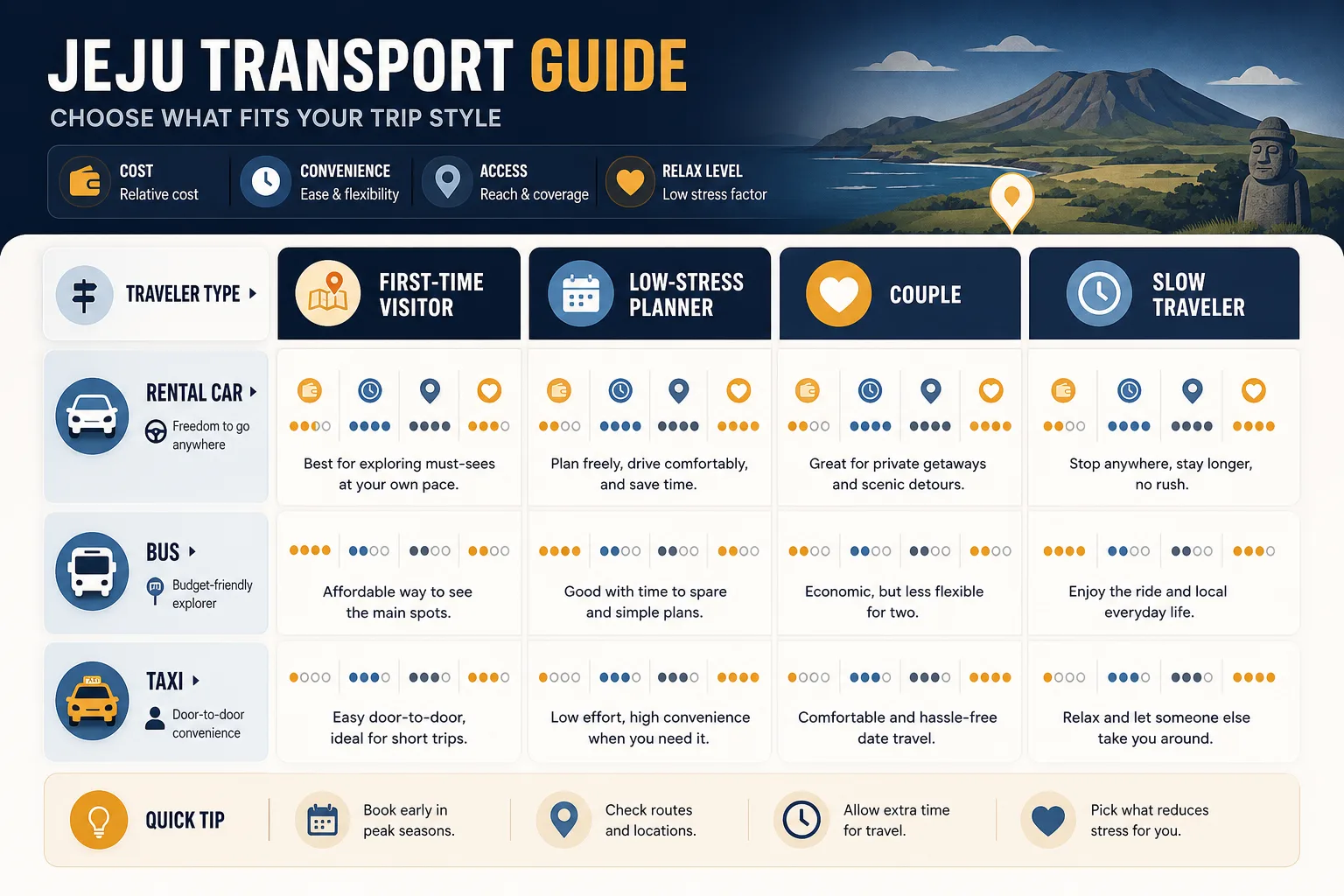 Editorial illustration: A simple visual comparison layout with labeled columns for traveler types (first-time visitor.
Traveler Type Table
The core variable is not "is Jeju easy or hard." It is: how will you move between places, and how many regions do you want to cover. Jeju's transit reality changes sharply depending on the answer.
| Traveler type | Real decision variable | Best transit approach | Main tradeoff |
|---|---|---|---|
| First-time visitor, no Korea experience | Comfort with self-navigation apps and unfamiliar bus systems | Rental car if budget allows, otherwise single-base itinerary using Blue Bus routes | Rental car removes stress but requires a printed IDP and a credit card in your name; skipping the car limits how much of the island you can see |
| Low-stress planner | Tolerance for mid-trip improvisation | Fixed 2 to 3 area plan, pre-booked hotel near main roads, Kakao T for backup rides | Less spontaneity, but far fewer navigation surprises |
| Couple | Willingness to split driving or share ride costs | Rental car for flexibility, or taxi-heavy single-base trip if neither wants to drive | Rental car gives romantic detours; taxi-only trip is calmer but pricier and slower |
| Slow traveler | Preference for fewer, longer stays over checklist sightseeing | Single-base or two-base itinerary, minimal daily transfers | Matches Jeju's pace well, but wastes the island's scenic range if you never leave one area |
The pattern across all four rows is the same: Jeju punishes travelers who want to move fast and freely without a car, and rewards travelers who either drive or accept a narrower plan.
Best for First-Time Visitors
A first-time visitor's biggest risk in Jeju is not the island itself, it is arriving with mainland-Korea assumptions. Someone who has read about Seoul's subway or Busan's metro may expect similar ease here. Jeju has neither. Jeju City center sits 2 to 4 km from the airport, a quick 10-minute taxi or short bus ride, so the arrival itself is genuinely easy. The complication starts once you try to leave the airport area for anywhere else on the island.
For first-time visitors, the fit test is simple: are you willing to either drive or accept that some regions of Jeju are effectively off-limits on this trip. If yes, Jeju works well as a first Korea-adjacent trip, since the arrival is short and the language and payment friction (T-money cards, Kakao T's pay-to-driver fallback) are manageable even without much prep. If a first-time visitor wants the freedom to wing it, hopping between distant coastal towns on a whim, Jeju will produce more frustration than a mainland city trip would.
Low-stress planners and couples fit into this same first-timer logic: the ones who pre-decide their transit method before landing have an easy trip, and the ones who plan to figure it out on arrival tend to lose a day to logistics confusion.
Best for Couples
Couples traveling to Jeju split into two workable patterns, and the mismatch happens when a couple tries to blend both without deciding in advance.
Pattern one is the rental-car couple: one or both partners are comfortable driving, they have arranged a printed International Driving Permit ahead of time, and the primary driver holds the credit card the rental counter will require. This pattern opens up the whole island, including scenic east coast and west coast drives that are hard to justify by taxi. It is the highest-flexibility option and suits couples who enjoy spontaneous stops.
Pattern two is the single-base couple: neither partner wants to drive, so they pick one area (commonly Jeju City or the Jungmun Tourist Complex) and use the Airport Limousine Bus No. 600 or a taxi to settle in, then rely on Blue Bus routes and Kakao T for day trips within reach. This pattern is calmer to plan but narrows the trip's scope and adds up in taxi costs if the couple wants to range farther.
The mismatch case: couples who rent a car "just in case" but neither partner is confident driving on unfamiliar roads, or couples who skip the car assuming taxis will cover everything, then discover a taxi from the airport to Seogwipo Downtown runs 40 to 50 minutes and roughly 35,000 to 45,000 won each way. Decide the pattern before booking flights, not after landing.
Best for Slow Travelers
Jeju rewards a slower travel style more naturally than a checklist-heavy one, because the friction of moving between distant points pushes you toward staying put and settling into fewer areas. A slow traveler who books three or four nights in one coastal town, walks the immediate area, and takes occasional short bus or taxi trips will experience very little of Jeju's logistics downside.
The fit breaks down when a slow traveler still tries to "collect" multiple distinct regions, for example wanting a few days near Seongsan on the east coast and a few days near the west coast waterfalls, without a rental car. Slow travel usually implies fewer transfers, but crossing Jeju between its coasts without a car means long, infrequent bus rides or expensive long-distance taxis, which contradicts the low-effort pace a slow traveler is looking for.
First-time visitors and low-stress planners who also lean toward a slow pace get the best version of Jeju: one base, short local trips, minimal decision fatigue. Couples who value slow travel together should apply the same single-base logic rather than trying to slow-travel two separate regions in one trip.
Best for Low-Stress Travelers
Low-stress planners are the traveler type most directly served or most directly punished by Jeju, depending on preparation. The stress in Jeju rarely comes from any single leg of a journey. The airport transfer is short, the Blue and Red bus systems are not expensive, and Kakao T offers a workable ride-hailing fallback with a cash or card option built in. The stress comes from the accumulation of small unknowns: which bus goes where, whether a transfer will count as free under the T-money system, whether the neighborhood you booked has any real evening bus service.
A low-stress traveler who does the following ahead of time tends to have an easy trip: install NAVER Map or KakaoMap before departure (not after, since Google Maps will not help), pick a hotel inside or very near a bus corridor rather than a scenic but isolated spot, and decide upfront whether a rental car is worth the paperwork (printed IDP, matching credit card) for the flexibility it buys.
A low-stress traveler who skips this prep and assumes "an island can't be that complicated" is the traveler most likely to end up frustrated, particularly if their hotel turns out to be in a beautiful but transit-poor area like parts of the east coast.
Common Mismatches
Certain traveler patterns consistently produce regret in Jeju, and they are worth naming directly rather than discovering mid-trip.
- The car-averse east coast booker. Booking a scenic stay near Seongsan without a rental car is the single most common mismatch. That area has weak bus connectivity to the western half of the island, so day trips elsewhere become long, multi-transfer ordeals or expensive taxi rides.
- The "we'll rent a car when we land" couple. Jeju rental counters require a physical, printed IDP valid under the 1949 or 1968 conventions and a credit card in the primary driver's name; digital permits and debit cards are commonly rejected. Travelers who assume they can sort this out on arrival sometimes cannot rent at all.
- The mainland-Korea assumption traveler. Visitors who have done Seoul or Busan and expect Jeju to have similarly dense transit are consistently surprised that there is no subway and that some routes run only every 18 to 20 minutes.
- The Google Maps user. Anyone who has not downloaded NAVER Map or KakaoMap before landing will find that their usual navigation habit does not work at all in South Korea, which is a jarring discovery mid-itinerary rather than a minor inconvenience.
- The wide-itinerary first-timer. Trying to cover east, south, and west Jeju in three or four days without a car leads to more time spent waiting for buses or booking long taxis than actually visiting places.
The common thread is a mismatch between how much ground the traveler wants to cover and how much freedom their chosen transport method actually gives them.
Final Match Recommendation
Choose Jeju as a first trip if you fit one of two profiles: you are comfortable renting and driving a car in an unfamiliar country (and you can arrange the printed IDP and matching credit card in advance), or you are willing to build the entire trip around one coastal base and treat everything outside easy bus or taxi range as out of scope for this visit. Both profiles turn Jeju's biggest logistics weakness, the lack of a subway and uneven bus coverage, into a non-issue because the plan is built around it rather than against it.
Do not choose Jeju, or at least reconsider the region and pace, if you want the loose, walk-and-improvise style of trip that works well in a dense subway city, if you are unwilling to drive abroad and also unwilling to narrow your itinerary, or if last-minute route changes are a normal part of how you like to travel. Jeju's terrain and road-based transit system do not forgive that style the way a well-connected city does.
For low-stress planners and first-time visitors specifically, the practical decision point is early and small: decide on the transport method before choosing a hotel, not after. Everything else, from how relaxed the trip feels to how much of the island you actually see, follows from that one choice.
FAQ
Do I need a rental car in Jeju as a first-time visitor? Not strictly, but it removes most of the logistics risk. If you stay in Jeju City or Jungmun and pick 2 to 3 areas instead of circling the whole island, buses and taxis can work. If you want to see the east coast, the south coast, and the west coast in one trip, a rental car is close to essential because bus connections between those areas are slow and infrequent.
Is Jeju harder to navigate than mainland Seoul or Busan? For a first-timer, yes, in a specific way. Seoul and Busan have subway systems that are easy to learn in a day. Jeju has no subway at all, so every trip is a bus, taxi, or self-driven route, and Google Maps does not work for navigation in South Korea, so you need NAVER Map or KakaoMap installed before you land.
What is the biggest logistics mistake first-time Jeju visitors make? Booking a hotel based on the prettiest photos rather than the area's transit reality, then discovering they need a 40 to 50 minute, roughly 35,000 to 45,000 won taxi ride just to reach central areas, or that the east coast area they picked has weak bus service to the rest of the island.
Can I do Jeju as a couple without renting a car? Yes, if you pick one base area and stay close to it, using taxis and the Kakao T app for anything outside easy bus range. It works best if neither of you minds spending more on taxis in exchange for not driving, and if your itinerary does not require crossing the island multiple times in a day.
Is Jeju a good choice if I get overwhelmed by planning? It can be, but only if you simplify the itinerary before you arrive. Jeju rewards travelers who accept a smaller, single-region plan. It punishes travelers who try to see the whole island on a first visit without a car, because the decision fatigue shifts from route-planning to constant on-the-ground improvisation.