travel-decisions
Is Jeju Good for Travelers Who Want Quiet Nights?
A practical look at whether Jeju fits travelers who prioritize calm evenings, quiet hotel surroundings, and low-stress nights over nightlife.
Quick Verdict
Jeju is a strong fit for quiet-night travelers, but only if you choose your base carefully. The island is not uniformly calm. Downtown Jeju City and the main roads around it carry real traffic and roadside noise, while a set of specific rural areas stay genuinely quiet after dark.
Choose Jeju for quiet nights if you are willing to stay outside the main urban centers, arrange your own transport for evenings, and accept that rural dining and transit shut down early. Skip it, or at least skip the rural quiet-town plan, if you need late-night walkability, rely entirely on public buses after dinner, or want a hotel that is both central and silent, because that combination barely exists on Jeju.
The short version: strong fit if you can drive (or arrange a car) and pick a rural or resort base; weak fit if you need urban convenience and quiet in the same location, or if you are relying on late transit to get back to your room.
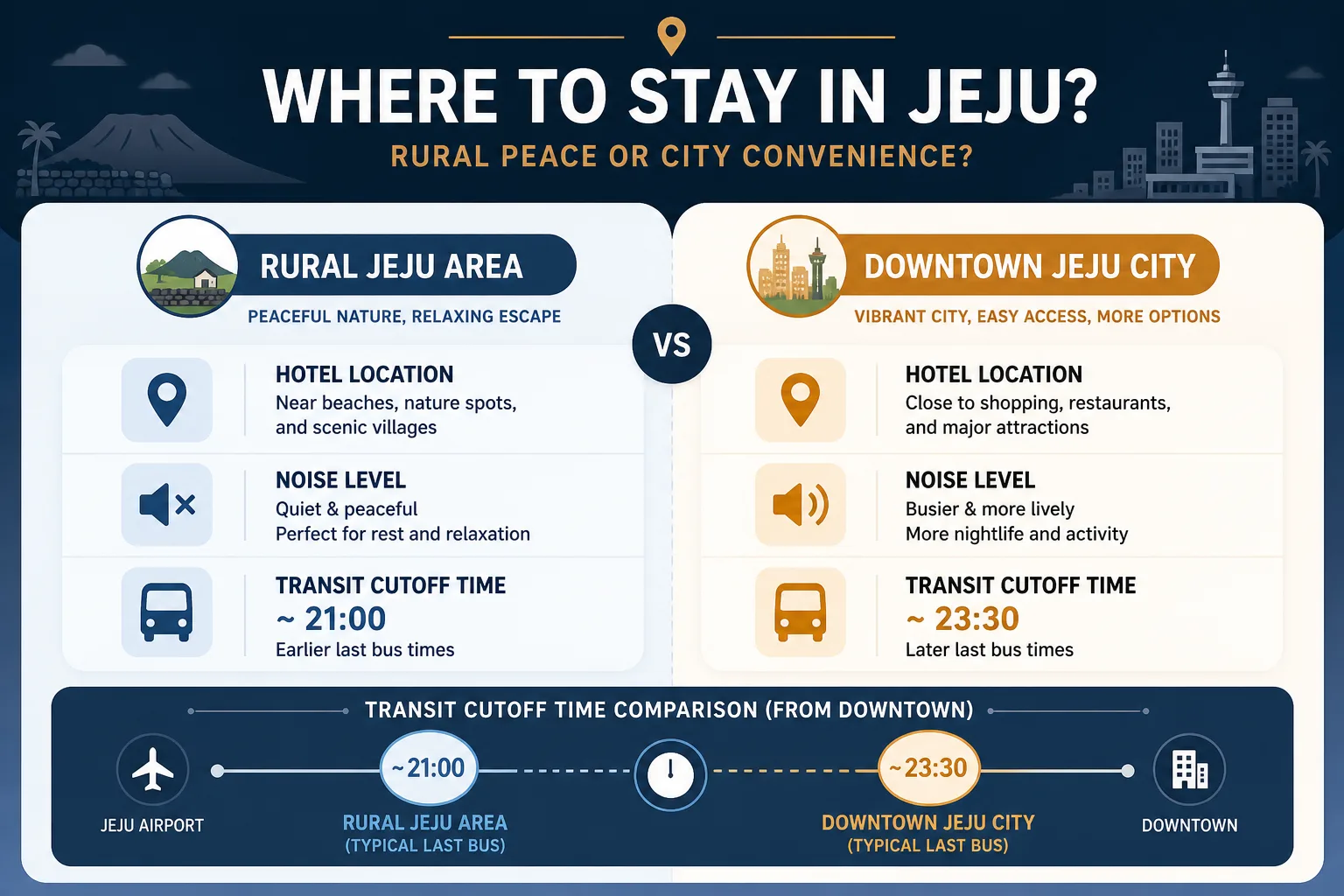 Editorial illustration: A simple decision comparison layout with two labeled columns.
Traveler Type Table
The real decision variable on Jeju is not "is Jeju quiet" in the abstract, it is where you sleep and how you get back there at night. The island is about 73 kilometers east to west, so a wrong hotel location does not just cost you ambiance, it costs you a real commute.
| Traveler type | What they actually need | Jeju fit | Main tradeoff | |---|---|---| | Quiet-night travelers | Low ambient noise, minimal traffic near the hotel | Strong, if based in Gujwa, Pyoseon, Namwon, Aewol, or Hallim | Rural quiet means early-closing restaurants and no late transit | | Couples wanting low-stress evenings | Calm surroundings without needing a packed itinerary | Strong, especially at secluded resorts like Haevichi in Pyoseon | Higher cost, $150 to $300+ per night for that level of seclusion | | Low-stress planners | Predictable logistics, minimal improvisation at night | Moderate, requires planning transport before dark | Bus 201 and 202 both stop before 10 PM, so evenings need a plan in advance | | Travelers wanting both quiet and downtown convenience | Walkable nightlife plus a peaceful room | Weak | Jeju City and Seogwipo core areas exceed safe roadside noise levels in the majority of areas studied |
The pattern is consistent: quiet on Jeju is a location choice, not an island-wide trait. The same trip can feel calm or stressful depending on a single hotel booking decision.
Best for First-Time Visitors
First-time visitors often default to booking near Jeju City or Seogwipo City center because it looks convenient on a map. For quiet-night travelers, that instinct works against the goal. Roadside noise in these urban zones exceeds environmental safety levels in the majority of areas measured, so a first-time visitor chasing both "central" and "quiet" is likely to get neither.
A better first-time approach: pick one quiet base, either east coast (Gujwa-eup, Pyoseon-ri, Namwon-eup) or west/inland (Aewol, Hallim), and structure day trips outward from there. First-timers who also want low stress should rent a car for the trip rather than relying on transit, since it removes the nightly question of how to get home. Couples on a first Jeju trip benefit the most from this setup, since it avoids the common mistake of booking a "central" hotel that turns out to sit on a noisy main road.
Best for Couples
Couples are arguably the best-matched traveler type for a quiet Jeju trip, because the island's quiet pockets are built around slow evenings rather than activity density. A guesthouse or beachfront pension in Gujwa, Namwon, or deep Aewol runs $15 to $75 (20,000 to 100,000) a night and delivers genuine calm, useful for couples on a moderate budget who want a low-stress evening without paying resort prices.
Couples with a higher budget who want zero compromise on quiet can look toward secluded resorts like Haevichi in Pyoseon, in the $150 to $300+ range, which are built specifically for calm, low-traffic surroundings. The tradeoff for couples in either tier is the same: dinner needs to happen earlier than in a city trip, since most rural restaurants and black pork grills close between 7 and 8 PM, and once you are in for the night, you are largely in for the night unless you have a car.
Best for Slow Travelers
Slow travelers, who prefer to settle into a mood rather than check off a list, are well served by Jeju's quiet zones precisely because those areas reward staying rather than moving. A multi-night stay in one village, rather than hotel-hopping around the island, avoids the worst of the friction: repeated late-night transfers on roads that lack consistent street lighting and pedestrian sidewalks.
The mismatch risk for slow travelers is underestimating how early the island winds down outside the cities. A slow traveler who plans a leisurely dinner at 8:30 PM in a rural village will likely find the kitchen already closed. Slow travelers who want the quiet-night experience should shift their whole evening schedule earlier, treating an early dinner and a calm walk before dark as the norm rather than the exception.
Best for Low-Stress Travelers
Low-stress planners want predictability more than anything else, and Jeju can deliver that, but only with the transport question settled in advance. The two main coastal loop buses have early cutoffs: Bus 202 (west coast) leaves Seogwipo for the last time at 9:30 PM, and Bus 201 (east coast) at 9:35 PM. Missing that window in a rural area means falling back on a street taxi, which is difficult to hail past 8 or 9 PM in small villages, or Kakao T, which can be slow or fail to match at night outside urban zones.
The low-stress path is to either rent a car for the trip, so evening plans are not dictated by a bus schedule, or to build the itinerary explicitly around the last bus time and stay close to the route. A local call taxi is a viable backup, but expect a possible 1,000 surcharge and plan for a driver who likely does not speak English. Travelers who treat this as a known constraint, rather than discovering it at 9:40 PM in Namwon, get the low-stress version of Jeju. Travelers who assume Korea's usual late-night transit convenience will apply here get the opposite.
Common Mismatches
The most common regret pattern is booking a "central" Jeju City or Seogwipo hotel expecting both quiet and convenience. Downtown areas carry real roadside noise, with the majority of measured areas in both cities exceeding safe noise levels, so travelers who booked for location convenience often find their room noisier than a typical city hotel back home, not quieter.
The second mismatch is transit assumptions. Travelers coming from mainland Korea or from cities with dense, late-running transit sometimes assume Jeju's buses run similarly late. They do not. A traveler who plans a late dinner out from a rural guesthouse, expecting to bus back at 10 or 11 PM, will find no bus running and a difficult taxi search on unlit rural roads.
The third mismatch is dining expectations. Travelers picturing a relaxed, extended dinner scene in a rural fishing village often do not realize most local restaurants and black pork grills close between 7 and 8 PM outside downtown Jeju City. Arriving hungry at 8:30 PM in Gujwa or Namwon with no car and no backup plan is a specific, avoidable disappointment.
None of these are reasons to avoid Jeju. They are reasons to plan the evening logistics with the same care as the daytime itinerary.
Final Match Recommendation
Choose Jeju for a quiet-night trip if you can commit to one of two setups: a rural base in Gujwa-eup, Pyoseon-ri, Namwon-eup, Aewol, or Hallim paired with a rental car, or a secluded resort in one of those same areas where the property itself absorbs the transport problem. Both couples and low-stress planners get a genuinely calm evening experience this way, and slow travelers get the settled, unhurried atmosphere they are looking for.
Do not choose this plan if you want to walk to dinner after 8 PM without a car, if you are relying on public buses for your entire evening schedule, or if you want a hotel that is simultaneously central to Jeju City nightlife and free of traffic noise. That combination is the one genuine mismatch on this island, and no amount of good planning fully resolves it, since the noise data and the early transit cutoffs are structural, not seasonal.
For most quiet-night travelers, the right call is simple: pick the village, not the city, and treat transport as a decision you make before booking, not after arrival.
FAQ
Is Jeju a quiet destination overall? Not uniformly. Local noise studies found 63% of roadside areas in Jeju City and 67% in Seogwipo City exceed environmental safety noise levels, so downtown and main-road areas are louder than many travelers expect. Quiet exists mainly in specific rural pockets.
Which parts of Jeju are actually quiet at night? Gujwa-eup, Pyoseon-ri, and Namwon-eup on the east coast, along with inland western pockets in Aewol and Hallim, are the quietest areas. These are agricultural and fishing villages, not resort strips.
Can I get back to my hotel late at night without a car? It is risky outside downtown Jeju City. The main coastal buses stop early, last departure from Seogwipo is 9:30 PM for Bus 202 and 9:35 PM for Bus 201, and street taxis are hard to find in villages after 8 or 9 PM. Kakao T matches in rural areas can be slow or fail at night.
Do I need a rental car for a quiet-night Jeju trip? For most quiet rural stays, yes. Without a car, plan your evening around the last bus, or budget extra time and a possible surcharge for a local call taxi, since drivers rarely speak English.
Is Jeju good for couples who just want to relax in the evening? Yes, if the hotel is chosen for surroundings rather than convenience alone. A quiet guesthouse in Gujwa or a resort in Pyoseon suits couples who want calm evenings; a downtown Jeju City hotel does not deliver the same experience even though it is more convenient.