travel-decisions
Is Hallasan Worth the Physical Toll If You Have Knee Pain or Low Stamina?
A practical decision guide to Hallasan's reservation caps, stair-heavy trails, and 8 to 10 hour time cost for hikers with knee pain or low stamina, plus easier Jeju alternatives.
Quick Verdict
Hallasan's summit trails are worth the physical toll only if you can commit to 8 to 10 hours of continuous walking, including several thousand steps on uneven volcanic stone, without stopping the trip's pace for days afterward. If that description does not fit you, the honest answer is no, and that is not a failure of nerve, it is a correct read of what the mountain actually demands.
Choose the Hallasan summit trails (Seongpanak or Gwaneumsa) if:
- You currently hike or walk 15,000+ steps comfortably on a normal day, with no flare-ups afterward.
- Your knees have no history of pain on stairs or downhill walking.
- You can dedicate a full day, arrive early, and accept losing the following day to recovery if needed.
- You are comfortable turning back at a checkpoint if you are behind schedule.
Skip the summit trails, and choose a shorter oreum trail instead, if:
- Stairs or downhill walking already trigger knee pain in daily life.
- You tire noticeably after 2 to 3 hours of continuous walking.
- You are traveling with limited days and cannot afford a full rest day afterward.
- You are attempting Hallasan mainly because it feels like a "must-do," not because the hike itself appeals to you.
The rest of this article explains exactly where that toll comes from, so the decision is based on specifics, not guesswork.
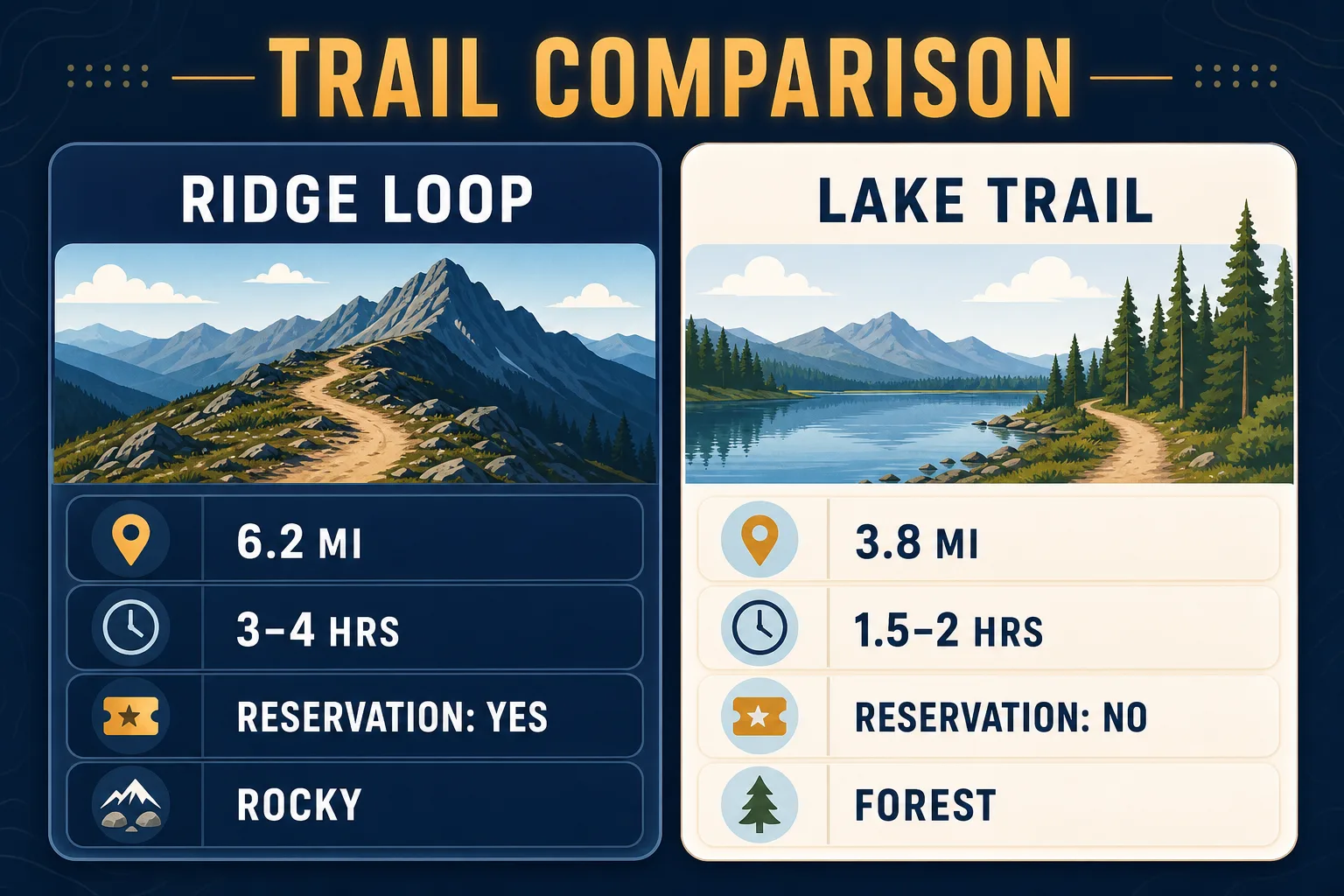 Editorial illustration: A clean simple data comparison layout with short labels for trail names.
Main Friction Problem
Hallasan is not difficult in the way a steep gym incline is difficult. It is difficult because four separate frictions stack on top of each other, and any one of them alone might be manageable, but together they compound.
Strict reservation caps. Reaching the summit crater lake, Baengnokdam, is only possible via two trails, Seongpanak and Gwaneumsa, and both require an advance reservation. Seongpanak allows 1,000 hikers per day and Gwaneumsa allows 500. Reservations open at 09:00 KST on the first business day of the preceding month and fill quickly in peak seasons. This means you cannot decide on a whim to attempt the summit, and you cannot easily reschedule if you wake up on hike day feeling worse than expected.
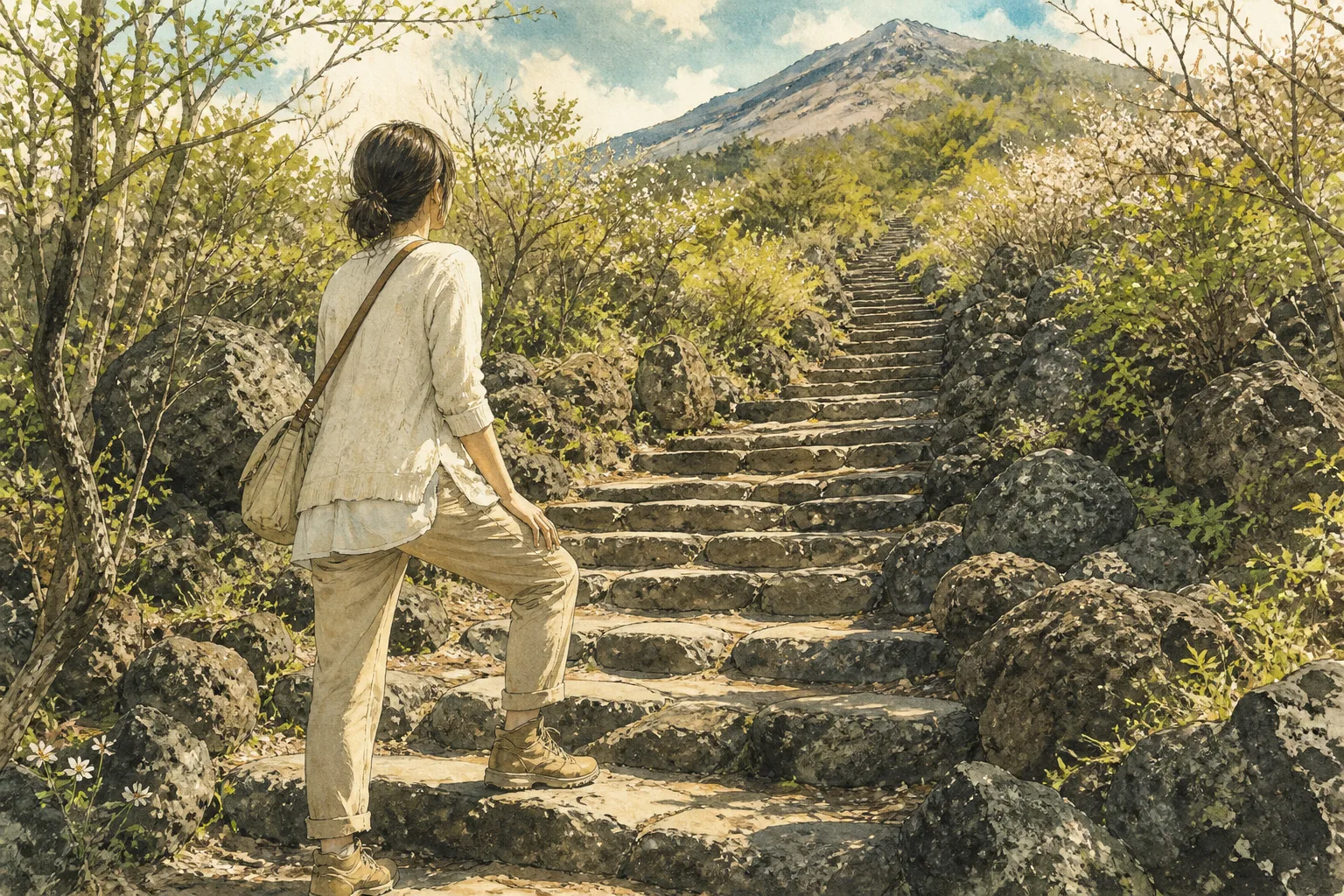
Steep rocky volcanic stairs. Both summit trails involve long stretches of uneven stone steps, not smooth pavement or soft dirt. These steps vary in height and depth, which forces constant small adjustments in stride, something that is far more taxing on knees than a consistent incline.
Joint pain on long descents. The climb up strains muscles, but the descent is where knee pain typically appears or worsens. Coming down thousands of uneven steps for 4.5 to 5 hours, after already being fatigued from the ascent, is the single largest physical cost of this hike. Many first-time regretters report that the pain started in the last third of the descent, not the climb.
8 to 10 hour time commitment. Seongpanak's round trip runs about 9 hours total. Gwaneumsa's runs about 10 hours total. That is not a morning activity you fit around other Jeju plans, it is the entire day, and often it affects how much walking you can comfortably do the day after.
None of these frictions are dealbreakers in isolation. A strong hiker with no reservation issues barely notices the cap. Someone with healthy knees barely notices the stairs. The problem is specifically for readers who already carry knee sensitivity or lower stamina, because all four frictions land on the same vulnerability at once.
Friction Table
The honest way to evaluate fit is to look at the real variables side by side, not at Hallasan's scenery or reputation.
| Decision variable | Seongpanak / Gwaneumsa (summit) | Yeongsil / Eorimok (non-summit) |
|---|---|---|
| Reservation required | Yes, capped at 1,000 / 500 per day, booked a month ahead | No advance reservation needed |
| One-way distance | 9.6 km (Seongpanak) or 8.7 km (Gwaneumsa) | 5.8 km (Yeongsil) or 6.8 km (Eorimok) to Witse Oreum |
| Total time commitment | About 9 hours (Seongpanak) or 10 hours (Gwaneumsa) | 2 to 2.5 hours (Yeongsil) or 2.5 to 3 hours (Eorimok) |
| Terrain for knees | Long uneven volcanic stone steps on both ascent and descent | Yeongsil: steep stairs briefly, then flat boardwalk. Eorimok: 2.4 km of uneven stone steps on the lower descent |
| Recovery day needed | Often yes, especially for low-stamina travelers | Rarely, unless you are very unaccustomed to walking |
| Reaches summit crater (Baengnokdam) | Yes | No |
| Booking flexibility if you feel unwell that morning | None, missed slots are lost | Full flexibility, walk-up any day |
The table makes the real tradeoff visible: the summit trails cost roughly four times the time and carry a fixed booking risk, in exchange for reaching Baengnokdam. If seeing the crater lake is not a personal priority, that trade rarely favors a knee-pain or low-stamina traveler.
Who Will Feel It Most
Not every reader in this situation faces the same risk. The friction lands hardest on a few specific profiles.
Occasional walkers who hike a few times a year, rather than regularly, tend to underestimate how much a 9 to 10 hour day differs from a normal day trip. The fatigue curve is not linear, hour 7 feels much harder than hour 3, and that is exactly when the descent's uneven steps demand the most control.
Seniors and travelers with any prior knee issue face the compounding problem directly: descent-related knee strain is cumulative, so the last 2 hours of stone steps often hurt more than the first 2 hours, even though the terrain is objectively similar. This is a physiological pattern, not a motivation problem.
Time-restricted tourists on a short Jeju trip face a different kind of friction. Losing a full day to the hike, plus a partial recovery day, can consume 20 to 30 percent of a short 4 to 5 day itinerary. For someone trying to also see Jeju's coast, cafes, or other regions, that opportunity cost is real even if the knees hold up fine.
Travelers who feel social or online pressure to "complete" Hallasan because it is Jeju's signature hike are the group most likely to override their own body's signals. That pressure is worth naming directly: skipping the summit trail is not skipping Jeju, and it is not a lesser trip.
How to Reduce the Friction
If you still want to attempt a Hallasan trail, several concrete adjustments lower the risk without pretending the difficulty away.
For the reservation caps: Book the moment slots open at 09:00 KST on the first business day of the preceding month, and set a calendar reminder in advance, since popular dates fill within the same day. Build a backup plan (a non-summit trail) into your itinerary in case you cannot get a summit slot at all.
For the steep rocky volcanic stairs: Use trekking poles to redistribute load away from the knees on both ascent and descent. Choose shoes with real ankle support and grip, not casual sneakers. Practice descending stairs deliberately in the weeks before the trip, since descent-specific muscle control matters more than general fitness.
For joint pain on long descents: Pace the ascent slower than feels necessary so leg muscles are less fatigued going into the descent. Take short seated breaks at shelters rather than pushing through, since a knee that is asked to work while already fatigued is where most pain reports originate. Consider a knee brace or compression sleeve if you have any history of joint sensitivity.
For the 8 to 10 hour time commitment: Start at the earliest allowed entry time so you are not rushing checkpoint cutoffs, which forces faster, harder-impact descending. Plan nothing else for that day or the following morning, and treat the day after as a low-walking recovery day by default, not as a contingency.
If, after reading this list, the adjustments feel like they add more stress than the hike is worth, that itself is useful information about fit.
Better Alternatives
For readers whose honest answer is "this is not worth the toll," Jeju does not require choosing between Hallasan or nothing. Three specific substitutes address the same "signature Jeju hike" instinct without the same physical cost.
The Yeongsil Trail reaches Witse Oreum in 2 to 2.5 hours one-way, needs no reservation, and switches to flat wooden boardwalk after an initial steep stair section, meaning most of the walk is far gentler on the knees than anything on the summit trails. Note that Bus 240 drops you 2.5 km from the actual trailhead, an extra 40-minute walk, so factor that into your time budget or arrange a taxi closer to the start.
The Eorimok Trail also reaches Witse Oreum, in 2.5 to 3 hours one-way, with no reservation needed. It does include a 2.4 km lower descent of uneven volcanic stone steps, so it is not knee-friendly throughout, but the total exposure to hard terrain is far shorter than Seongpanak or Gwaneumsa. Bus 240 drops passengers 1.2 km from this trailhead, about a 15 to 20 minute walk on a paved path, which is a milder approach than Yeongsil's.
The Eoseungsaengak Trail, starting near the Eorimok Visitor Center, is just 1.3 km and takes about 30 minutes, making it a realistic option for travelers who want a genuine Hallasan-area walk without any meaningful physical toll at all.
For travelers who decide the mountain is not the right fit this trip, Jeju's coastal walks, oreum with vehicle access, and shorter nature trails let you keep the day's pace light while still spending it outdoors. The point is not to avoid Hallasan out of caution, it is to match the specific trail to what your body can handle without turning the rest of the trip into recovery time.
Decision Checklist
Use this before booking any Hallasan reservation slot.
- I can currently walk continuously for 4+ hours without knee pain appearing.
- Downhill walking or stairs do not currently trigger joint discomfort for me.
- I can commit a full day (8 to 10 hours) plus tolerate losing part of the next day to recovery.
- I have checked the reservation booking date and set a reminder for 09:00 KST.
- I have a backup non-summit trail planned in case reservations are full or I feel unwell that morning.
- I own or can rent trekking poles and proper grip footwear before the trip.
- I am choosing this hike because I want to, not only because it feels obligatory.
- If Gwaneumsa is my planned trail, I have confirmed the Samgakbong-to-Baengnokdam closure dates do not affect my visit.
If you check fewer than six of these boxes, a non-summit trail is very likely the better choice for this trip.
FAQ
Can I do a shorter version of the Hallasan summit trails? No. Both summit-eligible routes, Seongpanak and Gwaneumsa, require a full round trip to reach Baengnokdam crater, and rangers check reservation times at checkpoints. There is no official half-route option that still counts as summiting. If you only want a partial walk, treat one of the non-summit trails as the actual goal instead of a fallback.
Are there bathrooms and rest points on the way up? Seongpanak and Gwaneumsa have shelters at intervals with restrooms and water, but the spacing between them is long, often over an hour of walking. On the shorter Yeongsil and Eorimok trails, rest points are closer together, which matters more for anyone who needs frequent short breaks rather than fewer long ones.
Is the descent really harder on the knees than the ascent? Yes, for most people with existing knee pain. Climbing uses muscle strength, but descending on uneven volcanic stone steps loads the knee joint with repeated impact over hours, especially in the final descent stretch when leg muscles are already fatigued. This is the single biggest reason low-stamina or joint-pain travelers regret attempting the summit trails.
Will I be turned away if I look slow or unfit? Rangers do not assess fitness by appearance, but they do enforce checkpoint cutoff times strictly. If you have not reached a set checkpoint by the posted time, you may be required to turn back regardless of how you feel. This is a time-based rule, not a judgment call, so pace planning matters more than perceived fitness.
Does bad weather change the difficulty for someone with knee pain? Yes, meaningfully. Wet volcanic stone becomes slick, and wind at higher elevation makes balance harder on already uneven steps. If you have any joint instability, a rainy or high-wind forecast is a reasonable reason to postpone or switch to a lower, more sheltered trail rather than push through.