travel-decisions
Is Cycling Jeju's Coastal Path Realistic for Casual Bikers Who Hate Strong Winds and Luggage Hauling?
A traveler-fit breakdown of Jeju's coastal cycling path for casual riders worried about wind, hills, and hauling luggage, with a staged plan and a clear verdict by traveler type.
Quick Verdict
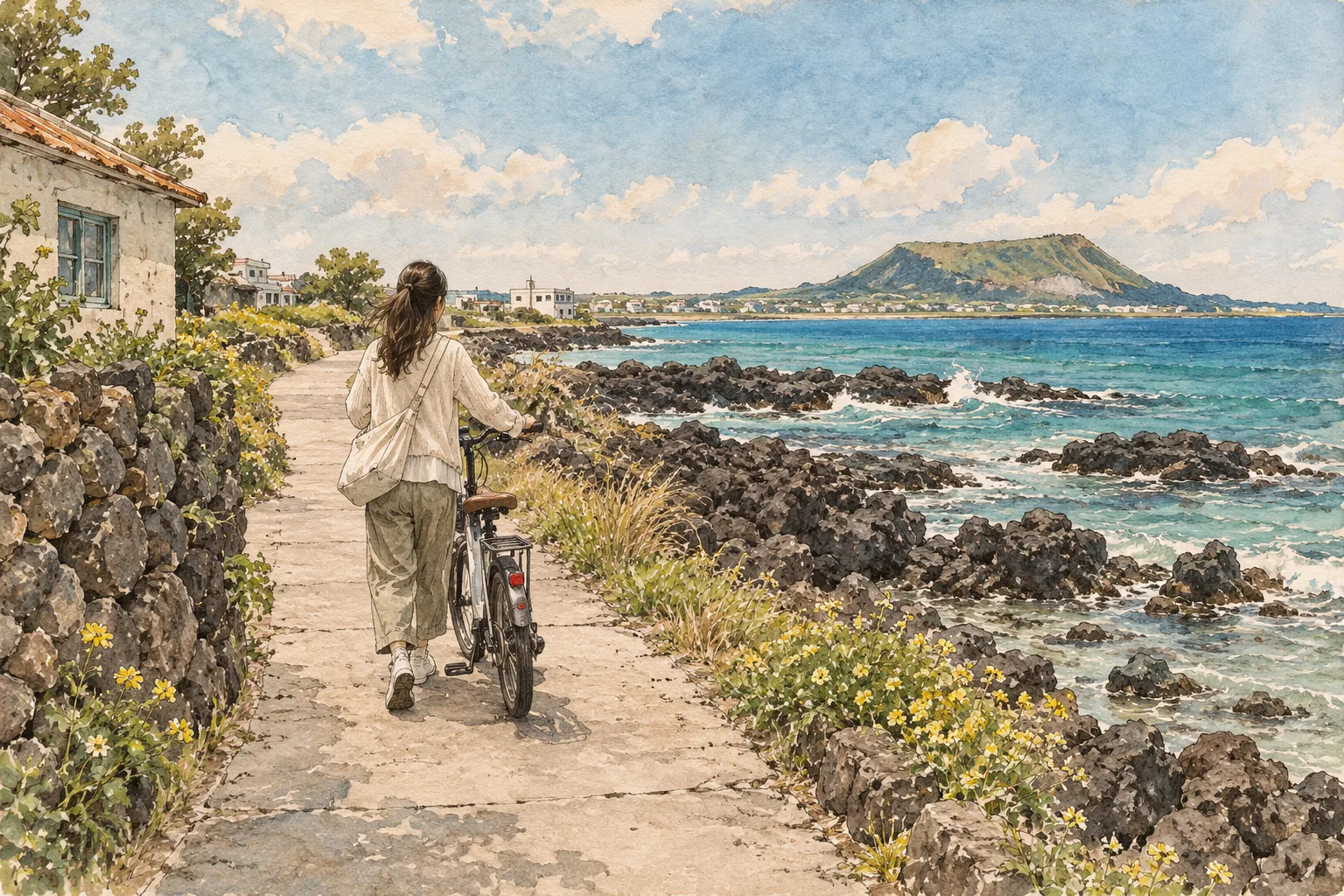
Yes, but only on a scaled-down version of the plan most people picture. Jeju's coastal path is realistic for casual bikers who ride short, charged, mostly-flat segments, not the full 234 km loop in one continuous push. Treat the ring road as a menu of day-rides, not a single itinerary.
Strong fit: slow travelers and value-conscious riders who pick one or two gentle stretches (the eastern Gimnyeong-to-Pyoseon section is the easiest), confirm e-bike range and charging before booking, and carry or store luggage with a verified plan instead of assuming it is automatic.
Weak fit: anyone assuming the entire loop is flat, anyone planning a 60-80 km day on an e-bike without confirming real-world range and a charging stop, and anyone booking multi-night point-to-point travel while assuming rental-shop bag storage covers overnight stays away from that shop.
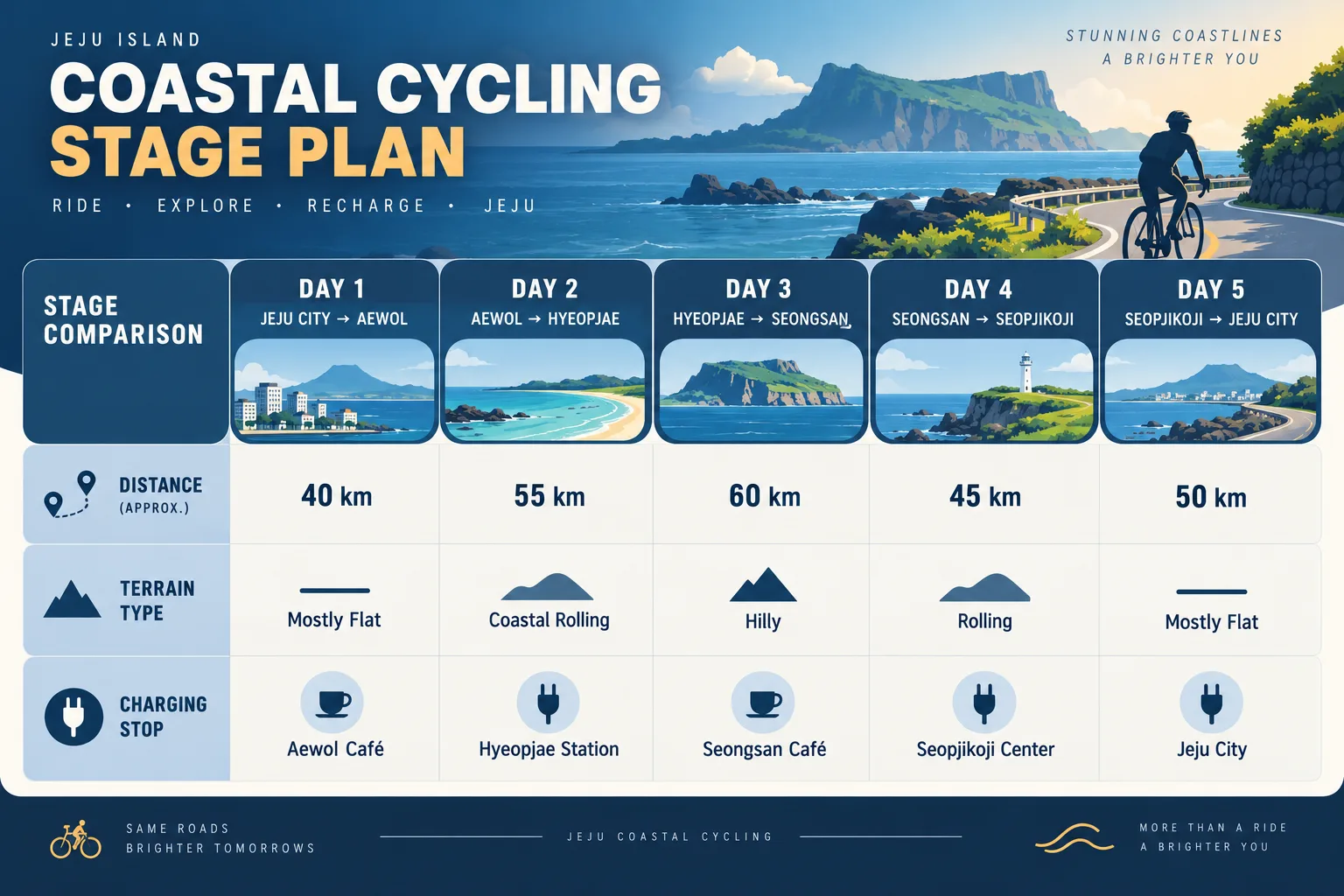 Editorial illustration: A simple flat comparison table graphic showing a multi-day Jeju coastal cycling stage plan.
Traveler Type Table
The honest decision variables are terrain by section, e-bike range versus daily distance, and how luggage actually moves between nights. These three variables, not general fitness, decide whether the trip feels manageable or miserable.
| Traveler type | Terrain handling | Realistic daily distance (e-bike) | Luggage approach | Overall fit |
|---|---|---|---|---|
| Active traveler (fit, wants structure) | Can push through the southern climb and western hills with assist power | 25-30 km per charge, matching the documented BESV PS1 single-charge max; a different model's range needs separate verification, and longer days need a confirmed charger swap or a second rental | Carries a light overnight bag or arranges verified transfer between bases | Strong fit with route planning |
| Adventure seeker (wants challenge) | Will seek out the southern climb and exposed western stretches on purpose | Same 25-30 km ceiling as the documented BESV PS1 rental, unless the shop confirms a different model's range; treat anything past that as unverified until confirmed | Comfortable improvising, but still needs to confirm storage per stop, not assume it | Strong fit if wind- and range-ready, weak fit if underprepared |
| Slow traveler (wants mood over mileage) | Sticks to the eastern Gimnyeong-Pyoseon stretch and similar flat sections, skips the southern climb | 20-25 km, with a safety margin below the documented BESV PS1's roughly 30 km max charge | Returns to one base each night, or stores bags at the same rental shop for the loop | Strong fit |
A sample three-day stage plan for a casual, non-athletic rider, based out of Gimnyeong: Day 1, ride out along the flat eastern coastal path for roughly 10-12 km, then turn around and return to Gimnyeong for a 20-25 km round trip, well inside the documented BESV PS1's roughly 30 km single-charge range; Day 2, repeat the same out-and-back in the opposite direction along the coast, then recharge the bike overnight at the base; Day 3, a short test ride of 10-15 km round trip from the same base, staying on flat ground and skipping the western hills and southern climb entirely, since reaching those sections would require a separate rental or transfer from this east-coast base. Riding out-and-back from one fixed base, rather than a point-to-point route, means luggage stays at the base the whole time and the bike recharges overnight in the same place.
Best for First-Time Visitors
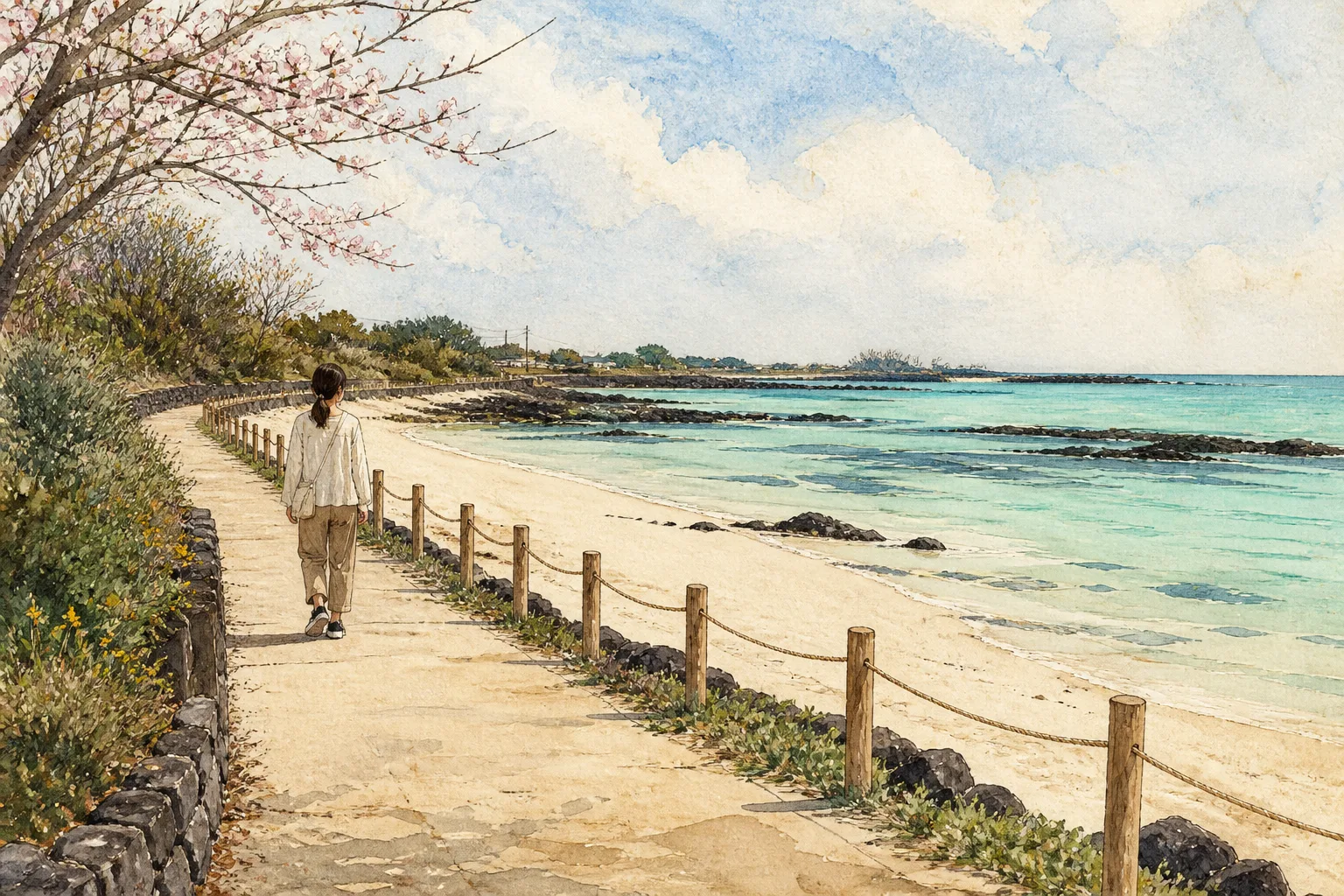
A first-time visitor who has never cycled Jeju's coast should treat this as a one-section sampler, not a full-island commitment. Pick the eastern Gimnyeong-to-Pyoseon stretch, rent an e-bike, and skip the western hills and southern climb entirely on a first trip. This avoids the common mistake of booking a multi-day loop before confirming how the wind, the hills, or the battery actually behave in person.
Active travelers taking their first trip usually do fine here because they are willing to turn back early if a section gets hard. Adventure seekers on a first visit sometimes commit to the full loop before testing their e-bike's real range, which is the riskiest combination on this island. Slow travelers on a first visit are the safest bet, since a short, flat test ride matches how they already like to travel.
Best for Couples
Couples should agree on terrain and distance before booking, not during the ride. One partner wanting to tackle the southern climb while the other wants a flat coastal cruise is a common source of mid-trip tension, especially once battery range starts running low on one bike and not the other.
Active-traveler couples who both accept the documented BESV PS1's roughly 30 km single-charge ceiling (or confirm their own bike's range) tend to do well, since they can agree on a realistic target within that range instead of improvising a longer day. Adventure-seeker couples should discuss the western hills and southern climb specifically, because pushing a low-charge e-bike uphill is a bad surprise for either partner. Slow-traveler couples are the strongest fit, since the flat eastern stretch and a shared single-base plan keep both people comfortable and both batteries charged overnight.
Best for Slow Travelers
This is the traveler type the route suits best, specifically the eastern Gimnyeong-to-Pyoseon section. Slow travelers already prefer short days and no fixed mileage target, which matches a 20-25 km flat ride that stays well inside a single e-bike charge, with margin below the documented BESV PS1's roughly 30 km max. Returning to one base each night also solves the luggage question without needing any special transfer arrangement.
Active travelers who deliberately slow themselves down also do well under this approach. Adventure seekers can use the slow-traveler plan as a fallback on a bad-wind or low-battery day rather than forcing the full loop regardless of conditions. For this route, "slow" is less a traveler label and more a working risk-management strategy.
Best for Low-Stress Travelers
Low-stress travelers who want an easy, businesslike trip need three things confirmed before departure: an e-bike with verified real-world range, a charging or swap plan if the day's distance approaches that range, and a specific answer from the rental shop about where bags go overnight. None of these take long to check, and confirming them in advance is what actually makes this trip low-stress.
Active travelers who want predictability should pre-book e-bikes and ask the shop directly about charging options rather than deciding day-of. Adventure seekers chasing a low-stress version of this trip should pick October over winter and stay off the southern climb on their first attempt. Slow travelers already match the low-stress profile by default, since a one-base, flat-section plan absorbs a bad day without derailing the trip.
Common Mismatches
The most common disappointment comes from travelers who picture the entire coastal ring road as flat and easy, based on photos from the gentle eastern stretch, and then hit the western hills or the southern climb unprepared. This mismatch gets worse in January and February, when persistent, sharp winds turn even the flat sections into a grind on top of the existing hills elsewhere on the loop.
A second mismatch is the rider who assumes an e-bike will comfortably cover 70-80 km a day because it has a motor, without checking that at least one documented rental model, the BESV PS1, has a maximum of roughly 30 km on a full charge. Riders who skip this check either run out of battery mid-route on a hill, or burn out their own legs finishing the day on pedal power alone.
A third mismatch is the rider who assumes luggage storage is solved everywhere just because one Jeju rental shop is known to store bags for the rental period. That coverage applies to leaving bags at the origin shop, not to carrying belongings between overnight stops on a multi-night, point-to-point route. Riders who do not confirm this with their specific shop sometimes arrive at a second town with no plan for their bag.
| Mismatch pattern | Why it causes regret |
|---|---|
| Assuming the full 234 km loop is flat | Western hills and a major southern climb are skipped in planning, then hit unprepared |
| Planning 70-80 km e-bike days without checking range | The documented BESV PS1 tops out at roughly 30 km per charge; other models may differ, but unverified range means a midday battery failure on a hill |
| Assuming all rental shops store luggage overnight at every stop | Origin-shop storage does not equal multi-night, point-to-point luggage handling |
| Booking in January or February expecting calm conditions | Persistent, sharp winds stack on top of existing hills and drain battery faster |
Final Match Recommendation
Choose this option if you are a slow traveler, a flexible active traveler, or an adventure seeker willing to stage the route into short, charged segments and verify both terrain and luggage logistics by section rather than assuming the whole loop behaves like the easiest part. Pair that with a confirmed e-bike range, a charging plan for any day near that range limit, and a specific luggage answer from your rental shop.
Skip, or at least redesign, this plan if you intend to ride the full loop as one continuous multi-day push without a staged distance plan, if you are not willing to confirm real-world e-bike range before committing to daily mileage, or if you are booking multi-night stays in different towns without first confirming how your bags will get there. Also reconsider timing if your trip falls in January or February and you are not prepared to shorten routes around wind.
FAQ
Is the whole 234 km coastal loop flat and beginner-friendly?
No. Only selected sections, such as the eastern stretch between Gimnyeong and Pyoseon, are genuinely gentle and beginner-friendly. The western side has repeated hills, and the southern coast includes a substantial climb, so treat the full loop as mixed terrain, not one flat ring road.
Can an e-bike actually cover a full day of coastal riding?
Only if you plan around its range. One documented rental example, the BESV PS1, has a maximum full-charge range of roughly 30 km, so a 60-80 km day needs a mid-route charging stop, a battery swap, or a shorter distance target. Confirm the real-world range and charging options with the rental shop before you build a daily mileage plan.
Do I have to carry my luggage while cycling between towns?
It depends on your plan, and you should confirm this directly with your rental shop. At least one Jeju rental provider stores bags at its own shop for the rental period, which covers a loop that returns to that same shop. It does not automatically cover overnight stays elsewhere, so for a multi-night point-to-point trip, carry a small overnight bag, book one base and do day loops from it, or verify a separate luggage transfer service before you commit to the route.
When is the best time to attempt this for a first casual attempt?
October is generally considered the best month, with clear skies, comfortable temperatures, and low typhoon risk. Avoid January and February if possible, since persistent, sharp winds in those months make even flat eastern sections tiring.
Can slow travelers do this without feeling rushed or overextended?
Yes, if they stick to short, charged, mostly flat segments rather than chasing the full loop. A slow traveler who rides 20-25 km a day on the eastern coast, recharges overnight, and skips the southern climb will have a far better experience than one who tries to finish the ring road in three or four days.