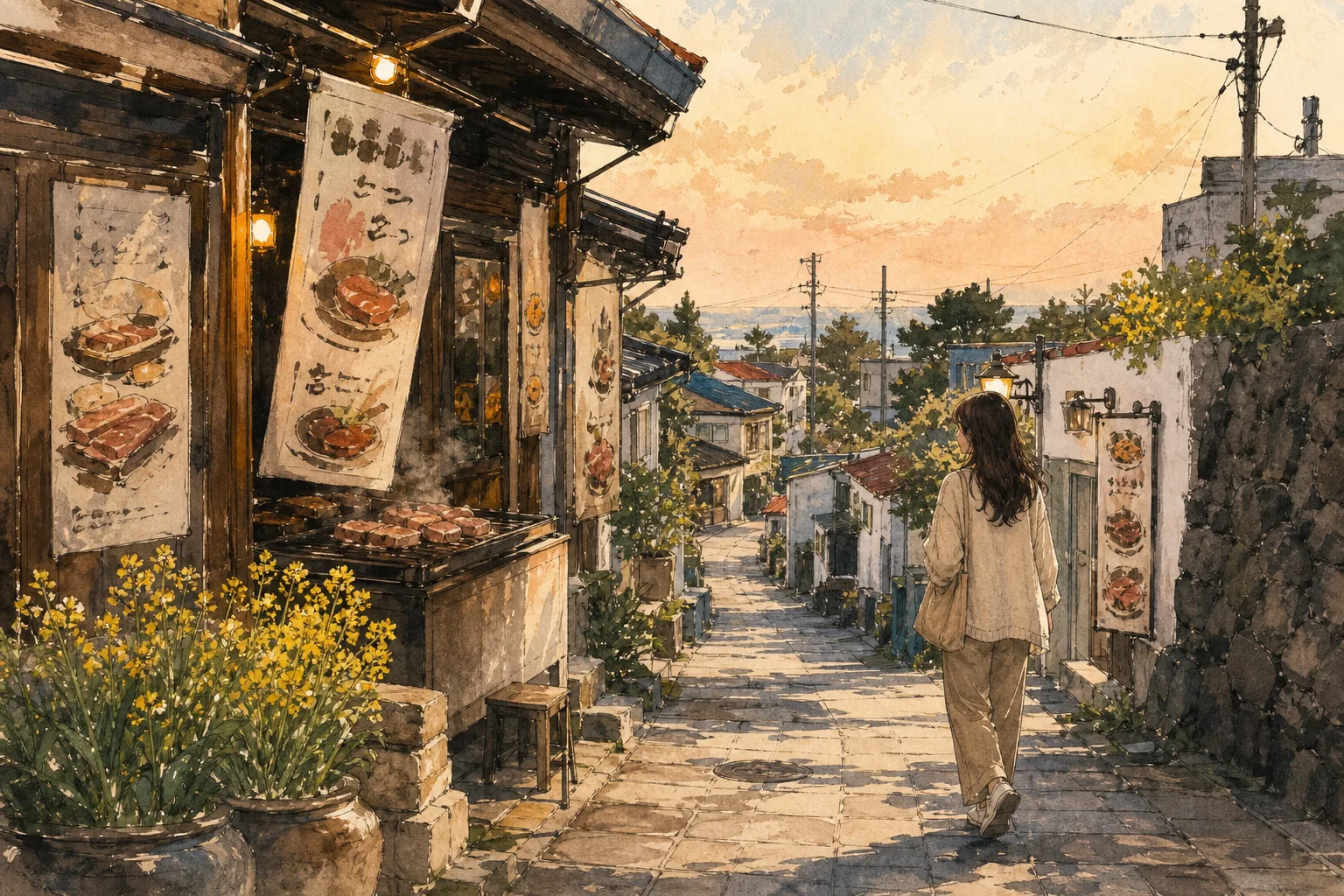
travel-decisions
Is Jeju Worth It If You Care More About Atmosphere Than Landmarks?
A decision guide for travelers who value mood and wandering over checklists. See who Jeju actually fits, who tends to regret it, and how to plan around atmosphere.
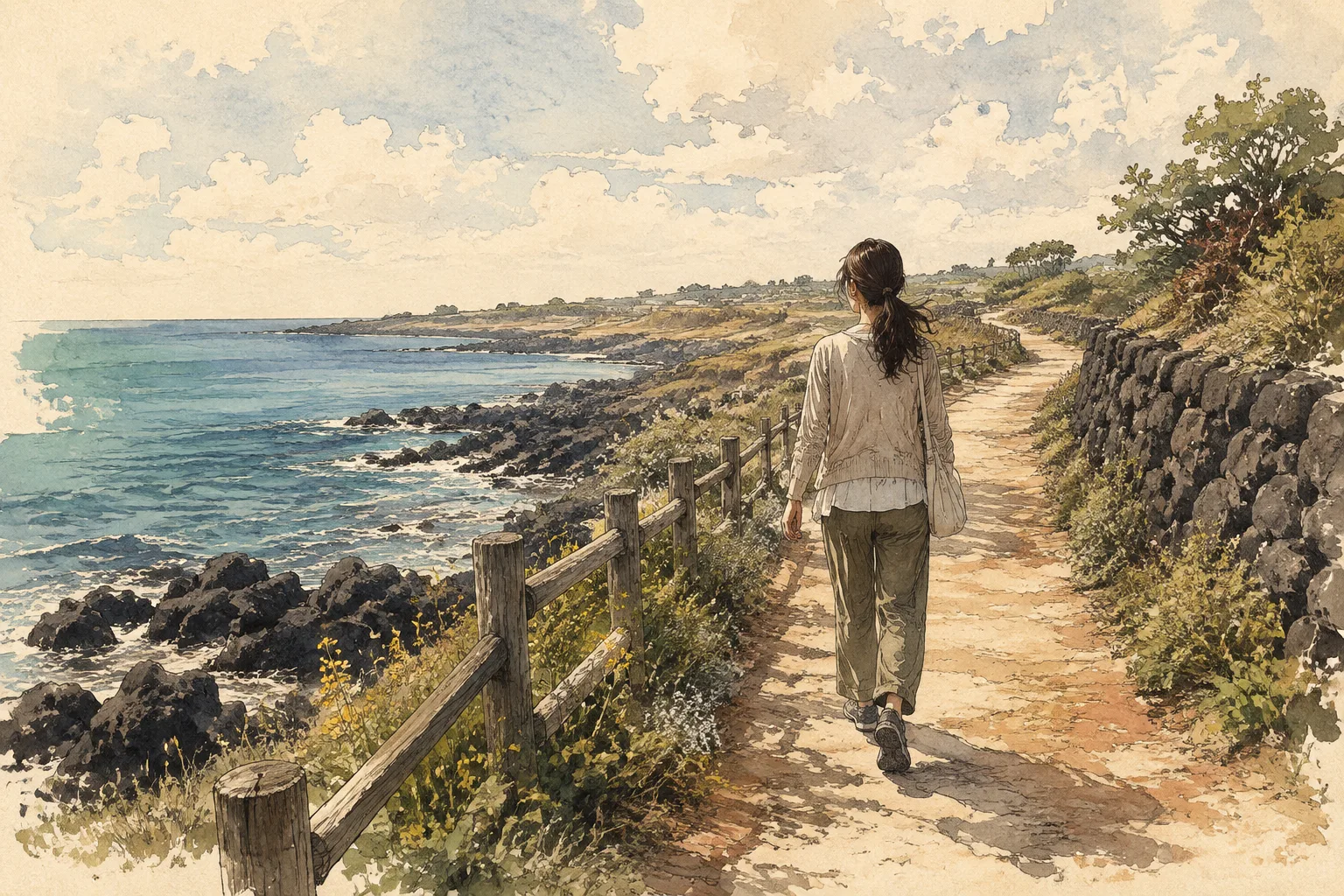
Quick Verdict
Jeju is worth it if your idea of a good trip is a quiet coastal walk and a slow coffee, not a list of sights to photograph. It works well for travelers who like wandering without a fixed plan, who notice light and texture more than famous names, and who are fine skipping crowded viewpoints. It works poorly for travelers who need each day to feel "checked off" against a landmark list, because Jeju's landmarks are spread out and thin compared to a city like Kyoto or Seoul.
Choose Jeju if you are drawn to caf towns, coastal trails, and small farming villages more than ticket booths and photo queues. Skip it, or at least reset your expectations, if you are the kind of traveler who feels unsettled without 3 to 4 "major" sights per day. The short version: Jeju rewards presence over collection.
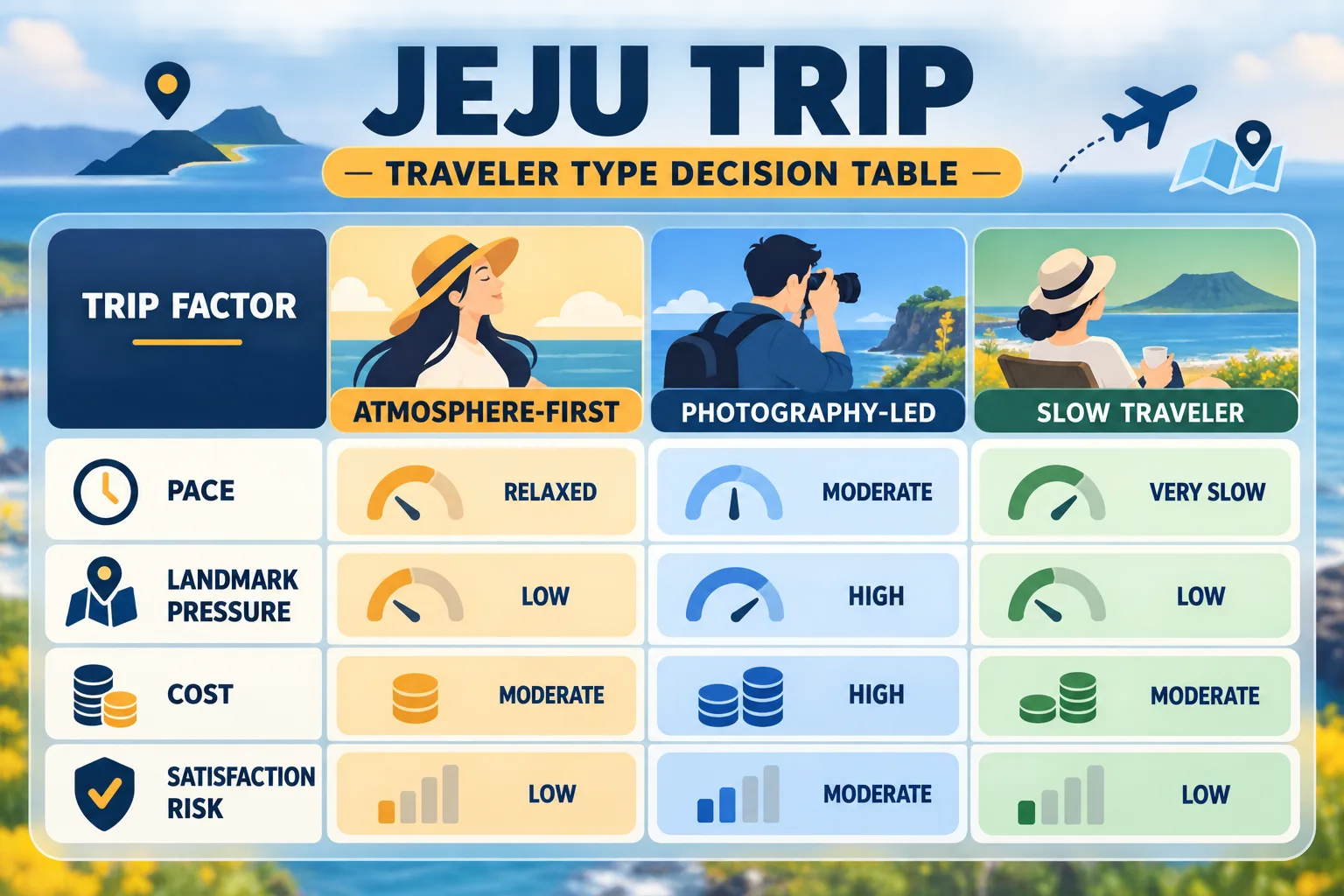 Editorial illustration: A simple decision table graphic comparing three traveler types (atmosphere-first.
Traveler Type Table
Jeju's fit is not really about age or travel style labels. It comes down to what you need a day to contain in order to feel like the trip worked. The table below breaks that down by real behavior.
| Traveler type | What they actually want from a day | Jeju fit | Main tradeoff |
|---|---|---|---|
| Atmosphere-first travelers | A mood to sink into, not a schedule | Strong | Fewer "proof" moments, more unstructured time that can feel aimless at first |
| Photography-led travelers | Specific compositions and light, not landmark counts | Strong to moderate | Best light needs patience and repeat visits to the same coastal spot, not one quick stop |
| Slow travelers | Long stretches in one area, minimal transit switching | Strong | Car dependence outside towns limits how "slow" you can go without planning routes |
| Landmark-first travelers | A checklist of named sights completed each day | Weak | Jeju's marquee sights are spread across the island and thin compared to landmark-dense cities |
| Low-stress planners wanting a fixed itinerary | Predictable timing, minimal improvisation | Moderate | Weather and trail closures (like Hallasan's Gwaneumsa route) force last-minute changes |
The common thread for a strong fit: you are comfortable with a day that has no single "highlight," because the highlight is the walk itself.
Best for First-Time Visitors
First-time visitors to Jeju often arrive with a landmark list copied from a blog. That list usually disappoints them, because Jeju's landmarks are real but modest compared to what a first Seoul or Tokyo trip delivers. Atmosphere-first travelers avoid this trap entirely by planning around neighborhoods instead of names.
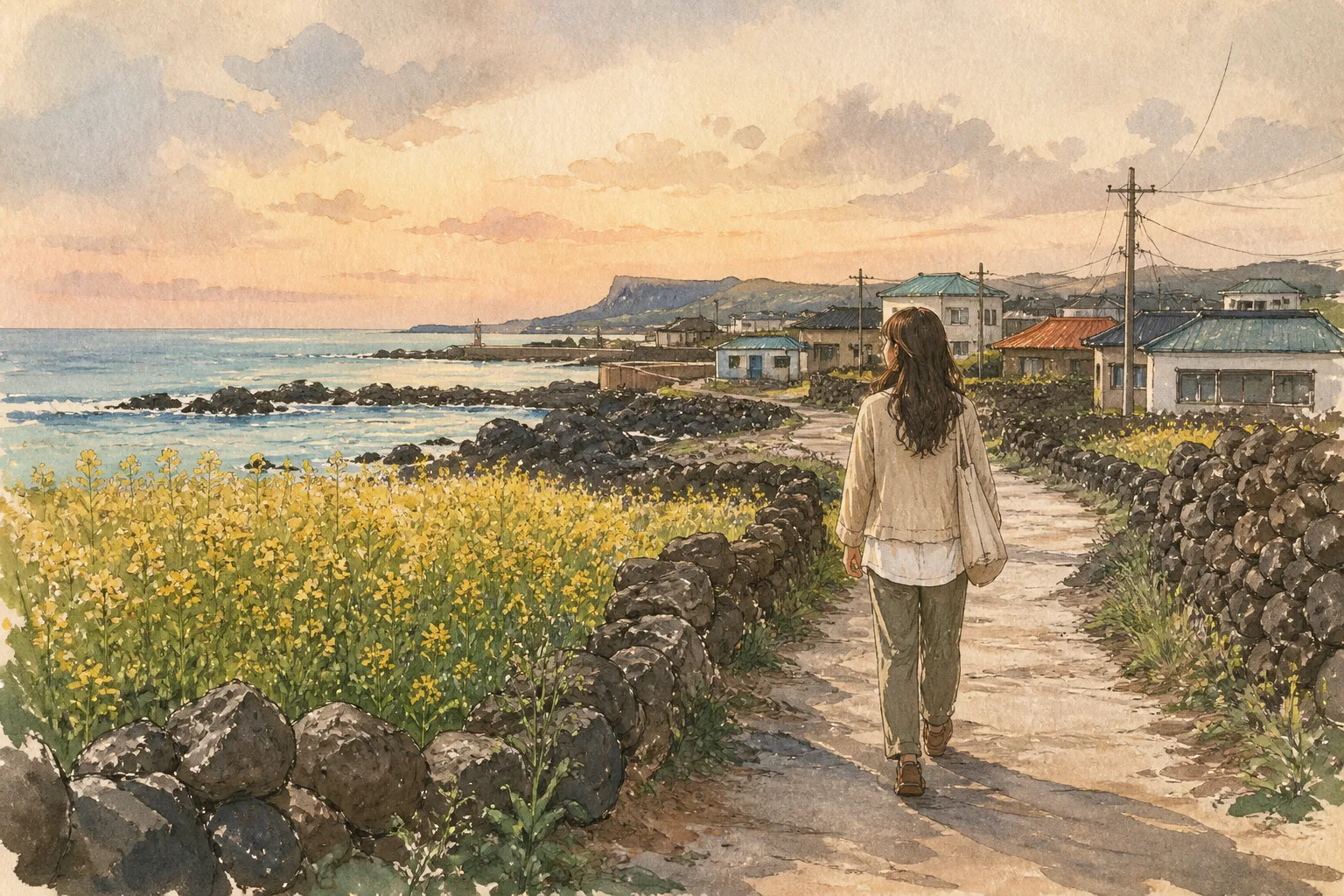
Photography-led first-timers do better here than they expect, because Jeju's value is in repeatable, unhurried scenes: coastal light, stone walls, canola fields in season. A single quick stop rarely produces the shot; a slower first visit does. Slow travelers get the smoothest first trip of the three, since they are not measuring the island against a checklist to begin with.
The practical risk for any first-timer: underestimating how much a car changes the experience. Renting one requires a physical international driving permit, a valid home license, and a physical credit card in the driver's name, since digital IDPs and debit cards are not accepted. Without meeting those conditions, a first-timer is stuck relying on buses and taxis, which narrows how far off the main routes they can wander.
Best for Couples
Couples who want a quiet, low-pressure trip together tend to do well on Jeju, especially atmosphere-first pairs who are happy sharing a coastal walk with no agenda. The island's slower pace suits conversation and unstructured time in a way that a landmark-dense itinerary does not. Neither partner has to push the other through a list.
Photography-led couples find Jeju workable if both people are patient with each other's pace at a scenic stop; one wants five minutes, the other wants twenty. That mismatch is manageable here because there is rarely a queue forcing you to move on. Slow-traveling couples get the best outcome of the three, since a relaxed shared pace is the whole point.
Couples chasing a landmark-heavy honeymoon-style itinerary should recalibrate before arriving. Jeju is a better fit for a mellow, walk-and-talk trip than for a "see everything" romantic checklist.
Best for Slow Travelers
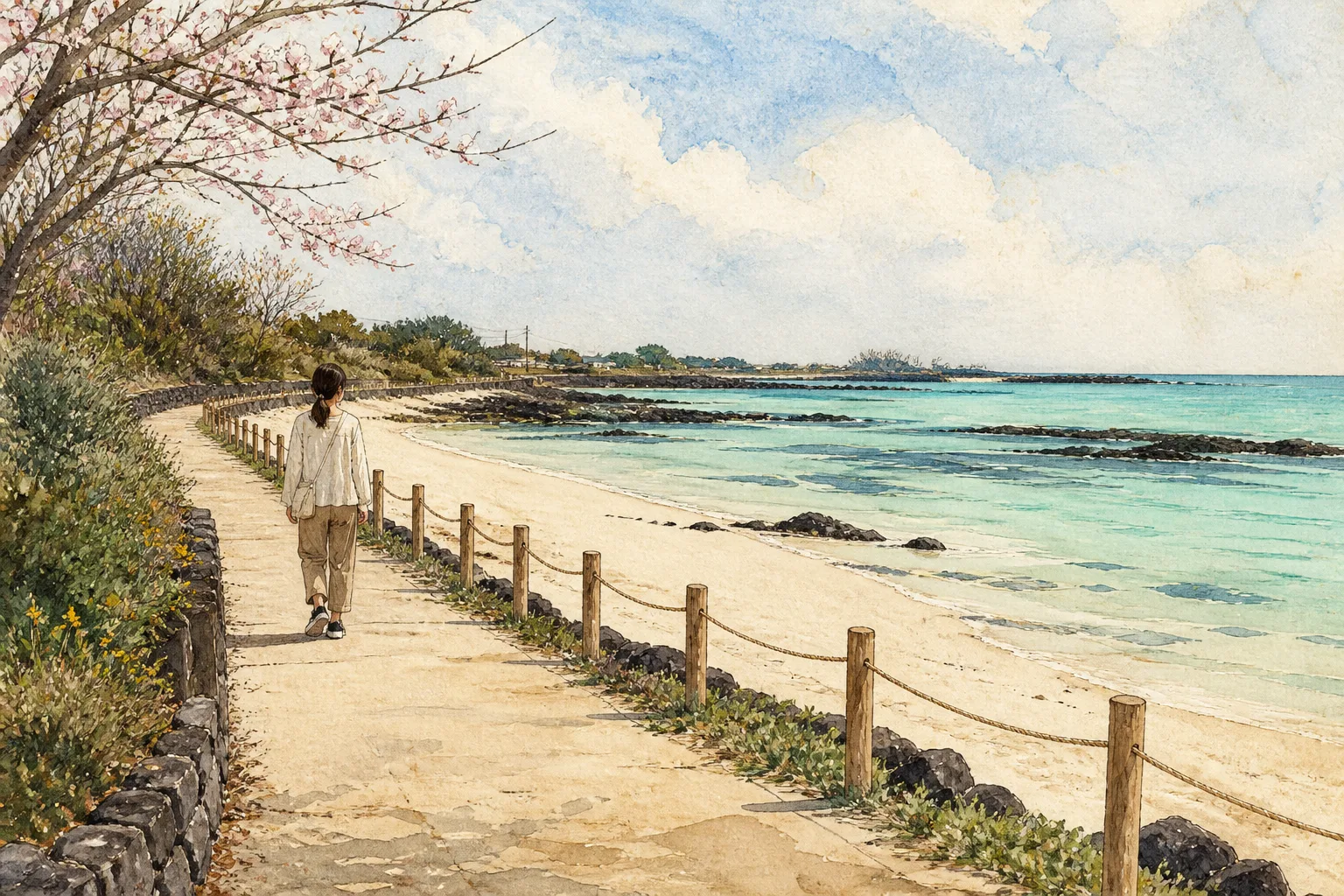
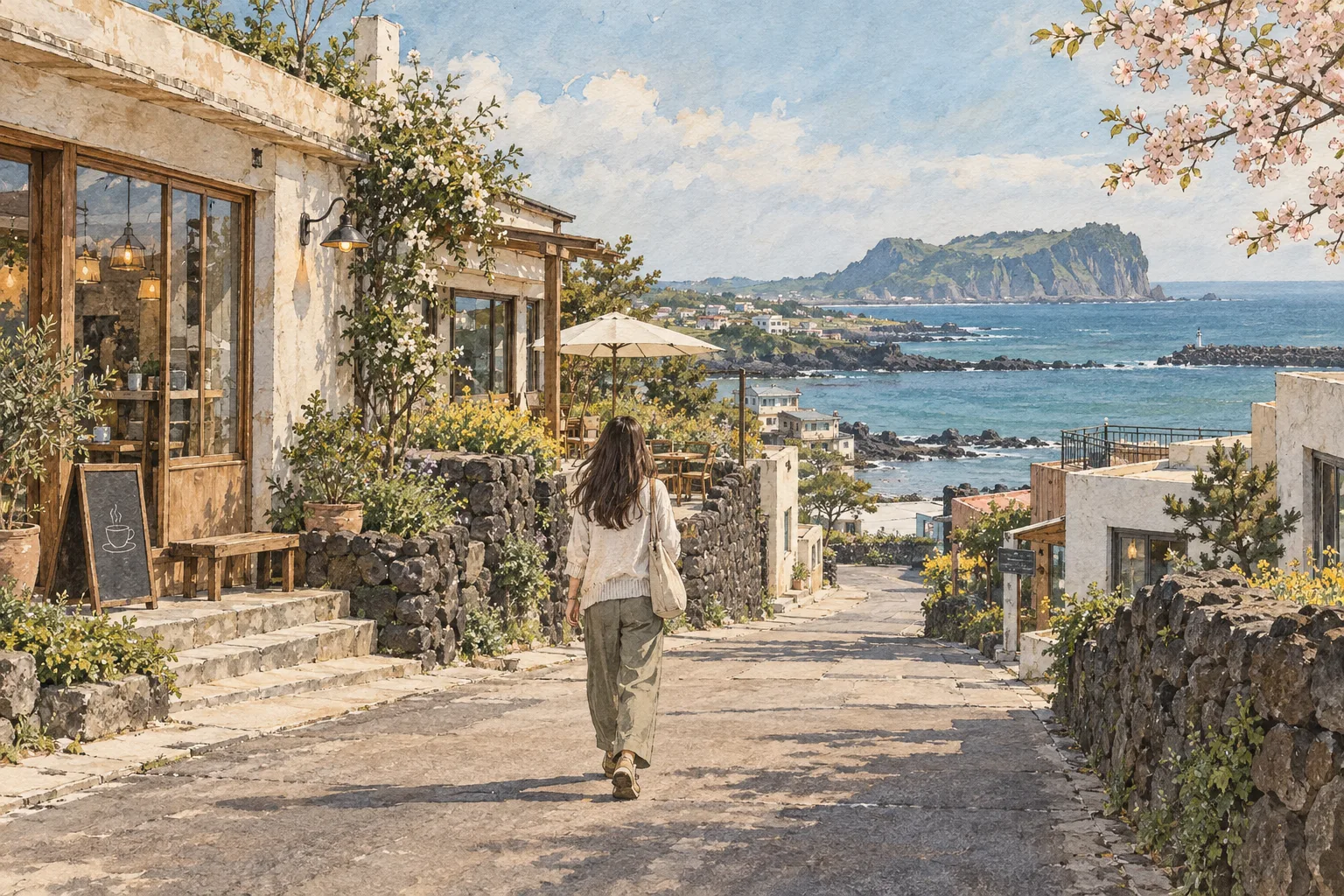
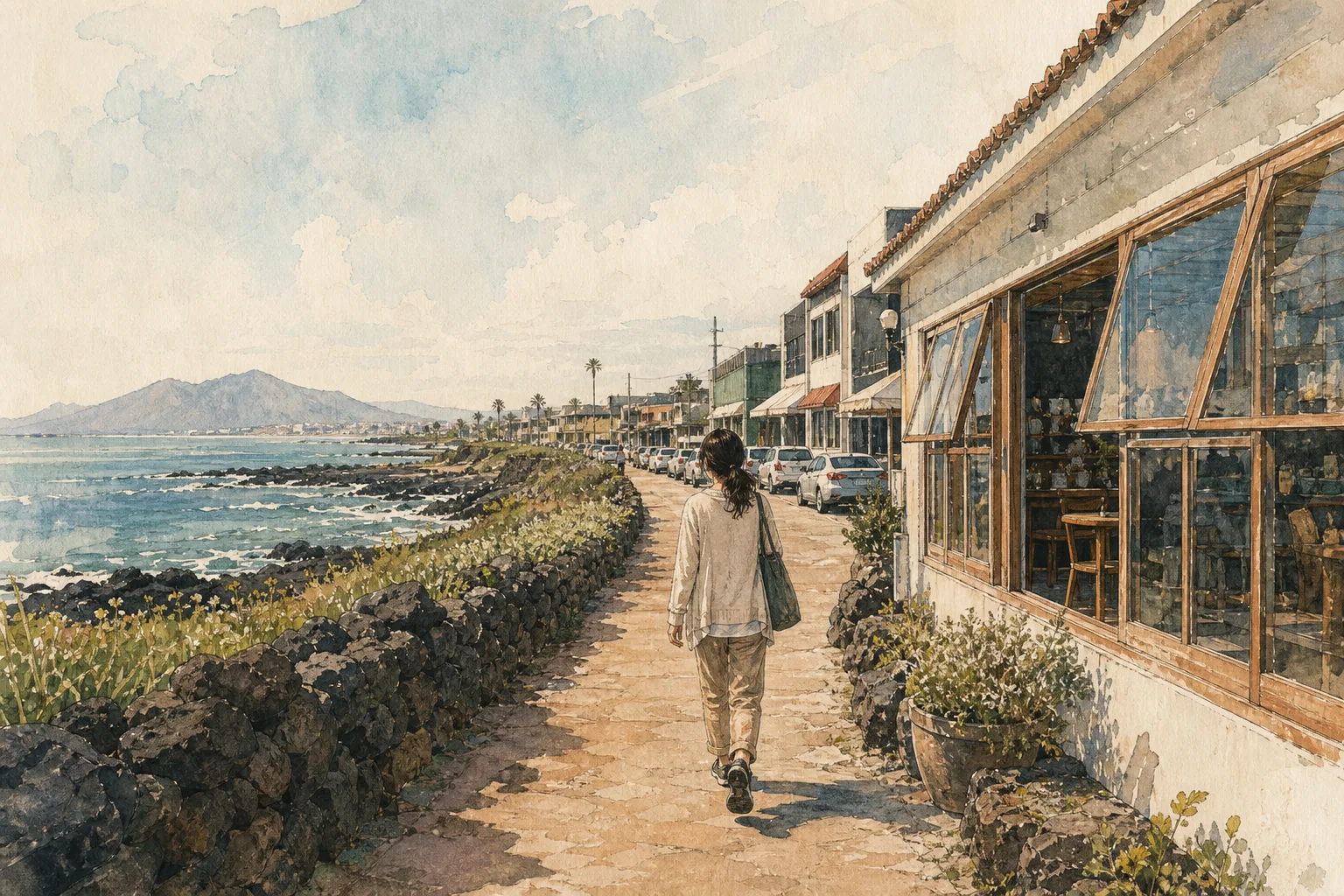
Slow travelers are Jeju's best match among the three groups. The island's small towns and coastal trails are built for lingering, not rushing between sights. A short walk like the roughly 1.2 km Aewol Handam Coastal Trail, which takes about 15 to 20 minutes, connects a caf district straight to a beach, so you can stretch that stretch into a full unhurried afternoon without ever feeling like you are behind schedule.
Atmosphere-first slow travelers can spend a whole day in one town and call it a success. Photography-led slow travelers benefit from returning to the same spot at different times of day, something a landmark-hopping itinerary rarely allows. This is the group least likely to leave Jeju feeling shortchanged.
The one caution: slow travel on Jeju still needs some transportation plan. Public buses accept contactless cards and cost 1,150 per ride with a T-money card, which covers town-to-town movement, but reaching quieter coastal stretches often still needs a car or a taxi.
Best for Low-Stress Travelers
Low-stress travelers who want a mostly fixed, predictable plan get a mixed result on Jeju. The island cooperates when the plan is simple: pick a town, walk, eat, repeat. It cooperates less when the plan depends on a specific peak or trail being open. From August 1 to September 30, 2026, the Gwaneumsa trail to the Hallasan summit is closed for maintenance, leaving Seongpanak as the only summit route, which forces a reroute for anyone who had that hike locked into a schedule.
Atmosphere-first low-stress travelers handle this well, because their plan was never landmark-dependent to begin with. Photography-led low-stress travelers should build in a buffer day, since best-light conditions do not follow a booking calendar. Slow travelers in this group are the least affected, since their itinerary was already loose.
A useful low-stress habit on Jeju: treat any single paid attraction, such as the 5,000 entry to the Seongsan Ilchulbong summit, as optional rather than mandatory, and keep the free coastal trail around its base as the fallback plan.
Common Mismatches
The clearest mismatch is the landmark checklist traveler who expects Jeju to deliver density like a major city. It does not. Someone who needs to "see everything" in three days will end up driving more than walking, and the trip will feel like errands instead of atmosphere.
A second mismatch is the overplanner who books a tight, sequenced itinerary with little slack. Jeju punishes over-scheduling because weather, trail closures, and traffic on two-lane coastal roads do not respect a spreadsheet. The regret pattern here is arriving back home with a full camera roll of "efficient" stops and no memory of actually enjoying any single place.
A third, quieter mismatch is the traveler who wants Jeju to feel dramatic or grand. Jeju's atmosphere is gentle, not spectacular. Travelers expecting cliffside drama at every turn, rather than a slow accumulation of small, calm scenes, tend to come away underwhelmed even when nothing went wrong logistically.
Final Match Recommendation
Choose Jeju if you can genuinely enjoy a day built around one neighborhood, one coastal trail, and no fixed sightseeing quota. Atmosphere-first, photography-led, and slow travelers all fit this description, and all three tend to leave satisfied. The island gives back proportionally to how much unstructured time you allow it.
Do not choose Jeju, or at least lower your expectations sharply, if your travel satisfaction depends on landmark density and a full checklist by day's end. That traveler is better served by a city with concentrated, walkable sights. Going to Jeju with that mindset produces the most common regret: driving past quiet, worthwhile places in a rush to reach the next "official" stop, and missing the thing Jeju actually does well.
Quick Checklist Before You Book
- You are comfortable with a day that has no single "highlight" moment
- You can meet the requirements for a rental car (physical IDP, physical credit card) or you are fine limiting your range to bus routes
- You are giving the trip at least 3 to 4 days, not a rushed weekend
- You are treating paid landmarks like Seongsan Ilchulbong as optional, not mandatory
- You are checking trail status in advance, since routes like Hallasan's Gwaneumsa section can close for maintenance
FAQ
Is Jeju worth visiting if I do not care about seeing famous landmarks? Yes, if your satisfaction comes from mood, coastline, and cafe culture rather than ticking off sights. Jeju's landmarks are mostly optional scenery, not the core experience. Skipping most of them does not shrink the trip; it just changes the pace.
Will I feel like I am missing out if I skip Seongsan Ilchulbong or Hallasan? Some travelers do feel a pull to see them once they are on the island. That pressure is manageable if you decide in advance that atmosphere is the goal. Landmark FOMO fades faster once you accept the trade you are making.
Is Jeju too car-dependent for a slow, atmosphere-led trip? It leans car-dependent outside the main towns, since buses cover the basics but not every quiet coastal stretch. A rental car gives the most freedom to linger, but it requires a physical international driving permit and a physical credit card in the driver's name. Without a car, plan around bus routes and accept some places stay out of reach.
Does Jeju work for a short weekend trip if I want atmosphere over landmarks? It works less well on a tight weekend, because atmosphere needs unscheduled time to register. A rushed itinerary pushes you back toward landmark-checking just to feel productive. Three to four days gives enough slack for actual wandering.
Is Jeju more expensive for an atmosphere-first trip than a landmark-focused one? Not necessarily. Entry fees at major sights add up quickly, while cafes, coastal walks, and markets cost little beyond a coffee or a meal. An atmosphere-first trip can actually run cheaper if you rent a budget car and skip most paid attractions.