travel-decisions
Is Gyeongju Worth It in Spring If You Hate Crowds And Price Pressure?
A direct decision guide for travelers weighing Gyeongju's spring cherry blossoms against crowd density and hotel price spikes, with timing windows and alternatives.
Quick Verdict
Gyeongju is worth it in spring for most travelers, but not on the single peak weekend. Go if you can shift your dates by even a few days, stay flexible about which cherry blossom site you visit, and book accommodation early. Skip it, or plan around it, if you can only travel during the exact peak bloom window and you have a hard budget ceiling or a strong aversion to dense pedestrian crowds.
Choose Gyeongju in spring if you are a low-stress planner who can travel midweek or a few days off peak, if you are budget-conscious but flexible on dates, or if you value atmosphere over ticking off every landmark on the busiest day. Avoid it, or treat it as a lower priority, if you are locked into peak-weekend-only travel dates, if a hard budget makes a 2 to 3 times hotel price spike a dealbreaker, or if crowd density in tight pedestrian zones genuinely ruins your trip experience regardless of how good the blossoms look.
 Editorial illustration: A simple comparison table layout on a flat background showing three columns labeled crowd level.
Main Friction Problem
The friction is not Gyeongju itself. It is timing your visit against four specific pressure points: crowds, hotel prices, overplanning, and a mismatch between what you expect and what a peak-weekend visit actually feels like. Each of these gets worse the closer you get to the historic peak bloom window, roughly March 27 to April 5. Understanding how they interact lets you make a real decision instead of guessing.
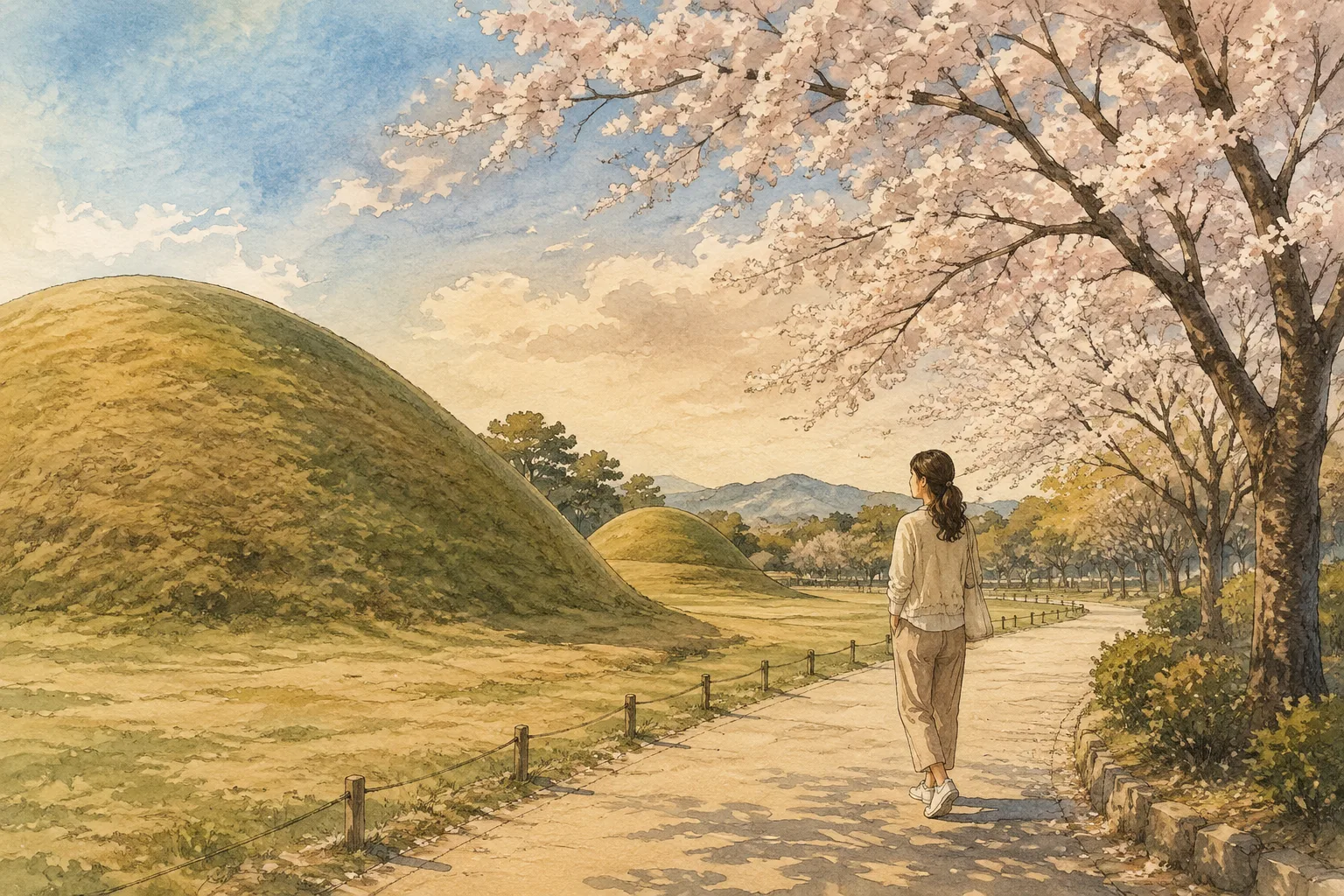
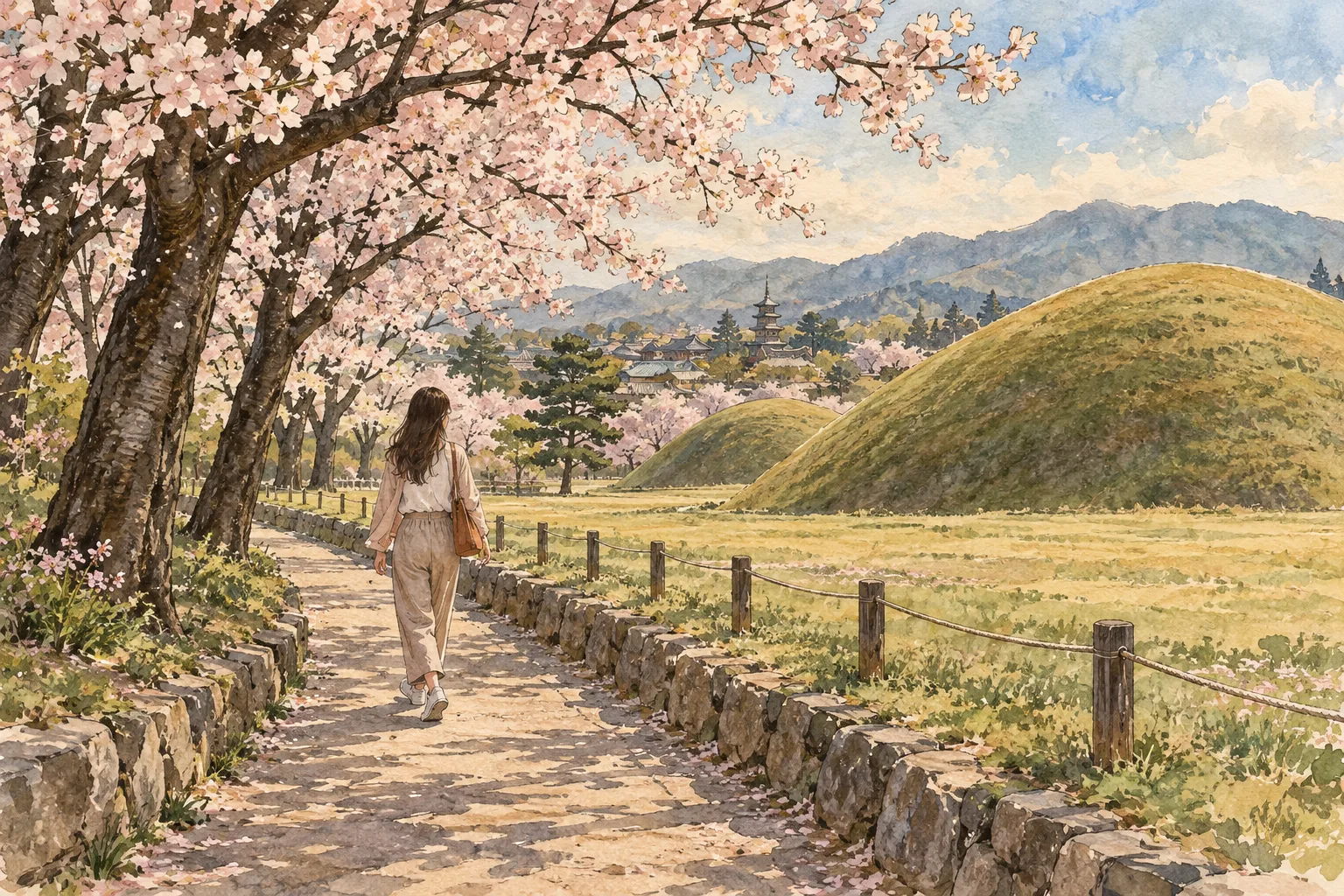
Crowds concentrate hardest around Daereungwon Doldam-gil, the tomb-lined path most associated with Gyeongju's cherry blossom photos. During the Daereungwon Stone Wall Road Festival, vehicle traffic is completely blocked on that street, which is good for pedestrians but also means everyone is funneled into the same walking space at once. If you hate dense foot traffic, this is the specific spot and the specific dates to plan around, not Gyeongju as a whole.
Hotel price spikes are steep and short-lived. Budget properties that normally cost around $32 USD a night can rise to $100 to $138 USD during peak bloom weekends, a 2 to 3 times jump concentrated in a narrow window rather than spread across the whole season. This is a booking-timing problem more than a Gyeongju-is-expensive problem.
Overplanning creeps in because travelers try to force a rigid itinerary onto a festival-crowded downtown, then get frustrated when walking times balloon and buses run behind schedule. Real-time bus ETA data on Naver Map and Kakao Maps can be inconsistent in Gyeongju, so a tightly timed itinerary is more fragile here than it looks on paper. Expectation mismatch follows from the same root cause: photos of empty tomb-lined paths under full bloom set an expectation that a packed peak weekend cannot deliver, and travelers who did not budget for crowds feel let down even though the blossoms themselves are exactly as advertised.
Friction Table
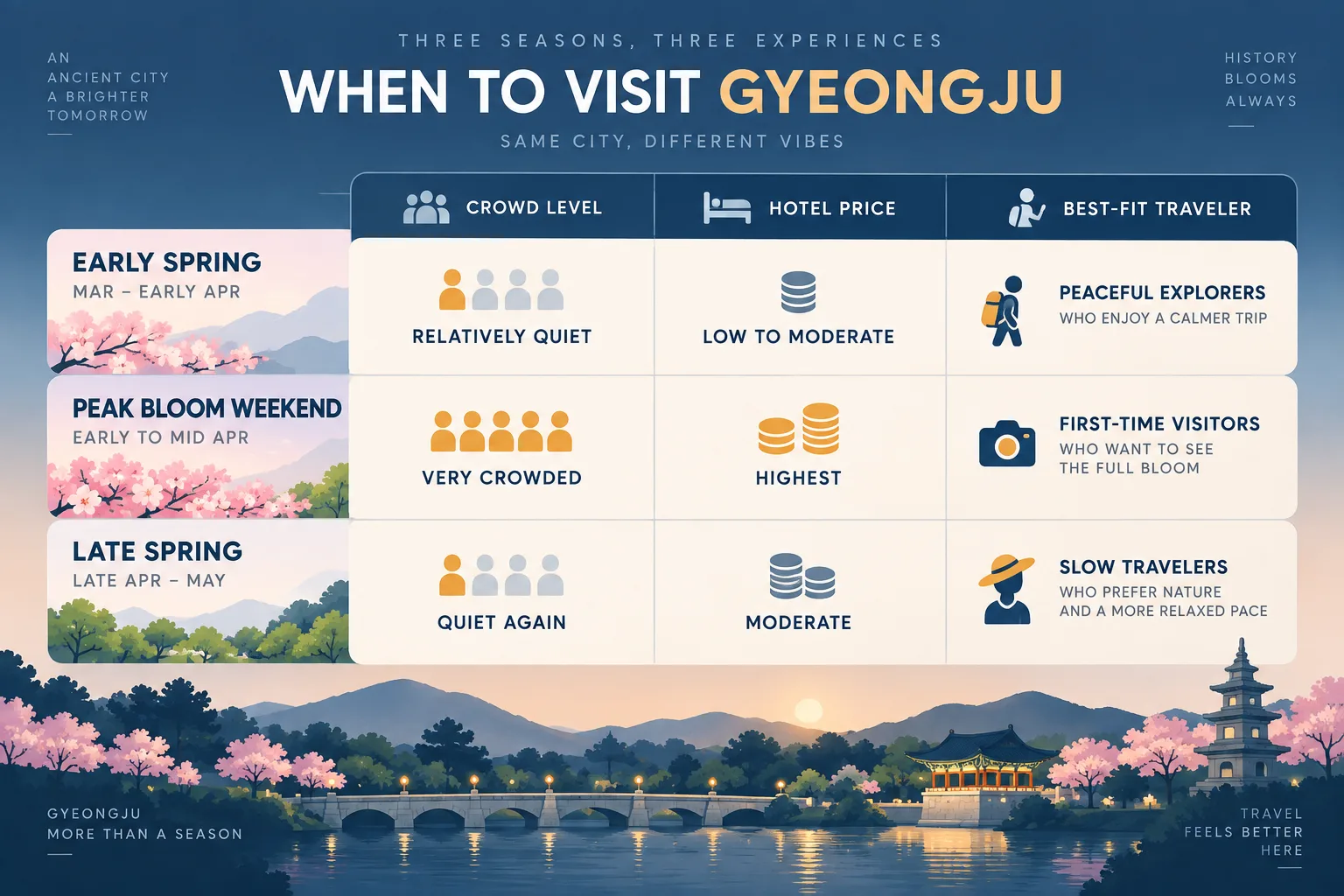
The core decision variables move together. Below is how they typically line up across a spring visit window.
| Timing window | Crowd level | Hotel price vs. normal | Best-fit traveler |
|---|---|---|---|
| 1-2 weeks before historic peak (mid-to-late March) | Low to moderate | Close to normal | Low-stress planners, budget-value travelers |
| Historic peak weekend (roughly March 27-April 5) | Very high, especially at Daereungwon | 2-3x spike ($100-138 vs. $32 baseline) | Travelers who prioritize peak bloom over crowd comfort |
| Festival dates specifically (e.g. Mar 27-29) | Highest; vehicle-free but pedestrian-dense | Peak or near-peak | Only travelers comfortable in festival-density crowds |
| First week of April, alternative sites (Yeongji Circular Path) | Low | Normal (free admission/parking) | Crowd-sensitive, budget-value travelers |
| 1-2 weeks after downtown peak (Hill of Hwarang blooms later) | Low | Normal to slightly elevated | Crowd-sensitive travelers who still want blossoms |
The pattern is consistent: crowd level and hotel price move together, and both peak on the same narrow weekend that downtown's official festival occupies. Every alternative window or alternative site trades some bloom intensity for a real drop in both crowd pressure and cost.
Who Will Feel It Most
Crowd-sensitive travelers will feel Daereungwon's peak-weekend density the hardest, since that specific street becomes vehicle-free and pedestrian-packed during the festival dates. If dense foot traffic in a confined space is a hard limit for you, that particular weekend at that particular site is the problem, not Gyeongju in general.
Budget-conscious travelers with fixed dates feel the hotel price spike most acutely, especially if they are booking budget-tier rooms that triple in price rather than mid-range rooms with more price stability. Travelers who can shift their trip by even 5 to 7 days largely sidestep this, since the spike is tied to a narrow window rather than the whole spring season.
Overplanners feel the friction differently: they build a tight schedule assuming normal walking and bus times, then get thrown off when festival crowds slow pedestrian movement and bus ETA data becomes unreliable. Loosely structured itineraries absorb this friction far better than back-to-back timed plans.
Travelers chasing the exact postcard image of empty tomb-lined paths in full bloom are the group most likely to feel expectation mismatch, because that image and peak-weekend reality are close to mutually exclusive. Travelers who accept that Gyeongju in spring means blossoms and moderate-to-high crowds together, as a package, tend to report a better experience than those expecting one without the other.
How to Reduce the Friction
Each friction point has a fairly direct fix, and most of them come down to timing and site choice rather than avoiding Gyeongju altogether.
- Crowds: Visit 5 to 10 days before or after the historic peak (March 27-April 5), or pick an alternative bloom site like the Hill of Hwarang or Yeongji Circular Path instead of downtown Daereungwon.
- Hotel price spikes: Book at least 4-6 weeks ahead if your dates must fall near peak, or shift your stay by even a few days to land outside the narrowest peak-weekend pricing window.
- Overplanning: Build in 30-50% more time than normal for downtown walking segments during festival dates, and treat real-time bus ETAs as unreliable rather than exact.
- Expectation mismatch: Decide in advance whether you want maximum bloom intensity or a calmer experience, since peak-weekend Gyeongju cannot reliably deliver both at the same time.
None of these fixes require exotic planning. They mostly require picking a date and a site deliberately instead of defaulting to the single most photographed weekend at the single most photographed street.
Better Alternatives
If your dates are genuinely locked to the peak weekend and you cannot move them, redirecting your itinerary within Gyeongju is more useful than avoiding the city outright. The Hill of Hwarang blooms one to two weeks later than downtown, is pet-friendly, and stays noticeably less crowded even during downtown's peak dates, though it charges admission. Yeongji Circular Path at Yeongji Folk Tale Park blooms around the first week of April, has free admission and free parking, and sits outside the festival-crowd zone entirely.
If your real constraint is budget rather than dates, staying near Gyeongju Station rather than downtown Hwangridan-gil softens the price spike, since demand pressure concentrates most heavily on downtown lodging closest to the festival zone. A taxi from the station to Hwangridan-gil runs about 15,000 KRW and 15-20 minutes, or buses connect in roughly 30 minutes for a flat 1,500 KRW fare, which keeps the tradeoff manageable if the room rate savings outweigh the commute.
If neither date flexibility nor site substitution works for you, and you specifically want blossoms without any festival-level crowd exposure, it may be worth treating Gyeongju as a future-spring trip rather than forcing it into a peak-weekend visit this year. That is a legitimate decision, not a failure to plan well enough.
Decision Checklist
Use this before you book anything.
- Can you shift your travel dates by 5+ days from the historic peak bloom window (March 27-April 5)?
- Have you checked whether your visit overlaps the Daereungwon Stone Wall Road Festival dates specifically?
- Is your hotel budget able to absorb a 2-3x price spike, or do you need to book 4-6 weeks ahead to lock in a lower rate?
- Are you open to an alternative bloom site (Hill of Hwarang, Yeongji Circular Path) instead of downtown Daereungwon?
- Does your itinerary build in extra time for slower pedestrian movement and unreliable bus ETAs during festival dates?
- Have you decided whether maximum bloom intensity or lower crowd density matters more to you this trip?
If you can check most of these boxes, spring Gyeongju is a reasonable choice even with crowd and price sensitivity. If you cannot check more than one or two, consider shifting your window or your target site before booking.
FAQ
Is Gyeongju worth visiting in spring if I cannot travel on the exact peak bloom weekend? Yes, and it may work better for you. Bloom in Gyeongju is not a single day; it runs roughly from late March through the first week of April across different sites, so arriving a few days off the historic peak (around March 27 to April 5) still gets you blossoms with a smaller crowd.
How much more does a Gyeongju hotel cost during peak cherry blossom weekends? Budget properties that normally run about $32 USD (40,000 to 50,000 KRW) a night can jump to roughly $100 to $138 USD (140,000 KRW) during peak bloom weekends, a 2 to 3 times increase. Booking outside the single peak weekend, or staying near Gyeongju Station instead of downtown, usually avoids the worst of that spike.
Can I skip downtown Gyeongju entirely and still see good cherry blossoms? Yes. The Hill of Hwarang blooms one to two weeks later than downtown and stays less crowded, and Yeongji Circular Path at Yeongji Folk Tale Park has free admission and parking with blooms around the first week of April. Both are reasonable substitutes if downtown's Daereungwon-area crowds are the problem, not the blossoms themselves.
Is Gyeongju a good fit for someone who dislikes overplanned itineraries? It can be, because the historic core is compact: Daereungwon to Cheomseongdae is a 7 to 15 minute walk, and Cheomseongdae to Donggung Palace is another 10 to 15 minutes. That density means you can wander without a tight schedule and still cover the main sites, which suits low-stress planners better than destinations that require constant transit connections.
Should I avoid Gyeongju in spring entirely if I strongly dislike crowds? Not entirely, but avoid the single peak weekend and the Daereungwon Stone Wall Road Festival dates, when vehicle traffic is blocked and pedestrian density is highest. Visiting a week before or after peak bloom, or choosing alternative bloom sites away from downtown, keeps the trip workable for crowd-sensitive travelers.