travel-decisions
Is Gyeongju Too Physically Demanding for a Multigenerational Family Trip with Elderly Parents?
A traveler-fit breakdown of Gyeongju's walking demands, uneven terrain, and rest-stop gaps for adult children planning a trip with elderly parents.
Quick Verdict
Gyeongju is a strong fit for a multigenerational family trip if your elderly parent can comfortably walk 800 meters to 1 kilometer at a slow pace, take occasional steps, and tolerate open, sun-exposed ground without constant benches nearby. It is a weak fit if your parent needs a fully paved, bench-lined route at every stop, cannot manage any unpaved surface, or gets fatigued after 15 to 20 minutes of continuous walking.
The honest answer is: most of Gyeongju is manageable with planning, but one site (Seokguram Grotto) is not, and the city's flat layout hides real walking totals that add up faster than they look on a map.
- Choose Gyeongju if you can build a two-site day, skip or reassign Seokguram, and accept that rest stops mean finding a low wall or a cafe rather than a public bench.
- Skip or heavily modify the plan if your parent uses a wheelchair full-time and needs paved paths everywhere, or if the trip has to include Seokguram Grotto as a non-negotiable stop.
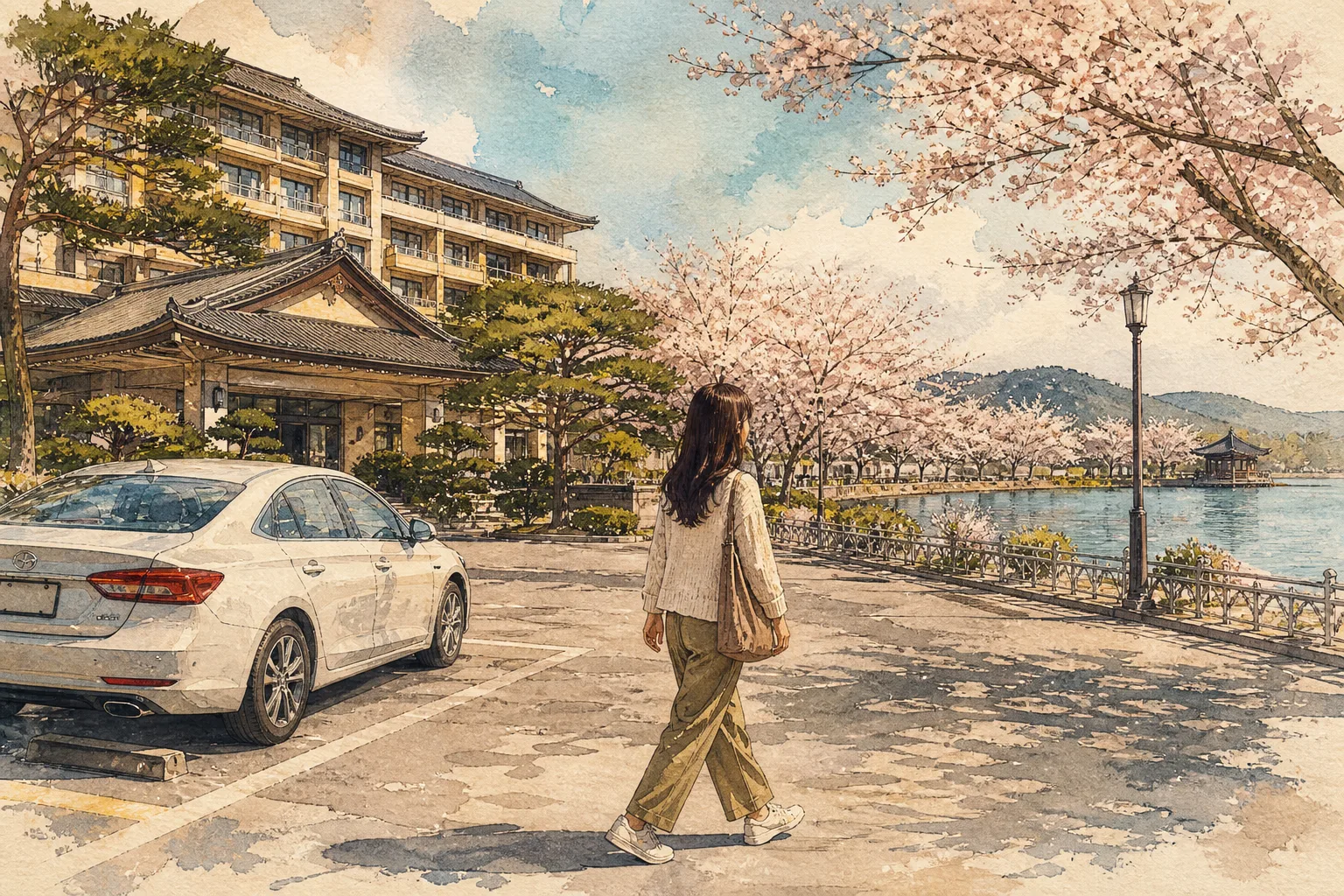
 Editorial illustration: A clean.
Traveler Type Table
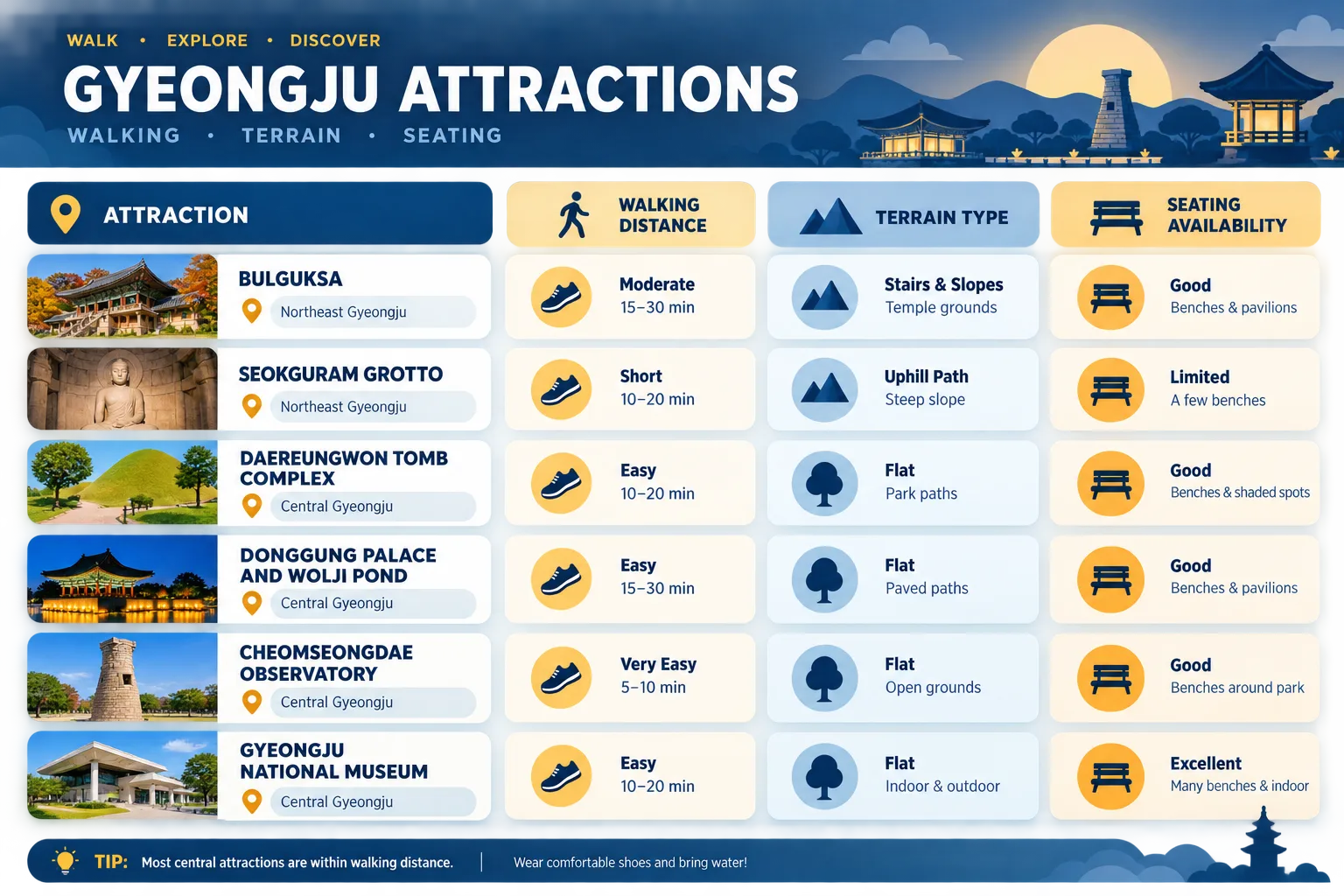
The physical demand in Gyeongju is not evenly spread. It concentrates at specific sites and specific gaps between them. This table breaks down where the real friction sits.
| Site | Walking distance | Terrain | Seating along the way | Elderly-parent fit |
|---|---|---|---|---|
| Bulguksa Temple | 10 to 15 minutes from parking to entrance | Paved paths, some temple steps | Limited, mostly near the entrance | Good with a slow pace; steps inside require care |
| Seokguram Grotto | 650 to 850 meters one-way dirt-and-gravel trail plus a final staircase | Unpaved mountain trail, no wheelchair route | None along the trail | Poor fit for moderate walking limitations |
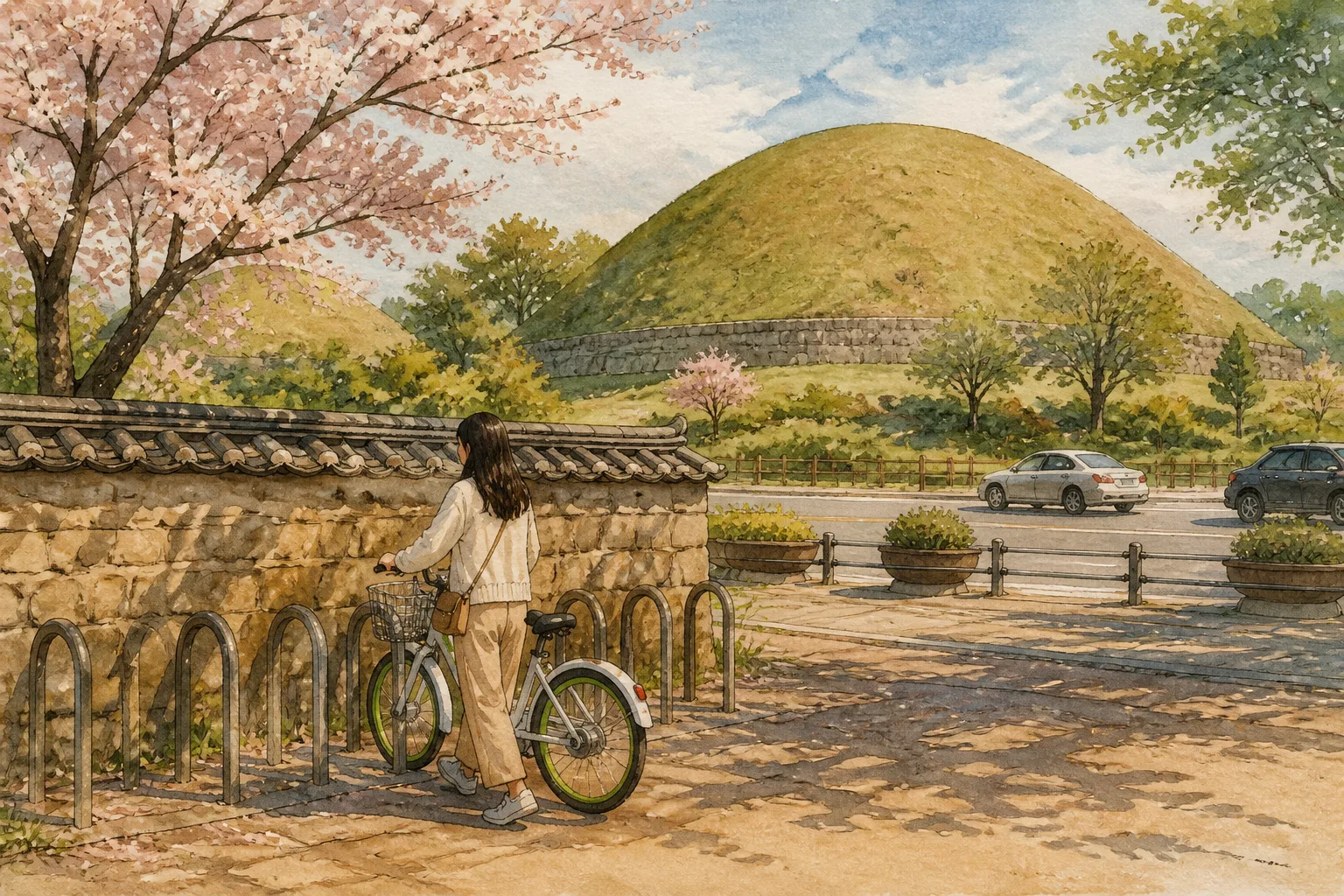
| Daereungwon Tomb Complex | Flat grounds, free wheelchair and stroller rental at the gate | Paved, flat | Some benches on the grounds | Best fit of the major sites |
| Donggung Palace and Wolji Pond | About 1 kilometer for the full perimeter loop | Paved, flat, mostly outdoors | Occasional benches along the loop | Good, but the full loop adds up; a partial loop works too |
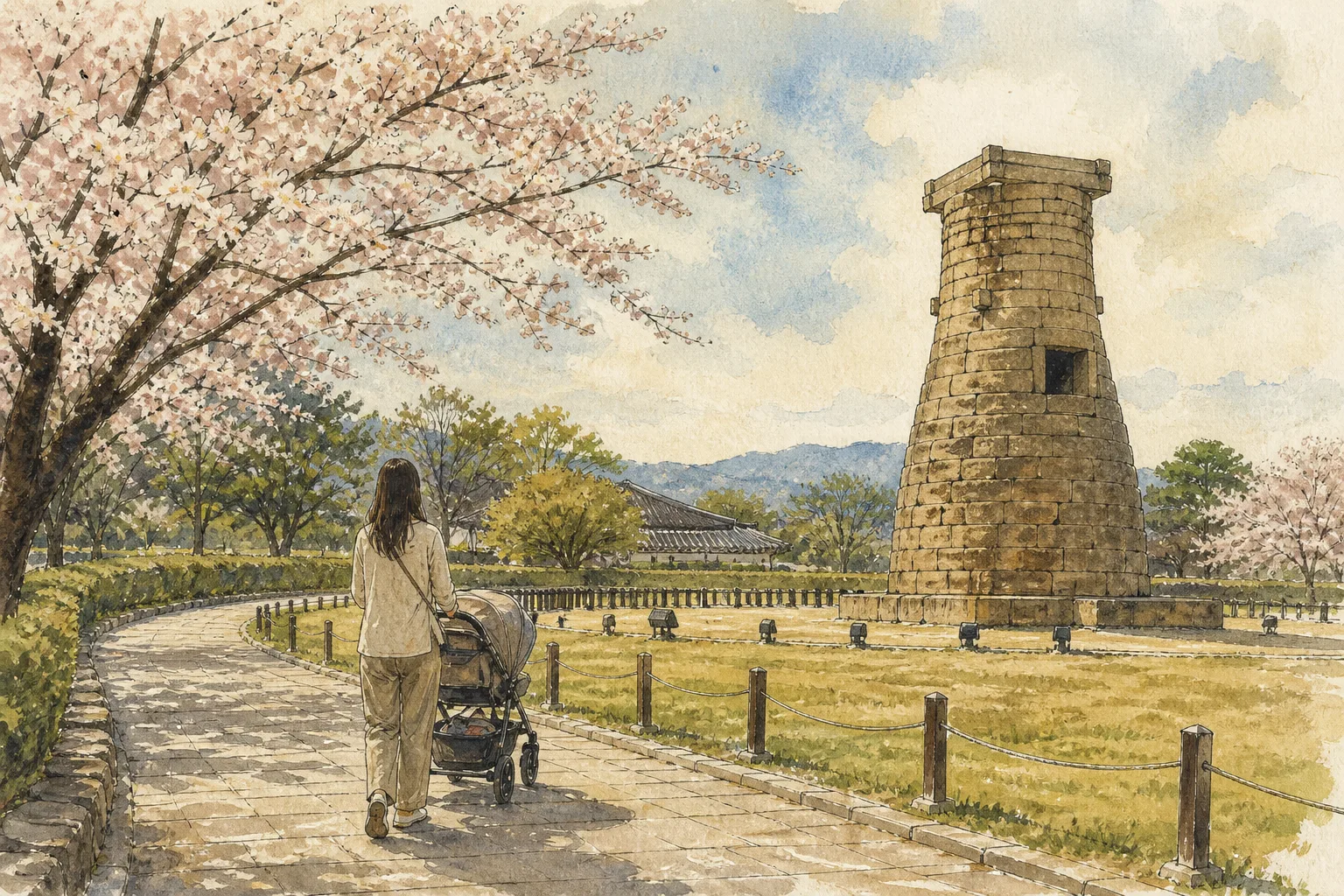
| Cheomseongdae Observatory | About 900 meters from the Daereungwon parking area | Open public park, flat, no shade | No benches on the approach | Manageable but exposed; time it outside midday heat |
| Gyeongju National Museum | Short indoor and outdoor distances, free wheelchair rental | Paved, flat, indoor rest areas | Indoor seating and shade | Best fit for a lower-stamina day |
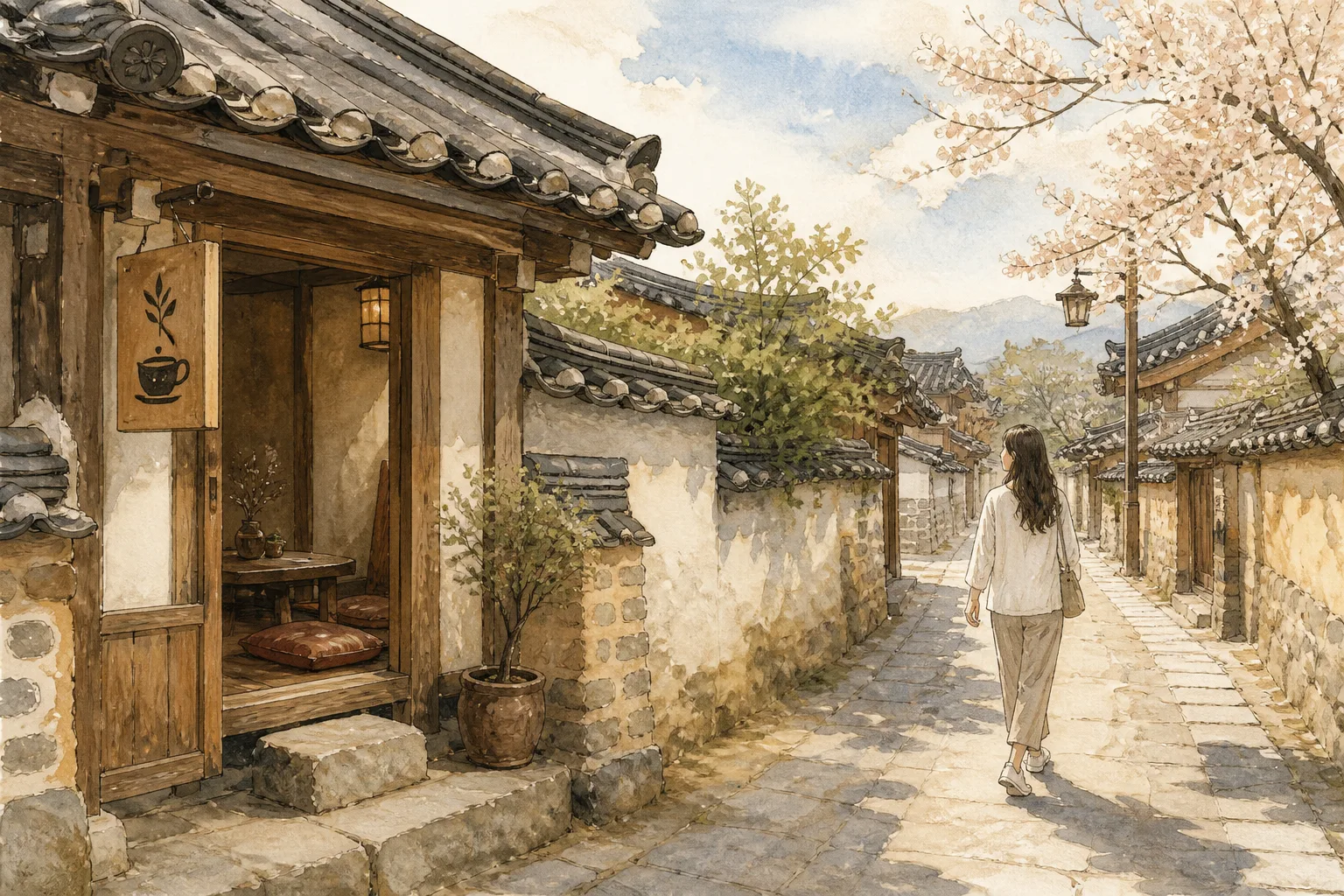
| Hwangridan-gil | Variable, but narrow and crowded | Paved sidewalks shared with traffic | Almost no public benches | Workable for a short visit, not a long stroll |
The pattern is clear: distance alone is not the deciding factor. Terrain, shade, and seating availability decide whether a site is realistically doable for a parent with moderate limitations. Daereungwon and the museum are the two sites built for a lower-stamina day. Seokguram is the one site built against it.
Best for First-Time Visitors
Families visiting Gyeongju for the first time with elderly parents tend to arrive with a checklist built from photos: Bulguksa, Seokguram, Cheomseongdae, Daereungwon, all in one or two days. That checklist works for able-bodied travelers. It does not work as written for a parent with moderate walking limitations.
The fix is not to shorten the list randomly, but to reorder it by physical cost. Daereungwon and the National Museum should anchor the trip because both are flat, free, and equipped with wheelchair rental. Bulguksa can follow if the pace stays slow and the 10 to 15 minute walk from parking is treated as the first leg of the day, not a warm-up before the "real" walking starts. Seokguram should be treated as optional, not default, for this traveler type. A first-time family that assumes every listed landmark is equally accessible will be surprised by how much the terrain, not the distance, wears a parent down.
Best for Couples
A younger couple traveling without elderly parents has far more flexibility in Gyeongju, and that flexibility is exactly what changes when parents join the trip. Couples can absorb the Seokguram trail, the full Wolji Pond loop, and a long Hwangridan-gil stroll in a single day without much cost.
When the same itinerary is scaled down for a multigenerational group, that flexibility disappears. The couple's version of "a full day in Gyeongju" and the family version with elderly parents are not the same trip; they only share a map. Couples planning for their parents' comfort, not their own pace, need to plan around the slowest member's realistic distance, not the average.
Best for Slow Travelers
Slow travel already matches Gyeongju's actual shape better than a checklist does, and this works in favor of a multigenerational group. A family that plans two sites a day, with long breaks and no rush to see everything, will find Gyeongju far less physically demanding than a family trying to compress the same list into a single day.
For elderly parents specifically, "slow" needs to mean more than a relaxed schedule. It means choosing sites where rest is actually available, since Hwangridan-gil and the approach to Cheomseongdae both lack benches. A slow-travel plan that still routes through bench-free stretches for long periods is not actually easier on a parent's legs; it is the same physical load spread over more hours. The traveler type that benefits most is one who treats seating availability, not just pace, as a planning variable.
Best for Low-Stress Travelers
Low-stress travelers who want a straightforward, businesslike trip without constant improvising will find Gyeongju workable, but only if the plan accounts for a few known friction points in advance rather than reacting to them on the day.
- Decide before arrival which sites are non-negotiable and which are optional, so no one has to argue about skipping Seokguram at the trailhead.
- Confirm wheelchair or stroller rental availability at Daereungwon or the museum ahead of time if a parent will need it, rather than assuming it on arrival.
- Plan the 15 to 20 minute, 15,000 to 25,000 KRW taxi ride from Gyeongju Station into downtown as a built-in cost and time block, not an afterthought.
- Build in a real midday break, since Cheomseongdae's approach and Hwangridan-gil both offer no shade or seating relief.
A low-stress trip here is achievable, but it depends on pre-deciding the tradeoffs rather than discovering them mid-walk.
Common Mismatches
The most common regret pattern is not "Gyeongju was too hard." It is "we didn't realize Seokguram was that different from everything else." Families who treat every listed landmark as roughly equal in effort are the ones most likely to end up with an exhausted, frustrated parent standing at the base of a gravel mountain trail with no way to turn the group back easily.
A second mismatch: families who plan around distance in meters but not terrain type. Nine hundred meters on a flat paved path and 650 meters on a dirt-and-gravel incline are not comparable, even though one number is smaller. A parent who can do the flat walk to Cheomseongdae without trouble may still struggle badly on a shorter but rougher stretch elsewhere.
A third mismatch is timing against weather and crowd season together. Spring cherry-blossom season is the easiest weather window for walking, but it is also when Hwangridan-gil's narrow sidewalks get busiest. A parent who walks slowly in a dense, shared-with-traffic sidewalk crowd faces more physical stress than the same walk on a quiet day, even if the distance and terrain are identical.
Final Match Recommendation
Choose Gyeongju for a multigenerational family trip if your elderly parent can manage roughly 800 meters to 1 kilometer of walking per site at a slow pace, tolerate a mix of paved paths with occasional steps, and you are willing to treat Seokguram Grotto as optional rather than mandatory. The city's core sites, Bulguksa, Daereungwon, Donggung Palace, Cheomseongdae, and the National Museum, are all reachable without extreme physical demand when paced across two sites a day instead of four or five.
Do not choose Gyeongju as planned, or plan a heavily modified version, if a parent cannot walk on any unpaved surface, needs paved and bench-lined routes without exception, or if the trip's itinerary treats Seokguram as a must-see rather than a maybe. In that case, the better move is to keep the visit to Daereungwon, the museum, and a shortened version of Donggung Palace, and skip the temple-and-grotto day entirely rather than forcing it.
The deciding factor is rarely Gyeongju's overall size. It is whether your family plans around the specific sites that punish slow walkers (Seokguram's trail, Hwangridan-gil's crowded sidewalks, Cheomseongdae's shadeless approach) or assumes the whole city is uniformly easy just because it looks flat on a map.
FAQ
Can wheelchairs or strollers be rented in Gyeongju? Yes. The Daereungwon Tomb Complex offers free wheelchair and stroller rentals at its front gate ticket office, and the Gyeongju National Museum offers free wheelchair rental at its main Information Center. Seokguram Grotto is the exception, since its final approach is a mountain trail and steps that no rental wheelchair can cover.
Is Seokguram Grotto worth skipping for elderly parents? For a parent with moderate walking limitations, it is the single hardest stop in Gyeongju: a 650 to 850 meter one-way dirt-and-gravel mountain trail after a 15-minute winding drive, ending in steps with no wheelchair-accessible route. Many multigenerational groups choose to skip it and keep the day to Bulguksa and the valley sites instead.
Which Gyeongju sites are the easiest for someone with limited walking stamina? Daereungwon Tomb Complex and the Gyeongju National Museum are the most manageable, since both are flat, free to enter, and offer free wheelchair rental. Cheomseongdae Observatory is also flat but has no shade and no benches along the approach, so timing matters more than terrain.
How many Gyeongju sites can a family realistically cover in one day with elderly parents? Most families with a mobility-limited parent manage two, sometimes three, paced sites per day rather than the five or six a fully able-bodied itinerary assumes. Bulguksa plus Daereungwon, or Donggung Palace plus the museum, is a realistic one-day pairing when rest breaks and a slower pace are built in.
Does spring cherry-blossom season make Gyeongju harder for elderly parents? Spring is the most walkable weather window in Gyeongju, but it is also peak season, which means denser crowds and busier sidewalks, especially on Hwangridan-gil. The physical difficulty comes less from the season itself and more from navigating crowds while walking slowly.