travel-decisions
Is Gyeongju a Good Destination for Casual Cycling, or Will Road Conditions Stress You Out?
A traveler-fit breakdown of cycling in Gyeongju: which travelers enjoy the Bomun Lake loop and downtown routes, and who ends up fighting traffic and heat instead.
Quick Verdict
Gyeongju works well for casual cycling if you are an active or budget-minded traveler who wants to link spread-out sights without waiting on local buses, and if you are comfortable riding on a normal road shoulder next to real traffic. The city is flat, the major attractions form a loose loop between downtown and Bomun Lake, and rental costs are low enough that a full day on two wheels rarely strains a budget.
It is a weak fit if you get anxious sharing a road with cars, if you are traveling with young kids who cannot safely ride in traffic, or if your trip lands in July or August when monsoon heat and rain turn a scenic ride into an endurance test. The road conditions themselves are not dangerous in the way a city with no cycling infrastructure would be, but they are not a protected bike path either. That gap between "cycling-friendly reputation" and "actual traffic-sharing reality" is where most disappointment comes from.
Strong fit: confident riders comfortable on shared roads, budget travelers who want to skip repeated bus fares, and slow travelers who want unhurried movement between sites. Weak fit: nervous or first-time cyclists, anyone traveling with small children, and anyone visiting during peak summer heat and rain.
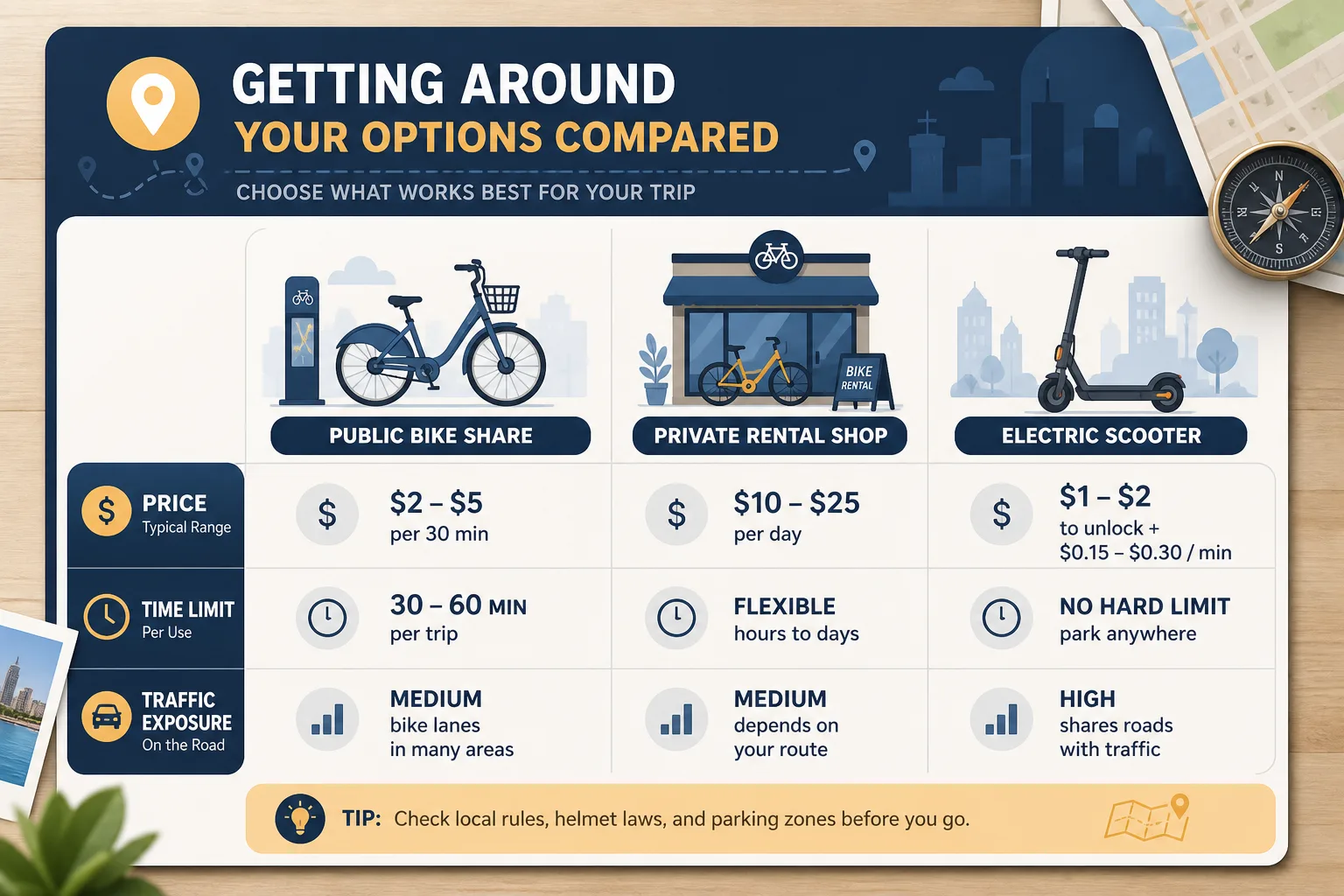 Editorial illustration: A simple flat-layout comparison chart on a table surface showing three columns labeled public bike share.
Traveler Type Table
The decision is not really "is Gyeongju bike-friendly." It is closer to three separate questions: how much traffic exposure can you tolerate, how much are you willing to pay for convenience, and how much time pressure are you under. Here is how those variables actually play out.
| Traveler type | Real decision variable | Practical tradeoff |
|---|---|---|
| Active travelers | Comfort sharing the road with vehicles on the 6-8 km downtown-to-Bomun stretch | Gets you between major zones fast, but there is no separated bike lane for most of it, so you ride in the flow of traffic |
| Budget travelers | Cost per session vs cost per day | Tasilla public bikes cost 1,000 won a day but cap each ride at 90 minutes before a 500 won per 30-minute overage fee; a private rental at 7,000-10,000 won removes that clock entirely |
| Slow travelers | Session time limits vs unhurried pacing | A leisurely rider who lingers at each stop will blow through the 90-minute public bike window repeatedly; a full-day private rental matches a slower pace much better |
The core tension: the cheapest option (public bike share) rewards quick, purposeful trips between points, while the traveler most likely to enjoy Gyeongju by bike (someone moving slowly, stopping often) is better served by paying a bit more for an unrestricted rental.
Best for First-Time Visitors
First-time visitors to Gyeongju are usually trying to cover a lot in a short window: Cheomseongdae, Daereungwon, Donggung Palace and Wolji Pond, maybe Bulguksa if time allows. A bike is genuinely useful here because these sites are spread across downtown with real gaps between them, not clustered on a single walkable street.
The friction: none of the historic grounds themselves allow bikes inside. Daereungwon, Cheomseongdae, and Donggung Palace and Wolji Pond all require parking at a rack outside and walking in. So a first-timer's bike functions purely as transport between stops, not as a way to tour the sites themselves. Active travelers who accept this "park and walk" rhythm get a lot out of cycling here. Budget travelers benefit from the low rental cost versus repeated local bus fares at 1,650 won per ride. Slow travelers who want to see everything in one day but not rush any single stop find the bike useful for covering ground quickly between longer, unhurried visits.
Best for Couples
For couples, cycling in Gyeongju is less about efficiency and more about shared pacing. Riding side by side on the quieter stretches around Bomun Lake, then splitting off to walk the tomb parks together, gives a rhythm that a bus schedule cannot replicate.
The catch is road conditions on the busier connecting roads. If one partner is a confident rider and the other is not, the 6-8 km stretch toward Bomun Lake with fast-moving traffic can create real tension rather than a relaxed day out. Active-traveler couples who both ride comfortably in traffic get the most out of this. Budget-conscious couples benefit from splitting a day rental rather than paying for two people on local buses all day. Slow-traveler couples do better renting for a full day (7,000-10,000 won each) rather than the public bike share, since stopping often for photos or food will eat into the 90-minute session limit fast.
Best for Slow Travelers
This is where Gyeongju cycling makes the most sense on paper and where the time-limit mechanics matter most in practice. A slow traveler wants to stop at a lakeside bench, linger over a tomb mound view, and not watch a clock. The Tasilla public bike system's 90-minute cap actively works against that instinct, since overage fees stack at 500 won per extra 30 minutes.
A private rental shop near the Express Bus Terminal or Daereungwon solves this directly: pay once for the day, keep the bike as long as you want, dock it back when you are done. Active travelers who also want a slower day appreciate that a full-day rental removes the anxiety of checking the time. Budget travelers should run the math themselves: if you will realistically use the bike more than a couple of hours, the flat private rate usually beats accumulated public-bike overage fees. Slow travelers specifically should treat the private rental as close to mandatory, since the entire point of slow travel is incompatible with a ticking 90-minute window.
Best for Low-Stress Travelers
Low-stress in Gyeongju by bike means minimizing three things: traffic exposure, legal ambiguity, and weather surprises. On traffic, the honest answer is that casual cyclists share real roads with real cars for a meaningful portion of any route, especially downtown-to-Bomun. There is no way to fully route around this. On legal ambiguity, Korean law classifies bicycles as cars and prohibits sidewalk riding for anyone over 12 except where marked, so retreating to the sidewalk when a road feels stressful is not actually a safe workaround, it is a rule violation. On weather, riding in July or August means monsoon rain and 29 degree Celsius average highs, which turns a relaxed ride into a sweaty, sometimes slippery ordeal.
Active travelers with some road-cycling comfort handle all three factors fine. Budget travelers should factor in that an unplanned taxi or bus swap due to weather or fatigue adds cost they did not budget for. Slow travelers seeking a genuinely low-stress day should avoid summer entirely and choose morning or early-evening rides when traffic and heat are both lighter. Anyone who wants zero traffic interaction should reconsider cycling as the day's main transport method rather than forcing it.
Common Mismatches
The travelers most likely to end up disappointed or stressed are not necessarily unfit for Gyeongju itself, just for cycling as their transport choice there.
Checklist of mismatch patterns to watch for:
- You picture a car-free, dedicated bike path the whole way: most of the downtown-to-Bomun route runs alongside regular vehicle traffic, not a separated lane.
- You are traveling with young children who cannot ride independently in traffic: there is no protected route to compensate for this.
- Your trip falls in July or August: monsoon rain and high heat make multi-hour rides physically taxing rather than scenic.
- You plan to ride into the tomb parks or Cheomseongdae grounds: bikes are prohibited inside all three major historic sites, so you will be parking and walking regardless.
- You are relying on the 1,000 won public bike pass for a full leisurely day: the 90-minute session cap will force repeated re-docking or overage fees, undercutting the "cheap and easy" appeal.
- You expect to cut through traffic on sidewalks when roads feel unsafe: this is not a legal fallback for riders over 12 except where explicitly marked.
Any one of these alone might just be a minor annoyance. Two or more together (say, a summer trip with young kids and an expectation of a protected path) usually means cycling should not be the primary way you get around Gyeongju.
Final Match Recommendation
Choose cycling in Gyeongju if you are an active or budget-conscious traveler comfortable sharing the road with vehicle traffic, visiting outside peak summer heat, and willing to treat historic sites as park-and-walk stops rather than ride-through attractions. A private full-day rental at roughly 7,000 to 10,000 won suits slower-paced sightseeing better than the public bike share's 90-minute cap, and the flat 6-8 kilometer stretch to Bomun Lake rewards riders who just need a direct, unhurried way to cover distance.
Do not choose cycling as your primary transport if you are nervous around traffic, traveling with small children, visiting in July or August, or expecting a fully separated bike path experience. In those cases, the local bus loop (routes 10 and 11, flat 1,650 won fare) covering the Intercity Bus Terminal, downtown, Bomun Lake, and Bulguksa Temple is the lower-stress alternative, even if it trades some flexibility for predictability.
FAQ
Is it safe to cycle from downtown Gyeongju to Bomun Lake? The route is roughly 6 to 8 kilometers and shares the road with fast-moving vehicle traffic for most of it. It is manageable for a confident casual rider who is comfortable on a regular road shoulder, but it is not a car-free path, so nervous or first-time cyclists often feel more stress than scenery.
Can I ride a bike into Daereungwon or up to Cheomseongdae? No. Bicycles are prohibited inside the historic grounds of Daereungwon, Cheomseongdae, and Donggung Palace and Wolji Pond. You park at a rack outside and walk in, so a bike works as transport between sites, not as a way to see them.
Is the public bike share or a private rental shop the better choice? The Tasilla public bike system costs 1,000 won for a day pass but limits each session to 90 minutes before overage fees apply, which suits short hops between sights. A private rental shop near the bus terminal or Daereungwon runs about 7,000 to 10,000 won for a full day with no re-docking required, which suits a slower, one-loop sightseeing day.
Is cycling on Gyeongju's sidewalks legal if the road feels unsafe? Generally no. Bicycles are legally classified as cars under Korean law, and riding on sidewalks is prohibited for anyone over 12 except where specifically marked for bikes. If a stretch of road feels unsafe, the legal fallback is not the sidewalk, it is walking the bike or choosing a different route.
What season makes cycling in Gyeongju most stressful? Summer, specifically July and August. Monsoon rain, high humidity, and average highs near 29 degrees Celsius combine to make multi-hour rides physically draining and occasionally unsafe on wet pavement. Spring and autumn are far more forgiving for a casual rider.