travel-decisions
Is Gyeongju Stroller-Friendly, or Will You End up Carrying Your Toddler up Temple Stairs?
A friction-first look at whether Gyeongju works with a stroller, where you will fold it or carry it instead, and how to plan around the city's temple stairs and non-low-floor buses.
Quick Verdict
Gyeongju is stroller-friendly in one specific zone and stroller-hostile in another, and the split matters more than any single "yes" or "no."
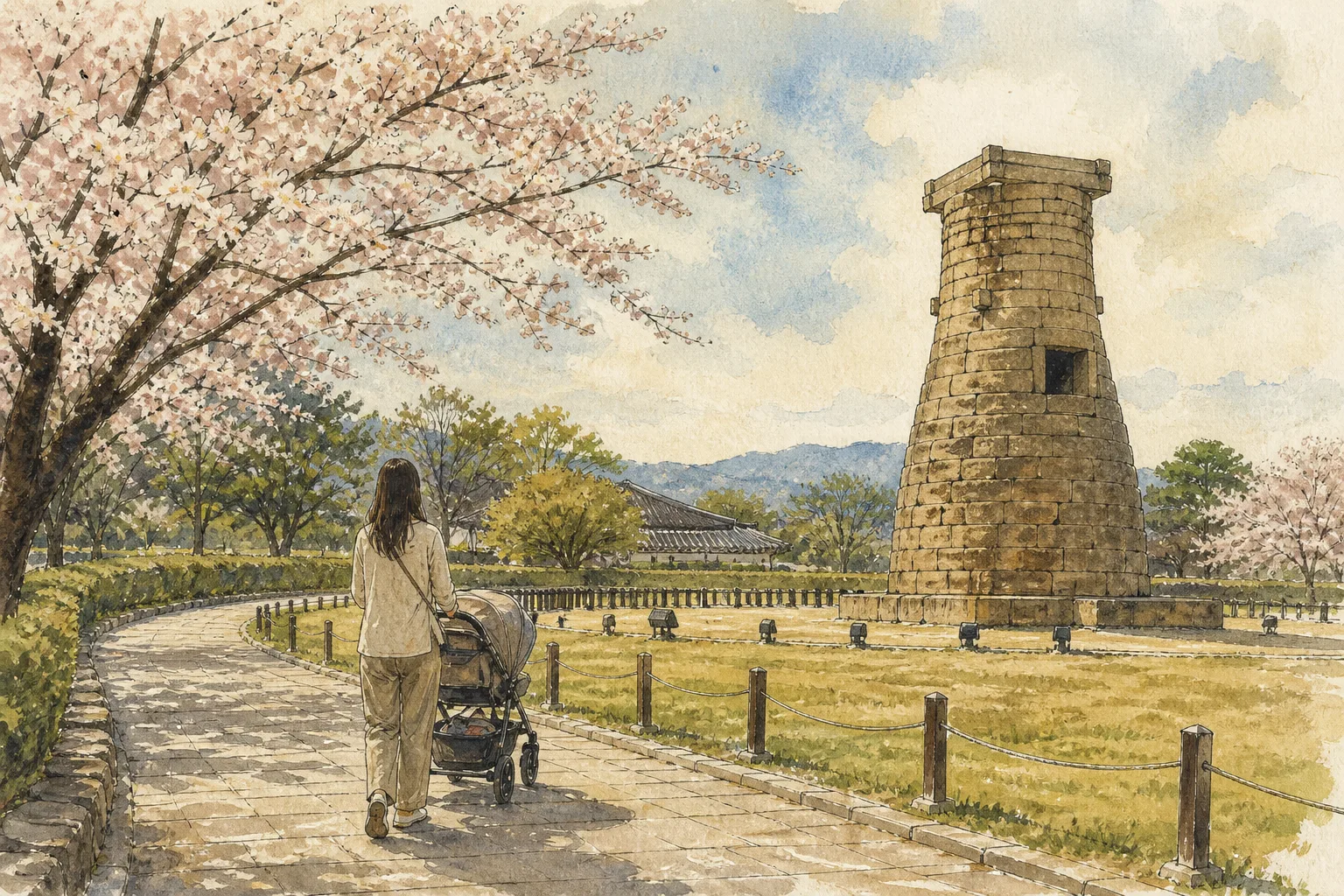
Choose Gyeongju with a stroller if your plan centers on the downtown historic core: Hwangridan-gil, Daereungwon, Cheomseongdae Observatory, Donggung Palace and Wolji Pond, and the Gyeongju National Museum. That corridor is flat, paved, and genuinely walkable with a toddler in a stroller for most of a day.
Skip the stroller-heavy plan, or budget for a baby carrier as backup, if Bulguksa Temple and Seokguram Grotto are non-negotiable stops. Both sites involve stone stairs that a stroller cannot climb, and Seokguram in particular ends at a staircase with nowhere to roll.
Strong fit: your itinerary is 70 percent or more downtown sites, you are comfortable folding a stroller once or twice for a bus or taxi, and you are traveling in the flatter, cooler months rather than fighting heat with a toddler.
Weak fit: you are set on seeing Seokguram Grotto up close with a toddler still in the stroller, you dislike carrying a folded stroller through crowds, or your trip is a single tight day with no slack for the extra time carrying adds.
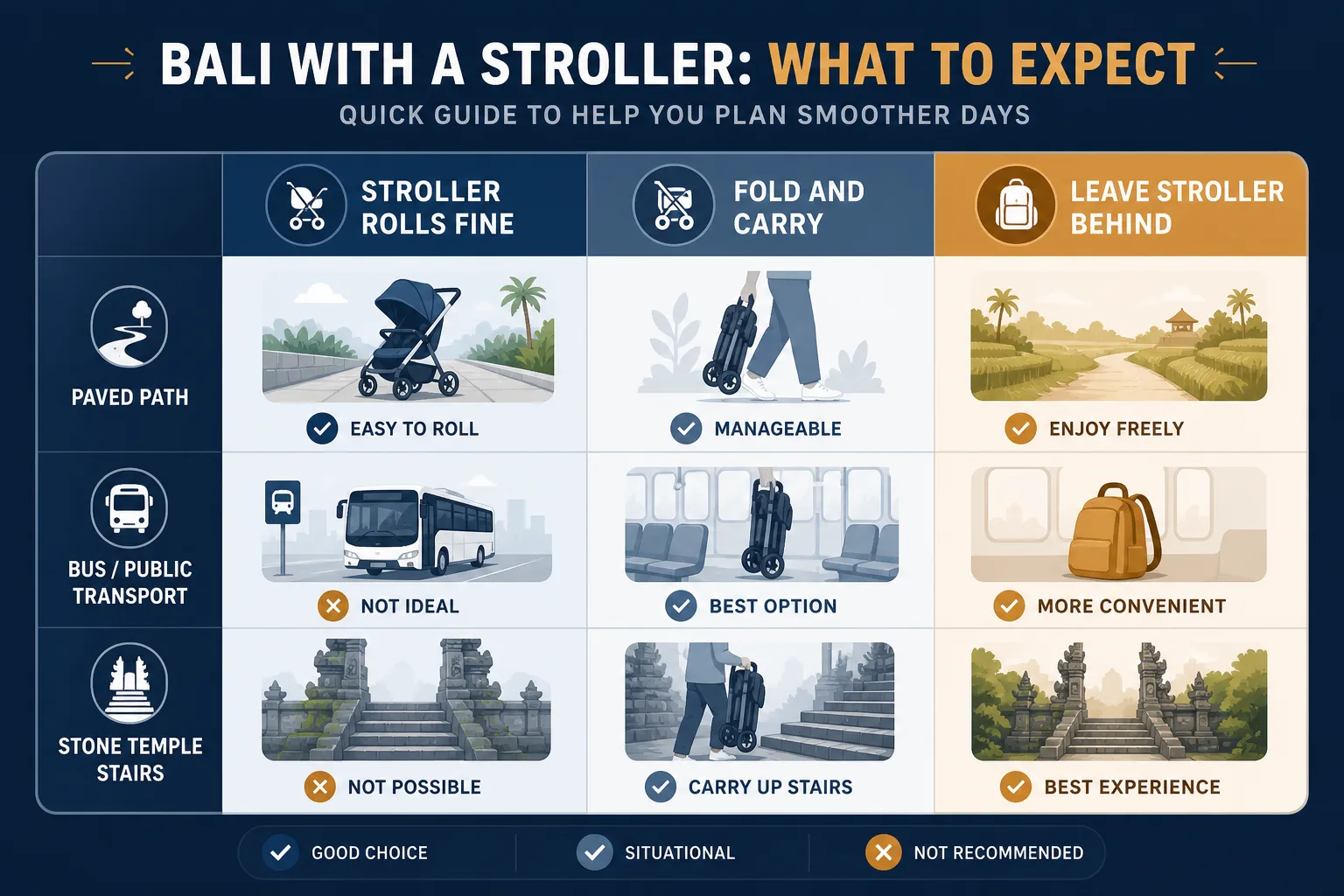 Editorial illustration: A clean simple comparison chart or table layout with three columns labeled roughly as 'stroller rolls fine'.
Main Friction Problem
The friction in Gyeongju is not the whole city; it is the specific transition points between "flat historic district" and "mountain temple complex."
Terrain challenges. Downtown Gyeongju was rebuilt around wide, paved pedestrian paths connecting its major tomb parks and landmarks, which is unusual for a Korean historic city and genuinely good news for strollers. Bulguksa and Seokguram sit on a mountain outside downtown, and their layouts predate any stroller consideration by centuries. Seokguram's approach ends at stone stairs leading to the main chamber, with no ramp or side path around them. Woljeonggyo Bridge has a second-floor history exhibit reachable only by a steep, narrow staircase, so that upper floor is off the table with a stroller regardless of how you get to the bridge itself.
Physical exertion. The cost here is not distance, it is elevation and stairs stacked on top of a full day of downtown walking. A toddler who napped through the flat morning at Daereungwon may be awake and heavy exactly when you reach Bulguksa's stairs in the afternoon. Parents underestimate this because the walking-distance numbers for the temple sites look moderate on paper; the exertion comes from carrying a stroller and a toddler up stairs, not from the walk itself.
Gear hassle. The buses that connect downtown to Bulguksa, including routes 10 and 11, are not low-floor models, which means folding the stroller before boarding every time, holding a toddler on your lap or hip while you do it, then unfolding again at the other end. Do this twice (there and back) and it becomes the most tiring part of the day, more than any single walk.
Friction Table
| Site or leg | Terrain | Physical exertion | Gear handling | Stroller verdict |
|---|---|---|---|---|
| Hwangridan-gil to Daereungwon (about 3 min walk) | Flat, paved | Low | None needed | Roll freely |
| Hwangridan-gil to Cheomseongdae (about 10 min walk) | Flat, paved | Low | None needed | Roll freely |
| Cheomseongdae to Donggung Palace (about 15 min walk) | Flat, paved | Low to moderate | None needed | Roll freely |
| Gyeongju National Museum | Flat, indoor and paved outdoor | Low | Free rental available on-site | Roll freely, or rent there |
| Cheonmachong Tomb interior | Flat, paved inside the excavated tomb | Low | None needed | Roll freely |
| Downtown to Bulguksa by city bus (10 or 11) | N/A (transit) | Moderate (folding while holding toddler) | Fold required, not low-floor | Fold and carry |
| Bulguksa grounds (from top parking lot) | Mixed paths, some steps | Moderate | Partial fold likely | Mostly roll, some carry |
| Seokguram Grotto approach | Stone stairs, no ramp | High | Leave stroller at base | Leave stroller, carry toddler |
| Woljeonggyo Bridge, ground level | Flat, paved | Low | None needed | Roll freely |
| Woljeonggyo Bridge, second-floor exhibit | Steep narrow stairs only | High | Not stroller-compatible | Skip with stroller |
| KTX Gyeongju Station to downtown | Road transit, 10 km | Low (in taxi), moderate (on bus) | Taxi avoids folding; bus does not | Taxi preferred |
Who Will Feel It Most
Parents traveling with a single infant in a lightweight stroller feel the least friction. You can fold and unfold quickly, and a baby who naps through most transitions will not notice the bus stops or the parking lot drop-off at Bulguksa.
Parents with a toddler who wants to walk, be carried, and be pushed in rotation feel the most friction, because every transition point becomes a negotiation: fold the stroller, convince the toddler to walk or be carried, then find somewhere to park the stroller before the stairs at Seokguram. This is the group where a baby carrier as backup, not a replacement, makes the biggest practical difference.
Parents managing two children, one in a stroller and one walking, feel it hardest at Bulguksa and Seokguram specifically, since one adult typically ends up carrying the walking child up stairs while the other manages the stroller and bags. If that is your setup, treat the temple half of the day as a separate logistics problem from the downtown half, not a continuation of the same easy pace.
Parents whose itinerary skips the mountain temples entirely and stays in the downtown corridor plus the National Museum will barely notice any of this. The friction in Gyeongju is concentrated, not distributed evenly across the city.
How to Reduce the Friction
For terrain challenges: front-load your downtown walking day (Hwangridan-gil, Daereungwon, Cheomseongdae, Donggung Palace, the National Museum) into one full day where the stroller stays open the entire time. Treat Bulguksa and Seokguram as a separate half-day with a different mental model: this is a carrying day, not a rolling day.
For physical exertion: arrange a drop-off at Bulguksa's top parking lot near the main gate instead of walking up from the base. This single choice removes the steepest introductory climb and saves the exertion for inside the temple grounds, where you actually want the energy. For Seokguram, decide in advance whether the toddler will nap in a carrier for the stair section, and bring the carrier even if you have been stroller-only all trip.
For gear hassle: choose a stroller that folds in one motion if your itinerary includes the downtown-to-Bulguksa bus leg at all. If a taxi is within budget for that leg, it removes the folding problem entirely and is worth the cost difference on a day when you are already managing a tired toddler. Pack light at the temple sites specifically; a heavy diaper bag makes the stair-carrying section at Seokguram noticeably harder.
Better Alternatives
If Seokguram Grotto with a toddler in tow feels like more friction than it is worth, consider viewing it as optional rather than essential. Bulguksa alone, approached via the top parking lot, delivers most of the temple-visit experience with far less stair exposure, and it is a reasonable substitute if your goal is "see a major Korean temple," not "see this specific grotto."
If your priority is a genuinely low-friction day with a toddler, restructure the trip around the downtown historic corridor and the National Museum, and treat Bulguksa and Seokguram as a separate day-trip decision you make once you see how the toddler is handling the rest of the visit. This keeps the easy day easy and isolates the harder logistics into a contained, plannable block instead of scattering it across the whole trip.
If stairs and mountain terrain are a hard no for this trip, Gyeongju's downtown-only version is still a legitimate, complete visit; the temple sites are add-ons to the historic core, not the only reason to come. A family that skips the mountain temples entirely and spends two unhurried days downtown will likely have an easier trip than one that pushes through Seokguram on a tight schedule.
Decision Checklist
- Does your itinerary already lean mostly downtown (Hwangridan-gil, Daereungwon, Cheomseongdae, Donggung Palace, National Museum), or is it built around Bulguksa and Seokguram as the main event?
- Do you have a lightweight, quick-fold stroller, or a heavier model that will make bus transfers slow?
- Are you willing to arrange a drop-off at Bulguksa's top parking lot rather than walking up from the base?
- Do you have a baby carrier packed as backup for the Seokguram stone stairs, separate from the stroller?
- Is your Gyeongju day split into a "rolling" half (downtown) and a "carrying" half (temples), rather than treated as one continuous easy walk?
- Have you budgeted taxi money for the KTX station transfer and possibly the Bulguksa leg, instead of assuming the bus will be just as easy with a stroller?
- If a toddler naps unpredictably, does your schedule have slack for a stair-carrying stretch that takes longer than expected?
FAQ
Can I bring a full-size stroller to Gyeongju, or should I get a lightweight umbrella stroller? Bring a lightweight, easily foldable stroller if you have a choice. Downtown Gyeongju is flat and fine for any stroller, but city buses to Bulguksa are not low-floor, so you will fold the stroller to board. A compact umbrella stroller folds faster and is easier to carry up the stairs at Woljeonggyo Bridge or hold while you queue at Seokguram.
Is Bulguksa Temple stroller-accessible? Partially. You can avoid the steepest approach walk by arranging to be dropped off at the top parking lot near the main gate, which removes most of the climbing before you even start pushing. Inside the temple grounds, paths are mixed, and you should expect some sections where you carry rather than push.
What about Seokguram Grotto with a stroller? Plan to leave the stroller at the bottom of the stone stairs, since there are no stroller rentals on site and the final approach to the main stone chamber is stairs only. If you are taking a toddler up to see the grotto itself, budget for carrying that last stretch, ideally with a baby carrier rather than the stroller.
Do I need a taxi from the KTX station, or is there a stroller-friendly bus option? Either works logistically, but a taxi is easier with a stroller and luggage. KTX Gyeongju Station sits about 10 kilometers from downtown, roughly a 15 to 20 minute taxi ride versus a 30 minute bus ride. The taxi avoids folding the stroller and managing bags on a bus at the same time, which matters more with a tired toddler after a train ride.
Are there places in Gyeongju where I will not need the stroller folded at all? Yes. The Hwangridan-gil to Daereungwon to Cheomseongdae to Donggung Palace corridor is walkable and paved, and it is realistic to keep the stroller open the whole time. The Gyeongju National Museum is also fully stroller-friendly, with free admission and free stroller rentals at the main desk if you want to leave your own stroller at the hotel.