travel-decisions
Is Gyeongju a Nightmare for Strict Vegan Travelers, or Can You Easily Find Plant-Based Korean Food?
A direct fit check for vegan and vegetarian travelers weighing Gyeongju: where the plant-based food actually is, where you will struggle, and who should skip it.
Quick Verdict
Gyeongju is a workable, not effortless, destination for strict vegan travelers. It is a strong fit if you plan your meals around three specific restaurants and accept that spontaneous eating outside them is risky. It is a weak fit if you want to wander and decide where to eat on the spot, the way you might in Seoul or Busan.
The city has exactly one fully vegan restaurant, one 100% vegan Buddhist temple-food restaurant, and one high-end vegetarian course restaurant. That is the entire dedicated list. Vegetarians have more breathing room than strict vegans, since a vegetarian course meal is easier to trust than a vegan-adapted dish at a general restaurant. Culinary-sensitive travelers who enjoy researching and pre-booking meals will find this manageable and even rewarding. Travelers who dislike planning food in advance will find Gyeongju frustrating.
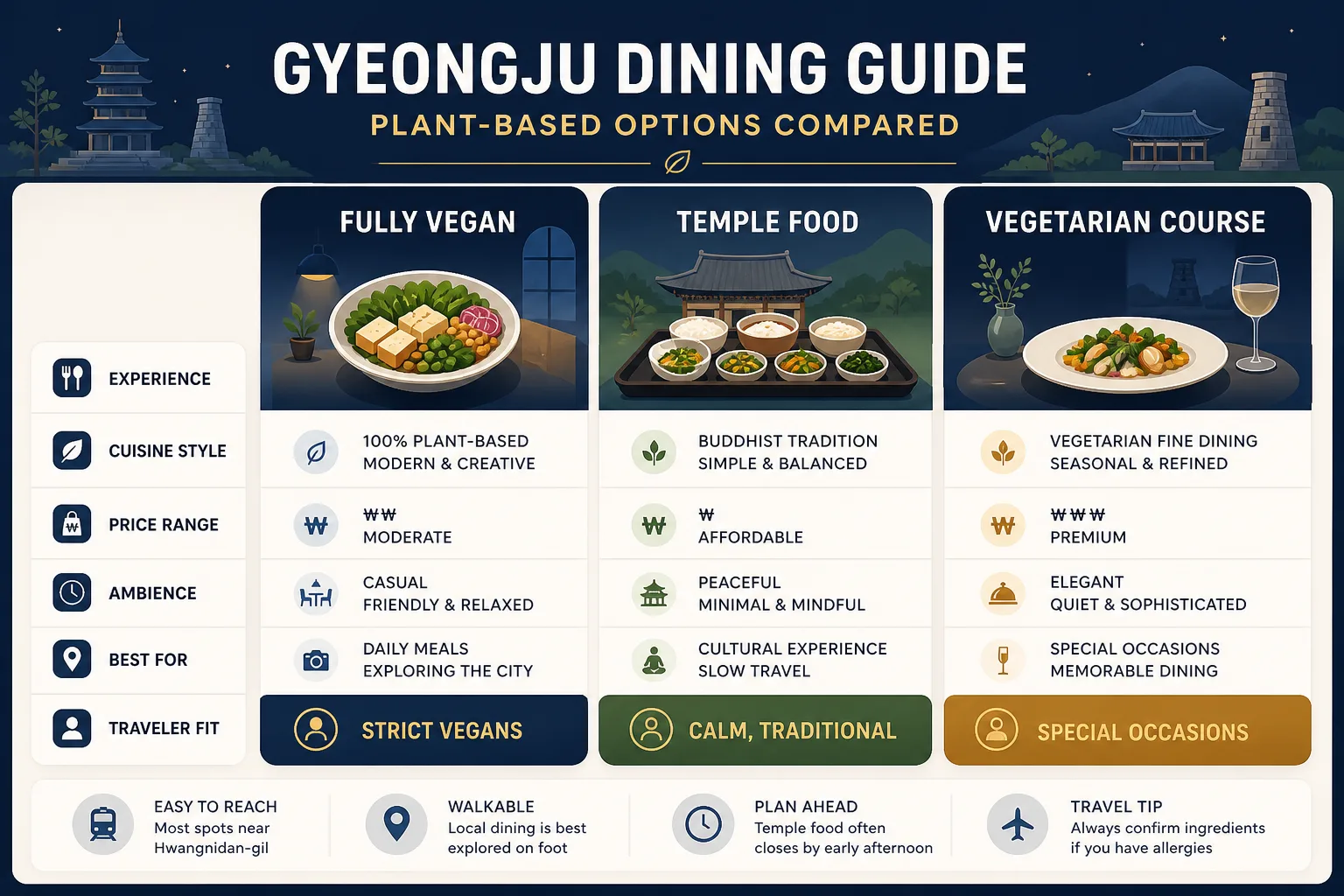 Editorial illustration: A simple decision table graphic comparing three Gyeongju dining options for plant-based travelers: a fully vegan restaurant.
Traveler Type Table
The real decision variable here is not "does Gyeongju have vegan food" (it does), but how much structure you are willing to build your day around to get it.
| Traveler type | What Gyeongju offers | The tradeoff | Fit |
|---|---|---|---|
| Vegan travelers (strict) | One fully vegan restaurant (Yella) plus one 100% vegan temple-food restaurant (Yeonhwa Baru) | Only two locations you can trust without questioning every ingredient; everything else requires vetting | Workable with planning, stressful without it |
| Vegetarian foodies | The same two vegan spots, plus a high-end vegetarian course restaurant (Ssukbujaengi) near Bulguksa | Wider margin for error since dairy and egg are less commonly hidden in Korean savory dishes than fish sauce or anchovy stock | Strong fit |
| Culinary-sensitive travelers (curious about temple food, provenance) | Genuine access to traditional Korean Buddhist temple cuisine, which is vegan by doctrine, not by trend | Requires booking ahead and eating on the restaurant's schedule, not yours | Strong fit if flexible on timing |
The pattern across all three: Gyeongju rewards travelers who treat meals as planned stops on a small, flat downtown circuit, and punishes travelers who expect food discovery to happen the way it does in a bigger city.
Best for First-Time Visitors
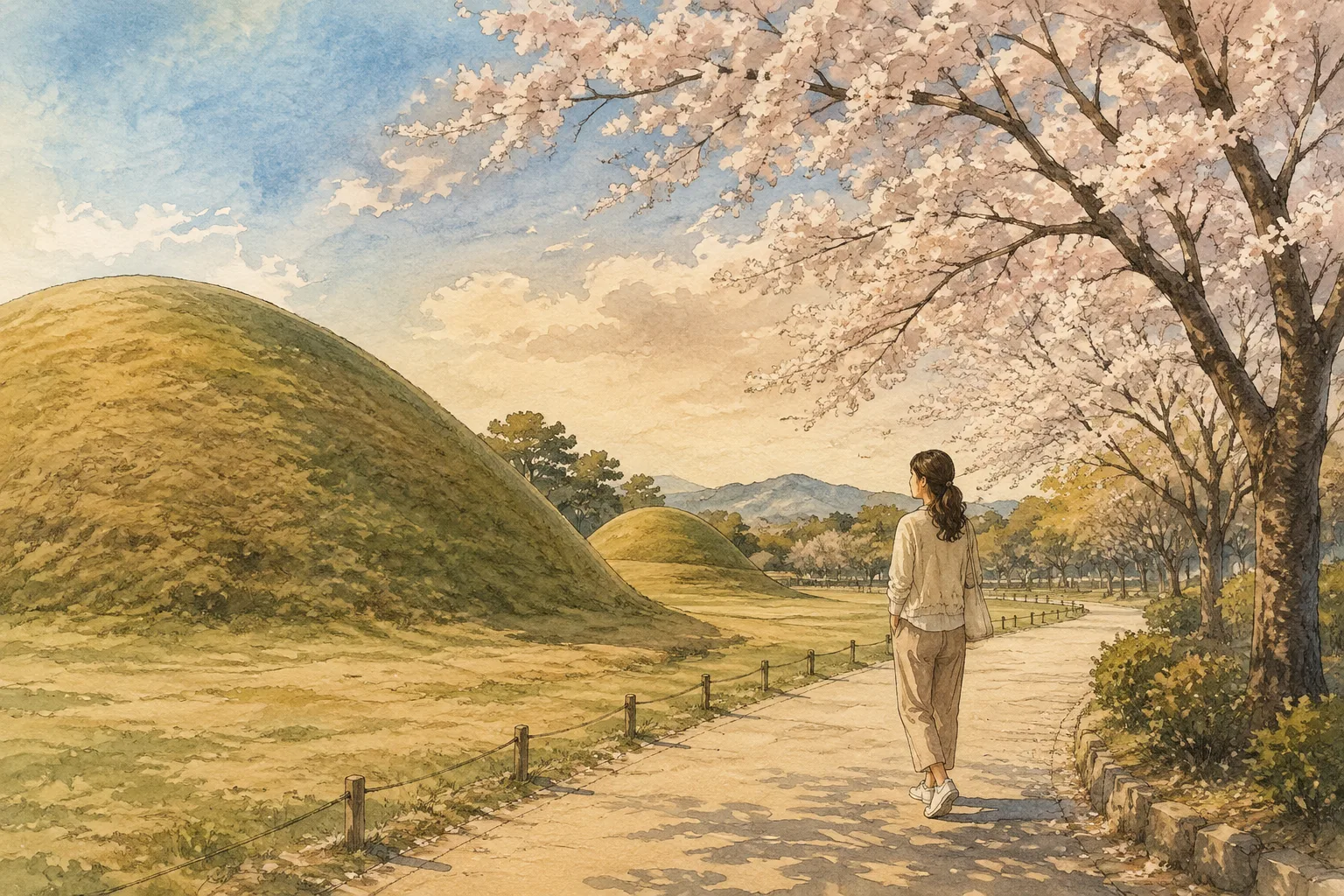
First-time visitors to Gyeongju who are also vegan or vegetarian have one advantage: the historic core is compact. Downtown sights sit inside a flat 2 km radius, and Hwangridan-gil, Cheomseongdae Observatory, and Daereungwon Tomb Complex are all within a 10 to 15 minute walk of each other. That means a vegan traveler can realistically build a day where sightseeing and a trusted meal (like Yella, near this same area) sit close together, instead of trekking across a sprawling city to reach the one restaurant that works.
Vegetarian foodies visiting for the first time should treat Ssukbujaengi, near Bulguksa, as a planned lunch stop tied to that specific sightseeing day rather than something to fit in wherever convenient, since it is not downtown.
Culinary-sensitive first-timers who want to understand Korean temple food as a tradition, not just a dietary workaround, get real payoff here: Yeonhwa Baru's course sets are an actual introduction to a centuries-old cuisine, not a diluted "vegan option" bolted onto a regular menu.
Best for Couples
Couples where one person is vegan and the other is not face the most friction in Gyeongju, more than in most Korean cities. General restaurants near Hwangridan-gil are not built for mixed-diet groups the way some Seoul neighborhoods are, so a couple often ends up choosing a dedicated vegan or vegetarian restaurant for both people rather than splitting into "one eats anything, one eats vegan."
The upside: Ssukbujaengi's course format and Yeonhwa Baru's temple-food sets are genuinely good meals, not compromise meals, so a non-vegan partner is not being dragged to a lesser restaurant. Couples who enjoy a slower, shared meal built around a fixed course menu will find these restaurants work well as date-style dinners, not just dietary accommodations. Couples who want more everyday flexibility, grabbing street food or a quick casual dinner on a whim, will feel the limits fastest, since Gyeongju's street food scene (hotteok, tteokbokki-adjacent stalls) is not reliably vegan-friendly by default.
Best for Slow Travelers
Slow travelers who stay several days and do not need a packed itinerary get the most value out of Gyeongju's small vegan food scene, because they have time to space out the three key restaurants across different days instead of scrambling to hit all of them before checking out. A multi-night stay, including a hanok stay from roughly $55 a night in the historic area, puts you within easy reach of Yella and Hwangridan-gil daily.
Slow travelers can also use extra time to call ahead or arrange Yeonhwa Baru's course sets in advance, which matters more for temple-food restaurants than for casual dining, since course meals are often prepared to order rather than held ready. Fast-paced travelers trying to see Gyeongju in a single day alongside Bulguksa and Seokguram will struggle to fit a proper vegetarian course meal into that schedule without it feeling rushed.
Best for Low-Stress Travelers
Low-stress travelers who want a businesslike, predictable trip should treat Gyeongju's food plan the same way they treat transit: decide in advance, don't improvise. That means picking which day you eat at Yella, which day (if any) you book Yeonhwa Baru or Ssukbujaengi, and building the rest of your meals around convenience store staples, fruit, and simple rice-based dishes you have already vetted, rather than hoping to find something new each night.
This approach removes almost all the food-related stress from a Gyeongju trip. The failure mode for low-stress travelers is arriving without a plan and assuming a small city with a big historic reputation will have vegan-labeled cafes on every corner the way Seoul's popular neighborhoods do. It will not. Travelers who accept that upfront and pre-plan two or three meals end up with a calm trip; travelers who don't plan end up hungry, frustrated, or eating something they didn't want to risk.
Common Mismatches
The most common disappointment pattern is a traveler who assumes Gyeongju's food scene mirrors Seoul's. Seoul has a wide vegan restaurant density and delivery-app filtering that lets vegans discover new places daily. Gyeongju has three dependable sit-down options total. A traveler expecting Seoul-level spontaneity will feel Gyeongju is a "nightmare," not because vegan food is absent, but because it does not appear where and when they expect it.
A second mismatch: travelers who assume "vegetarian" and "vegan" are treated the same by staff at general restaurants. Hidden animal products, particularly fish sauce, anchovy-based broths, and shrimp paste, are common in Korean savory cooking and not always disclosed unless you ask directly, and language barriers make that harder outside the three dedicated restaurants. Vegetarians who eat dairy and egg have more room here than strict vegans, who need to be far more deliberate about where they eat.
A third mismatch: travelers expecting temple food to taste "safe" or bland because it's restrictive. Temple food also excludes the five pungent herbs (onion, garlic, chives, green onion, leek), which changes the flavor profile from what most travelers expect from Korean food generally. Culinary-sensitive travelers tend to appreciate this; travelers who just want familiar Korean flavors in vegan form may find it unexpected.
Final Match Recommendation
Choose Gyeongju as a vegan or vegetarian traveler if you are willing to plan two or three meals around Yella, Yeonhwa Baru, and Ssukbujaengi, you enjoy temple food or vegetarian course dining as part of the cultural experience rather than a diet workaround, and you are staying multiple days or traveling at a slower pace that allows advance booking.
Do not choose Gyeongju, or plan very carefully if you must, if you need constant food flexibility, travel with a mixed-diet group expecting broad restaurant choice, or are passing through on a single tight day alongside major sights like Bulguksa and Seokguram with no meal buffer. In that scenario, the food logistics alone can turn a short visit stressful.
The honest middle ground: Gyeongju is not a vegan food destination the way Seoul or Busan can be, but it is not a nightmare either. It is a city where plant-based eating is entirely possible with a short, specific list and some advance intent, and entirely frustrating without either.
FAQ
Does Gyeongju have any fully vegan restaurants? Yes, but only one. Yella, on Taejong-ro 791beon-gil, is Gyeongju's only restaurant that is entirely vegan by menu design, not just vegan-adaptable. Everything else on your plant-based list is vegetarian-friendly or vegan-by-tradition, not vegan-labeled.
Is Korean temple food actually vegan? Yes, strictly. Traditional Korean temple food excludes all animal products and also the five pungent herbs (onion, garlic, chives, green onion, leek), which makes it stricter than most Western vegan cooking in one direction and unusual in another. Yeonhwa Baru serves 100% vegan temple-food course sets, so this is a genuine, reliable option, not a workaround.
Can vegetarians eat well in Gyeongju even if they are not strict vegan? Yes, more easily than strict vegans. Ssukbujaengi near Bulguksa runs a 7 to 10 dish vegetarian course, which gives vegetarian foodies a proper sit-down meal without needing to inspect every ingredient, something strict vegans still have to do even there.
How much extra planning does a vegan trip to Gyeongju require compared to Seoul? Meaningfully more. Seoul has dozens of vegan-labeled restaurants and delivery apps with filters; Gyeongju has three reliable sit-down options total. Plan meals around those three locations and their opening hours rather than expecting to find something nearby whenever you get hungry.
Is language a real barrier for ordering vegan food in Gyeongju? It can be, outside the three dedicated restaurants. Menus at general restaurants are rarely translated in detail, and staff may not know every hidden ingredient (fish sauce, anchovy stock, lard) in a dish. Inside Yella, Yeonhwa Baru, and Ssukbujaengi this risk mostly disappears because the entire menu is already built for your diet.