travel-decisions
Is Busan a Good First Trip for Travelers Who Want Easy Logistics?
A decision-first look at whether Busan is a good first trip for travelers who want easy logistics, covering arrival, hotel base, daily navigation, and who should skip it.
Quick Verdict
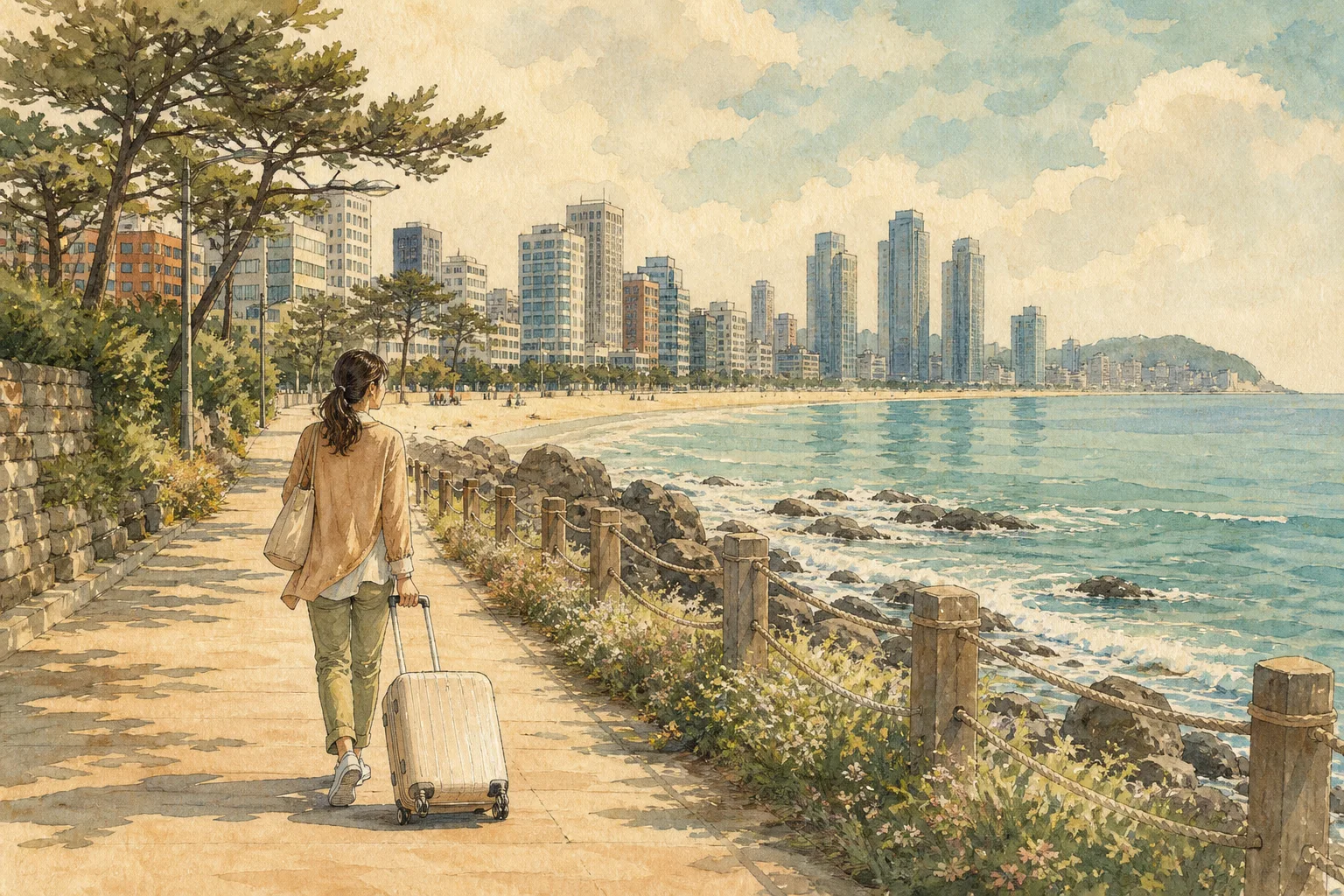
Busan is a good first trip if you want a coastal city that is easier to navigate than a sprawling capital, and you are willing to make one deliberate decision up front: where you sleep. It is a weak fit if you want to wing your hotel choice or expect every neighborhood to feel a short walk from the next.
Choose Busan for an easy-logistics first trip if you:
- Are comfortable booking a hotel near a subway line before comparing every listing on price
- Want a trip with a clear "beach side" and "old town side" rather than one dense center
- Are traveling as a couple or solo and can plan two to three anchor days instead of a packed itinerary
Skip Busan, or treat it as a second Korea trip instead of a first, if you:
- Tend to book hotels last-minute based on photos rather than transit access
- Want everything walkable from one hotel without checking a map first
- Are arriving with tight day-of-arrival plans and no buffer for a 40 to 80 minute transfer from the airport
The core tradeoff: Busan rewards one good hotel-location decision with a genuinely low-stress trip, and punishes a careless one with a week of longer-than-expected transit. That single decision point is why this is a traveler-fit question, not just a city-quality question.
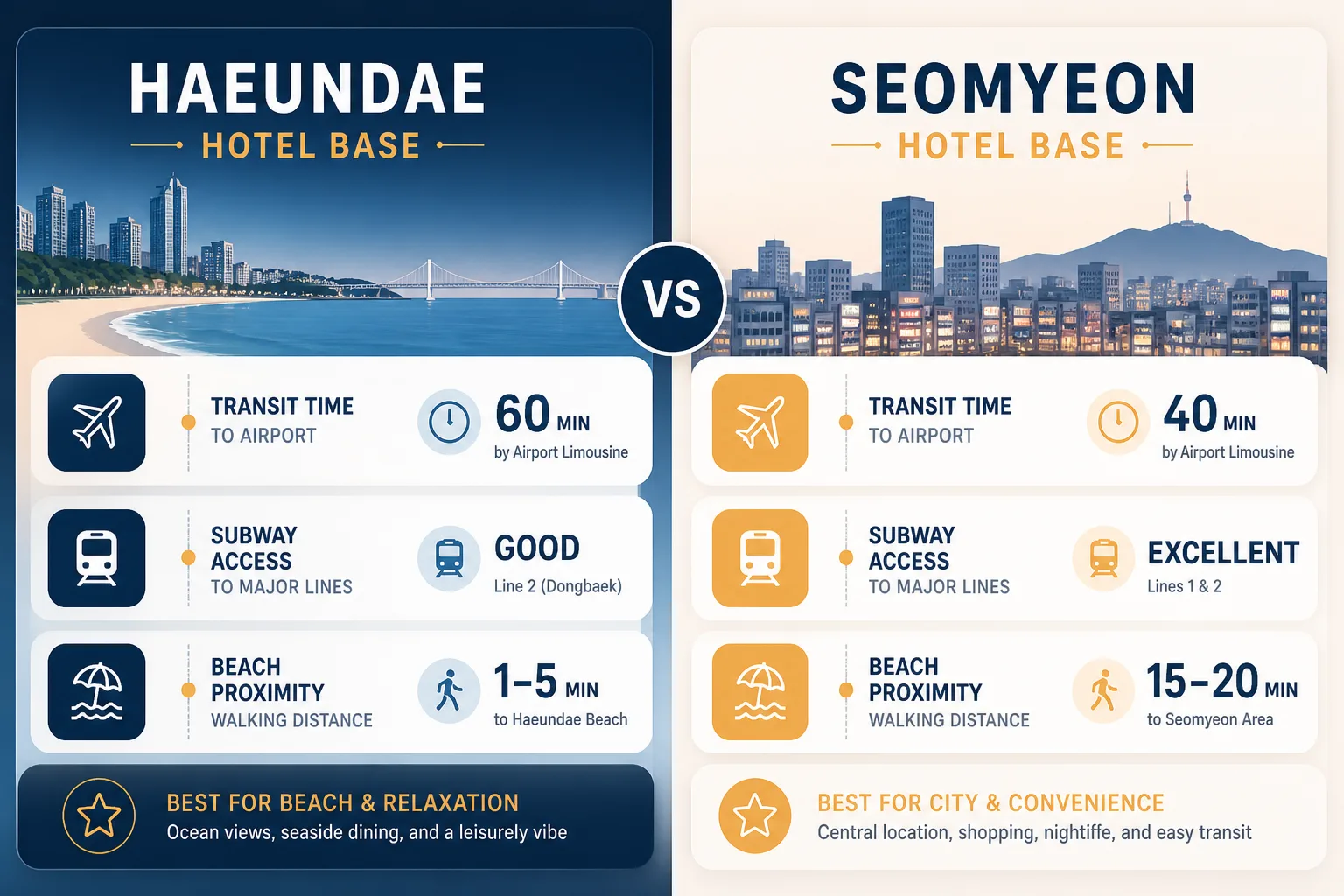 Editorial illustration: A simple side-by-side data comparison layout with two labeled columns.
Traveler Type Table
The real decision variables in Busan are not "things to see" but "how much transit friction you are willing to accept in exchange for what." Gimhae International Airport sits about 30 kilometers from Haeundae, the most popular hotel district, so every first-time visitor faces the same opening question: how do I get from the airport to my hotel, and does my hotel put me near a subway line for the rest of the trip.
| Traveler type | What they need from Busan | Where the friction shows up | Good fit or risk |
|---|---|---|---|
| First-time visitors | A simple mental map: one main base, short list of anchor sights | Arrival from Gimhae Airport (30 km to Haeundae) | Good fit if they pick a subway-connected hotel before arrival |
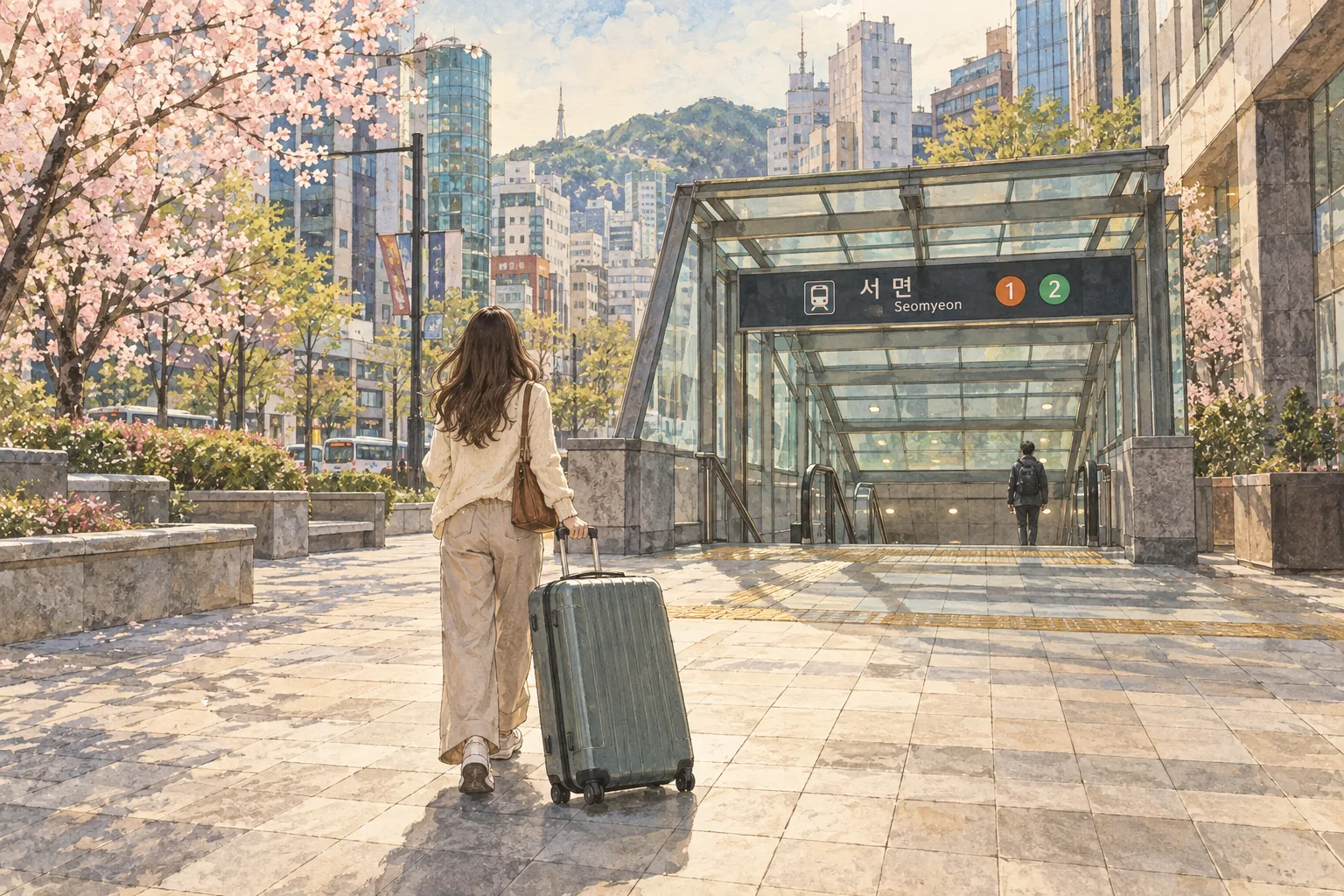
| Low-stress planners | Predictable transit times, minimal re-routing mid-trip | Line transfers (e.g., Line 1 to Line 2 at Seomyeon) | Good fit; Busan's transfer network is small enough to learn in a day |
| Couples | A base with both practical transit and a pleasant evening walk | Hotel location risk: beach vibe vs. transit efficiency | Good fit if they accept a short tradeoff either way |
| Slow travelers | Fewer, longer stays in one area rather than daily relocation | Cross-city trips (e.g., Haeundae to Gamcheon) take over an hour | Mixed fit; works if they accept one long day trip, not several |
| Budget-driven bookers who skip location research | Cheapest available room | Discovering the hotel is 45+ minutes from anything by transit | Poor fit; this is the main regret pattern in Busan |
The pattern across every row is the same: Busan's logistics are easy only after the hotel-location decision is made well. Nothing else in the trip creates as much variance in daily stress.
Best for First-Time Visitors
First-time visitors do best in Busan when they treat the airport transfer as the first test of the trip, not an afterthought. From Gimhae International Airport, the eco-friendly Airport Limousine Bus 1 costs KRW 9,500 and takes 60 to 80 minutes to Haeundae-Gijang, while a taxi runs KRW 30,000 to 45,000 and takes 40 to 60 minutes. Neither option is complicated, but both require accepting that the ride is closer to an hour than 20 minutes, since the airport and the main hotel district sit roughly 30 kilometers apart.
For a first-timer, the practical decision is: bus if you are comfortable with luggage and don't mind the extra 20 to 30 minutes, taxi if you land tired or late and want a direct door-to-door option. Either choice is fine. What matters is knowing the number in advance so it does not read as a bad surprise after a long flight.
First-time visitors who also arrive by KTX from Seoul face a similar choice at Busan Station: the subway (Line 1, transfer to Line 2 at Seomyeon, 50 to 60 minutes, KRW 1,700 to 1,800) or the direct 1001 or 1003 express bus to Haeundae Beach, which has front-bus luggage storage and takes 45 to 80 minutes for KRW 2,100. The bus is the lower-decision option for someone still adjusting to the city; the subway is fine once you already have the KakaoMap or Naver Map app installed and working, since Google Maps does not give reliable walking directions in Korea.
Best for Couples
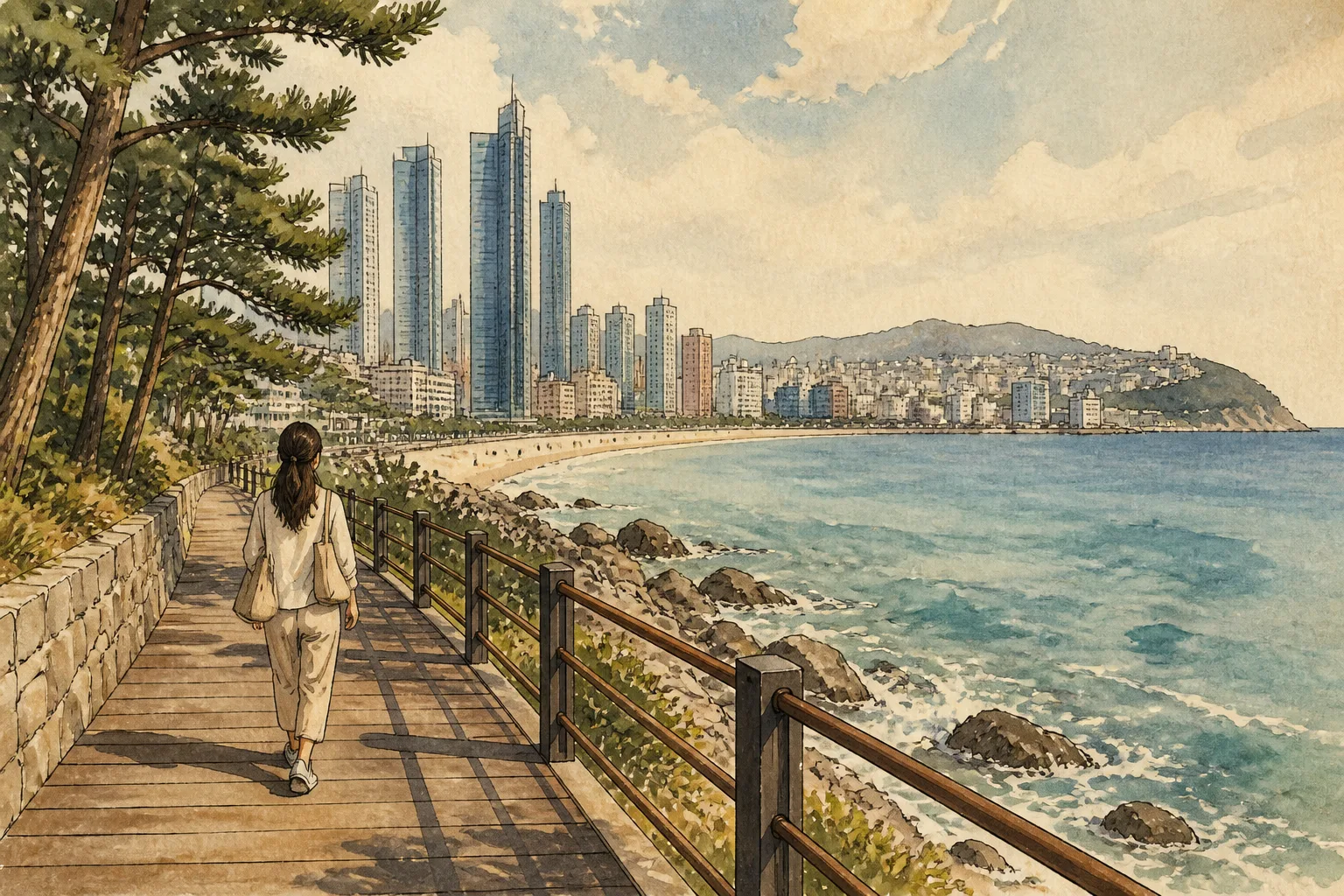
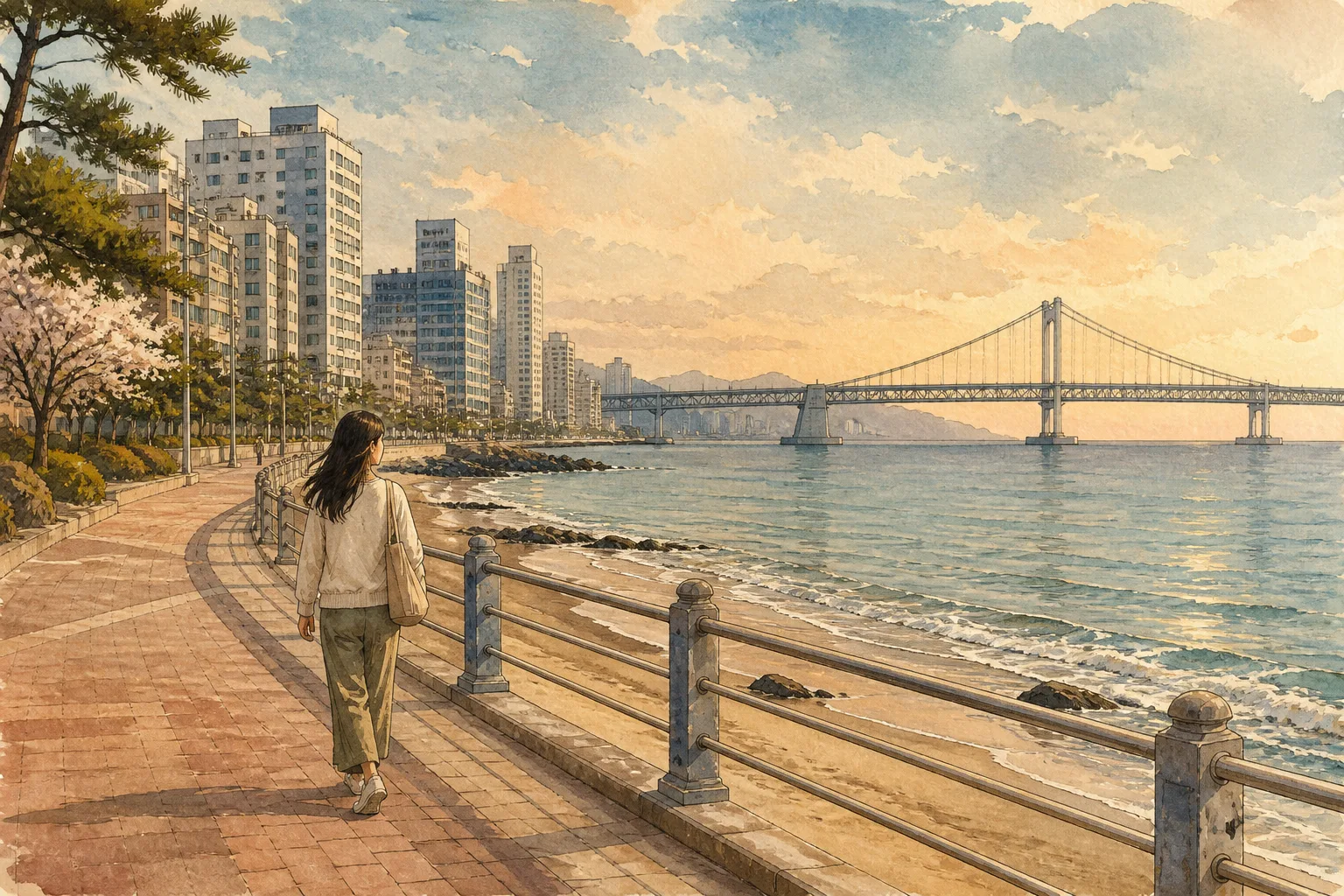
Couples get a specific benefit from Busan that solo low-stress planners do not always prioritize: a base that doubles as an evening activity. Haeundae works well for couples because a flat, walkable coastline is part of the appeal, not just a means of getting from A to B. The entrance to Haeundae Blueline Park at Mipo Station, for example, is a flat 12-minute walk along the coast from the center of the beach, which makes for an easy shared evening walk without a transit decision attached to it.
The tradeoff for couples choosing Haeundae is accepting a longer trip on any day that includes western Busan sites like Gamcheon Culture Village, which run over an hour from Haeundae by transit. For most couples on a first trip, this is a reasonable exchange: one longer day trip in return for a hotel district that feels good to walk around in every evening. Couples who care more about minimizing total transit time than about a beach-adjacent evening walk should weigh Seomyeon instead, since it sits at the direct junction of Metro Lines 1 and 2.
Best for Slow Travelers
Slow travelers, meaning those who prefer to settle into one or two areas rather than criss-cross the city daily, are a reasonable fit for Busan but need to plan around one structural fact: Busan is elongated along the coast, and staying in Haeundae puts you over an hour from western historical sites like Gamcheon Culture Village. A slow traveler's instinct to "just relax and explore nearby" works well within Haeundae or within the old town area, but does not work well if the itinerary assumes both areas are equally close.
The practical adjustment for slow travelers is to treat Busan as two loose zones rather than one city: an eastern beach-and-modern zone anchored around Haeundae, and a western historical zone anchored around Gamcheon Culture Village and the old port areas. Committing one full day to the western zone, rather than trying to fold it into a half-day between other plans, matches how slow travelers already prefer to move and avoids the frustration of a rushed hour-plus transit day.
Best for Low-Stress Travelers
Low-stress travelers, who want predictable transit and minimal on-the-fly decisions, benefit most from Busan's smaller subway network compared to a capital-sized city, but only if they lean into the few fixed tools that make it predictable. An unlimited 1-Day Subway Pass costs KRW 5,000 and removes the small daily decision of calculating individual fares. Installing Naver Map or KakaoMap before arrival removes the larger and more stressful problem of Google Maps failing to give reliable walking directions in South Korea.
The other low-stress lever is accepting local transit help instead of walking when a route is inconvenient. The walk from Toseong Station up to Gamcheon Culture Village is a steep 30-minute uphill climb; taking one of the green mini-buses (Saha 1-1, Saha 1-2, or Seo-gu 2) from Exit 6 instead turns that into a 10 to 15 minute ride for KRW 1,300 to 1,600. A low-stress traveler who defaults to "take the short bus, not the long walk" will consistently have an easier trip than one who insists on walking every route Google-style.
Common Mismatches
The most common regret pattern in Busan is not about the city itself, it is about hotel selection. Travelers who book based on price or photos, without checking subway distance, frequently end up 40 to 60 minutes from everything they actually planned to do. Because Busan's neighborhoods can look close together on a map but are functionally separated by hills, coastline, and limited cross-town roads, this mistake is easy to make and expensive in time once discovered.
A second mismatch pattern involves travelers expecting a compact, single-center city similar to some other short-trip destinations. Busan does not have one central walkable core; it has several distinct pockets (Haeundae, Seomyeon, Nampo-dong/old town, Gamcheon) connected by transit rather than by foot. Travelers who arrive expecting to wander freely between all of them on a single day will be disappointed by how much of the day disappears into transit.
A third mismatch is the expensive novelty-experience trap. The Haeundae Sky Capsules look like a spontaneous activity in photos, but one-way tickets cost KRW 40,000 to 50,000 and must be booked online weeks in advance, since walk-up tickets are rarely available. Travelers who plan to decide on the day will likely be turned away, which is a small but avoidable disappointment for anyone who did not check this ahead of time.
Quick self-check before booking:
- I have chosen a hotel neighborhood, not just a hotel, and checked its nearest subway line
- I know my airport-to-hotel transfer time and cost in advance (bus vs. taxi)
- I have Naver Map or KakaoMap installed, not just Google Maps
- I have accepted that at least one day will involve 45+ minutes of one-way transit
- Any pre-booked, timed activity (like the Sky Capsules) is already reserved online
Final Match Recommendation
Choose Busan for a first trip focused on easy logistics if you are willing to make one upfront decision well: a hotel near a subway line, in either Haeundae for a beach-forward stay or Seomyeon for the shortest average transit to everything else. Both are legitimate choices; the mistake is not choosing between them, it is skipping the choice and booking on price or photos alone.
Do not choose Busan as a low-friction first trip if you plan to book your hotel at the last minute without checking transit access, if you expect to walk between every neighborhood without using the subway or a bus, or if you want zero long transit days at all. Busan can be an easy, low-stress destination, but it asks for a small amount of upfront planning discipline in exchange for that ease. Travelers who give it that planning get a genuinely manageable first trip; travelers who don't often end up blaming the city for a hotel-location decision that was actually the real cause of the stress.
FAQ
Is Busan easier to navigate than Seoul for a first trip?
Busan's subway system is smaller than Seoul's, which cuts down on route choices, but the city is more spread out along the coast, so hotel location matters more in Busan. If you pick a well-connected base like Seomyeon or Haeundae, daily navigation is generally simpler than Seoul. If you scatter your days across the east coast and the old west-side neighborhoods, Busan can feel more disjointed than Seoul because the distances are longer.
Do I need a car or private driver to get around Busan?
No. The subway, buses, and taxis cover the areas most first-time visitors want to see. A car adds parking and traffic stress that most visitors do not need. The main requirement is downloading Naver Map or KakaoMap before you arrive, since Google Maps does not give reliable walking directions in South Korea.
Should I split my stay between two neighborhoods in Busan?
For a first trip focused on easy logistics, no. Splitting hotels adds a repacking and re-orientation cost that undercuts the low-stress goal. A single well-placed base, with day trips out and back, keeps the trip simpler even if it means slightly longer transit on your Gamcheon Culture Village day.
Is Haeundae or Seomyeon the better base for a low-stress first trip?
Haeundae suits travelers who want beach access and are willing to accept a longer trip to western sites like Gamcheon Culture Village. Seomyeon suits travelers who want the shortest average trip to everything else, since it sits at the junction of Metro Lines 1 and 2, but it does not offer beach access on foot.
What is the single biggest logistics mistake first-time visitors make in Busan?
Booking a hotel based on photos or price without checking its distance from a subway line. Busan's neighborhoods can look close together on a map but sit 30 to 60 minutes apart by transit, and a poorly placed hotel turns every day into a longer commute than expected.