where-to-stay
Seomyeon vs Nampo-dong: Which Busan Base is Better for Travelers with Heavy Luggage?
A direct comparison of Seomyeon and Nampo-dong as a Busan hotel base for travelers with heavy suitcases, focused on stairs, transit friction, and luggage handling.
Quick Answer
Choose Seomyeon if you want a documented elevator route and easy subway transfers with heavy luggage. Choose Nampo-dong if you are prioritizing walkable old-town sightseeing and are comfortable handling your own transit choice for the first and last mile.
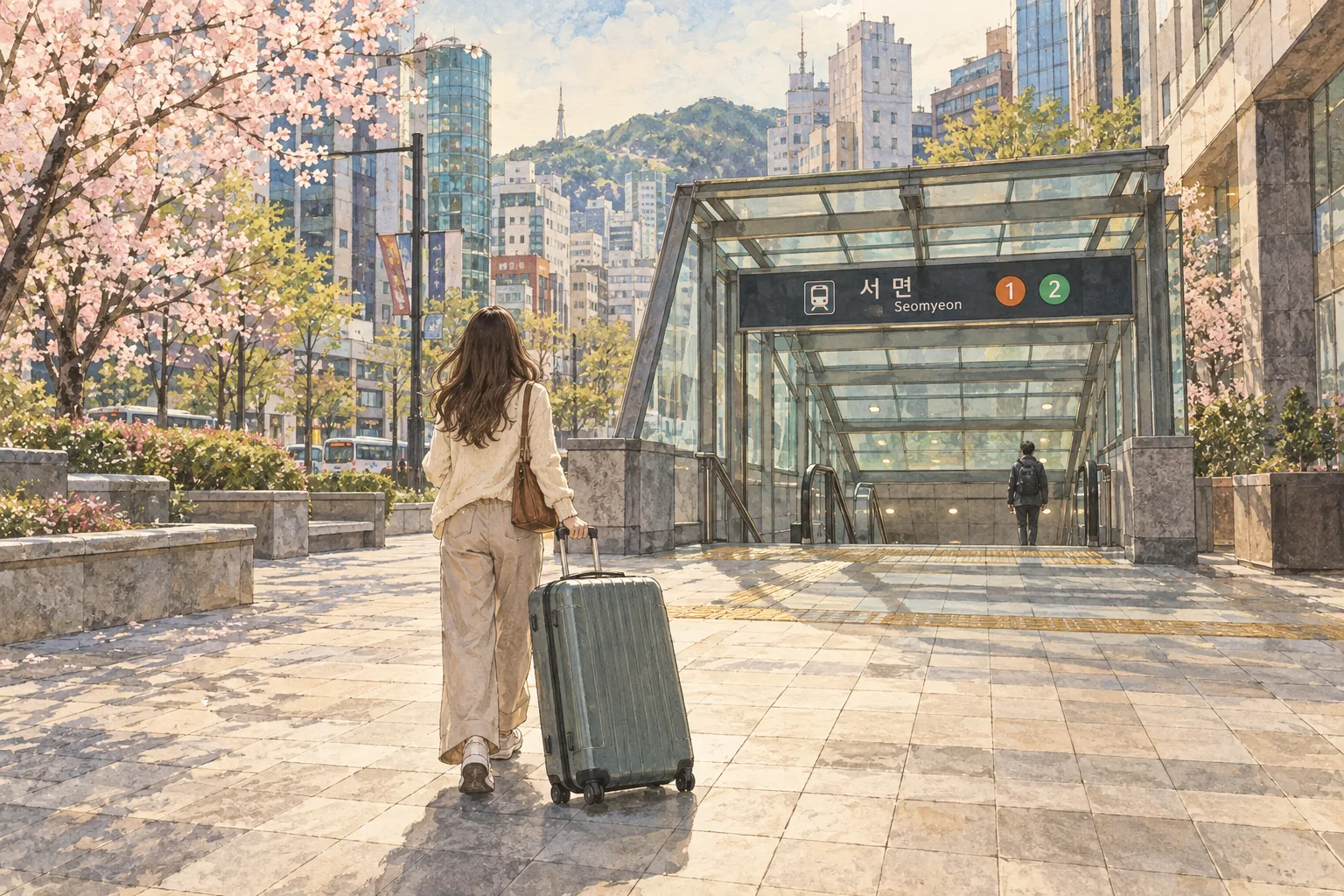
Seomyeon works best for travelers who want a confirmed elevator at the exit-to-surface segment, since it sits on a Line 1 and Line 2 interchange and Exit 9 has a documented elevator to a major hotel and shopping complex; the platform-to-exit portion inside the station is not documented, so if you cannot manage any stairs at all, verify that segment with the metro operator or your hotel before booking. It does not work well for travelers who want to walk straight into Busan's harbor, market, and film-district scenery, because Seomyeon is inland and functions more as a transit and shopping hub.
Nampo-dong works best for travelers who want to stay close to Jagalchi Market, BIFF Square, and the harbor, and who are willing to either take a short taxi from Busan Station or manage a direct subway ride with their bag. It does not work well for travelers who assume every station exit in the area has elevator access, because that is not documented across the district.
If you are choosing purely to reduce stair-climbing risk with a suitcase, Seomyeon is the one with a documented elevator route, so start your hotel research there. That is not a claim that Nampo-dong lacks elevators — it simply means you have to verify each Nampo-dong hotel's own entrance and lobby access yourself, since no area-wide elevator confirmation exists for that district. If you are choosing to minimize walking distance to Busan's classic sightseeing core once you arrive, Nampo-dong wins.
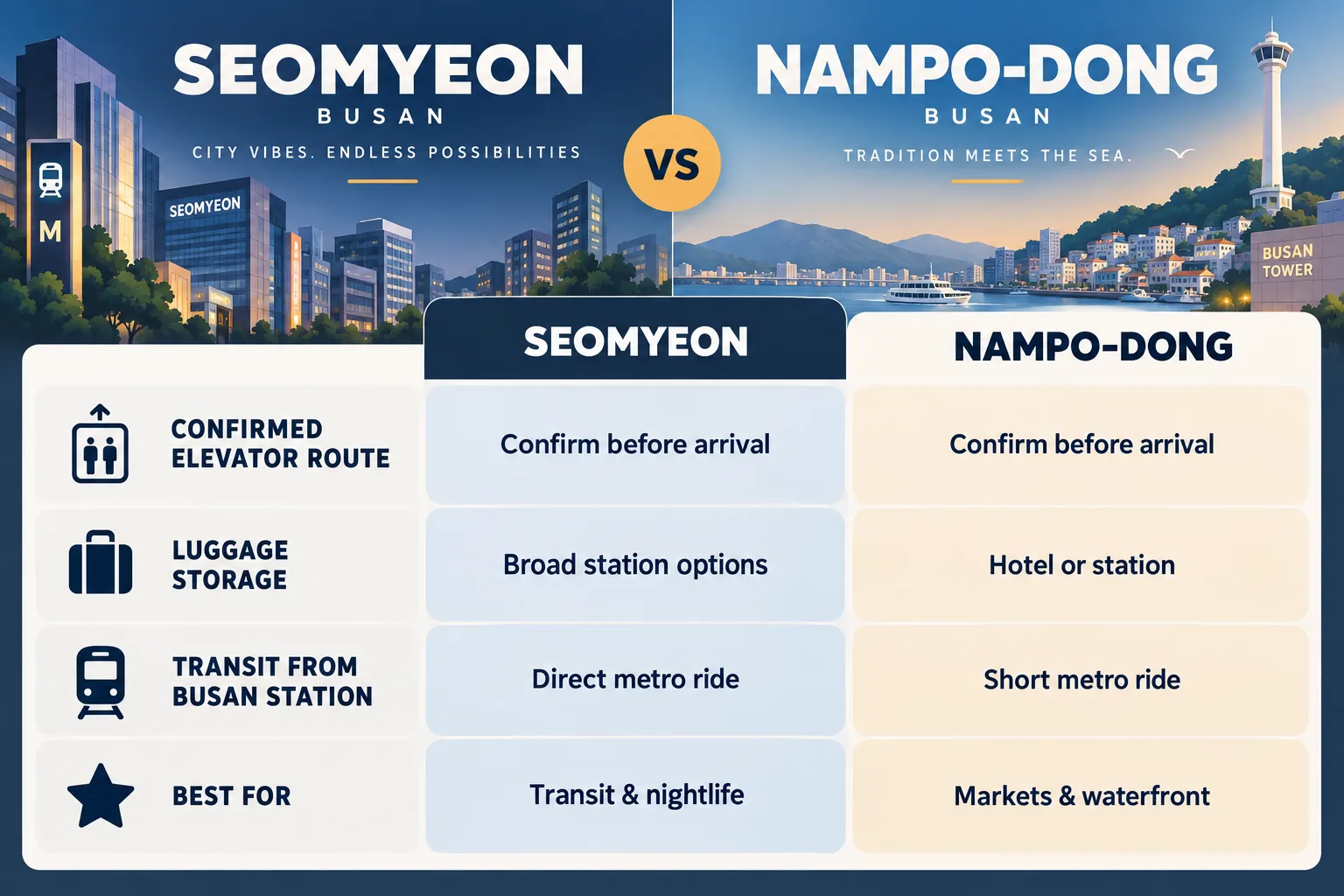 Editorial illustration: A simple side-by-side comparison table graphic with two columns labeled Seomyeon and Nampo-dong.
Hotel Location Risk Summary
The core risk in this decision is not the neighborhood's reputation. It is whether your specific hotel's entrance, lobby, and nearest subway exit force you to carry a suitcase up or down stairs.
Both Seomyeon and Nampo-dong sit directly on Busan Metro Line 1, so a train from Busan Station reaches either one without changing lines. The risk is not "no subway access." The risk is uneven elevator coverage inside each station and inconsistent building access once you leave the platform.
For transit practicality, Seomyeon has one clear, checkable advantage: Exit 9 has a confirmed elevator to the Lotte Hotel and Department Store level. Nampo-dong's advantage is different: it has more confirmed luggage storage points, useful if you want to explore hands-free before or after checkout rather than needing elevator access at every step.
For getting from Busan Station itself, you have two real options for both areas. A direct Line 1 train is workable if you can handle stairs or escalators with your bag along the way. A taxi removes that handling entirely and is worth the modest fare if your suitcase is heavy or you are traveling solo; note that Seomyeon's surface streets can see rush-hour traffic, so a train may actually be faster there at peak times.
Best Areas at a Glance
This is not a "both are fine" situation. The two areas solve different problems, and picking the wrong one for your priority creates real friction on day one.
| Factor | Seomyeon | Nampo-dong |
|---|---|---|
| Subway from Busan Station | Direct on Line 1, no transfer | Direct on Line 1, no transfer |
| Taxi from Busan Station | Workable alternative to avoid bag handling; watch rush-hour surface traffic | Workable alternative; fare runs close to the basic fare given the short distance |
| Confirmed elevator route | Exit 9 to Lotte Hotel/Department Store level | Not documented as consistent across exits |
| Luggage storage | Not documented as a strength | Lockers at Nampo Station and Jagalchi Station, plus Lotte Mart storage |
| Best for | Interchange convenience, travelers who need a checkable elevator path | Walkable old-town sightseeing, market and harbor access |
| Main tradeoff | Less walkable to harbor sights | Elevator access must be confirmed hotel by hotel |
The practical read: Seomyeon gives you one documented elevator at Exit 9 serving the Lotte Hotel/Department Store complex, while Nampo-dong gives you more places to offload your bag once you arrive. Neither claim extends further than what is confirmed above — the elevator covers that one exit-to-destination segment, not the full platform-to-street journey — so verify your specific hotel and exit before booking either one.
Best Area by Traveler Type
For luggage-heavy travelers, the deciding factor is a checkable elevator, not neighborhood charm. Seomyeon's Exit 9 elevator is specific and verifiable: if your hotel sits near the Lotte Hotel or Department Store complex, that exit has a documented elevator serving that destination. This does not confirm a stair-free route from the platform to the exit itself, and it does not extend to every exit or every building in Seomyeon, so match your hotel address to that specific exit and confirm the full route with the hotel or metro operator before assuming the whole area is easy.
For independent travelers managing their own bags without help, predictability matters more than adventure. Nampo-dong rewards independent travelers who want to lock a bag at Nampo Station, Jagalchi Station, or the connected Lotte Mart and walk the old town hands-free for a few hours. Seomyeon rewards independent travelers who need to move between neighborhoods by subway multiple times a day, since it functions as a transfer point between Line 1 and Line 2.
If you are both luggage-heavy and independent, the two priorities can pull in different directions. In that case, decide which friction you would rather manage: confirming one elevator route in Seomyeon in advance, or accepting a short taxi or direct train ride into Nampo-dong and locking your bag once you arrive.
Areas to Be Careful With
The mismatch risk in Nampo-dong is assuming every station exit is elevator-equipped because the area is walkable and touristy. That assumption is not supported by what is documented. Some exits and older buildings in the area may still involve stairs, so do not book on the assumption that the whole district is step-free just because lockers are available.
The mismatch risk in Seomyeon is assuming its status as a shopping and transit hub means it is close to Busan's harbor attractions. It is not. Travelers who book Seomyeon expecting Jagalchi Market or BIFF Square within walking distance will be disappointed, and they will end up on the subway or in a taxi anyway to reach those sights.
A second Seomyeon-specific risk is treating the Exit 9 elevator as proof the whole station, or the whole neighborhood, is step-free. The confirmed elevator covers the route to the Lotte Hotel and Department Store level, nothing more. If your hotel is elsewhere in Seomyeon, ask the property directly which exit is closest and whether that route includes stairs.
Both risks point to the same rule: check the specific hotel and the specific exit, not the district name. A district-level reputation for convenience does not guarantee your building has an elevator or a step-free lobby.
Budget vs Convenience Tradeoff
There is no confirmed area-wide price gap between Seomyeon and Nampo-dong. Rates in both areas move with season, hotel class, and how close a property sits to a station or landmark, so treat any claim of one area being cheaper overall as something to verify for your own dates, not a fact to plan around.
What you can control is the tradeoff between logistics and location premium. A lower rate anywhere only pays off if the hotel's stair situation is manageable; if saving money means climbing two flights with a heavy suitcase twice a day, the savings gets spent in fatigue, slower mornings, and a higher chance of missing a train connection.
A higher rate near Nampo-dong's harbor and market only makes sense if you will actually use that walkable access. If your itinerary mostly involves day trips elsewhere in Busan, you are paying a location premium for proximity you will not use, regardless of which area technically costs more on your travel dates.
Hotel Location Checklist
Before booking either area, verify these points directly with the hotel or on a map, not from the district's general reputation.
- Confirm which subway exit is closest to the hotel entrance and whether that exit has a confirmed elevator, not just an escalator or stairs.
- If considering Seomyeon, check whether the hotel connects to or sits near the Lotte Hotel/Department Store complex served by Exit 9; if it does not, ask the hotel directly about stair-free access from its nearest exit.
- If considering Nampo-dong, confirm the walking distance from the hotel to Nampo Station or Jagalchi Station, where lockers are available, and ask about the hotel's own entrance and lobby.
- Ask whether the hotel lobby is street-level or requires stairs to reach from the drop-off point, whether you arrive by taxi or on foot from the station.
- Decide in advance between a direct Line 1 train and a taxi from Busan Station; pick the taxi if your bag is heavy or you are traveling solo, and pick the train if you can manage stairs and want to avoid Seomyeon's surface traffic at rush hour.
- Compare actual room rates for your specific travel dates rather than assuming either area is the cheaper base by default.
Final Recommendation
Choose Seomyeon if your top priority is a checkable elevator at Exit 9 and you value interchange convenience over harbor-adjacent sightseeing. It suits low-stamina travelers, older travelers managing joint pain, and anyone who wants that elevator confirmed before they arrive — just verify the platform-to-exit route separately, since that segment is not documented.
Choose Nampo-dong if you are comfortable taking a direct train or a short taxi to bridge the first and last mile, and you want to be steps from Jagalchi Market, BIFF Square, and the harbor once you arrive. It suits independent travelers who plan to store their bag and explore on foot for a stretch of the day.
Do not choose either area based on general reputation alone. Confirm your specific hotel's entrance, nearest exit, and elevator status before booking, since both areas have real friction that a district name will not tell you.
FAQ
Is Seomyeon or Nampo-dong easier to reach from Busan Station with luggage? The subway on Line 1 reaches both directly, so a direct train is a valid option if you can manage your bag on stairs or escalators along the way. If you want to avoid handling your bag at all, a taxi is the luggage-friendly alternative for both areas, and the fare to Nampo-dong runs close to the basic fare because the distance is short.
Does Seomyeon Station have elevator access for suitcases? Exit 9 has a confirmed elevator that reaches the Lotte Hotel and Lotte Department Store level. That is the one segment that is documented as step-free; it does not confirm that every other exit or every hotel lobby nearby is equally accessible.
Where can I store luggage if I want to explore before hotel check-in? Nampo-dong has more confirmed options. Luggage lockers exist at both Nampo Station and Jagalchi Station, and the Lotte Mart connected to Nampo Station also offers storage.
Which area is better for a solo traveler who cannot manage stairs well? Seomyeon is the safer default to research first because Exit 9 has a documented elevator route to a major hotel and shopping complex. Still confirm your specific hotel's entrance, lobby floor, and the exit closest to it before booking, since that one elevator does not cover every building in the area.
Should I choose my hotel based on price or on luggage logistics? Logistics first, then compare price only between hotels that already pass the logistics check. A cheaper room that requires two flights of stairs with a heavy suitcase will cost you more in fatigue and time than the price difference saves you, and neither area has a confirmed area-wide price advantage worth chasing on its own.