travel-decisions
Is Busan Good for Travelers Who Want Quiet Nights?
A decision-focused look at whether Busan fits travelers who want calm evenings, low noise risk, and stress-free hotel returns instead of nightlife energy.
Quick Verdict
Busan works well for quiet-night travelers, but only if you treat neighborhood choice as the deciding factor, not an afterthought. Busan is a large coastal city with distinct zones: some built around nightlife and beach bar culture, others residential, calm, and asleep by 10 or 11 pm. The city itself is not "loud" or "quiet" as a whole. Your night is loud or quiet depending on which few blocks you sleep in.
Choose Busan if you are willing to research hotel placement before booking and you are comfortable trading a bit of nightlife energy for calm evenings. Do not choose Busan, or at least do not choose it without changing your plan, if you assume any coastal hotel will be peaceful by default, or if you want unpredictability and street energy as part of your trip.
Strong fit: you want a coastal city with real quiet options, you are willing to pick your neighborhood deliberately, and an early, calm evening matters more to you than being near bars.
Weak fit: you want a hotel booked purely on beach proximity or lowest price, with no attention to which side of the neighborhood it sits on, and you are hoping the destination itself guarantees quiet.
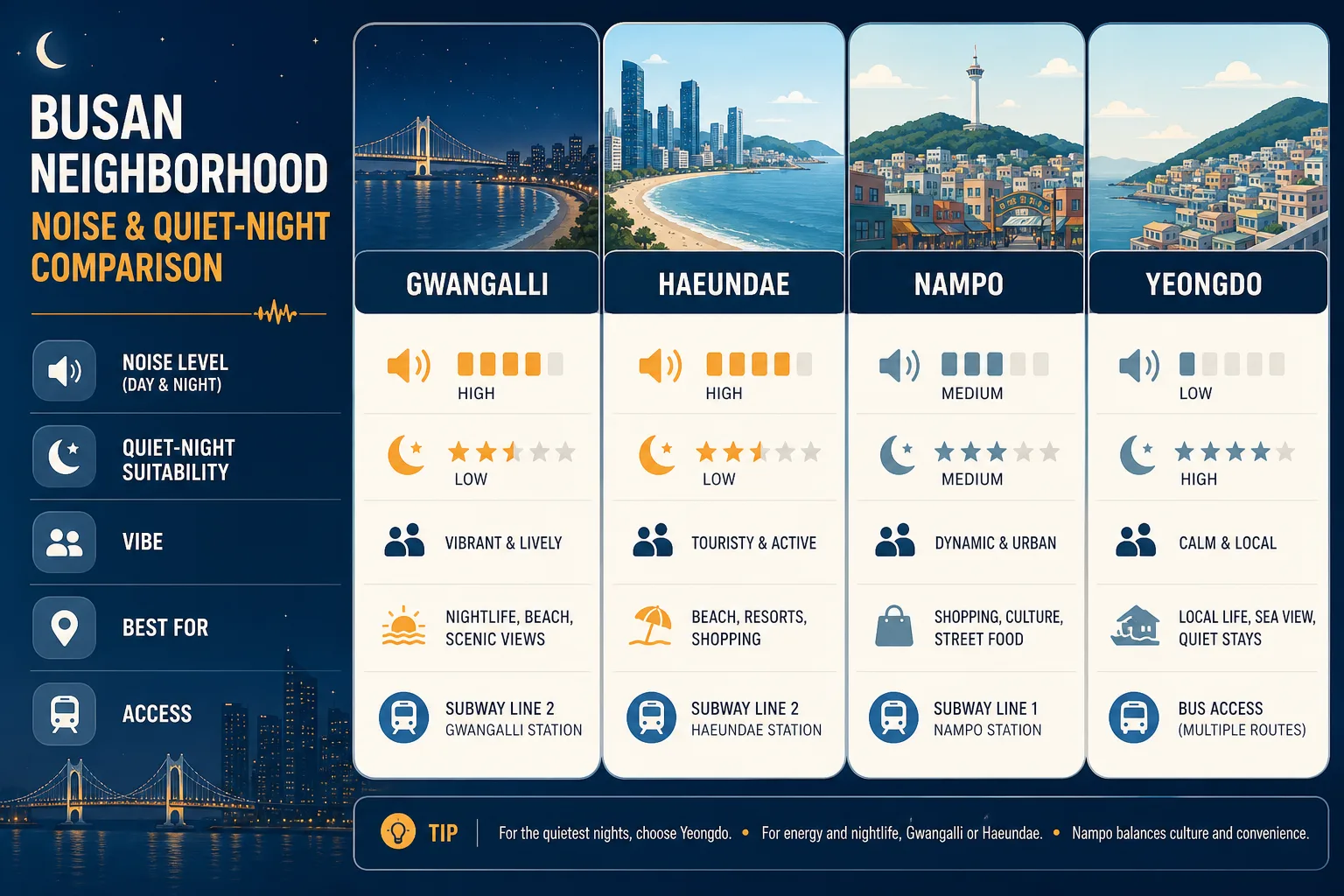 Editorial illustration: A simple comparison layout or table graphic contrasting Busan neighborhoods like Gwangalli.
Traveler Type Table
The real decision variable in Busan is not "is this city quiet" but "which of these specific tradeoffs am I choosing." Below is how the main traveler types line up against Busan's actual layout.
| Traveler type | What they actually need | Where Busan delivers it | Where it breaks down |
|---|---|---|---|
| Quiet-night travelers | Predictable calm after dark, minimal street noise near the hotel | Yeongdo, residential Haeundae side streets, quieter stretches away from the main beach promenades | Booking anything directly on Gwangalli's central strip or Haeundae's bar-facing blocks |
| Couples | Calm evenings plus easy, short walks back to the hotel without navigating crowds | Areas a short walk from a beach or scenic spot but off the main nightlife row | Underestimating how loud a "beachfront" address can be on a weekend night |
| Low-stress planners | A trip that does not require constant vigilance about noise, safety, or last-minute changes | Neighborhoods with predictable subway access and calmer late-evening patterns | Assuming all subway lines run as late as they need, or arriving after last trains without a backup plan |
The pattern across all three types is the same: Busan rewards travelers who decide on a neighborhood first and a hotel second, rather than picking a hotel by price or beach view alone.
Best for First-Time Visitors
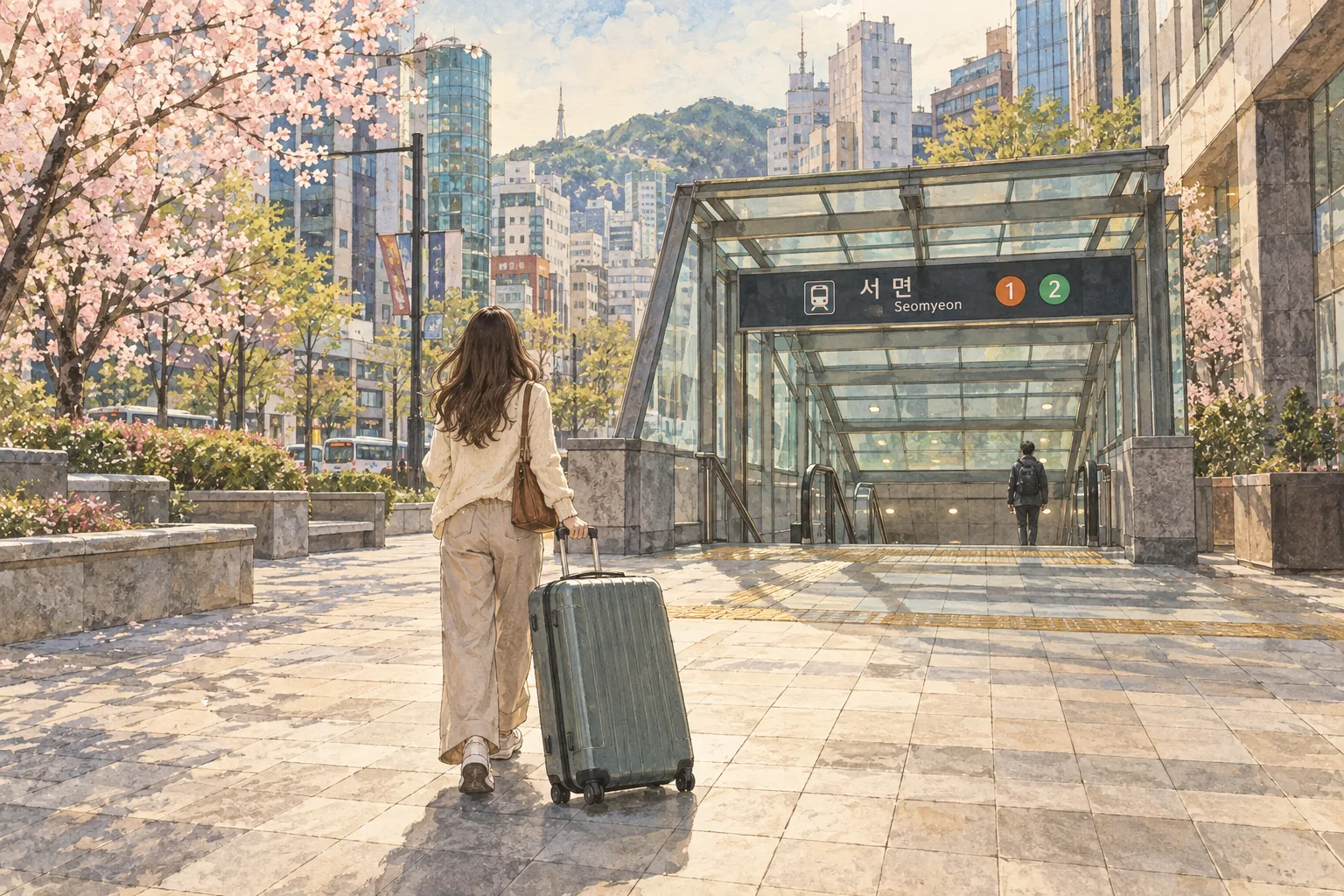
First-time visitors to Busan often default to Haeundae Beach because it is the most recognizable name, and that instinct is not wrong. Haeundae Station connects to the beach with a flat, straight 5-minute walk down Gunam-ro, which is convenient and low-effort. The friction shows up in exactly where along that strip you book.
Quiet-night travelers doing a first Busan trip should treat "Haeundae" as a zone, not a single quiet guarantee. A hotel a block or two back from the main beachfront bar cluster can be genuinely calm, while a room facing the promenade on a weekend night usually is not. Four-star hotels near Haeundae Beach run $110 to $250 USD per night on normal days, rising to roughly $220 to $300+ USD on weekends and peak summer, so the price tier alone does not tell you about noise exposure.
Couples on a first visit benefit from the same logic: pick the walk-back distance and street orientation over the address name. Low-stress planners should specifically ask, before booking, whether the room faces the beach promenade or a quieter interior street, since that single detail predicts more about the night than the neighborhood name does.
Best for Couples
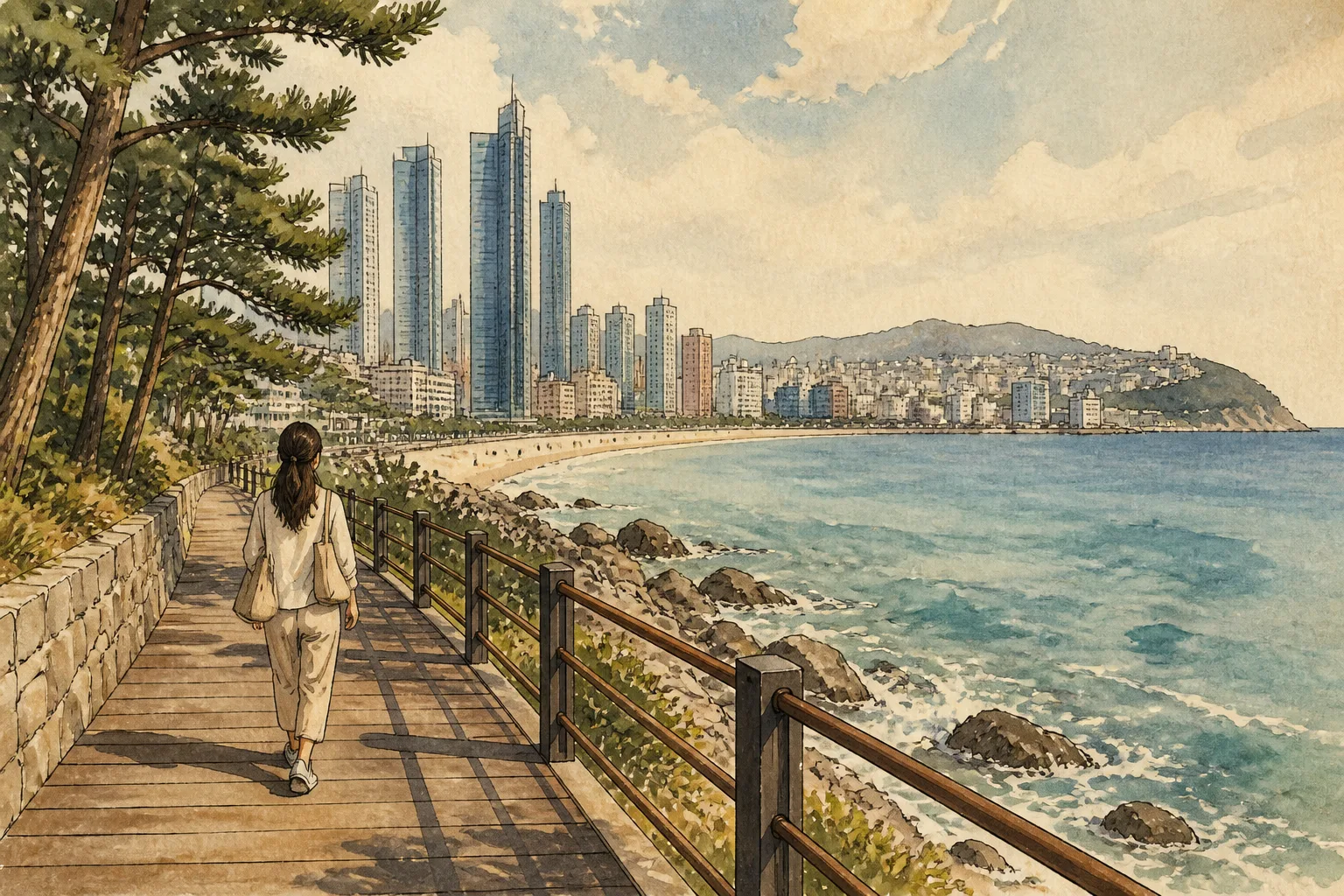
Couples chasing quiet nights in Busan have more flexibility than they might expect, because Busan's calmer areas are not hard to reach, they are just less marketed. Gwangalli Beach, reachable via a 5 to 10 minute walk from Gwangan Station Exit 5, has a lively central strip, but side streets and the far ends of the beach away from the bar row are noticeably calmer after dark.
For couples specifically, the tradeoff is usually romance-adjacent atmosphere versus guaranteed quiet. The Saturday Gwangalli M Drone Light Show is a real draw, running twice each Saturday evening for about 12 minutes, and it is worth timing a visit around if you want that moment without committing to staying in the loudest part of the strip afterward. A couple can watch the show, then walk or taxi back to a quieter hotel elsewhere rather than staying directly in the crowd zone.
Low-stress planners traveling as a couple should also factor in return-trip friction: Busan Metro Lines 1 and 2 run roughly 05:00 to midnight, with last trains departing terminal stations between 11:30 pm and midnight. If an evening runs late, that cutoff matters more to a couple who dislike scrambling for a taxi than it does to a solo traveler with more flexible plans.
Best for Slow Travelers
Slow travelers, who move at a lower daily pace and value mood over checklist coverage, are arguably the best-matched traveler type for a quiet Busan trip, because their itinerary style naturally avoids the friction points that trip up others.
A slow traveler is less likely to be out until 1 am chasing a full day's worth of sights, which sidesteps the late-return, last-train problem entirely. They are also more likely to notice and appreciate the quieter residential character of areas like Yeongdo, where casual hotel stays run around $35 to $50 USD per night and 4-star options like the Lavalse Hotel run $60 to $130 USD per night. Yeongdo is a 7 to 11 minute walk from Nampo Subway Station on the harbor side, close enough to stay connected without sitting inside a nightlife zone.
The one caution for slow travelers: Songdo Beach, sometimes recommended for its quieter character, lacks direct subway access and requires a 10 to 15 minute bus or taxi ride to reach the nearest stations (Jagalchi or Toseong on Line 1). A slow traveler who values low-effort mornings should weigh that extra transit step against the quiet payoff before committing to stay there.
Best for Low-Stress Travelers
Low-stress travelers are the group with the most to gain from planning Busan's night logistics in advance, because their core need is not just quiet, it is predictability.
The clearest predictability win is around late-night transport. Busan's metro system stops running by midnight, so a low-stress traveler should decide before going out whether they will be back before last trains or whether they are planning to taxi back. The math on that is straightforward: the standard taxi base fare is 4,800 KRW for the first 2 kilometers, with late-night surcharges of 20% from 11 pm to midnight, 30% from midnight to 2 am, and 20% from 2 am to 4 am. None of that is expensive in absolute terms, but knowing it in advance removes the stress of guessing. Foreign travelers can also use Uber, which dispatches UT taxis, or k.ride, a multilingual Kakao T version, both bookable with international credit cards, which removes the language-barrier stress some travelers worry about.
The second predictability win is neighborhood-level noise rules. Suyeong-gu enforced a complete ban on late-night eating and drinking at Millak Waterfront Park starting July 2023, which has kept that specific spot calmer at night than it might otherwise be. That is a useful data point for low-stress travelers: not all of Busan's waterfront behaves the same way, and local rules do shape which spots stay quiet.
Common Mismatches
The most common regret pattern is booking by beach name or price instead of by street-level position. A traveler who books "a hotel near Haeundae Beach" or "a hotel on Gwangalli" without checking whether the room faces the main strip or sits a block back is the traveler most likely to end up disappointed. The disappointment is rarely about Busan itself; it is about a room that turned out to be twenty meters from a bar row the traveler did not realize was there.
A second mismatch is the traveler who wants nightlife energy but books a quiet-leaning area like Yeongdo or a residential side street expecting easy access to bars and late food. That traveler experiences the opposite problem: an evening that feels too still, with limited late-night options and slightly longer trips back from anywhere lively.
A third mismatch involves last-train timing. Travelers who plan a late dinner or a bar hop without checking the roughly midnight metro cutoff sometimes end up stranded further from their hotel than expected, forced into a taxi they had not budgeted for, which is a stress outcome rather than a cost problem given how modest base taxi fares are.
Quiet-night travelers, couples, and low-stress planners all share the same underlying risk: assuming a beach-adjacent hotel is automatically calm. It usually is not automatic. It is a choice made at the booking stage, not something the city hands you by default.
Final Match Recommendation
Choose Busan for a quiet-night trip if you are willing to do the small amount of upfront work to pick your neighborhood and, within that neighborhood, your specific street position. Busan genuinely has calm, low-noise areas with reasonable transit access, real coastal appeal, and hotel options across a range of budgets. That combination is hard to find in a major coastal city, and it makes Busan a strong fit for quiet-night travelers, couples wanting a calmer version of a beach trip, and low-stress planners who like predictable evenings.
Do not choose Busan, or at least reconsider your approach, if you plan to book based only on beach proximity or price without checking street-level placement, if you are hoping the city will naturally hand you quiet without any research, or if what you actually want is nightlife energy and you are only considering "quiet" because it sounds practical rather than because it is what you want. In that case, a quieter destination altogether, or a deliberately chosen nightlife-adjacent stay in Busan, may fit better than trying to force a quiet outcome in the wrong spot.
The deciding question to ask yourself before booking: can you name, specifically, which side of your chosen neighborhood your hotel sits on, and whether that side faces the main strip or faces away from it? If you can answer that with confidence, Busan will very likely deliver the quiet nights you are looking for.
Quick self-check before booking
- I know whether my hotel faces a main nightlife strip or sits on a quieter side street
- I have checked whether my planned evening activities end before the roughly midnight metro cutoff
- I have a backup plan (taxi app with English support) if I return late
- I am not assuming "near the beach" automatically means "quiet"
- I have picked a neighborhood based on noise tolerance, not just price or beach name
FAQ
Is Busan generally a loud city at night? Busan is not uniformly loud, but it has specific zones built around nightlife and street activity that stay noisy well past midnight. The city's noise level depends almost entirely on which neighborhood you choose, not on Busan as a whole.
Which Busan neighborhood is quietest at night? Yeongdo Island and residential stretches away from the main beach strips tend to be the quietest, since they sit outside the main nightlife circuit and have less foot traffic after dark. Areas directly on Gwangalli's central strip or near Haeundae's beachfront bar cluster are the least quiet.
Can I stay near Haeundae Beach and still get a quiet night? Yes, but it depends on exact placement. Hotels set back from the main beachfront strip or on side streets away from the bar cluster can be reasonably quiet, while rooms directly facing the central promenade often are not, especially on weekends.
Does the Gwangalli drone show affect noise levels at night? The drone show itself is a short, scheduled event, roughly 12 minutes on Saturday evenings, and is not a noise problem on its own. The bigger factor is the crowd and bar activity that builds around Gwangalli before and after the show, which does raise ambient noise along that strip.
Is it true that Busan has restrictions on late-night waterfront activity? Yes, at least in one specific area. Suyeong-gu banned late-night eating and drinking at Millak Waterfront Park starting July 2023, which reduced late-night noise in that particular spot, though it does not apply citywide.