travel-decisions
Is Jagalchi Market a Fun Food Experience or a Stressful, Overpriced Hassle for Introverted Travelers?
A friction-first look at Jagalchi Market for introverts and anxious diners: the noise, the pricing risk, and the language gap, plus how to reduce each one before you go.
Quick Verdict
Jagalchi Market is a strong fit if you like the idea of picking fresh seafood, watching it get cooked in front of you, and treating the noise and bustle as part of the entertainment. It is a weak fit if crowded, loud, enclosed spaces drain you quickly, if you freeze up when a vendor pushes back on a price, or if navigating an unposted menu in a language you do not speak sounds more stressful than fun.
Choose it if:
- You want one memorable Busan food scene, not a relaxed meal
- You are comfortable saying no or walking away from a vendor
- You can visit during a quieter window instead of peak hours
- You are traveling with someone who can help navigate ordering
Skip it, or heavily modify it, if:
- Enclosed, loud spaces with no clear exit route make you anxious
- You find price negotiation stressful even when the stakes are low
- You are traveling solo with no shared language with vendors
- You want a calm, unhurried seafood meal rather than a high-stimulation stop
This is not a verdict against Jagalchi Market as a place. It is a verdict about fit: the market rewards travelers who can tolerate some friction in exchange for a genuinely distinctive experience, and it punishes travelers who cannot.
 Editorial illustration: A clean.
Main Friction Problem
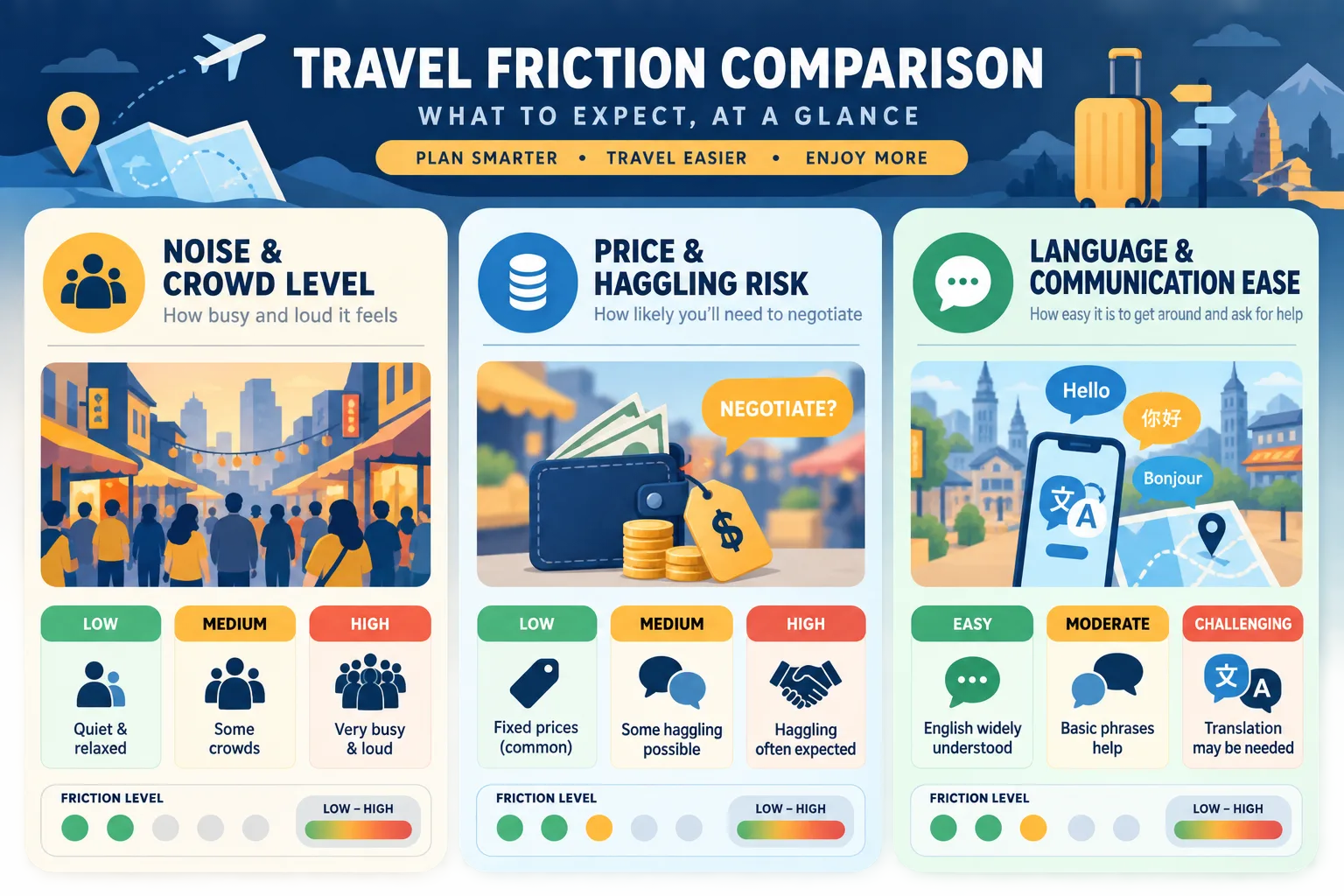
Three specific frictions drive most of the bad Jagalchi Market experiences reported by introverted or anxious travelers, and none of them are really about the seafood.
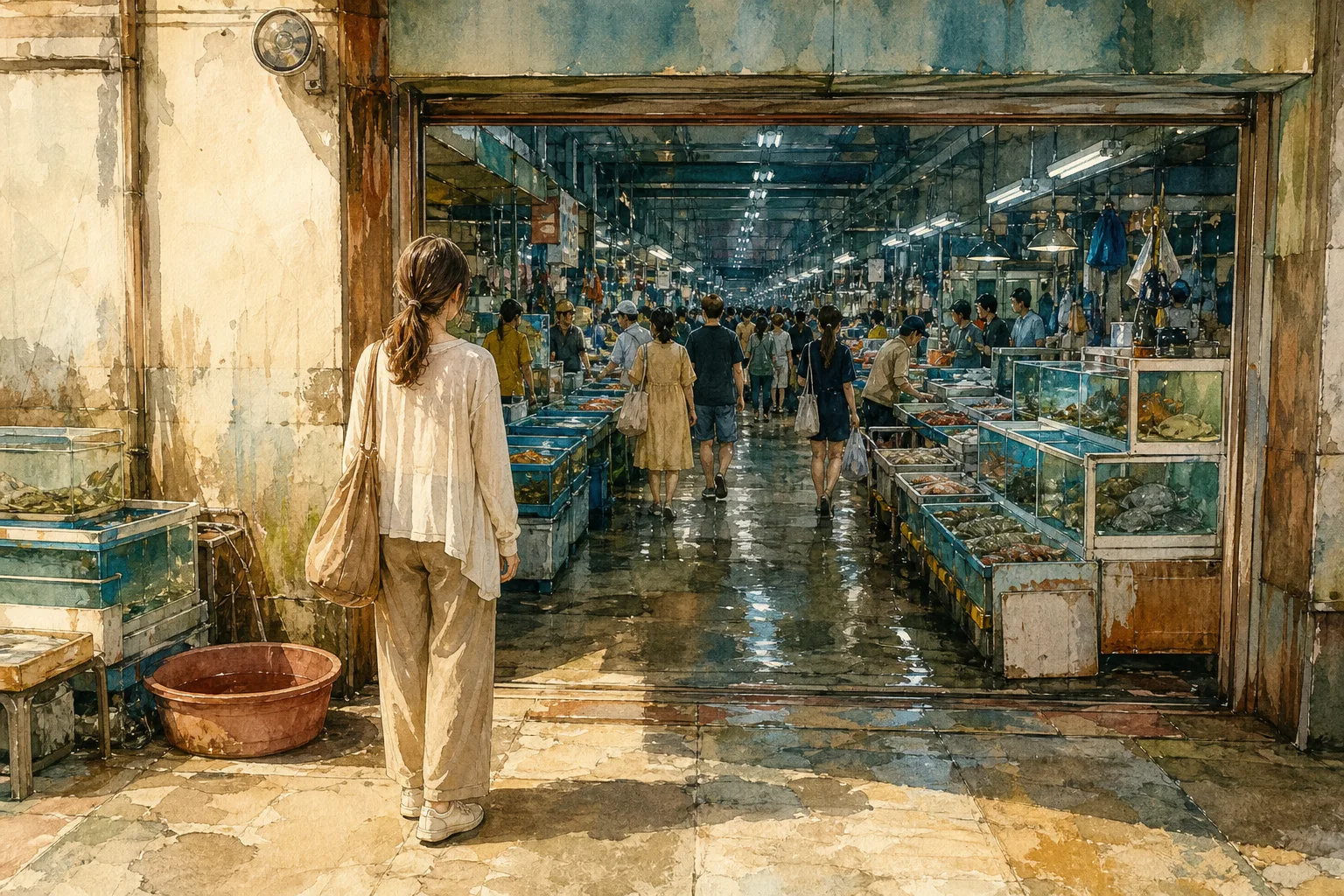
Sensory overload. The second-floor dining area is a loud, open hall with tables packed close together and no partitions between groups. There is no quiet corner. Steam, shouting vendors, clattering dishes, and the smell of raw and cooking seafood all hit at once, and the layout gives you nowhere to retreat to if it becomes too much mid-meal. For someone managing sensory sensitivity, this is the single biggest risk factor, bigger than cost or language.
Tourist-facing pricing risk. Because much of the market runs on live selection and verbal pricing rather than fixed menus, it is a structurally easy place for a small number of vendors to overcharge tourists who cannot easily verify a fair price. This is not a theoretical risk: in September 2025, a restaurant near the market was fined 600,000 won by Jung-gu authorities for failing to display prices after charging a tourist 70,000 won for sea cucumber. The government has since pushed back with mandatory price-labeling enforcement, including a market inspection in May 2026, but the incentive for a few operators to test an uninformed visitor has not disappeared entirely.
Communication barrier. Selecting a fish downstairs, agreeing on a price, and carrying it upstairs to be cooked is a multi-step interaction that assumes some negotiation, even if brief. If you do not share a language with the vendor, that negotiation can feel like guesswork under time pressure, which is exactly the kind of interaction non-confrontational travelers tend to avoid on a normal day, let alone in a foreign market.
Each of these is reducible, not fixed. The next two sections show how.
Friction Table
The three frictions do not weigh the same for every traveler. This table breaks down what actually drives each one and what the realistic tradeoff is.
| Friction | What drives it | Realistic tradeoff |
|---|---|---|
| Sensory overload | Second-floor hall: loud, open, no partitions, packed tables | Ground-floor stalls and off-peak hours (10 AM to 12 PM) cut this sharply; peak hours and festival dates make it unavoidable |
| Tourist pricing risk | Live seafood selection with verbal pricing instead of a fixed menu; documented overcharging cases | Stalls with visibly posted prices are lower risk; unposted-price stalls carry real risk even after 2026 enforcement efforts |
| Communication barrier | Selection-and-negotiation format requires some back-and-forth with vendors | A translation app or a Korean-speaking companion removes most of the pressure; going solo with no shared language raises it |
| Cost structure | Mandatory table/preparation fee of 5,000 to 10,000 won per person on top of the fish price | Predictable once you know it exists; surprising and stress-inducing if you learn about it only when the bill arrives |
| Crowd timing | Normal weekend traffic plus festival spikes in early and late October | Weekday late-morning visits are manageable; BIFF (early October) and the Jagalchi Fish Festival (late October) dates are not |
The pattern across all five rows is the same: nearly every source of friction has a low-friction version of itself available at the same market, if you choose timing, floor, and stall deliberately instead of walking in without a plan.
Who Will Feel It Most
Not every anxious or introverted traveler will struggle equally, and it is worth being specific about who is most at risk.
Travelers who will likely feel the most friction:
- Solo introverted travelers with no Korean and no travel companion. The combination of solo navigation, live negotiation, and a loud unfamiliar space compounds all three frictions at once.
- Travelers with diagnosed sensory sensitivities (noise, smell, crowding). The second-floor hall has no low-stimulation option built in; you either avoid it or tolerate it.
- Travelers who have been overcharged or scammed before, anywhere. Prior negative experience tends to raise vigilance and stress in any market-style setting, and Jagalchi's live-pricing format triggers that vigilance repeatedly.
Travelers who will likely feel comfortable or only mildly challenged:
- Introverts traveling with a talkative or Korean-speaking companion. Having someone else handle the ordering interaction removes most of the communication friction, leaving only the noise to manage.
- Foodies who prioritize the food experience over comfort. If the payoff of fresh, watched-cooked seafood outweighs 20 to 30 minutes of sensory strain for you, the friction is a fair trade.
- Travelers who already plan around off-peak timing. Visiting at 10 to 11 AM on a weekday outside festival season removes a large share of the crowd-driven noise before you even arrive.
The honest takeaway: this is less about being an introvert in general and more about which specific friction (noise, pricing, or language) actually triggers stress for you. Most people struggle with one of the three, not all three at once.
How to Reduce the Friction
Each friction point has a concrete lever, not just a general "be careful" warning.
For sensory overload:
- Visit between 10:00 AM and 12:00 PM, the documented lower-crowd window
- Avoid early October (Busan International Film Festival) and late October (Jagalchi Fish Festival) entirely if noise is your main concern
- Eat at a ground-floor stall instead of the second-floor hall if you want fresh seafood without the packed, partition-free dining room
- Plan the visit as a short stop (20 to 30 minutes) rather than a full sit-down meal, so you have a built-in exit point
For tourist pricing risk:
- Only order from stalls with a visibly posted price board; walk on if you cannot find one
- Ask the total price, including the per-person table fee, before the fish is cooked, not after
- Budget 5,000 to 10,000 won per person for the mandatory second-floor table/preparation fee on top of the seafood price
- If a quoted price feels far outside what nearby stalls are charging for the same item, treat that as a signal to walk away rather than negotiate
For communication barrier:
- Use a translation app for the selection-and-price conversation rather than relying on gestures alone
- Bring a companion who can handle the vendor interaction if solo negotiation is your main stress point
- Point at the posted price or menu item instead of verbally negotiating when possible
- Treat BIFF Square, a 2 to 5 minute walk from the market, as a lower-pressure fallback with calmer, more fixed-price street food stalls
None of these steps require becoming a different kind of traveler. They just shift when, where, and how you engage with the market instead of asking you to tolerate all three frictions at full intensity.
Better Alternatives
If, after reading the above, Jagalchi Market still sounds like more stress than it is worth, there are reasonable substitutes that keep the Busan seafood experience without the highest-friction elements.
- BIFF Square (2 to 5 minute walk from Jagalchi): Street food stalls with more visible pricing and a less enclosed, less loud format than the market's second floor. Good for travelers who want Busan street food without the negotiation-and-noise combination.
- A sit-down seafood restaurant elsewhere in Nampo-dong: Fixed printed menus remove the pricing-risk and communication-barrier frictions almost entirely, at the cost of the "pick your own fish" novelty.
- A quick Jagalchi visit without eating there: Walking through the ground floor for 10 to 15 minutes to see the market, then eating nearby, captures the atmosphere without the second-floor dining friction.
- Skipping it in favor of Gamcheon Culture Village or another lower-stimulation Busan stop: Gamcheon is roughly a 15-minute taxi ride from the market gates and offers a visually rich but much quieter alternative for a travel day built around calm pacing rather than sensory-dense food markets.
None of these are downgrades. They are the same city, the same neighborhood in most cases, with a different friction profile that may suit you better.
Decision Checklist
Use this before you commit to a Jagalchi Market visit on your Busan itinerary.
- I have picked a visit window between 10:00 AM and 12:00 PM, or accepted the tradeoff of a busier time
- I have confirmed my visit does not fall in early October (BIFF) or late October (Jagalchi Fish Festival), or I have accepted the added crowd
- I know the modernized main building's hours (5:00 AM to 10:00 PM) and that it is closed on the 1st and 3rd Tuesdays of the month
- I have decided in advance: ground-floor quick stop, or second-floor sit-down meal
- I understand the 5,000 to 10,000 won per-person table fee applies on the second floor
- I will only order from stalls with visibly posted prices
- I have a translation app ready, or a companion who can handle vendor conversations
- I have a fallback plan (BIFF Square or a fixed-menu restaurant) if the market feels like too much once I am there
- I am staying in or near Nampo-dong (roughly $35 to $70 USD per night), which keeps the market a 5-minute walk from Jagalchi Station Exit 10 rather than a longer transit trip
If you can check most of these boxes before you go, the friction points in this article shrink from unpredictable stressors to known, manageable tradeoffs.
FAQ
Is Jagalchi Market actually a scam-heavy place, or is that reputation overstated? It is not a scam by default, but pricing abuse has been documented and penalized. In September 2025, a restaurant near the market was fined 600,000 won for not displaying prices after charging a tourist 70,000 won for sea cucumber. In May 2026, the government inspected the market to enforce mandatory price-labeling rules. The risk is real but concentrated in stalls that skip posted prices, which you can avoid by checking for a visible menu board before you order.
What is the quietest time to visit Jagalchi Market? Between 10:00 AM and 12:00 PM tends to bring fewer crowds and calmer vendor interactions. Avoid early October, when the Busan International Film Festival draws heavy crowds to the area, and late October, when the Jagalchi Fish Festival adds festival-level congestion on top of normal market traffic.
Do I have to haggle or speak Korean to eat at Jagalchi Market? No, but the second-floor dining setup assumes some back-and-forth: you pick a fish downstairs, negotiate or confirm a price, then carry it up to be cooked, where a mandatory table fee of 5,000 to 10,000 won per person applies. If that negotiation step feels stressful, you can skip it entirely by eating at a ground-floor stall or a nearby BIFF Square restaurant with fixed, posted prices instead.
Is Jagalchi Market worth it for someone who gets overwhelmed by noise and crowds? It can be, if you time it well and set a clear exit plan. The second-floor dining hall is loud, open, and packed with tables with no partitions, which is the hardest part for sensory-sensitive travelers. Visiting during the 10 AM to 12 PM window, eating on the ground floor instead of upstairs, and treating the visit as a 20 to 30 minute stop rather than a full meal event all lower the load significantly.
What should I do instead if Jagalchi Market sounds like too much? Nearby BIFF Square, a 2 to 5 minute walk away, has calmer street food stalls with visible pricing and less enclosed noise. If seafood is the goal but the market format is not, a sit-down seafood restaurant elsewhere in Nampo-dong with a printed menu and no negotiation step delivers a similar food experience with far less friction.