travel-decisions
Is Busan Worth It If You Want to Enjoy It More Comfortably?
A traveler-fit breakdown of whether Busan delivers a relaxed, comfortable trip or whether the logistics and hype work against travelers who prioritize atmosphere over checklists.
Quick Verdict
Busan is worth it for comfort-seeking travelers who are willing to pick one coastal base and stay loyal to it. It is a weak fit for travelers who assume Busan is a single, compact, walkable city like central Seoul or a European old town.
Choose Busan if you want a slower, atmosphere-led trip built around one or two neighborhoods, mild coastal walks, and long unhurried meals, and you are comfortable letting go of seeing "everything." Skip it, or at least lower your expectations, if your idea of comfort means minimal transit time between sights, or if you are chasing the specific trendy districts you saw on social feeds without checking how far apart they actually are.
The core tension is this: Busan's most photographed spots (Haeundae, Gamcheon Culture Village, the waterfront cafes) are spread across a city that does not connect the way a single-district itinerary implies. Comfort here comes from accepting that spread and building your trip around one anchor point, not from trying to visit all of it in three days.
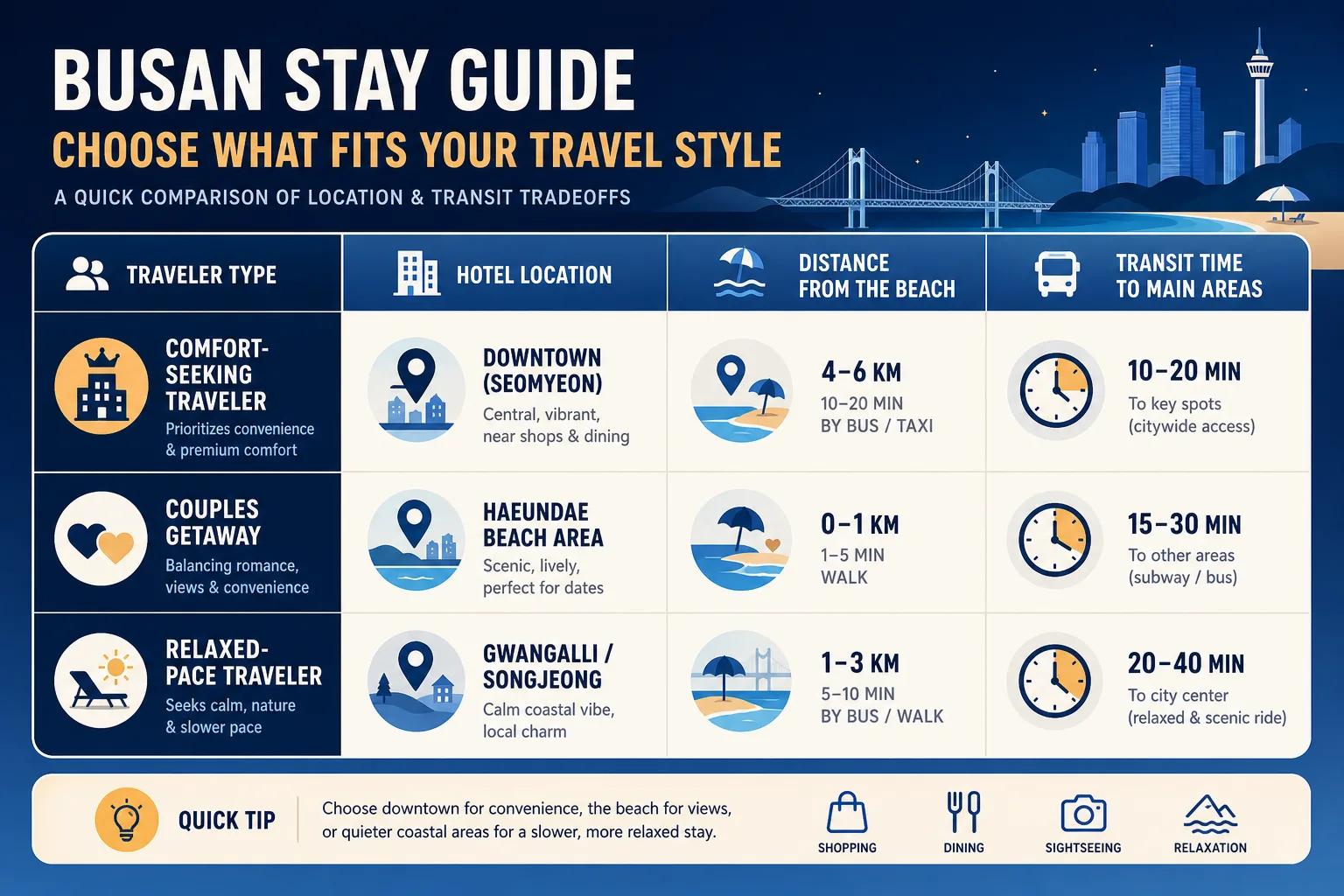 Editorial illustration: A simple decision table or comparison layout showing traveler types (comfort-seeking.
Traveler Type Table
The honest version of "is Busan worth it" depends less on the city itself and more on how you define comfort. The table below breaks down the real variables that decide fit.
| Decision variable | Comfort-seeking travelers | Couples | Relaxed-pace travelers |
|---|---|---|---|
| Ideal base | One well-reviewed coastal neighborhood, booked for the whole stay | A quiet area near the water with easy dinner options nearby | Anywhere that does not require daily long transfers |
| Tolerance for transit | Low; a 40-50 minute subway transfer feels like a tax on the day | Medium; willing to taxi once for a special dinner or view | Low; prefers to stay put and explore on foot |
| Biggest risk | Booking near Busan Station expecting quick beach access | Paying premium hotel rates without checking real amenities | Overpacking the itinerary because "everyone goes to X" |
| What actually delivers comfort | A hotel matched to where you will spend most days, not the flashiest address | A property with amenities that match the marketing, not just the price tag | Fewer stops, longer time at each one |
| What undermines comfort | Chasing Haeundae, Gamcheon, and Nampo-dong all in one loop | Discovering pool access, cap rules, or distance restrictions after check-in | Full-day itineraries copied from a "3 days in Busan" checklist |
The pattern across all three groups is the same: comfort in Busan is a function of narrowing your radius, not expanding your list.
Best for First-Time Visitors
First-time visitors who want comfort over checklist coverage do best when they accept early that Busan is not one neighborhood, it is several loosely connected ones. The distance between Busan Station and Haeundae Beach alone runs from roughly 14 to 21 km, and covering it by subway means a transfer at Seomyeon and 40 to 50 minutes each way. That is a meaningful chunk of a day if you did not plan for it.
For a comfort-first first visit, the better move is picking a single base, most often Haeundae or a nearby quieter coastal area, and treating the rest of Busan as optional day excursions rather than a full circuit. Travelers seeking comfort do better with an express bus (routes 1001 or 1003, 2,100, luggage under 20 kg) or a taxi (15,000 to 28,000, 30 to 45 minutes) between Busan Station and Haeundae rather than juggling the subway transfer with luggage. Couples on a first visit benefit from the same logic: fewer relocations, more time actually enjoying wherever they land. Relaxed-pace travelers should treat the first visit as a scouting trip for atmosphere, not a race to confirm every landmark.
Best for Couples
Couples chasing comfort in Busan tend to get the best return when they stop optimizing for the "best" neighborhood on paper and start optimizing for the neighborhood that matches how they actually want to spend evenings. A hotel that is technically close to a famous view is not comfortable if it comes with restrictions that clash with your plans, such as pool access limited to once per day during peak summer months, as is the case at some higher-end waterfront properties, or a strict swim cap requirement at the pool, which some couples find out about only at check-in.
Comfort-seeking couples should also weigh the gap between price and payoff carefully. A property with room rates well into the 300,000 to 600,000+ range does not automatically mean an easier trip if it sits a mile or more from the beach and requires a walk or drive to reach the waterfront, as is true for some Haeundae-adjacent luxury hotels. Relaxed-pace couples generally do better with a mid-range property directly on or near the water than a flagship luxury hotel set back from it. The honest comfort upgrade is proximity and fit, not the room rate alone.
Best for Slow Travelers
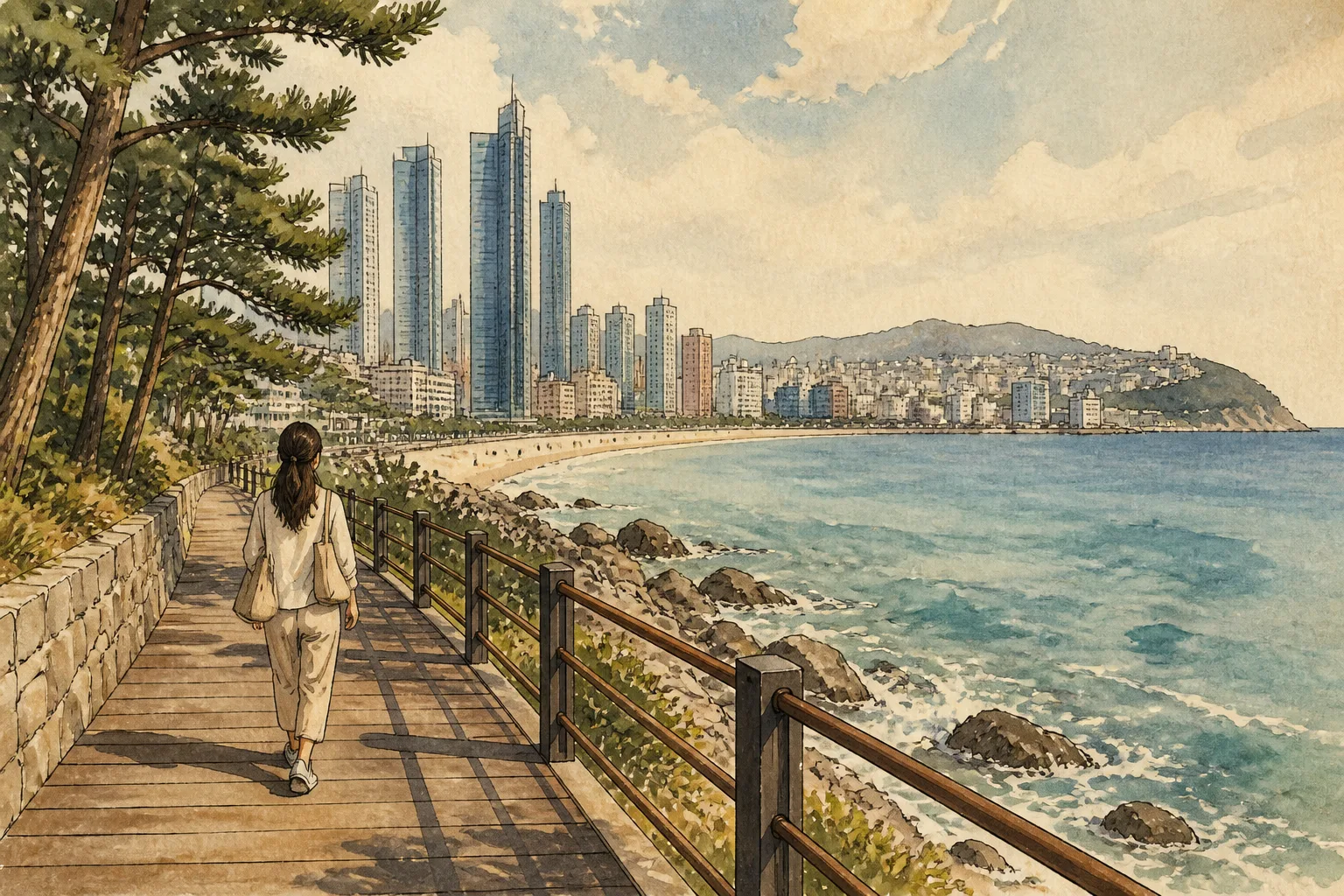
Slow travelers, the ones who would rather sit with a coffee and watch the water than sprint between five viewpoints, are arguably the best-fit persona for Busan, provided they resist the urge to "see it all." Busan rewards travelers who pick a walkable stretch of coastline and stay there for most of a day rather than travelers who try to string together every recommended stop.
That said, slow travel in Busan has real limits worth planning around. Gamcheon Culture Village is a Special Management Zone with restricted visiting hours and no nighttime tourism, so it does not work as a lingering evening wander the way some other neighborhoods do. Millak Waterfront Park bans alcohol entirely, which changes what a relaxed evening there can look like compared to expectations set by photos of waterfront drinking spots elsewhere. Comfort-seeking slow travelers do better treating Haeundae's beachfront and the Blue Line coastal path as their unhurried anchor, and treating Gamcheon as a shorter, planned daytime visit rather than an open-ended wander.
Best for Low-Stress Travelers
Low-stress travelers, who want a trip that runs smoothly without constant navigation and transfer math, need to be realistic about Busan's geography before booking. The single biggest stress risk is underestimating how far apart Busan's highlights actually are and assuming a short subway ride will cover it. A transfer at Seomyeon and a 40 to 50 minute ride is a normal part of the day if your hotel and your plans are not aligned.
The lowest-stress version of a Busan trip minimizes relocations and pre-books anything with limited capacity. The Sky Capsule at Haeundae Blue Line Park, for example, has a flat minimum rate of 50,000 for up to two people, and tickets release only four weeks in advance on Tuesdays at 7:00 AM, so travelers who want that specific experience without day-of stress need to plan the booking window in advance. Choosing the ocean-facing outer rail direction (Mipo to Cheongsapo) rather than the partially blocked return route is a small comfort decision worth knowing before you book, not after. Low-stress travelers, couples, and relaxed-pace travelers all benefit from the same underlying habit here: check capacity and booking windows before assuming a spontaneous Busan day will work out.
Common Mismatches
Some traveler patterns consistently end up disappointed in Busan, and the disappointment is usually about mismatched expectations rather than the city itself.
- Travelers expecting a compact, walkable city center like parts of Seoul or European old towns often feel like Busan "wastes time" on transit, when the real issue is that they booked a hotel disconnected from where they wanted to spend their days.
- Travelers chasing every trending district they saw online (Haeundae for the view, Gamcheon for photos, Nampo-dong for markets, Millak for the waterfront) in a short trip usually end up more tired than delighted, because these areas are genuinely spread out rather than clustered.
- Budget-conscious travelers who upgrade to a luxury hotel expecting the price to buy convenience sometimes find the opposite: some flagship properties sit over a mile from the beach or carry restrictions like limited pool hours that were not obvious at booking.
- Travelers expecting a European-style free-toiletries hotel experience may be caught off guard, since South Korean law prohibits hotels with 50 or more rooms from providing free single-use toiletries, meaning items like toothbrushes are often a paid add-on.
- Slow travelers hoping for an evening wander through Gamcheon Culture Village will be disappointed to learn it operates under restricted hours as a Special Management Zone, ruling out the nighttime, lantern-lit stroll some travelers picture.
These are not reasons to skip Busan. They are reasons to plan the trip around Busan's real shape instead of an assumed one.
Final Match Recommendation
Choose Busan if your comfort priority is atmosphere, coastal downtime, and a slower pace, and you are willing to commit to one primary base rather than chasing every neighborhood's highlight reel. Comfort-seeking travelers, couples, and relaxed-pace travelers all do well here specifically because Busan is generous with quiet coastal stretches, provided the itinerary respects the actual distances involved.
Skip Busan, or significantly adjust expectations, if your version of comfort depends on tight geographic compactness, minimal transit planning, or an assumption that a higher hotel price automatically means an easier trip. Travelers who want checklist efficiency more than atmosphere, or who cannot tolerate a 40-plus minute transfer as part of a normal day, will likely find Busan more effortful than advertised.
The strongest fit is a comfort-seeking, relaxed-pace couple or solo traveler who picks one coastal neighborhood, books a hotel matched to their actual plans rather than its reputation, and treats the rest of Busan as optional rather than mandatory.
FAQ
Is Busan a relaxing city or a busy one? Both, depending on where you base yourself. Busan is spread across distinct districts that do not feel connected to each other, so the pace of your trip depends heavily on how much you move between them. Stay concentrated in one coastal area and it feels slow and easy. Try to see all of Busan's highlights in a few days and it feels like a transit-heavy checklist trip.
Is Haeundae or a quieter neighborhood better for a comfortable trip? Haeundae gives you the most polished hotel options and the easiest access to the beach, but it is also the most crowded and trend-driven district. If your priority is atmosphere and quiet rather than proximity to nightlife and photo spots, a smaller coastal neighborhood near Haeundae, reachable by a short taxi or bus ride, often delivers more comfort per night than paying a premium to be in the center of Haeundae itself.
Do I need a car or private transport to enjoy Busan comfortably? No, but you do need to plan around Busan Station and Haeundae not being close together. The subway connection takes 40 to 50 minutes with a transfer at Seomyeon, so travelers who base themselves near Busan Station and expect quick beach access will find the trip more tiring than expected. Booking a hotel near where you plan to spend most of your time matters more than which single neighborhood has the best reputation.
Is Busan worth it if I am comparing it to Seoul for a relaxed trip? Busan tends to reward comfort-seeking travelers who want fewer big sights and more coastal downtime, while Seoul rewards travelers who want density and variety within short walking distance. If a slow morning by the water and an unhurried afternoon matter more to you than covering ground, Busan fits well, provided you accept it as a collection of separate areas rather than one compact city center.
Are luxury hotels in Busan actually worth the extra cost for comfort? Not automatically. Some higher-end properties come with real restrictions, such as pool access limited to once per day during peak summer, mandatory swim caps, or a location a mile or more from the beach despite the price. Comfort in Busan is less about hotel star rating and more about matching the property's actual amenities and location to how you plan to spend your days.