travel-decisions
Is Busan Worth It If You Care More About Atmosphere Than Landmarks?
A traveler-type breakdown of whether Busan fits atmosphere-first, photography-led, and slow travelers better than a landmark checklist trip.
Quick Verdict
Busan is worth it if what you actually want from a trip is mood, texture, and unplanned wandering rather than a list of must-see sights. It is a weak fit if you measure a trip's value by how many recognizable landmarks you photographed in front of.
Choose Busan for atmosphere if:
- You would rather sit in one neighborhood for two hours than cover three districts in one afternoon.
- You judge a good travel day by how a place felt, not by a checklist of sights completed.
- You are comfortable with a city that has fewer single-stop landmark clusters than Seoul, Tokyo, or Kyoto.
Skip Busan, or rethink the itinerary, if:
- You need a dense concentration of famous sights within short walking distance of each other.
- You have three days or fewer and want to "see Busan properly" in the landmark-checklist sense.
- You get anxious when a day has no fixed plan, since Busan's atmosphere-led areas reward loose scheduling more than tight ones.
The direct answer: Busan is not a landmark city. It is a mood city with a small number of well-known sights scattered across a spread-out coastline. If atmosphere is the actual goal, that spread works in your favor. If landmarks are the actual goal, the spread works against you, because getting between them takes real transit time, not a five-minute stroll.
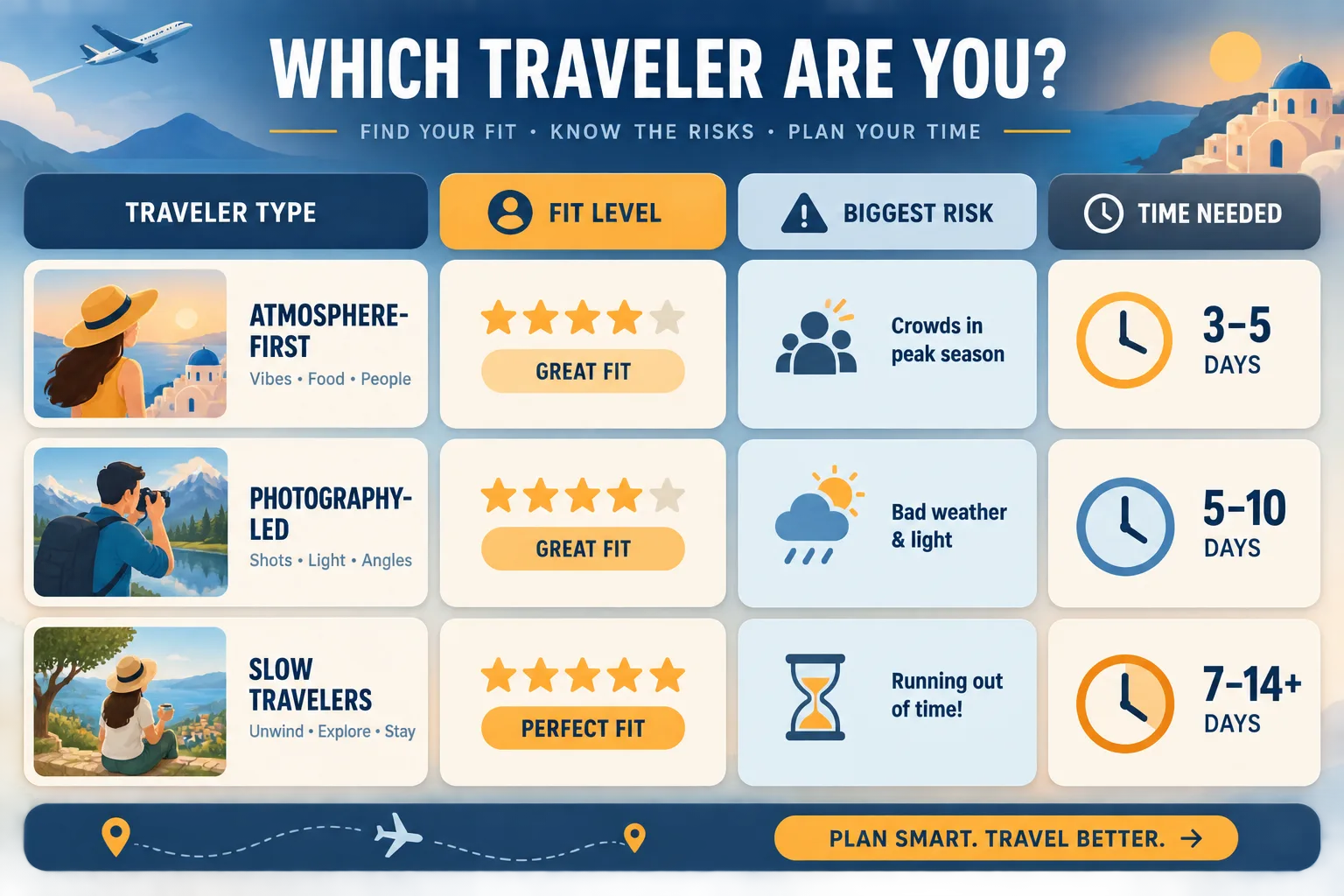 Editorial illustration: A simple comparison table graphic on a clean background showing three traveler type rows (atmosphere-first.
Traveler Type Table
The fit is not about liking or disliking Busan in the abstract. It comes down to what each traveler type actually optimizes for during a day of travel, and how that lines up with Busan's real shape: a long coastline, a handful of standout neighborhoods, and travel times between them that are longer than most first-time visitors expect.
| Traveler type | What they optimize for | Busan fit | Real tradeoff |
|---|---|---|---|
| Atmosphere-first travelers | Mood, quiet, unscripted time in a place | Strong | Fewer landmarks means less external validation that the day was "productive," which can feel unfamiliar at first |
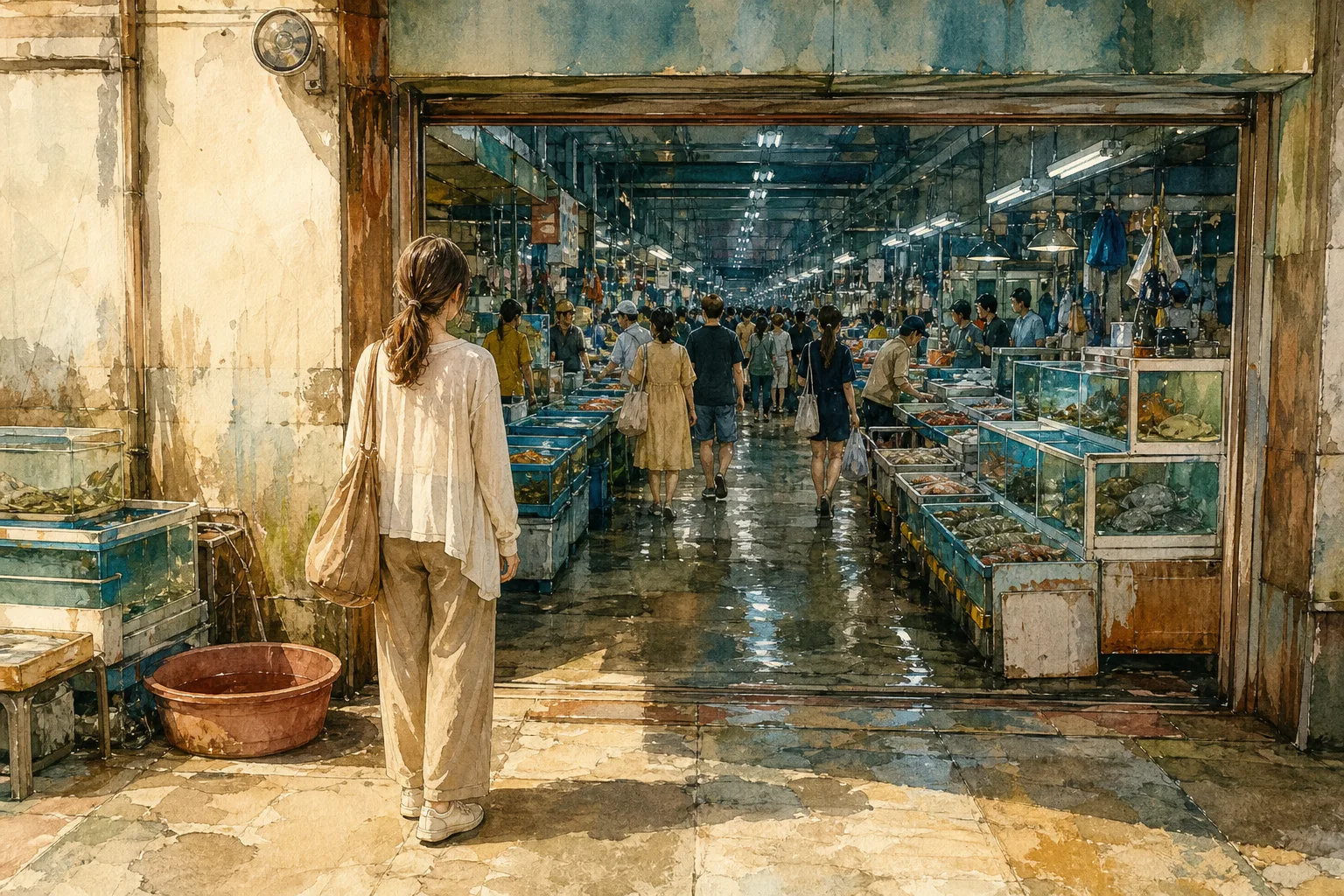
| Photography-led travelers | Light, texture, composition over recognizable icons | Strong to moderate | Busan's most photogenic spots (hillside villages, old market alleys) are visually rich but not landmark-dense, so a shot list built around famous buildings will come up short |
| Slow travelers | Depth in one or two areas over breadth across the city | Strong | Requires accepting that you will not "cover" all of Busan, since neighborhoods are spread along a long coastline with 40 to 50 minute transit gaps between them |
The pattern across all three types: Busan pays off when you plan around neighborhoods, not around a sightseeing list. It underperforms when the itinerary is built the way a first landmark trip to Seoul or Tokyo would be built, because the physical layout does not support that pace.
Best for First-Time Visitors
First-time visitors to Busan split into two groups, and the split matters more than "first time" itself.
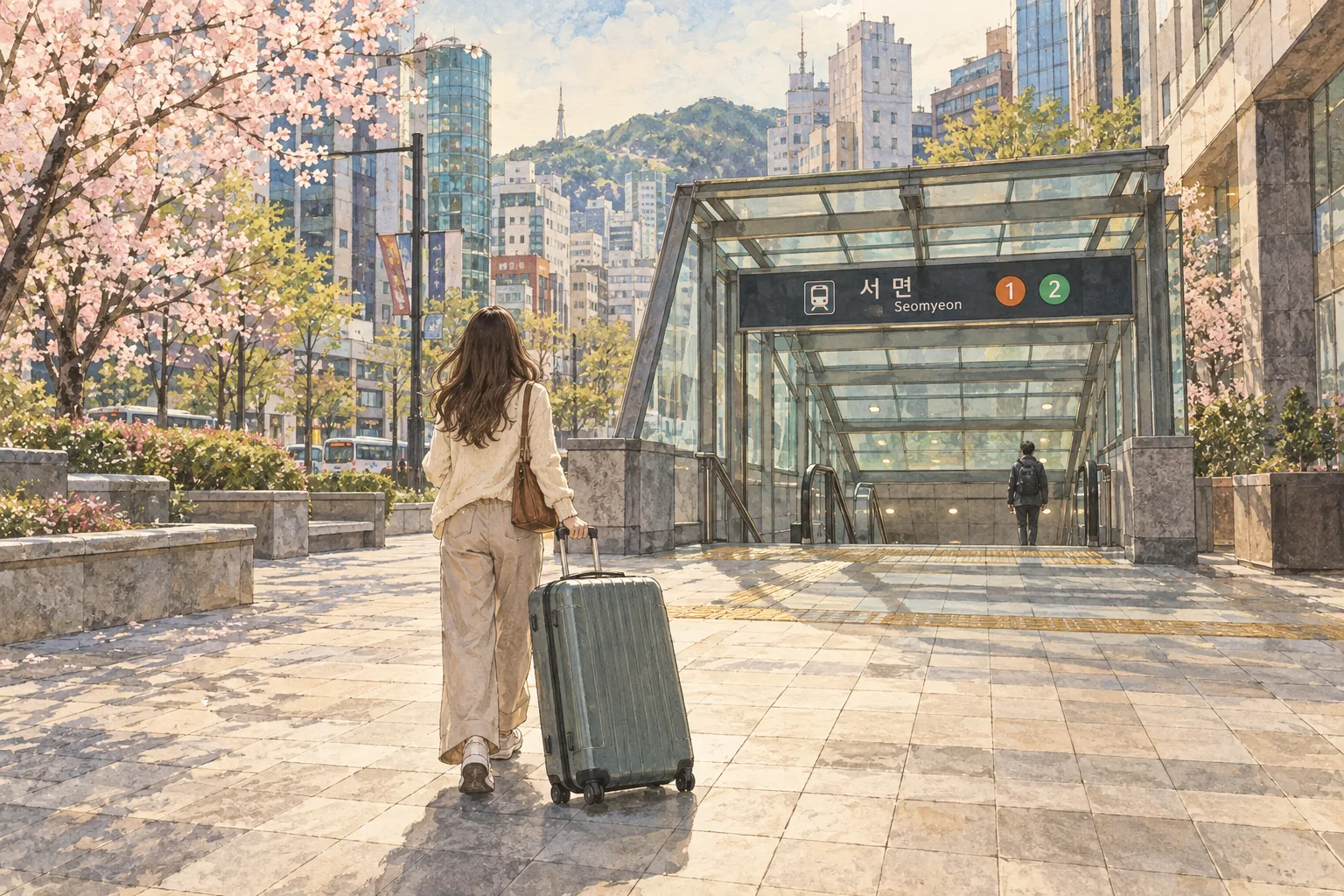
An atmosphere-first first-timer does well by picking one coastal or hillside neighborhood as a home base and giving it a full day before moving anywhere else. Because getting from the KTX arrival point at Busan Station to Haeundae Beach takes about 48 to 50 minutes by subway (with a transfer at Seomyeon) or 30 to 45 minutes by taxi, a first-timer who tries to bounce between the old downtown, Haeundae, and outlying hillside villages in a single day will spend more of the day in transit than in atmosphere.
A photography-led first-timer should treat Busan as a small number of strong locations rather than a long checklist. The payoff is in returning to one or two spots at different times of day for changing light, not in racing to photograph every recommended location once.
A slow-traveler first-timer benefits the most from having no fixed itinerary at all beyond a neighborhood and a rough time window. First-time visitors who insist on a landmark-paced schedule despite choosing Busan for its vibe are the group most likely to end the trip feeling like it "didn't click," not because Busan failed them, but because the itinerary fought the city's actual shape.
Best for Couples
For couples, the atmosphere-first case for Busan is strongest when both people are aligned on pace before the trip starts, not during it.
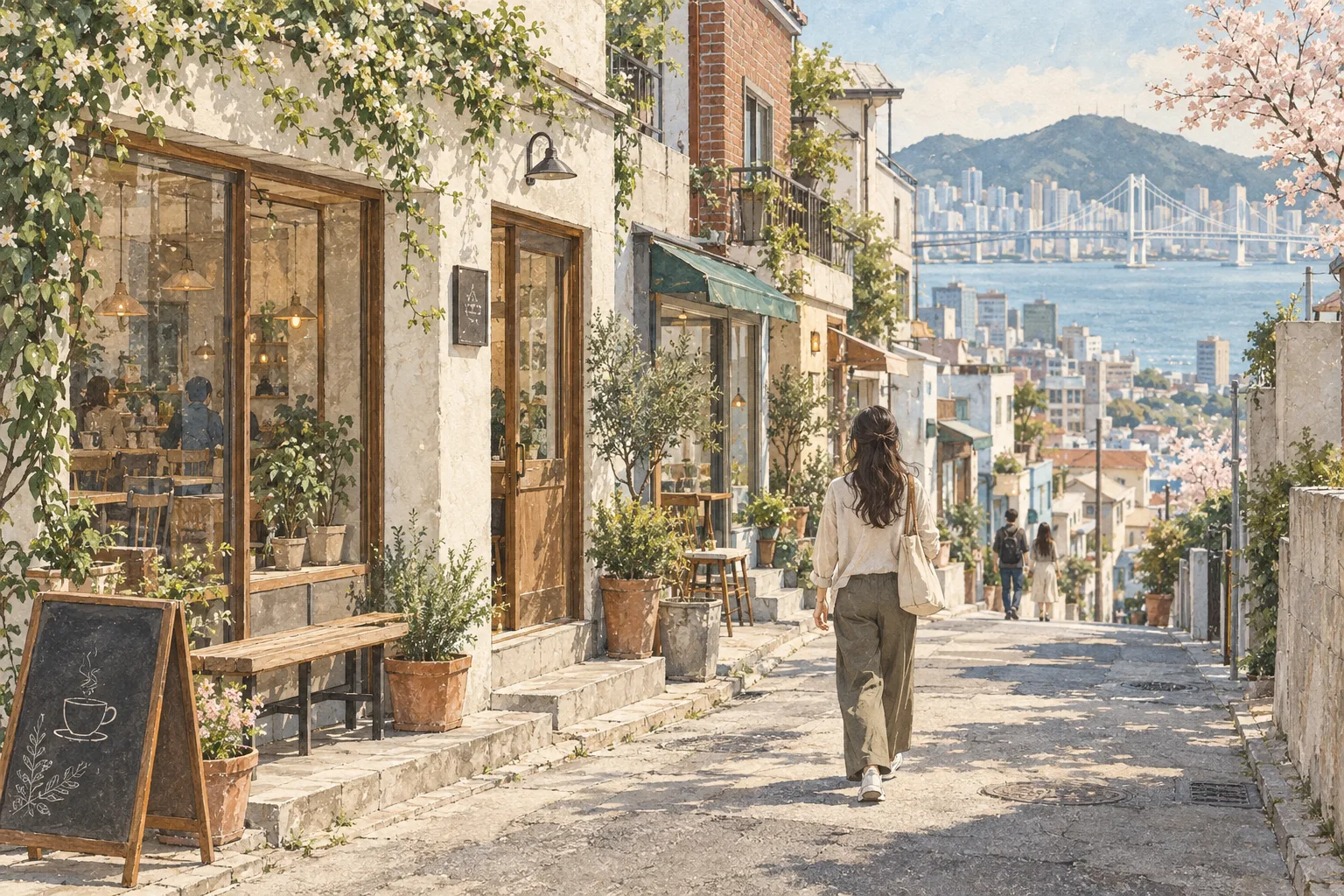
Atmosphere-first couples tend to do well because Busan gives you low-pressure, low-cost shared time: walking a hillside street at dusk, sitting somewhere with a sea view, letting an afternoon go unplanned. None of that requires a landmark to feel worthwhile as a couple's trip.
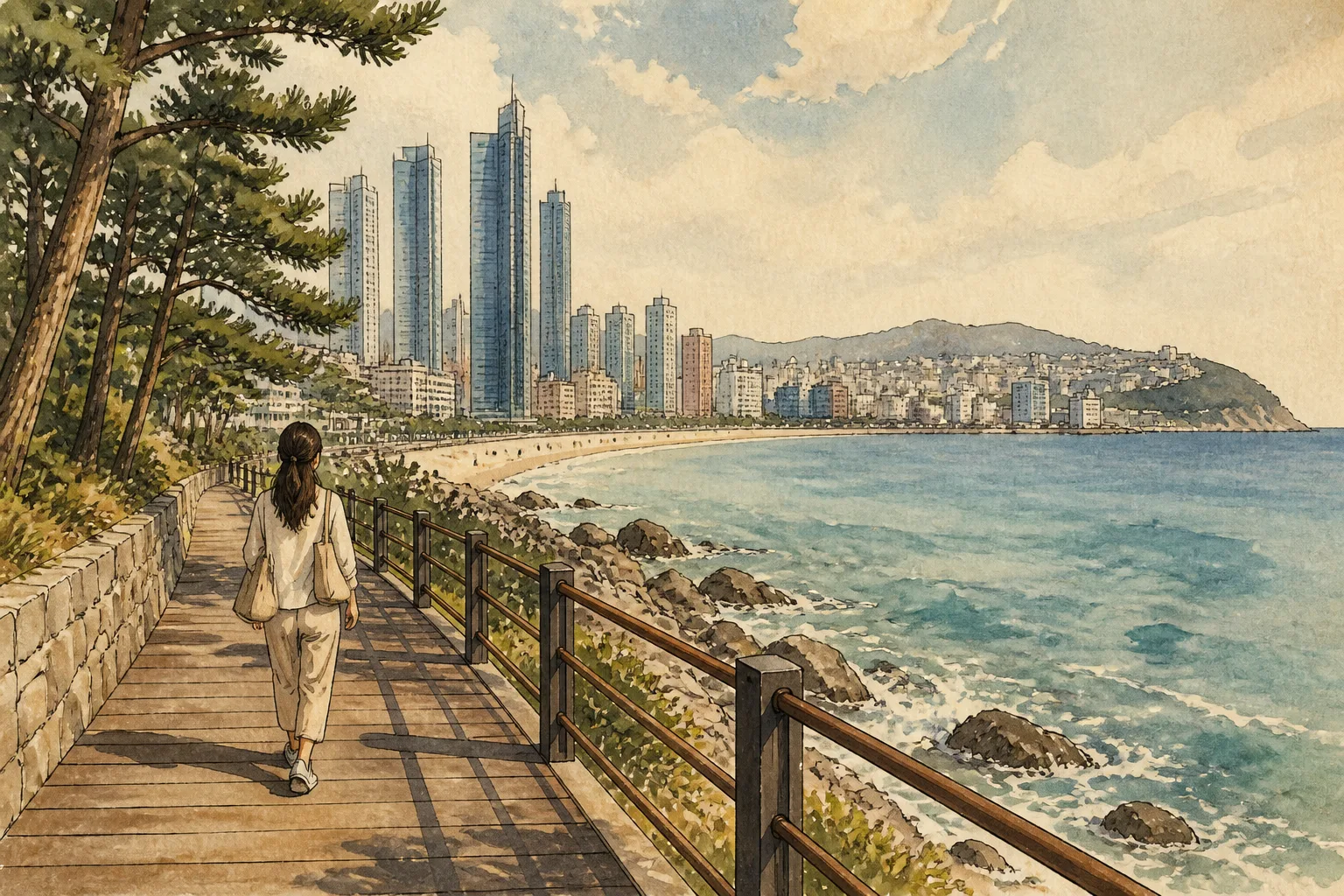
Photography-led couples do well when one or both people enjoy the process of finding a good frame together rather than needing a specific famous backdrop. Busan's older residential neighborhoods and coastal walking paths offer strong, varied light without requiring a landmark in the shot.
Slow-traveler couples benefit from Busan's cost structure working in their favor: highly rated 3-star business hotels in areas like Seomyeon and Nampo-dong start between USD 33 and USD 45 per night, which supports a longer, unhurried stay without the emotional payoff being tied to how much you spent on a room. The couples who struggle are the ones where one partner wants landmark efficiency and the other wants wandering time. That mismatch shows up faster in Busan than in a landmark-dense city, because there is less "middle ground" scenery to compromise on.
Best for Slow Travelers
Slow travelers are the traveler type Busan fits most naturally, and it is worth being specific about why.
Busan's neighborhoods are spread along a long coastline rather than clustered in a walkable core. That layout punishes a fast-paced, landmark-hopping trip and rewards a trip built around staying in one area long enough to notice its rhythm: what a street looks like in the morning versus late afternoon, which cafes fill up first, how the light changes over the water by early evening.
A slow traveler who commits to two or three neighborhoods over four days, rather than trying to see the whole city, gets the version of Busan that atmosphere-first and photography-led travelers are also chasing. A slow traveler who tries to add "just one more district" each day ends up recreating a landmark-paced trip by accident, and loses the exact quality that made Busan the right choice in the first place.
The cost side supports this pace too. With average double-room rates around USD 113 on weekdays, a slower multi-day stay in one area is financially reasonable compared to a trip that requires switching hotels to chase different sights.
Best for Low-Stress Travelers
Low-stress travelers, meaning people who want an easy, businesslike trip without constant decision-making, get a mixed result from Busan depending on how they define "low-stress."
If low-stress means "few decisions, clear plan, predictable transit," Busan adds friction that a landmark-dense city would not: foreign-issued Visa and Mastercard cards cannot be tapped directly at subway fare gates, so a low-stress traveler needs to plan ahead for a physical T-money, Cashbee, or WOWPASS card, or use cash QR tickets. That is one more logistical step than tapping a card, and it catches unprepared travelers off guard on day one.
If low-stress means "no pressure to perform a checklist, time to just exist in a place," Busan is a strong fit, because atmosphere-first and slow-traveler pacing removes the anxiety of "did we see enough" that landmark-dense cities can create.
The practical fix for a low-stress traveler who wants Busan's atmosphere without transit stress: settle the transit card question before arrival, pick a home base near a single subway line, and accept that some neighborhoods will simply be skipped. Trying to be low-stress while also seeing every recommended Busan neighborhood is the combination that fails.
Common Mismatches
The most common regret pattern with Busan is not that the city underdelivers. It is that the traveler brought a landmark-trip mindset to a mood-trip city, or the reverse.
Specific disappointment patterns to recognize before booking:
- The viral-photo mismatch. A traveler builds expectations from a handful of widely shared photo spots, expects that saturated, curated feel everywhere, and finds most of the city more ordinary and residential. This is an expectation-mismatch risk, not a city-quality problem.
- The overplanning mismatch. A traveler chooses Busan specifically for atmosphere, then books a landmark-density itinerary (multiple districts per day, tight time blocks) out of habit, and ends up with a trip that feels rushed despite the original intent.
- The landmark-pressure mismatch. A traveler who fundamentally wants a landmark checklist picks Busan anyway, based on general "beautiful city" reputation, and feels shortchanged that Busan does not offer the landmark density of Seoul, Tokyo, or Kyoto.
- The cost-versus-payoff mismatch. A traveler spends on a higher-end hotel or peak-season dates (for example, the crowd surge around the October Busan International Film Festival, or the summer humidity after Haeundae and Gwangalli Beaches open for the season) expecting a landmark-trip level of "content," and finds the emotional payoff was really about slower, quieter moments that peak-season crowds and cost do not amplify.
- The overtourism-access mismatch. A traveler assumes free, flexible access to visually popular spots like Gamcheon Culture Village, without accounting for the tourist-access hour restrictions now in place there since August 2026, and finds a favorite photo location less spontaneous to visit than expected.
None of these are reasons to avoid Busan. They are reasons to be honest about which traveler type you actually are before you build the itinerary.
Final Match Recommendation
Busan is worth it, clearly and directly, if your travel satisfaction comes from atmosphere, unplanned time, and noticing a place rather than checking off sights. Atmosphere-first travelers, photography-led travelers who value light and texture over icons, and slow travelers who prefer depth over breadth are all strong matches, and the city's real layout (spread-out neighborhoods, meaningful transit time between them, a lived-in rather than curated feel) plays to their strengths rather than against them.
Busan is not worth the trip, or at least not worth choosing over a landmark-dense alternative, if you need a high concentration of famous sights within easy walking distance, if you have very limited time and want to "cover" the city, or if your sense of a successful trip depends on checklist completion rather than mood. For that traveler, the same coastline and transit gaps that atmosphere-first travelers enjoy will read as inefficiency and missed opportunity.
The deciding question is not "is Busan a good city." It is "do I get more satisfaction from noticing a quiet street at the right hour, or from standing in front of something famous." Answer that honestly, and the Busan decision mostly makes itself.
FAQ
Is Busan worth visiting if I do not care about seeing famous landmarks? Yes, if your enjoyment comes from walking unplanned routes, sitting in quiet cafes, and noticing light and texture in a neighborhood. Busan's landmark list is short compared to Seoul or Kyoto, but its hillside streets, market alleys, and coastal walking paths are built for wandering rather than ticking boxes. If you need marquee sights to feel like the trip was worth the cost, the fit is weaker.
How many days in Busan do atmosphere-first travelers actually need? Three to four full days is enough to settle into one or two neighborhoods without rushing. Fewer than two days pushes you toward a landmark-speed itinerary even if that is not your intent, because transit time between areas (roughly 40 to 50 minutes each way to reach Haeundae from the KTX arrival point) eats into unstructured time.
Does Busan feel different from Seoul for someone who prioritizes mood over sights? Yes. Busan is lower-density and more coastal, with neighborhoods that read as residential and lived-in rather than curated for visitors. That works in favor of atmosphere-first travelers, but it also means less English signage and fewer single-stop landmark clusters, so the payoff depends on being comfortable navigating without a fixed sightseeing plan.
What is the biggest risk of choosing Busan for atmosphere instead of landmarks? The biggest risk is expectation mismatch: arriving with a mental image built from a handful of viral photo spots and finding that the actual atmosphere is quieter, more ordinary, and slower to reveal itself. A secondary risk is overplanning, where a traveler books a landmark-paced itinerary out of habit and then feels rushed despite choosing Busan for its mood.
Is Busan a good fit for photography-led travelers specifically? It fits well for travelers who prioritize light, color, and composition over having a recognizable landmark in frame, since hillside villages and older residential blocks offer strong visual texture. It fits less well for travelers who need iconic single-shot landmarks for a portfolio, since Busan's most photographed spots are fewer and more spread out than in landmark-dense cities.