travel-decisions
Can Vegans Enjoy Traditional Hungarian Food in Budapest Without Surviving on Side Dishes?
A decision-focused guide for vegan and vegetarian travelers weighing Budapest as a food destination, covering which traveler types get real dishes and who ends up eating plain potatoes.

Quick Verdict
Yes, vegans can eat traditional Hungarian-style food in Budapest without living on plain potatoes and side salads, but only if they plan around a small, specific set of restaurants rather than expecting general availability.
This is a strong fit if you are a food-curious traveler willing to route your day around a handful of named addresses in Districts V, VII, VIII, and XIII, and you are comfortable treating a fully vegan restaurant as a destination rather than something you stumble into. It is a weak fit if you want to wander into any traditional Hungarian restaurant and expect a satisfying plant-based main course, or if you are traveling with a group whose only shared meal option is whatever bistro is closest to the hotel.
The honest picture: Budapest's mainstream Hungarian food culture, built on lard, meat stock, and dairy, has not adapted broadly to vegan diners. What has emerged instead is a small cluster of dedicated vegan spots that reinterpret Hungarian comfort food, plus a couple of specific stalls that vegan-ize street food classics. Knowing the difference between those two categories is the entire decision.
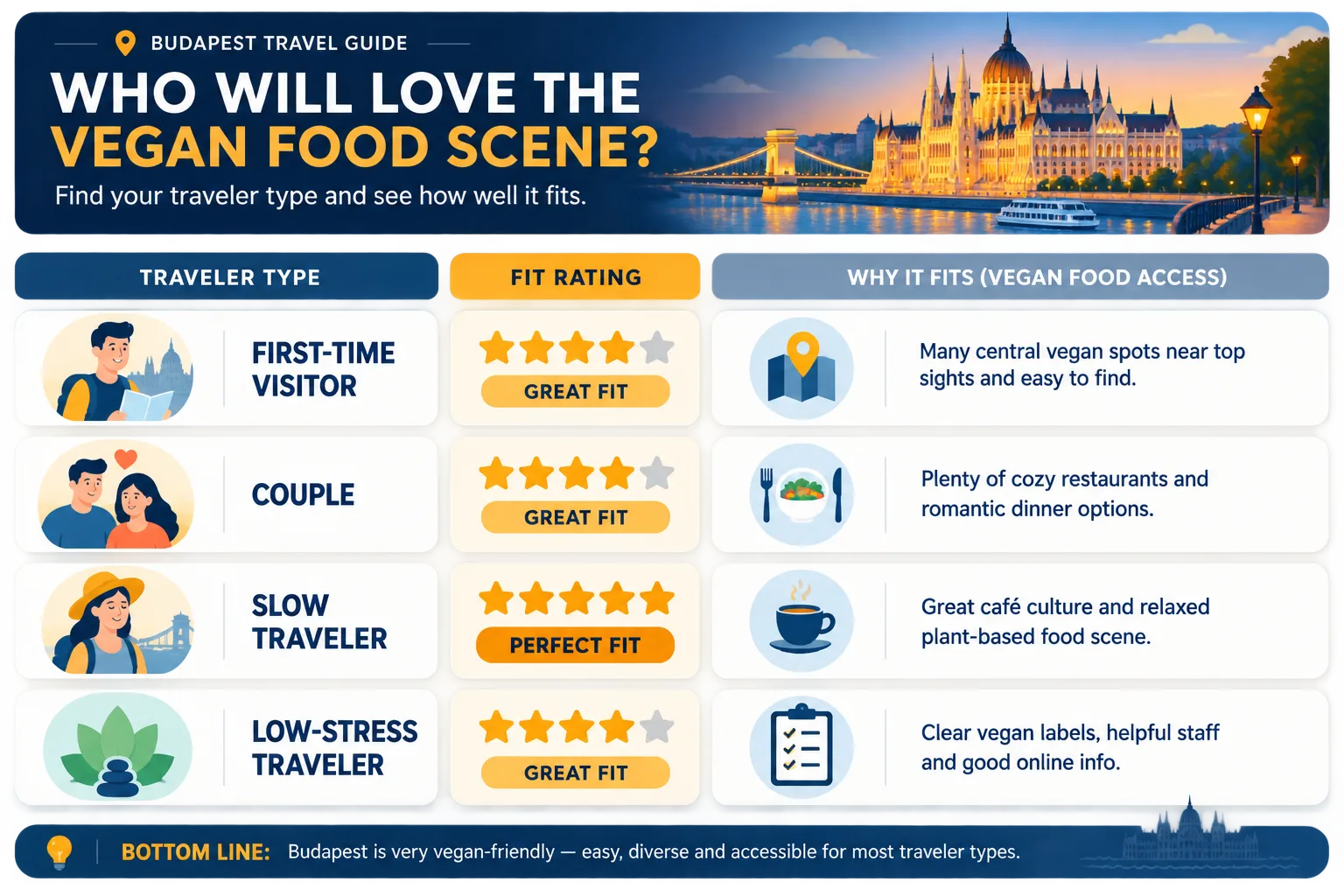 Editorial illustration: A simple comparison layout styled as a decision table.
Traveler Type Table
The real variable here is not "is Budapest vegan-friendly" in the abstract. It is whether your travel style matches how Budapest's vegan food is actually distributed: concentrated, address-specific, and requiring some transit planning rather than being spread evenly across neighborhoods.
| Traveler type | Fit for vegan Hungarian food in Budapest | Why |
|---|---|---|
| Foodie traveler seeking cultural dishes | Strong | Willing to seek out specific addresses like Napfenyes Etterem or Szabad Bisztro for reinterpreted Hungarian classics, not just generic vegan cafes |
| Couple splitting a food-focused day | Strong | Two fully vegan restaurants (Napfenyes, Szabad Bisztro) and a bakery (Fill Good) give enough variety for a full day without repeating the same menu |
| Slow traveler with flexible days | Strong | Can treat District VII and District XIII as separate food days instead of rushing between disconnected stops |
| Low-stress traveler wanting simple logistics | Moderate | Requires learning single-ride ticket rules and district layout first, which adds a small planning step before the trip feels effortless |
| Traveler expecting broad citywide vegan options | Weak | The scene is a handful of named locations, not a general trend across most restaurants |
| Group with mixed dietary needs prioritizing convenience | Weak | Dedicated vegan spots are not always near major sightseeing clusters, which can create friction with non-vegan companions |
The pattern is consistent: fit is high for travelers who treat vegan Hungarian food as a targeted mission, and low for travelers who want it to be effortless background convenience.
Best for First-Time Visitors
A first-time visitor to Budapest who is also vegan should not assume their hotel concierge or a random restaurant near a landmark will have a real option beyond a side salad. The better approach is to treat two or three specific addresses as anchor points for the trip.
Napfenyes Etterem es Cukraszda, a fully vegan restaurant at Ferenciek tere 2 in District V, sits right at the Ferenciek tere stop on Metro line M3, which makes it easy to fold into a first-time itinerary that already includes central sightseeing. Because it is fully vegan, a first-timer does not need to cross-examine a menu or negotiate substitutions, which matters when you are also managing jet lag, a new transit system, and general orientation to the city.
For a first-timer who also wants a taste of Hungarian street food culture without the anxiety of asking about ingredients, Nagyi Langos at Wesselenyi utca 30 offers a plain vegan langos for 1,890 HUF, a low-risk way to try a genuinely traditional dish without guesswork.
Best for Couples
Couples traveling together, especially where only one partner is vegan, benefit most from Budapest's fully vegan restaurants because everyone at the table can eat from the same menu instead of one person ordering around the other.
Szabad Bisztro, a 100% vegan gastropub with locations at Kiraly utca 84 in District VII and Vig utca 30 in District VIII, works well for a couple's dinner because it functions as a normal gastropub experience, not a compromise meal. Note that both locations include a 12% built-in service charge, so factor that into the bill rather than debating an additional tip at the table.
For a couple who wants a lighter, split-friendly outing, pairing Napfenyes in District V with a short walk to Gelateria Pichler at Kossuth Lajos u. 4, about 150 meters away, gives a real Hungarian-style dinner followed by a vegan chimney cake dessert without needing a taxi or long transit leg between the two.
Best for Slow Travelers
Slow travelers who prefer to settle into a neighborhood rather than sprint between checklist stops are well suited to Budapest's vegan food geography, because the options cluster by district rather than scatter randomly across the city.
A slow traveler could spend one day based around District VII, visiting Szabad Bisztro's Kiraly utca location and Nagyi Langos on Wesselenyi utca, both within the same general area, and a separate day around District XIII, where Fill Good, a fully vegan bakery at Hollan Erno utca 3, sits about 70 meters (roughly a 1-minute walk) from the Jaszai Mari ter tram stop, with Tokmag Vegan Street Food nearby at Hollan Erno u. 5 for a more substantial meal built around veggie-forward burgers starting at 5,890 HUF.
This district-by-district approach suits a traveler who is not trying to maximize stops per day, but it will feel inefficient to someone trying to cover multiple districts in a single afternoon.
Best for Low-Stress Travelers
A low-stress traveler who wants an easy, businesslike food plan can do well in Budapest as a vegan, but only after front-loading a small amount of research, since the city does not make vegan Hungarian food easy to discover on the fly.
The main sources of stress to plan around are transit mechanics rather than the food itself. A single Budapest transit ticket costs 500 HUF and covers one uninterrupted ride, with transfers permitted only among Metro lines M1, M2, M3, and M4. Riders who fail to validate a ticket face a 16,000 HUF fine, so a low-stress traveler should treat ticket validation as a fixed habit, not an afterthought, especially when moving between restaurant districts like V, VII, VIII, and XIII.
Once that logistics layer is handled, the actual dining experience at places like Napfenyes or Szabad Bisztro is low-stress by design: fully vegan menus mean no ingredient negotiations, no special requests, and no risk of a dish arriving with hidden animal products.
Common Mismatches
The most common disappointment pattern is a traveler who read that Budapest is "vegan-friendly" in a general sense and expected that friendliness to extend across typical Hungarian restaurants near major attractions. It does not. Traditional Hungarian cuisine relies on lard, meat stock, and dairy as core building blocks, not optional extras, so a vegan walking into an unresearched goulash restaurant will usually be offered a plain side dish or a green salad, exactly the outcome this decision is meant to help you avoid.
A second mismatch involves outdated information. Kozmosz Vegan Etterem at Hunyadi ter 11, once a well-known vegan option, is permanently closed, and Retro Langos's primary location at Bajcsy-Zsilinszky ut 25 is temporarily closed for renovation, with service redirected to Vecsey Street near the Parliament. A traveler relying on an old list or an outdated blog post risks planning a day around a restaurant that no longer exists at that address.
A third mismatch is the traveler who wants vegan food to be a low-effort, ambient part of the trip rather than a planned activity. Because the good options are specific addresses spread across several districts, someone who refuses to build any part of their itinerary around food will end up defaulting to convenience, and convenience in Budapest usually means a non-vegan restaurant with a side dish fallback.
Finally, larger groups with only one vegan member sometimes assume the whole group can simply "figure it out" once in Budapest. Given how concentrated the good options are, this usually results in either the vegan traveler compromising or the group splitting up for meals, which can create friction that a small amount of pre-trip planning would have avoided.
Final Match Recommendation
Choose Budapest as a vegan food destination if you are a foodie traveler, a couple who wants shared meals, or a slow traveler who does not mind organizing days around districts rather than landmarks. The dedicated vegan restaurants here genuinely deliver Hungarian-style comfort food, not just accommodations, which is a meaningfully different experience from simply finding "something vegan" wherever you happen to be standing.
Do not choose Budapest specifically for its vegan food if your priority is spontaneity, if you are traveling with a group unwilling to plan around specific addresses, or if you want a city where vegan options are common enough that you never have to think about it. In that case, Budapest will still be a fine general travel destination, but the food side of the trip will require more deliberate routing than a traveler used to larger vegan food scenes might expect.
The clearest signal for fit: if you are willing to treat a handful of named restaurants as trip anchors and build a day or two around Districts V, VII, VIII, and XIII, Budapest rewards that effort with real traditional-style dishes. If you want vegan food to require zero forethought, this is not that city yet.
Checklist Before You Go
- Confirm current opening hours and status for your target restaurants before your trip, since closures do happen (Kozmosz is permanently closed; Retro Langos's main address is temporarily relocated)
- Note the 12% built-in service charge at Szabad Bisztro locations so it does not surprise you on the bill
- Plan at least one meal in District V (Napfenyes, Gelateria Pichler) and one in District VII or XIII (Szabad Bisztro, Fill Good, Tokmag) to see the geographic spread
- Learn the single-ride ticket rule (500 HUF, no transfers except among M1 to M4) and validate every ticket to avoid the 16,000 HUF fine
- Budget a little extra planning time per day if you are prioritizing vegan meals, since these stops will shape your route more than a typical sightseeing day would
FAQ
Is Budapest actually vegan-friendly, or is that overstated? It is vegan-friendly in a narrow, concentrated way rather than a citywide way. A handful of fully vegan restaurants and bakeries exist, mostly in Districts V, VII, VIII, and XIII, and they serve real Hungarian-style dishes rather than just salads. Outside those specific spots, traditional Hungarian restaurants remain heavily meat and dairy based, so the experience depends on knowing where to go rather than wandering in anywhere.
Can I still try langos and chimney cake as a vegan? Yes, with planning. Nagyi Langos at Wesselenyi utca 30 sells a plain vegan langos for 1,890 HUF and a vegan cheese and sour cream version for 2,490 HUF. Gelateria Pichler at Kossuth Lajos u. 4 makes chimney cakes with a fully vegan dough base. Both are specific addresses, not a citywide guarantee, so treat them as destinations rather than assume any langos stand or chimney cake stall will have a vegan option.
Do I need to speak Hungarian or pre-book to eat well as a vegan in Budapest? No pre-booking is typically required at the restaurants named here, and English is commonly used on menus and by staff in central districts. The bigger practical skill is navigating the metro and tram system correctly, since a single ticket only covers one uninterrupted ride (with transfers allowed only among Metro lines M1, M2, M3, and M4), and failing to validate a ticket carries a 16,000 HUF fine.
Is it worth choosing Budapest specifically for vegan food, or should I go elsewhere in the region? Choose Budapest for vegan food if you also want the rest of the city's appeal, since the vegan scene alone is not large enough to be a standalone draw. It works well as one strong thread within a broader Budapest trip for a food-curious traveler, but a vegan traveler who wants a city built around plant-based dining in volume will find other European cities offer more density.
What is the single biggest mistake vegan travelers make in Budapest? Assuming any traditional Hungarian restaurant will accommodate them with something more than steamed vegetables or a plain side salad. Traditional Hungarian cuisine is built on meat, lard, and dairy as structural ingredients, not optional add-ons, so walking into a random goulash restaurant expecting a satisfying vegan main is the most common source of disappointment.