travel-decisions
Is Budapest Good for Travelers Who Want Quiet Nights?
A direct traveler-fit guide to whether Budapest suits quiet-night travelers, couples, and low-stress planners, with neighborhood and transit specifics.

Budapest can work for quiet nights if you compare the actual hotel street rather than treating the whole city as one noise level. The supplied evidence identifies District VII as a nightlife-noise risk and District I as a calmer comparison; it does not prove a clean boundary for every block.
That means this is less a question about tolerance for "city noise" and more a question about district discipline. Travelers who want calm evenings are really deciding whether the current route from a quiet base to the nightlife area is a fair trade for better sleep and lower evening stress.
Quick Verdict
Budapest can be a strong fit for quiet-night travelers, but only if you check the neighborhood and actual hotel street on purpose. District VII and District I provide a useful first comparison, while every property still needs current verification.
Choose Budapest if: you are willing to pick your hotel by district and actual street first, you do not need to be inside the party zone to feel like you experienced the city, and the current route between your bed and the loudest streets is a fair trade for a full night's sleep.
Skip Budapest, or change your plan, if: you book by price and star rating without checking the street name, or your idea of "seeing Budapest" requires staying immediately beside the ruin bars every night. No district label can replace checking the actual property and current evening conditions.
The evidence supports a narrower decision: District VII carries a documented nightlife-noise risk, while District I is a calmer comparison. Use that contrast to shortlist properties, then check the actual street and recent room-level reviews.
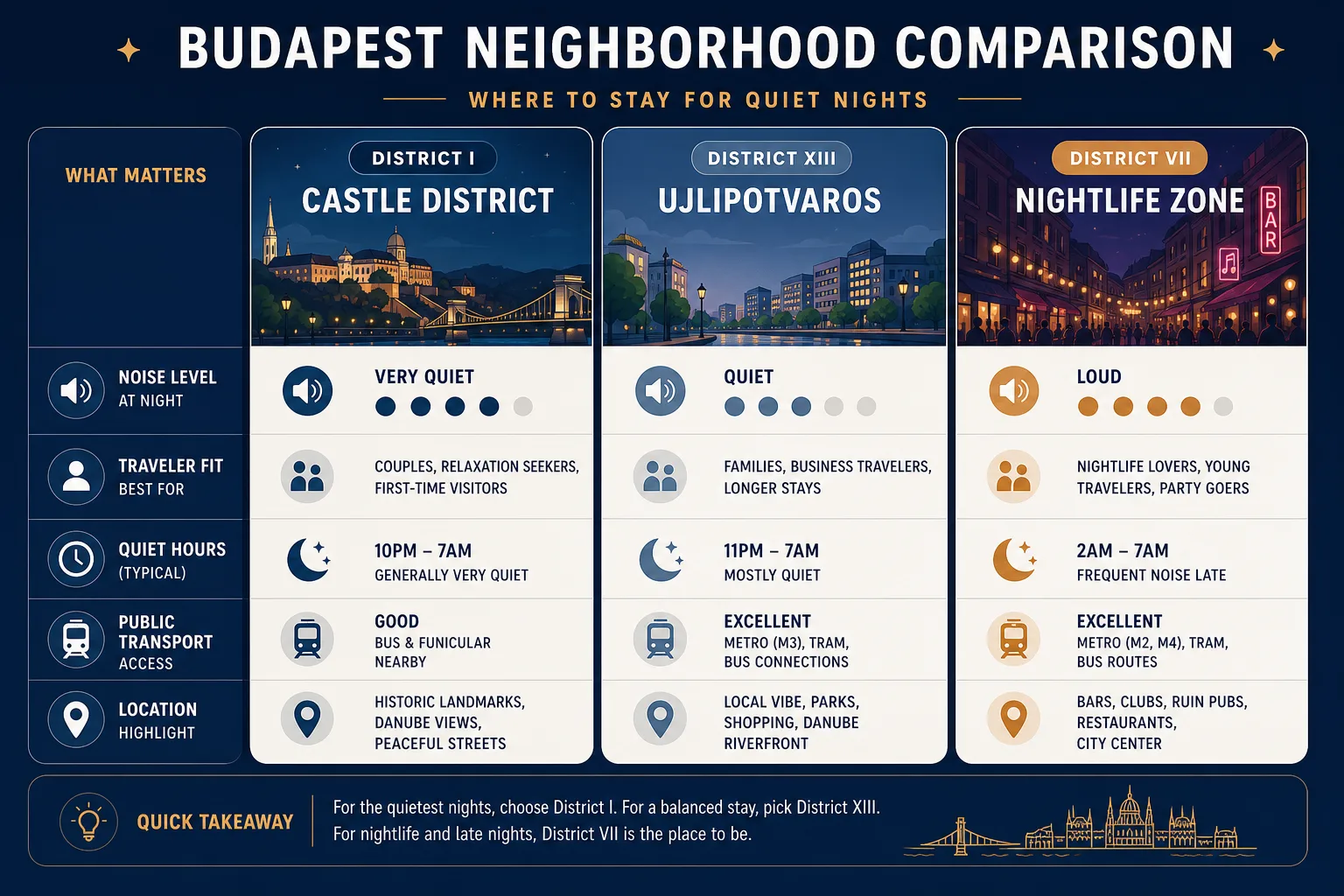 Compare District VII nightlife streets with District I and District XIII when quiet nights are the priority
Traveler Type Table
The single biggest variable in whether Budapest feels quiet or chaotic is not the city itself, it is which district your hotel sits in and how far that is from District VII. Transit cutoffs, safety, and pace all follow from that one choice.
| Traveler type | What they actually need | Where it points in Budapest | Realistic tradeoff |
|---|---|---|---|
| Quiet-night travelers | A hotel street with no bar noise late in the evening | Start with District I as the evidence-backed calmer comparison; District XIII is residential but still needs a property-level noise check | A quieter base may require more planning for evening routes; verify the actual street |
| Couples | Calm evenings plus a scenic, photogenic base | Compare District I for views and atmosphere with District XIII for a more residential setting | Check current prices, street noise, and transit convenience rather than assuming one district ranks higher |
| Low-stress planners | Predictable transit, no last-minute noise surprises | Either area can work if the evening route is checked in advance | Operating hours and night connections change; verify the current BKK route for each plan |
The pattern across all three types is the same: none of them need to avoid Budapest, they need to avoid booking inside or immediately adjacent to District VII without realizing it.
Best for First-Time Visitors
First-time visitors to Budapest often default to booking near "the center" without checking whether the actual street sits near District VII's nightlife. This is where quiet-night travelers, couples, and low-stress planners can get tripped up on a first visit.
The fix is straightforward. A first-timer who wants both sightseeing access and quiet nights can compare a base in District I with one in District XIII. Check the current walking and public-transport route from the actual property to the Pest-side sights, museums, and river walks before booking. A postcard view or a quiet street does not by itself guarantee an easy evening return.
Low-stress planners on a first visit benefit from the same logic: pick the quiet base before picking the itinerary, and build day trips into Pest and back rather than trying to sleep in the middle of them.
Verdict for this group: strong fit if you compare District I or District XIII and the actual property before comparing prices. Weak fit if you default to "closest hotel to Deak Ferenc ter" without checking which side of that intersection you land on.
Best for Couples
Couples weighing Budapest for a quiet trip usually have two competing wants: a romantic, atmospheric setting, and evenings that do not require dodging bar crowds to get back to the room. Budapest can deliver both, but not from the same street as the ruin bars.
District I can suit couples who want a scenic, quiet-night base, while District XIII can suit couples who prefer a more residential setting on the Pest side. Compare the actual building, street noise, and current route from each property rather than using a fixed distance or travel-time promise.
The practical decision for couples is less about which district is "more romantic" and more about which setting they want each evening: District I is the evidence-backed calmer option in this comparison, while District XIII offers a residential setting whose actual street noise and route still need checking.
Verdict for this group: strong fit for couples who want a calm evening walk as part of the trip itself. Weak fit for couples who specifically want a nightlife-adjacent restaurant scene within stumbling distance of the hotel.
Best for Slow Travelers
Slow travelers, who prefer to sit with a neighborhood rather than checklist through sights, are arguably the best-matched traveler type for a quiet-night Budapest trip. Both District I and District XIII reward staying rather than rushing through.
The Castle District rewards an unhurried pace: morning coffee before day-trippers arrive, an evening walk past Matthias Church once the tour groups have left, and a genuinely quiet night's sleep in between. Ujlipotvaros rewards a different kind of slow travel, local bakeries, a park, and a residential rhythm that has nothing to do with the tourist trail.
Slow travelers should resist the temptation to "stay near the action" in District VII for convenience. Nightlife can continue late, and a slow traveler who values calm mornings can pay for a loud night with a groggy start the next day. Quiet-night travelers and low-stress planners land in the same place here: proximity to nightlife is a poor trade against a full night of sleep.
Verdict for this group: strong fit when the traveler values a calm base and checks the actual street. Weak fit if the traveler equates "slow travel" with "staying inside the liveliest bar district," which is a different trip than the one this guide is scoring.
Best for Low-Stress Travelers
Low-stress planners want predictability more than adventure. Budapest's transit can work well for that traveler type when each evening plan includes a current check of the relevant metro, tram, bus, and airport connections. Do not carry a fixed cutoff, frequency, or overnight-service assumption into a future trip without checking BKK's current information.
For a low-stress planner, the practical checklist looks like this:
- Confirm your hotel district before comparing prices, not after
- Check the current last service and connections for each evening plan
- Identify the nearest current night tram or night bus stop to your hotel in advance
- Check current ticket, pass, and taxi fares rather than carrying an old price into the trip
- Treat District VII as a place to visit, not a place to sleep, if quiet nights matter
Couples and quiet-night travelers benefit from this same checklist, since the stress of a "will I get back to the hotel easily" question is what actually erodes a calm evening, not the nightlife district itself.
Verdict for this group: strong fit once current evening transit options are on your radar. Weak fit if you plan to wing it on transit timing and improvise a way home late at night from the far side of the city.
Common Mismatches
The mismatch in Budapest is usually not underestimating the city. It is underestimating how sharply one nightlife district can change the whole trip.
- The "central and affordable means good enough" traveler. They book a short-term rental or budget hotel in District VII without checking the block and only discover on arrival that nearby nightlife conflicts with sleep. Check current street-level noise information and recent reviews because district-level evidence cannot predict one room.
- The "safe must also mean calm" traveler. Safety and sleep quality are separate questions. A traveler can verify general area guidance, skip checking noise, and end up in a room sharing a wall with the evening they were trying to avoid.
A third mismatch involves changing short-term-rental rules and listings. Travelers relying on older reviews to judge a neighborhood's quietness may find the listing itself has changed hands, closed, or sits in a different noise environment than the reviews describe. Check the current district rules, listing status, and recent reviews before booking.
Finally, low-stress planners sometimes mismatch by assuming any hotel "downtown" is fine because the city overall is orderly and safe. Downtown Pest includes both quiet stretches and nightlife streets. Proximity to the center is not the same decision variable as proximity to District VII specifically.
If you read through these mismatches and recognize your own booking habits, that is a signal worth taking seriously, not a reason to force the trip. See the alternative-destination note below before you book.
Final Match Recommendation
Choose Budapest for a quiet-night trip if you can start with the documented District VII versus District I contrast and then verify the actual property. District XIII can remain on the shortlist for its residential setting, but the supplied evidence does not guarantee quiet there. Low-stress planners should also verify each evening's current transit options.
Do not choose Budapest for this specific goal if your trip planning style is to book the cheapest well-reviewed listing near downtown without checking which street it sits on, or if part of your idea of "experiencing Budapest" requires staying immediately beside the ruin bar scene every night. In that case the nightlife district itself is a better fit for your trip than a quiet-night itinerary, and this guide is not the right frame for your plans.
If Budapest's neighborhood tradeoff still feels like more navigation than you want, compare any alternative city with the same current evidence standard: actual hotel street, evening noise, transit schedule, and local accommodation rules for your dates. The deciding question for Budapest is whether the current route between your chosen hotel and District VII is a fair trade for a quieter night. If yes, compare District I or District XIII first; if the route feels like a compromise, keep the booking decision open until a comparable alternative has been checked.
FAQ
Is Budapest too loud for a quiet vacation? Do not turn one nightlife district into a claim about the whole city. Check the actual hotel street, recent reviews, and current evening conditions; the Castle District and Ujlipotvaros should be compared by property rather than treated as guaranteed quiet.
What is the quietest area to stay in Budapest? Start by comparing District I, the Castle District on the Buda side, with District XIII, Ujlipotvaros on the Pest side. The actual street, building, and current route matter more than a fixed area ranking, so verify the property before booking.
Is it safe to walk back to a hotel late at night in Budapest? Check current official travel guidance and the actual hotel street. Personal safety and sleep quality are separate questions for a quiet trip, so do not substitute an undated numerical score or city ranking for property-level checks.
Do I need to worry about public transit shutting down at night? You need to check it for your route. Metro, tram, bus, and airport service hours and connections can change, so check current BKK information and your last-service options before booking a late dinner far from your hotel.
Are short-term rentals like Airbnb still a good option for a quiet stay? That depends on the current district rules and listing status. Check official rules, recent reviews, and the actual street before booking. A hotel with reception staff may give more control over which floor and street side you get, but confirm the current terms for your property.
If Budapest still sounds like the wrong fit, where should I go instead? Compare any alternative city using current, like-for-like evidence for hotel-street noise, evening transit, and accommodation rules. Do not assume another city's neighborhood or transit tradeoff is simpler without checking those details for your dates.