travel-decisions
How Difficult Is It to Navigate Budapest with Large Luggage on Public Transport?
Budapest's metro and buses are cheap and fast, but large suitcases hit real rules and real obstacles. Here is who should use transit, who should not, and how to make it work.

Strong Opening
Budapest's public transport is cheap, dense, and genuinely fast once you understand it. That is exactly why so many travelers assume it will also be easy with luggage. It is not automatically easy. It is easy for a backpack and a carry-on. It gets harder, sometimes a lot harder, once you are managing two large suitcases, a stroller, or bags for a family of four through stairs, turnstiles, and a system with operator rules about the size and number of bags you may carry.
The mistake is not choosing Budapest. It is choosing public transport by default, the way you might in a city with universal elevators, without checking whether your specific route and your specific bags fit the current system. This is really a stair-and-accessibility problem disguised as a budget question. That is why it is worth checking the operator information before you land, not discovering a route problem while standing at a station with heavy luggage and a connecting ride to catch.
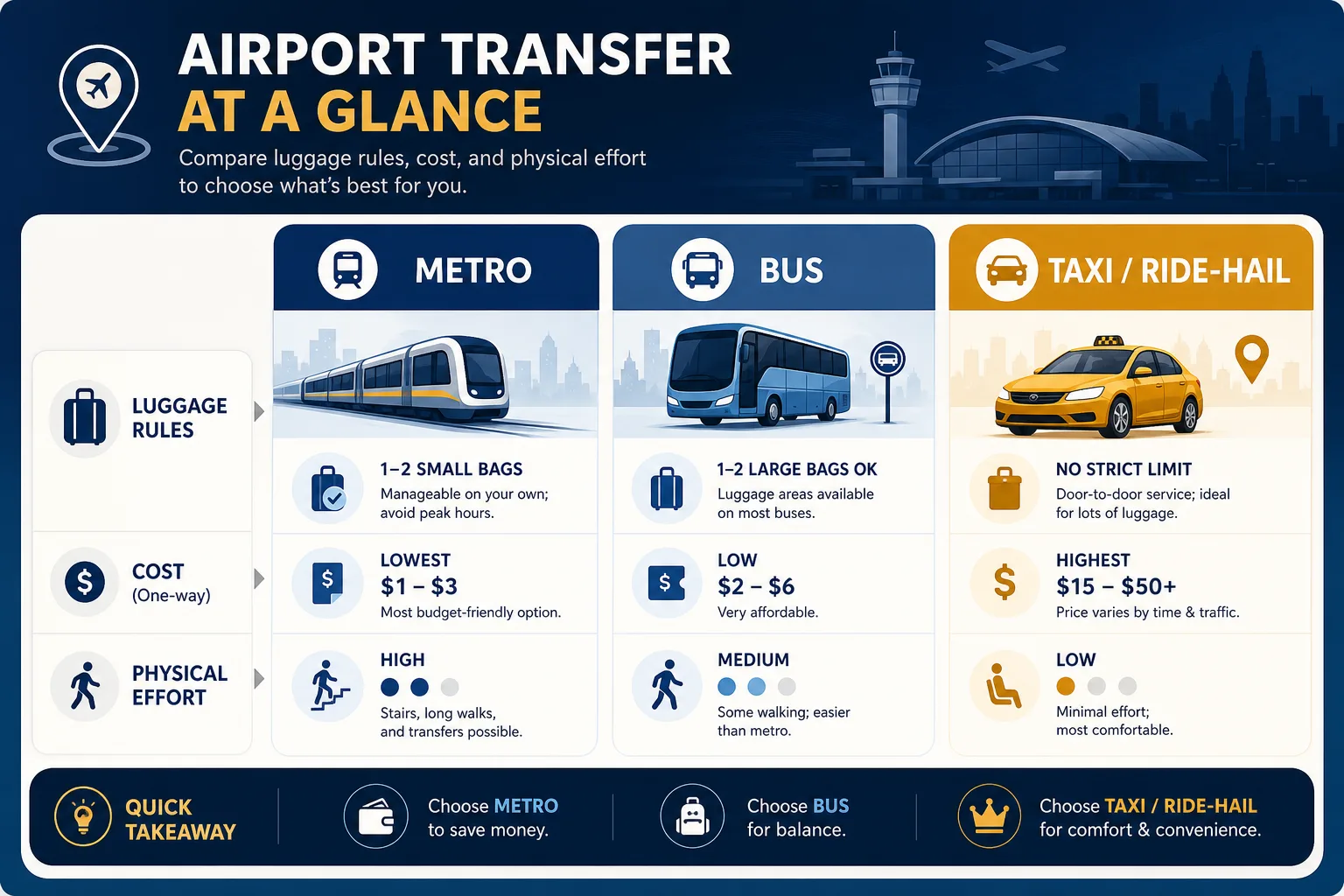 Metro line, luggage rules, and taxi cost compared side by side.
Quick Verdict
Public transport in Budapest works well with large luggage if you are traveling light-to-medium, your bags fit the operator's current allowance, your planned route has confirmed step-free access, and you are not in a rush during a first arrival. It works poorly if you have multiple oversized suitcases, need step-free access on an unverified route, are jet-lagged with young kids, or are arriving with tight connections.
Who should choose transit with large luggage: budget-conscious travelers and families willing to verify the current bag allowance and plan around stations with confirmed accessibility.
Who should not default to transit: solo travelers or families hauling multiple oversized suitcases, anyone who cannot manage stairs, and arrivals landing late at night or exhausted from a long-haul flight who just want the trip to start without a logistics puzzle.
Who Will Probably Love It
Travelers who pack light-to-medium and value cost over convenience may find Budapest transit pleasant. The fit depends on the operator's current size and item allowance, so check the published terms for your bags before assuming they ride free. That makes transit a better candidate for solo travelers and couples with one manageable main bag each than for groups carrying several large cases.
Budget-conscious travelers may reduce transport costs here, but the current fares, luggage limits, and route effort need to be compared with a taxi or transfer quote. Families should verify step-free access for every station and transfer. M4 is the useful exception: BKK identifies all M4 stations as step-free.
For a central stay, inspect the actual last walking leg from the stop to the property. A central transport hub does not establish that a particular pavement, crossing, or hotel entrance will be step-free with luggage.
Who Might Regret It
The mismatch here is rarely "Budapest transit is bad." It is assuming luggage friction is mostly about ticket price when it is often about stairs, bag shape, and timing. BKK's current rules allow up to two pieces within specified hand-luggage forms, including 40 x 50 x 80 cm, with a 30 kg limit; measure each case before relying on transit.
The specific disappointment: arriving at a station only to realize that the planned route has no confirmed step-free path, then discovering that carrying a heavy suitcase up stairs while also managing a second bag and a tired child is not a minor inconvenience. Verify each station and transfer instead of relying on a line-wide assumption.
Families with strollers, older travelers with joint or mobility concerns, and anyone landing exhausted and wanting to get directly to the hotel are the clearest wrong-fit cases. The final street and property entrance still need checking even when the transit vehicle and station are accessible.
Mistake / Consequence Table
| Decision variable | If you choose public transport anyway | Real-world consequence |
|---|---|---|
| Bag may exceed the current free-carry allowance | Assume an extra ticket makes it acceptable | The bag may not qualify for carriage; confirm the mode-specific rule before boarding |
| Multiple oversized bags per traveler | Rely on metro or bus for airport transfer | Physical struggle at stairs and uncertain onboard space |
| Station or transfer has no confirmed step-free path | Plan a route without checking accessibility | Manual stair-carrying may be required; choose a verified alternative if that is not workable |
| Airport bus has no confirmed space for your bags | Commit to the airport bus without checking current service information | Bags may be difficult to manage in the cabin, especially when the service is busy |
| Arriving exhausted or with young kids | Default to transit to save money | Fatigue and stress may outweigh the savings versus a fixed taxi fare |
| Backpack or small bag on board | Ignore the operator's current onboard-bag instructions | You may have to reposition it in a crowded vehicle; check the current rule before riding |
The pattern across every row is the same: transit rewards planning and punishes assumptions. None of these are Budapest being difficult for its own sake. They are checkable current rules and route conditions that either work in your favor or against it depending on your bags and your itinerary.
Hidden Friction Points
Luggage rules are measurable. BKK's current business rules allow up to two pieces within the listed forms: 40 x 50 x 80 cm, 20 x 20 x 200 cm, or one of each, and no piece may exceed 30 kg. A case outside those limits is not automatically accepted through an extra ticket; check the rule for the specific mode.
Transit accessibility is uneven, not universal. It is tempting to assume "the metro" is one consistent experience. It is not. Verify the current accessibility of every station and transfer on the route you intend to use. Picking a route without that check means committing to possible stairs with heavy bags, possibly more than once if you need to transfer.
Fatigue compounds with every transfer. A single staircase may be manageable. Two transfers, each with stairs, after a long flight, with a partner or child who is also tired, is where the "it's just public transport" plan quietly falls apart. BKK describes 100E as low-floor with ample room for luggage and suitcases, but that does not guarantee space on your departure or a step-free route to the hotel.
How to Make It Easier
Luggage: Measure, weigh, and count your bags before you go. Compare them with BKK's two-piece forms and 30 kg limit, then check the specific mode if any bag falls outside them.
Transit: Check the current accessibility of every station and transfer on your actual route. If your hotel or destination only connects through a stop without confirmed step-free access, treat that leg as a stair-carrying risk and compare a different route or door-to-door option before you travel.
Fatigue: Save public transport for legs where you are not simultaneously jet-lagged, luggage-heavy, and time-pressured. The single hardest combination is arrival day. Consider splitting the decision by day of the trip rather than committing to one mode for the whole visit: taxi or ride-hail on arrival day when you are most loaded down and most tired, transit for lighter day-to-day movement once bags are at the hotel.
Better Alternatives
If your luggage load or your travel party's stamina does not match Budapest transit's accessibility gaps, compare a current metered taxi or ride-hail quote with the current transit cost. Split the quoted total across the travelers who will use it, then weigh the difference against the uncertainty and physical cost of stairs.
For families with strollers or travelers with mobility limitations, a private transfer booked in advance can be worth the quoted fixed cost for the certainty: no station accessibility gamble, no cabin space competition, no lifting.
For travelers who want to use transit for most of the trip but arrived with too much luggage for day one, a hybrid approach works well: taxi from the airport to the hotel on arrival, then transit for the rest of the stay once bags are dropped and you are only carrying a day bag.
Self-Checklist
- Have you checked each bag against the two-piece size forms and 30 kg limit, and confirmed the specific mode's rule if it falls outside them.
- Have you checked the current accessibility of every station and transfer on your planned route.
- Does any part of the route lack confirmed step-free access, and if so, is a different route or door-to-door option workable.
- Will you be arriving tired, jet-lagged, or with young children on the day you plan to use transit with full luggage.
- Does the final street and property entrance have a verified step-free path from the stop.
- Have you priced a current taxi or ride-hail transfer and compared it honestly to the current transit costs and physical effort.
- Have you checked the operator's current onboard-bag instructions for backpacks and smaller items.
If you checked more than two or three of these as likely problems, plan on a taxi or private transfer for at least your arrival day, and treat transit as a tool for lighter, later-stage movement around the city.
FAQ
Can I bring a large suitcase on the Budapest metro for free? BKK's rules allow up to two pieces within the listed hand-luggage forms: 40 x 50 x 80 cm, 20 x 20 x 200 cm, or one of each, with a 30 kg limit. Measure every case. A bag outside those limits is not automatically made acceptable by buying an extra ticket.
Which Budapest metro line should I avoid with heavy luggage? M4 is the clearest choice because BKK identifies every M4 station as step-free. On M2, BKK lists only Ors vezer tere, Pillango utca, and Puskas Ferenc Stadion as step-free. Verify every station and transfer in the live accessible journey planner before travel.
Is the 100E Airport Express bus good for large luggage? BKK describes 100E as a low-floor bus with ample room for luggage and suitcases. It requires its own airport shuttle ticket, and that statement does not guarantee space on a particular departure or a step-free route from the central stop to your hotel.
Is it worth just taking a taxi instead of public transport in Budapest? For a single arrival transfer with multiple large suitcases, it can be. Compare the current metered or ride-hail quote with the current transit cost, then include stairs, transfers, and the effort of handling the bags when you decide.
What happens if I get caught with oversized luggage and no ticket? Do not assume an extra ticket makes an over-limit suitcase acceptable on every mode. Check the current BKK conditions before boarding; special payment rules for oversized objects are mode-specific.