travel-decisions
Is a Late-Night Flight to Budapest a Bad Idea? (How to Avoid a First-Night Disaster)
A late-night arrival in Budapest can wreck your first day. Here is who should book it, who should not, and how to protect your first night either way.
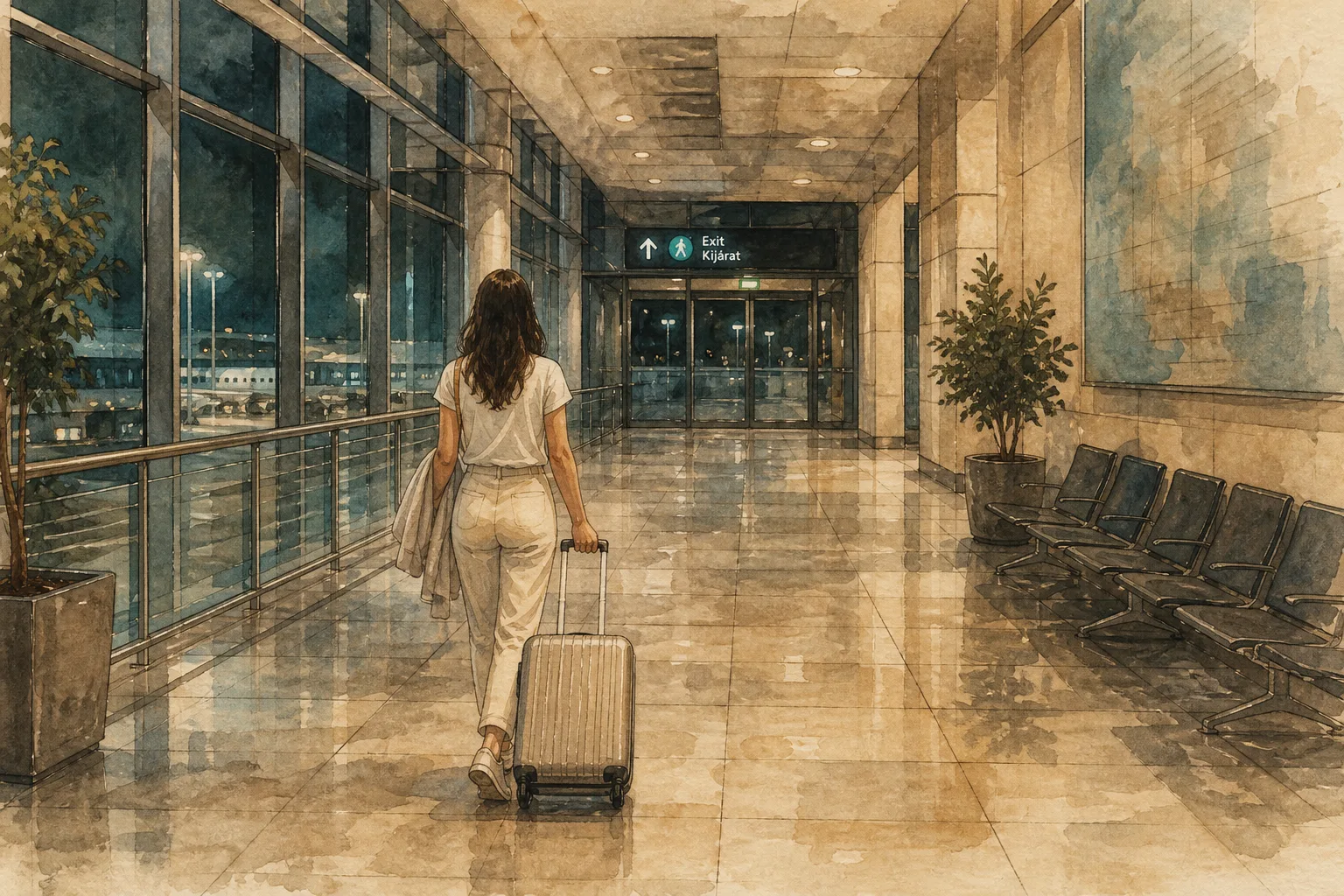
A Late Flight Doesn't Break Budapest. A Bad Plan Around It Does
Here is the decision in one sentence: book the late flight if you have a transfer arranged and a hotel that will actually let you in, skip it if you are planning to "figure it out on arrival."
A cheap fare that lands at 11:40 p.m. looks harmless when you book it three months out. It stops looking harmless the moment you are standing in a quiet arrivals hall at Ferenc Liszt Airport, phone battery at 14 percent, wondering whether anyone will answer the door at your guesthouse.
Budapest itself is not the problem. Ferenc Liszt Airport runs transport around the clock, the taxi system is regulated, and the main tourist districts are calm rather than dangerous at night. The actual risk is a chain of small decisions made weeks earlier: which flight time you picked, which neighborhood you booked, and whether you arranged a transfer or decided to sort it out when you land.
This is not a scare piece about Budapest at night. It is a decision check. Some travelers can take a late flight into Budapest and barely notice the difference the next morning. Others set themselves up for a genuinely rough first 12 hours without realizing it until they are already in it.
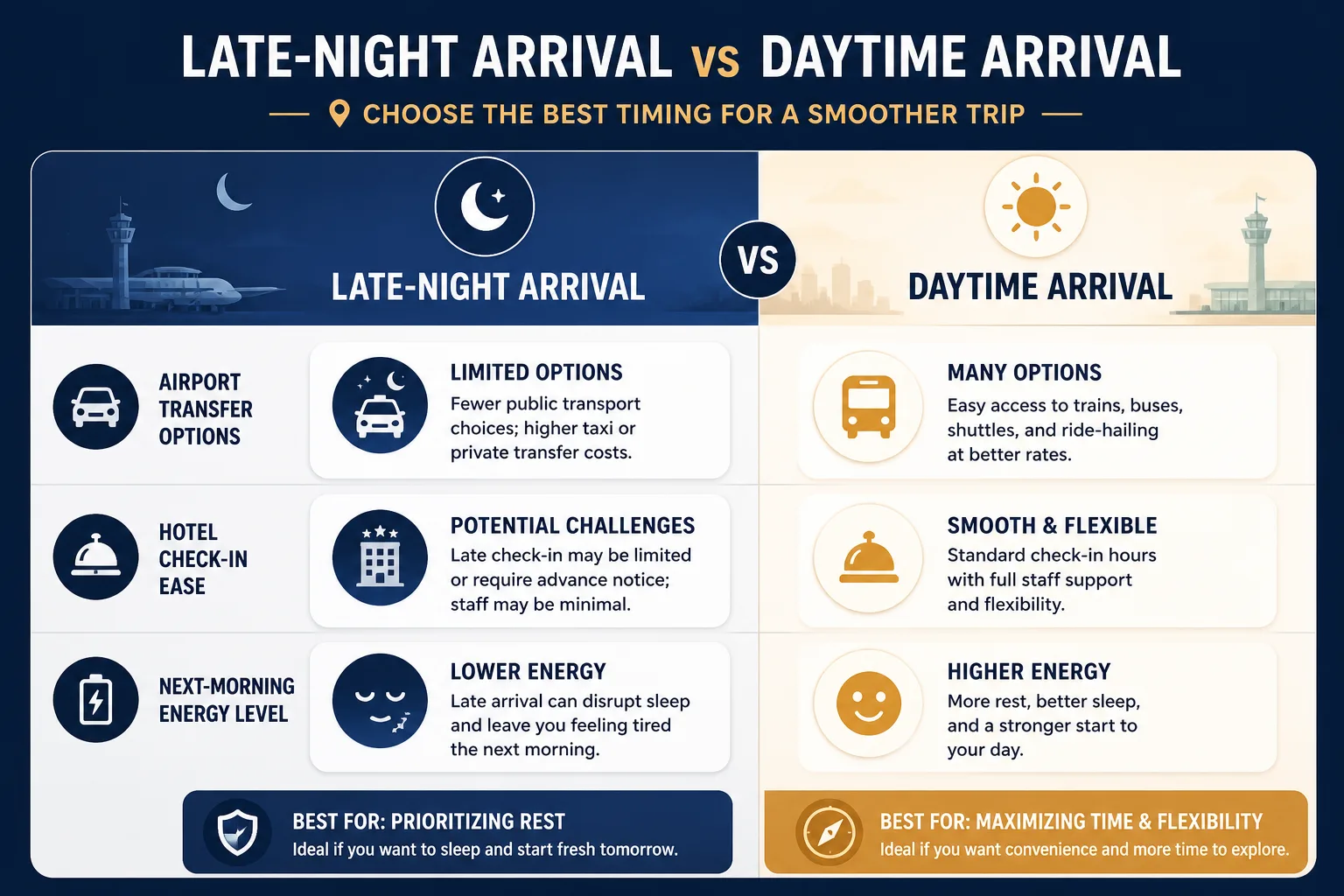 Editorial illustration: A clean simple comparison layout with two columns labeled Late-Night Arrival and Daytime Arrival.
Quick Verdict
A late-night flight to Budapest is a reasonable choice if you pre-book a transfer, a Fotaxi, or a rideshare, stay in a hotel with 24-hour or self-check-in, and treat day one as a recovery day rather than a sightseeing day.
It is a bad idea if you are relying on figuring out transport after landing, booked a small guesthouse with no night staff, or scheduled an early tour or train for the next morning.
Choose the late flight if:
- You have already pre-booked a transfer, a Fotaxi, or a confirmed rideshare
- Your hotel confirms 24-hour or self-check-in in writing
- Your first full day is intentionally light, not packed
Skip the late flight if:
- You are hoping to "sort out transport on arrival"
- Your accommodation is a small apartment or guesthouse with a host who keeps normal hours
- You have an early tour, train, or activity booked for the next morning
Who Will Probably Love It
Late flights into Budapest work well for a specific kind of traveler, and it is worth being honest about who that is.
Low-stress planners who prepare ahead of time do fine with a late landing, because the entire risk in this decision is logistics, not the flight itself. If you are the type who books the transfer, confirms the check-in policy, and reads the fine print on your hotel listing, a late arrival is just a slightly tired evening, not a crisis.
Budget-focused travelers who chase off-peak fares also benefit here, since late-night and red-eye legs are often meaningfully cheaper than the same route at 2 p.m. If the savings matter more to you than losing an evening, this is a fair trade as long as the rest of the plan holds up.
Couples and solo travelers staying in larger hotels near Deak Ferenc ter or another central hub are also well positioned, because those properties are built for round-the-clock arrivals and sit close to where the night bus routes actually converge.
Who Might Regret It
The mismatch shows up clearly in a few traveler patterns, and it is worth checking yourself against them honestly before you book.
First-time visitors who have not researched the airport transfer system tend to assume "there will be a bus or a taxi, obviously," without checking what that actually involves at midnight. There usually is transport, but the easy, no-thinking version of it stops applying earlier than people expect, and the version that remains takes more effort than a daytime arrival would.
Travelers who booked a boutique guesthouse or a small private apartment for the charm and the price are a second risk group. Many of these listings are genuinely lovely, but they are run by one or two people who are not standing by a front desk at 1 a.m. A late flight paired with this kind of stay is the single most common setup for a bad first night in Budapest.
Anyone who stacked an early activity onto day one, like a 9 a.m. walking tour or a morning train to another city, is the third group. The specific disappointment here is not the arrival itself, it is showing up to that activity running on four hours of sleep and getting far less out of it than the money paid for it deserved.
Mistake / Consequence Table
| Decision variable | Lower-risk choice | Higher-risk choice | What actually happens if you get it wrong |
|---|---|---|---|
| Transfer plan | Pre-booked private transfer or a Fotaxi reserved at the arrivals booth | "We will find a bus or rideshare when we land" | You lose 30 to 60 minutes sorting transport at your most tired, and risk overpaying an unlicensed driver out of desperation |
| Hotel check-in | 24-hour front desk or confirmed self-check-in | Guesthouse or apartment with host-only hours | You arrive to a locked door with no one answering, and now you are solving a housing problem at 1 a.m. in an unfamiliar city |
| Neighborhood choice | Central district near Deak Ferenc ter or a major transit line | Quiet residential street chosen for price alone | A longer, less obvious walk from the drop-off point, with fewer people around and less signage in English |
| Day one itinerary | Light morning, first real activity after lunch | Early tour, train connection, or packed schedule | You either cancel something you paid for or attend it running on minimal sleep and remember little of it |
| Luggage plan | Carry-on only or a bag you can manage alone | Heavy checked luggage with no porter or lift confirmed | Dragging bags up stairs or across cobblestones in the dark adds real physical strain right when you have the least energy for it |
Hidden Friction Points
Four specific frictions cause almost all late-night Budapest arrival problems, and each one is avoidable if you know it is coming.
Late arrival risk is less about the flight landing late and more about delay compounding. A flight scheduled for 11:15 p.m. that lands at 12:40 a.m. after a delay pushes you into the thinnest part of the night's schedule. Build in a buffer assumption: treat any flight scheduled after 9:30 p.m. as if it might actually land after midnight, and plan your transfer around that later time, not the printed one.
Airport transfer stress is the most immediate friction, and it is worth getting the facts right instead of guessing. The 100E direct bus to Deak Ferenc ter in the city center runs 24 hours a day, but service thins out overnight, so you may wait longer between buses in the early hours than you would at noon. You also need a specific Airport Shuttle Single Ticket, currently 2,200 HUF, which is not the same as a standard BKK transit ticket and is not always obvious to buy at 1 a.m. with limited signage. Fotaxi, the official regulated taxi operator, runs a staffed booth right outside arrivals and charges a fixed zone fare, typically around 10,000 to 12,000 HUF (roughly 25 to 32 EUR) into the center. That is the most predictable option at night: no schedule to catch, no ticket machine to figure out, just a queue and a fixed price.
Hotel location risk compounds the transfer problem. A hotel that looked perfectly located on a map during daytime planning can feel very different at 1 a.m. if it means a 10-minute walk from your drop-off point through quiet streets with your luggage. Staying within easy reach of Deak Ferenc ter or another well-lit transit hub matters more at night than it does during the day, because that is where the bus, taxi, and metro lines all meet.
First-night fatigue is the quiet one that people underestimate. Long-haul or connecting flights that land late leave you running on accumulated sleep debt, not just a late bedtime. That fatigue does not disappear by morning if you also had a stressful transfer and a difficult check-in. It carries into day one and quietly reduces how much you actually experience and remember.
How to Make It Easier
Each friction point above has a direct fix, and none of them require changing your flight.
- Pre-book a private transfer or plan to use the Fotaxi booth at arrivals rather than deciding on arrival. This removes the single biggest source of late-night stress.
- If you plan to use the 100E bus, buy the Airport Shuttle Single Ticket (2,200 HUF) from the machine or kiosk before you leave the terminal, and check the overnight timetable in advance so you are not guessing at 1 a.m.
- Confirm your hotel's actual check-in hours in writing, not just "flexible check-in" in the listing description. Message the property directly if a late-night arrival is not explicitly addressed.
- Choose accommodation within easy reach of Deak Ferenc ter or another major transit hub, even if it costs slightly more than a similarly priced option tucked into a quiet side street.
- Pack a carry-on you can manage alone, or confirm your hotel has a lift, if you are arriving without help.
- Deliberately leave your first morning light. Push your first real activity to early afternoon so a rough night does not cost you a paid experience.
- Download offline maps and save your hotel's address and phone number before you land, in case your phone data does not connect immediately at the airport.
Better Alternatives
If checking the list above makes the late flight feel like more risk than it is worth, there are better-fit options.
A daytime or early-evening arrival, even if it costs somewhat more, removes almost every friction point in this article at once. Regular transit runs on its normal schedule, your hotel's front desk is staffed on normal hours, and you get an actual usable evening in Budapest instead of losing it to recovery.
If the schedule or price genuinely locks you into a late flight, booking one extra night at an airport-adjacent hotel and moving into the city the next morning is a reasonable middle path. It costs one additional night but eliminates the late-night transfer and check-in risk entirely, and you arrive in the city center rested rather than depleted.
For travelers who specifically dislike unpredictability, a mid-range hotel chain with confirmed 24-hour reception near Deak Ferenc ter or another central hub is a safer structural choice than a boutique stay, regardless of what time you land. The predictability is worth more than the extra charm on a late-arrival trip.
Self-Checklist
Run through this before you finalize the booking, not after:
- My flight is scheduled to land before 10 p.m., or I have already accepted the later-arrival tradeoffs below
- I have a pre-booked transfer, a Fotaxi plan, or a confirmed rideshare for arrival, not a "figure it out there" plan
- If using the 100E bus, I know I need the separate Airport Shuttle Single Ticket (2,200 HUF), not a regular BKK ticket
- My hotel or apartment has confirmed 24-hour or self-check-in in writing
- My accommodation is within easy reach of Deak Ferenc ter or another major transit hub, not deep in a quiet side street
- I have not scheduled an early tour, train, or activity for the morning after arrival
- I can manage my luggage alone if no help is available at check-in
- I have my hotel's address and phone number saved offline
If you cannot check most of these boxes, move your flight earlier or add a buffer night before deciding the late flight is fine.
FAQ
Is it safe to arrive in Budapest late at night? Ferenc Liszt Airport and the official Fotaxi rank outside arrivals are safe and staffed at any hour. The real risk is not personal safety at the airport, it is ending up in an unfamiliar side street at 1 or 2 a.m. with a hotel that has no one awake to let you in.
What time counts as a late-night arrival in Budapest? Treat anything scheduled to land after 10 p.m. as late-night for planning purposes, and anything after midnight as high-risk. Regular city buses and the metro stop running well before midnight, and many small guesthouses stop offering staffed check-in by then too.
Does public transport actually run from Budapest Airport at night? Yes, the 100E direct airport bus to Deak Ferenc ter runs 24 hours a day, including overnight, though it comes less often in the early morning hours. You need the separate Airport Shuttle Single Ticket, currently 2,200 HUF, not a normal BKK transit ticket. It is a workable option, but you are still walking through the terminal, waiting on a schedule, and dragging luggage across the city center late at night, which is why a pre-booked transfer or Fotaxi is the lower-stress choice.
How much does a taxi from Budapest Airport actually cost? Fotaxi is the official, regulated operator with a staffed booth right outside arrivals, and a ride into central Budapest typically runs roughly 10,000 to 12,000 HUF (about 25 to 32 EUR), fixed by zone rather than negotiated. That is more than the airport bus but far safer and faster than flagging down an unmarked car at midnight.
Should I just book a daytime flight instead? If the price difference is small and your itinerary allows it, yes. A daytime arrival removes almost every friction point in this article at once: transit runs on its normal schedule, hotel check-in is routine, and you get a usable first evening instead of losing it to recovery.
Does a late arrival ruin the whole trip? Not if you plan for it, but it can wreck the first 12 to 18 hours if you do not. A late flight paired with a self-check-in hotel near Deak Ferenc ter and a pre-booked Fotaxi or transfer is a minor inconvenience. The same flight paired with a guesthouse on a quiet residential street and no transfer plan is how a genuinely bad first night happens.