city-matchups
Gyeongju vs. Andong: Which Historical Hub Fits Your Pace If You Hate Crowded Tourist Streets?
Gyeongju and Andong both promise Korean history without the Seoul crowds, but they suit different paces. Here is the direct verdict on which one fits you.
Quick Verdict
Choose Gyeongju. For most travelers who want deep Korean history without fighting crowds, Gyeongju's compact downtown wins on pace.
You get a walkable cluster of tombs, palaces, and temple sites, plus enough infrastructure to move fast when you want to. Andong is the better pick only if you specifically want village-level stillness and are willing to build your day around a bus schedule to reach it.
Choose Gyeongju if you want history sites close enough together to string into one relaxed walking day. Choose Andong if a single quiet folk village matters more to you than seeing several major sites in one trip. Skip Gyeongju in April or October if crowd avoidance is your top priority. Skip Andong entirely during the Mask Dance Festival window unless the festival itself is the point.
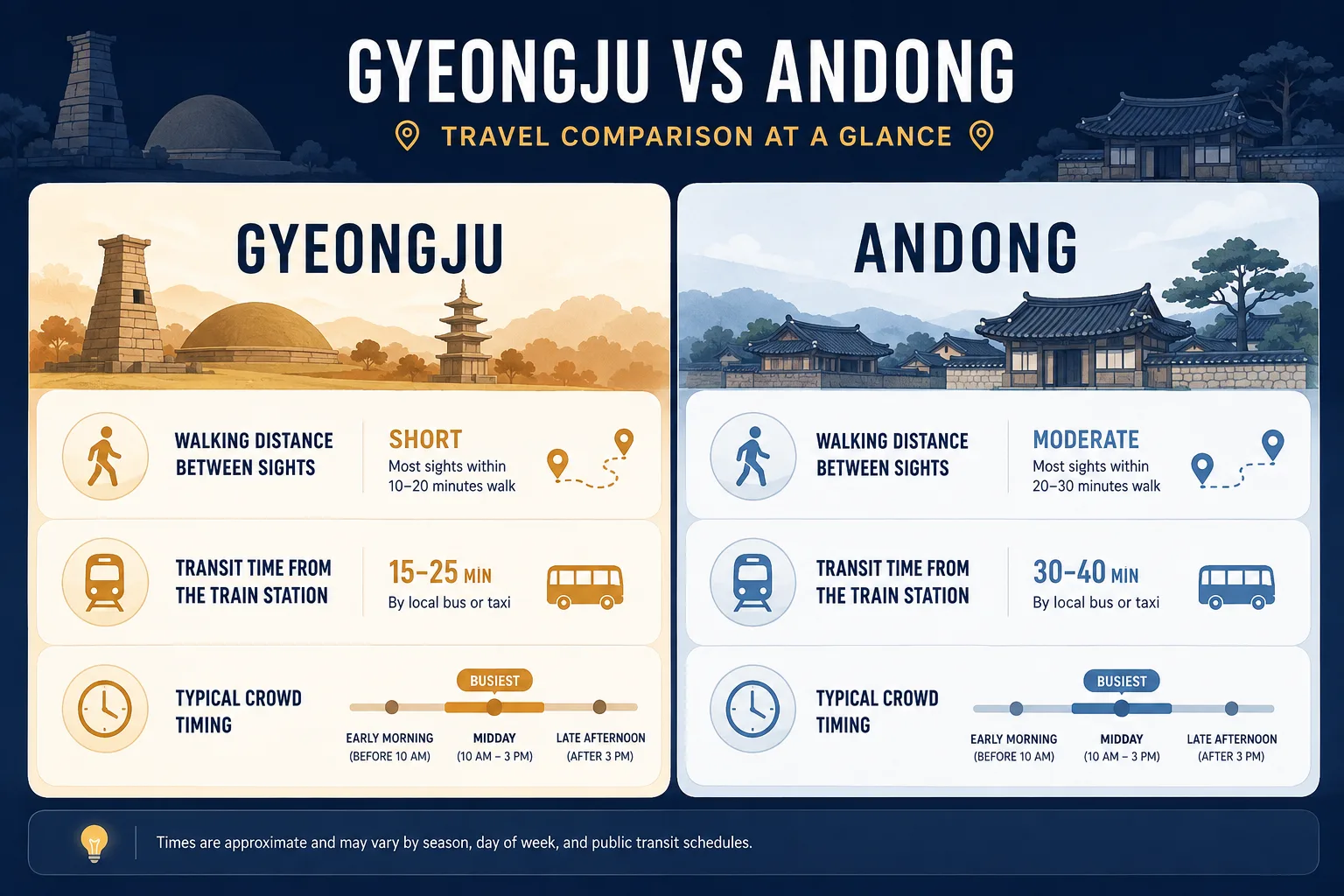 Editorial illustration: A simple side-by-side comparison layout with two labeled columns.
At a Glance Table
The real decision here is not "which city has more history." Both do. The real decision is how much walking, waiting, and transit friction you're willing to accept to reach it.
| Decision variable | Gyeongju | Andong |
|---|---|---|
| Distance from station to historic core | 10 to 15 km, 20 to 30 min taxi (~15,000 KRW) or local bus | 7 km, 10 to 15 min taxi (10,000+ KRW), station shares building with bus terminal |
| Walkability between main sights | Under 2 to 3 km radius, 5 to 15 min walks between sites | Downtown sights compact, but Hahoe Folk Village is 30 km / 40 to 50 min away |
| Getting to the signature site | Bulguksa and Seokguram reachable by local bus from downtown | Hahoe reachable by Bus 210, about 13 departures a day |
| Lodging cost (mid-range) | 75,000 to 120,000 KRW/night (hanok/guesthouse) | 35,000 to 75,000 KRW/night (business/city hotel) |
| Lodging cost (premium) | 150,000 to 260,000 KRW/night (boutique hanok) | Limited premium tier; mostly standard hotels |
| Peak crowd risk | High in April (cherry blossoms) and October (foliage, muhly fields) | Low most of the year; spikes hard during Mask Dance Festival (mid-Sept to early Oct) |
| Entry costs | Daereungwon grounds free; Cheonmachong interior 3,000 KRW; Bulguksa and Seokguram free since May 2023 | Village and site entry costs vary; budget for transit more than tickets |
| Best fit | Travelers who want a full day of connected sights on foot | Travelers who want one deeply quiet, uncommercialized village experience |
The tradeoff in one line: Gyeongju gives you density, Andong gives you distance from other tourists, but that distance costs you transit time.
Choose Gyeongju If
Pick Gyeongju if you want to see several major historical sites in a single day without renting a car or memorizing a bus timetable. The downtown core rewards travelers who like to wander from one site to the next and stumble onto smaller finds along the way.
Gyeongju works best for slow travelers who still want efficiency. You can walk from Hwangridan-gil to Daereungwon in under five minutes, then to Cheomseongdae in about ten more, then on to Donggung Palace and Wolji Pond in another ten to fifteen. That's a full afternoon of layered history covered almost entirely on foot.
It also fits budget-conscious culture travelers who want free or low-cost entry. Bulguksa, Seokguram, and the main Daereungwon grounds no longer charge admission, so your money goes toward lodging and food instead of ticket stacking.
Choose Andong If
Pick Andong if a single, unhurried folk village experience matters more to you than covering multiple sites. Hahoe Folk Village is a living settlement, not a reconstructed display, and that authenticity is the entire draw.
Andong suits travelers who don't mind building a day around a bus schedule. If you can plan around Bus 210's roughly 13 daily departures, or you're comfortable paying for a taxi, the tradeoff in travel time buys you a village with far less tourist infrastructure pressing in on it.
It also fits quiet-seekers who prioritize atmosphere over checklist coverage. Outside the Mask Dance Festival window, Andong stays genuinely calm, which is harder to find in Gyeongju during its two peak seasons.
Who Might Regret Gyeongju
Travelers expecting total solitude will be disappointed. Gyeongju in April or October gets crowded, and Donggung Palace and Wolji Pond specifically bottleneck at sunset and after dark, exactly when the lighting looks best in photos.
If you arrive during either peak window expecting the quiet, contemplative pace this article recommends Gyeongju for, you'll instead find shoulder-to-shoulder viewing at the most photogenic spots. That mismatch between expectation and reality is the single biggest regret risk here. The fix is simple: visit outside April and October, or accept the tradeoff and go early morning before crowds build.
Who Might Regret Andong
Travelers with limited time or low tolerance for transit friction will regret Andong. The signature site, Hahoe Folk Village, sits 30 kilometers from downtown, and reaching it eats 40 to 50 minutes each way plus a 15-to-20-minute walk or shuttle from the ticket office to the entrance.
If you're on a tight schedule and expected Andong to feel as walkable as Gyeongju's downtown, you'll be frustrated by how much of your day disappears into transit. Anyone booking a trip during the Mask Dance Festival window without realizing accommodations sell out months ahead will also regret the timing badly. Book Andong lodging early if your dates overlap mid-September to early October, or avoid that window altogether if the festival isn't your specific goal.
Key Friction Comparison
Crowds. Gyeongju's crowd risk is seasonal and predictable: April and October are the danger zones, with sunset at Donggung Palace and Wolji Pond as the worst chokepoint. Andong's crowd risk is narrower but sharper, concentrated almost entirely in the Mask Dance Festival window. Outside these specific windows, both cities are manageable, but Andong stays quieter more consistently across the calendar year.
Expectation mismatch. The biggest gap between what travelers expect and what they get shows up in pacing. People picture Gyeongju as a slow wander and don't expect crowd bottlenecks at golden hour. People picture Andong as a quick add-on to a Gyeongju or Seoul itinerary and don't expect a 30 kilometer, 40-to-50-minute detour just to reach Hahoe. Set your expectations to match each city's actual layout, not its marketing image.
Transit and station friction. Neither city puts you downtown when you arrive by train. Gyeongju Station sits 10 to 15 kilometers from the historic core, a 20-to-30-minute taxi ride at roughly 15,000 KRW, or a local bus. Andong Station, relocated in 2020, sits about 7 kilometers from downtown, a shorter 10-to-15-minute taxi ride at 10,000 KRW or more, and is conveniently co-located with the bus terminal. Once you're downtown, Gyeongju's sights cluster tightly for walking; Andong's downtown is walkable too, but its signature village requires a separate, longer trip on top of that.
Here's a simple pre-trip checklist to reduce friction on either route:
- Confirm whether your visit dates fall in Gyeongju's April or October peak windows
- Confirm whether your visit dates overlap Andong's Mask Dance Festival (mid-Sept to early Oct)
- Budget taxi fare separately for the station-to-downtown leg in either city
- If choosing Andong, check Bus 210's schedule to Hahoe before you plan your day around it
- If choosing Gyeongju, plan Donggung Palace and Wolji Pond for early evening arrival, not peak sunset
Final Recommendation
Gyeongju is the better default choice for most culture-focused, slow-paced travelers who hate crowded tourist streets but still want to cover meaningful ground. Its compact downtown, free major sites, and short walking times between landmarks let you move at a relaxed pace without losing a full day to transit.
Choose Gyeongju if you want walkable density, free entry to Bulguksa and Seokguram, and a mix of hanok lodging options. Do not choose Gyeongju if your travel dates fall in April or October and crowd avoidance is non-negotiable; shift your dates or accept the tradeoff.
Choose Andong instead if a single, quiet, uncommercialized village experience outweighs your interest in seeing multiple major sites. Do not choose Andong if you have limited time or low patience for schedule-dependent transit, since Hahoe's distance from downtown will eat a disproportionate share of your trip.
FAQ
Is Gyeongju or Andong better for a first-time Korean history trip? Gyeongju is the better first stop. Its main sights sit within a 2 to 3 kilometer radius, so you get a dense, walkable introduction without needing a car or detailed bus schedule. Andong rewards a second, more deliberate visit once you already know you want village-level quiet over palace-level scale.
Can I visit both Gyeongju and Andong on the same trip? Yes, but treat them as two separate legs rather than a day-trip pairing. They are not adjacent, and each deserves at least one full overnight to justify the transit time in and out.
Which city has fewer crowds, Gyeongju or Andong? Andong is quieter overall for most of the year. Gyeongju gets genuinely crowded in April and October, while Andong's only major crowd spike is the Mask Dance Festival in late September to early October. Outside those windows, Andong stays calmer simply because it draws fewer visitors.
Is Hahoe Folk Village worth the extra travel time from Andong? If quiet, lived-in village atmosphere is your priority, yes. The village sits about 30 kilometers from downtown Andong, a 40 to 50 minute bus or taxi ride, plus a short walk or shuttle from the ticket office to the entrance. That's a half-day commitment, not a quick add-on.
Do I need a car in Gyeongju or Andong? Not in Gyeongju, where downtown sights are walkable and local buses cover the rest. In Andong, a car or reliance on the Bus 210 schedule to Hahoe becomes more important, since the village sits well outside town and buses run on a fixed, limited schedule.