where-to-stay
Is Booking a Gyeongju Hanok Stay a Mistake If You Have Heavy Luggage and Back Pain?
A direct look at whether a Gyeongju hanok stay is worth the floor-bed and luggage tradeoffs, with area-by-area risk and a hybrid-room shortlist.
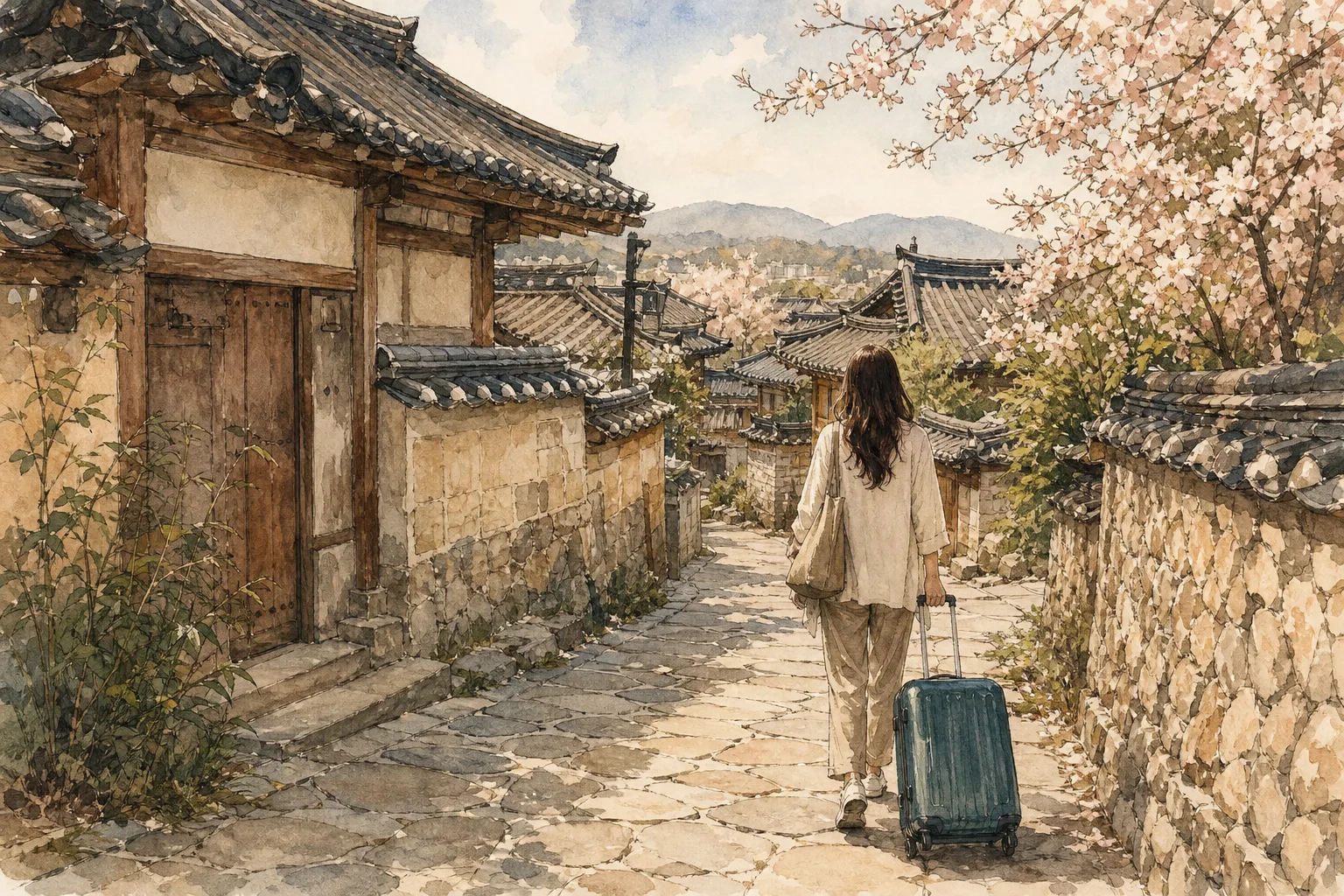
Quick Answer
A classic Gyeongju hanok stay is not automatically a mistake, but it is a real risk if you have heavy luggage, back pain, or low tolerance for floor sleeping. The traditional room format uses a floor mattress on a heated ondol floor, and most hanok properties sit on narrow lanes that are awkward for wheeled suitcases.
Choose a traditional hanok if you can carry your own bags a short distance, you can get up and down from a floor mattress without pain, and atmosphere matters more to you than convenience. Skip it, or choose one of the hybrid-bed hanok stays, if you have chronic back or knee pain, you are traveling with a large suitcase and no help carrying it, or you are booking for an older traveler who needs a raised bed and a step-free entry.
This is a one-or-two-night decision, not a lifestyle one. The way to avoid regret is to match the room format to your body and your bags before you book, not after you arrive at the gate with a suitcase you cannot lift.
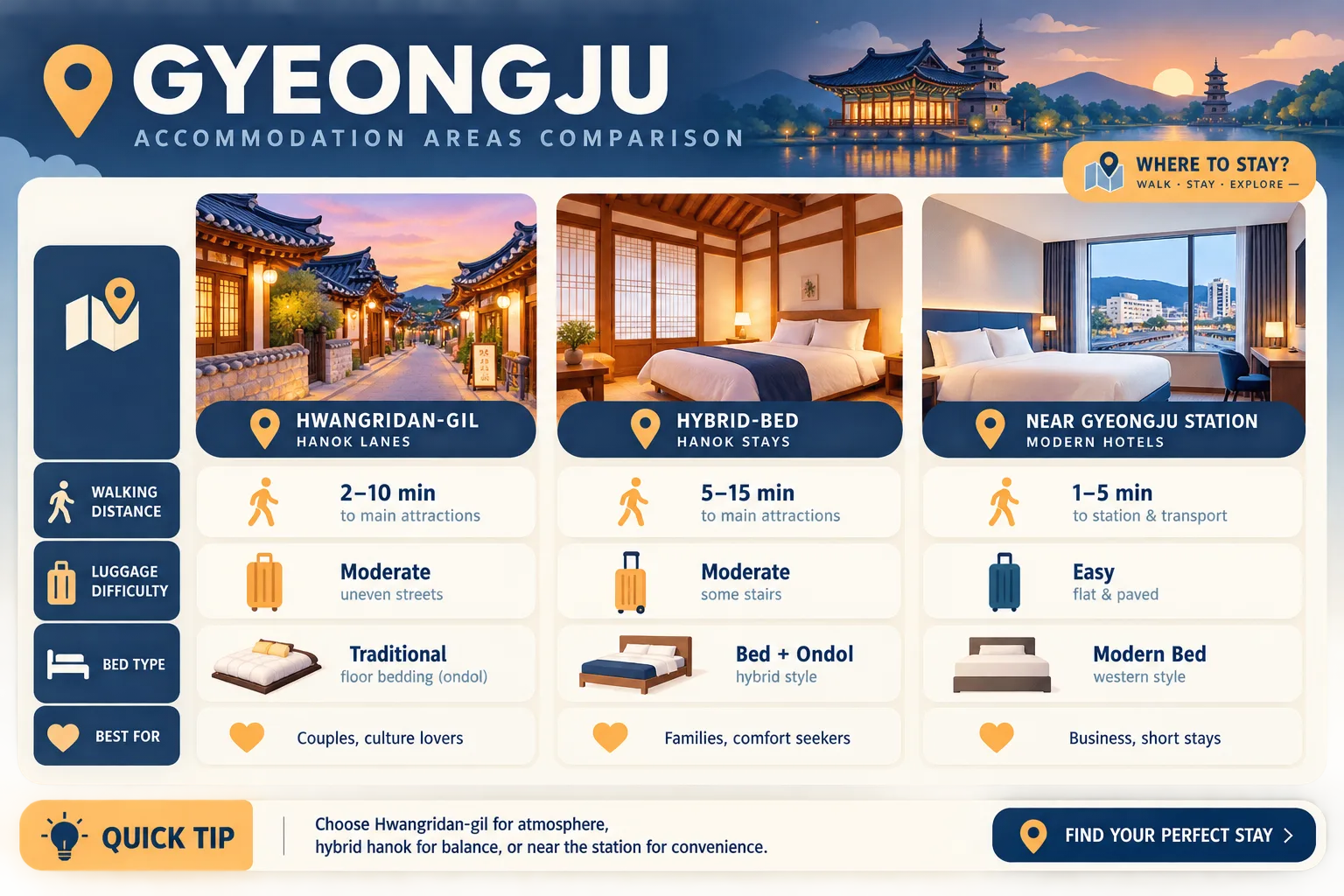 Editorial illustration: A simple comparison table graphic listing Gyeongju accommodation areas such as Hwangridan-gil hanok lanes.
Hotel Location Risk Summary
The core risk with a Gyeongju hanok stay is not the neighborhood, it is the physical format layered on top of the neighborhood. Two separate frictions stack together: getting to the hanok cluster with your luggage, and then living inside a hanok room once you are there.
Getting there is manageable. Hwangridan-gil, the main hanok cluster, is well connected: it sits about 110 meters from the Daereungwon Ancient Tomb Complex, roughly 900 meters from Cheomseongdae Observatory, and about 1.2 kilometers from Gyochon Traditional Village. From Gyeongju Station, a taxi takes 15 to 20 minutes and costs about 16,000 to 20,000 won, which is the easiest option if you have more than a carry-on. Buses 50, 70, or 700 are cheaper at 1,250 to 1,650 won but mean carrying your bags on board and walking the final stretch.
Living there is where the risk actually sits. Once you are inside the hanok cluster, the lanes themselves are narrow, sometimes gravel or uneven stone, and many hanok entrances have a small gate or a raised threshold. That is a minor inconvenience for a backpack and a real problem for a large hard-shell suitcase, especially if lifting it triggers back pain. Layer in that almost all hanok stays enforce a 10:00 PM quiet hour because of low sound isolation, and you have three compounding frictions: terrain, lifting, and noise.
Best Areas at a Glance
Not every Gyeongju stay option carries the same friction. The table below separates the classic hanok experience from two more forgiving alternatives.
| Area / Option | Walking distance to sights | Luggage difficulty | Bed type | Best for |
|---|---|---|---|---|
| Hwangridan-gil classic hanok | 110m to 1.2km to major sights, on foot | High: narrow lanes, gravel, gate thresholds | Floor mattress (yo) on ondol floor | Travelers prioritizing atmosphere, no back pain |
| Hybrid-bed hanok (e.g. Wiyeonjae, Soi, Seomcholong) | Same cluster, same walking distances | Moderate: same lanes, but room itself is easier once inside | Raised Western-style bed | Travelers who want hanok atmosphere but need a real bed |
| Modern hotel near Gyeongju Station or town center | Requires taxi or bus to reach Hwangridan-gil sights (15 to 20 min taxi) | Low: standard elevators, level entries | Standard hotel bed | Back pain, heavy luggage, mobility concerns, families with strollers |
The tradeoff is direct: the closer you are to the postcard hanok experience, the more physical friction you take on. The more comfort and predictability you want, the further you trade away from the historic lanes.
Best Area by Traveler Type
Luxury travelers. If comfort and design matter more than sleeping on a traditional floor mattress, a hybrid-bed hanok stay is the better fit than a classic hanok room. You keep the aesthetic, the wood detailing, and the courtyard feel, but you get a raised bed and generally a more considered bathroom. If even that feels like too much compromise, a well-reviewed modern hotel with a short taxi ride into Hwangridan-gil protects your comfort without giving up much sightseeing time, since the sights themselves cluster within a 1.2 kilometer radius of each other.
Senior travelers. This is the group where the floor-mattress format matters most. Repeated up-and-down movement from a yo on an ondol floor is hard on knees and lower backs, and narrow hanok lanes with uneven paving are a fall risk with luggage in hand. A hybrid-bed hanok stay solves the bed problem but not the terrain problem on arrival day. If mobility is a real concern, a modern hotel with step-free access and a short taxi to the historic core is the lower-risk choice, even though it means a 15 to 20 minute ride to reach the tomb complex and observatory each day.
Families with kids. Hanok stays can be charming for families for one night, but the practical issues are noise (a 10 PM quiet hour is hard to guarantee with young kids) and space (most hanok rooms are compact, and moving strollers or travel cots through narrow gates is awkward). A hybrid-bed hanok works better for families than a classic one because at least the sleeping arrangement is simpler. Families who need real flexibility on bedtime and noise are usually better off in a standard hotel near the center, using the hanok lanes for daytime visits instead of overnight stays.
Areas to Be Careful With
The mismatch pattern is consistent: travelers who book a hanok stay for the photos, then discover the physical reality only after arriving with a suitcase. A few specific disappointment risks show up repeatedly.
- Arriving by taxi with a large suitcase and finding the hanok is set back on a lane the car cannot enter, meaning the final 50 to 150 meters are walked over gravel or stone.
- Discovering the room has a raised wooden threshold at the entrance, which is a genuine trip hazard when carrying a heavy bag or navigating with joint pain.
- Assuming "hanok stay" automatically means a hybrid bed, then finding a traditional floor mattress on check-in with no way to swap rooms that night.
- Underestimating the 10 PM quiet hour, then being unable to shower, unpack, or settle a child after a late train arrival without disturbing neighboring rooms.
- Booking based on Hwangridan-gil's central location relative to Daereungwon and Cheomseongdae, without accounting for the fact that Bulguksa Temple and the Tohamsan area are a separate 12 kilometer, 30-minute trip, not a walkable extension of the same stay.
None of these are reasons to avoid Gyeongju. They are reasons to ask specific questions before paying a deposit, not after.
Budget vs Convenience Tradeoff
Mid-range Gyeongju hanok stays average 100,000 to 150,000 won (about 75 to 115 USD) per night, which is broadly comparable to a mid-range hotel room in the same area. So the tradeoff here is not really about price, it is about what that price buys you.
With a classic hanok, you are paying for atmosphere and location density: proximity to Daereungwon, Cheomseongdae, and Gyochon Village, plus the wood-and-courtyard aesthetic. What you are not paying for is bed comfort, sound isolation, or step-free access. With a hybrid-bed hanok, you are paying a similar price but trading a small amount of that authenticity for a bed your back will thank you for. With a standard hotel, you often gain predictable comfort and easier luggage handling, but you add a taxi ride each time you want to walk the historic lanes.
The honest framing: if back pain or heavy luggage is a factor, spending the same money on a hybrid-bed hanok or a hotel is not a downgrade, it is spending your budget on the thing that will actually affect how you feel each morning of the trip.
Hotel Location Checklist
Use this before booking any Gyeongju hanok stay, not after:
- Confirm directly with the property whether the room has a floor mattress or a raised bed.
- Ask whether the entrance has a step, threshold, or gate that a wheeled suitcase must be lifted over.
- Check the walking distance from the nearest drop-off point a taxi can actually reach to the room door.
- Confirm the quiet-hour policy (commonly starting at 10:00 PM) and whether it fits your arrival time or a child's schedule.
- If arriving with heavy luggage, plan to use the free lockers at the Hwangridan-gil Life Culture Center (10:00 to 19:00 daily) rather than hauling bags on foot all day.
- Decide in advance whether Bulguksa Temple and Tohamsan will be a separate half-day trip (about 30 minutes each way), since it is not reachable from Hwangridan-gil on foot.
- If mobility or back pain is a concern, shortlist hybrid-bed properties like Wiyeonjae Hanok Stay, Soi Hanok Stay, or Seomcholong Hanok Stay before browsing standard hanok listings.
Final Recommendation
Book a classic Gyeongju hanok stay if you can comfortably carry your own luggage a short distance over uneven ground, you do not have chronic back or knee pain, and the courtyard-and-wood atmosphere is worth more to you than a raised bed and thick walls. For one or two nights, most travelers in good physical condition manage the floor mattress and the quiet hours without real complaint.
Do not book a classic hanok, and choose a hybrid-bed hanok stay or a standard hotel instead, if you have ongoing back pain, you are traveling with a large suitcase and limited help lifting it, you are booking for an older traveler with mobility concerns, or you are traveling with young kids whose schedule will not respect a 10 PM quiet hour. In those cases, the atmosphere a classic hanok offers is not worth the physical cost, and a hybrid-bed property or nearby hotel gets you close enough to the same sights without the same risk.
The decision is not "hanok or not." It is "which version of a hanok stay, if any, matches what your body and your luggage can actually handle."
FAQ
Is a Gyeongju hanok stay bad for people with back pain? It depends on the property. Most traditional hanok rooms use a floor mattress (yo) on a heated ondol floor, which can be hard on lower-back pain, especially getting up and down repeatedly. A small number of hanok stays, including Wiyeonjae Hanok Stay, Soi Hanok Stay, and Seomcholong Hanok Stay, offer hybrid rooms with raised Western-style beds. If back pain is a real concern, book one of those or choose a standard hotel instead.
Can I bring a large suitcase to a Hwangridan-gil hanok? You can, but expect friction. Hanok lanes have narrow stone or gravel paths, small entry gates, and sometimes a step or raised threshold into the room, which are all awkward for a large wheeled suitcase. If you are traveling with heavy luggage, ask the property directly about entry terrain before booking, or use the free luggage lockers at the Hwangridan-gil Life Culture Center to travel lighter for the day.
How far is Hwangridan-gil from Gyeongju Station and is that a problem for luggage? Gyeongju Station is roughly 10 kilometers from Hwangridan-gil. A taxi takes 15 to 20 minutes and costs about 16,000 to 20,000 won, which is the easiest option with heavy bags. Local buses 50, 70, or 700 cost 1,250 to 1,650 won but require carrying luggage on and off the bus and walking the last stretch, which adds friction if you already have back pain.
Are hanok stays noisy at night? Traditional hanok construction has low sound isolation between rooms, and almost all Gyeongju hanok stays enforce a 10:00 PM quiet hour specifically because of this. Light sleepers, families with young kids on different schedules, or anyone recovering from a long travel day should treat this as a real constraint, not a minor detail.
Is it better to just book a regular hotel near Gyeongju instead of a hanok? If your priority is comfort, mobility ease, or predictable luggage handling, a standard hotel or a hybrid-bed hanok stay is the safer choice. If your priority is atmosphere and you can tolerate a floor bed and some walking, a classic hanok in Hwangridan-gil is still a reasonable pick for one or two nights.