travel-decisions
Is Vienna Worth It in Spring If You Hate Crowds And Price Pressure?
A direct look at whether spring is the right season for Vienna if crowds and hotel price spikes stress you out, with a friction breakdown and a decision checklist.
Quick Verdict
Spring is worth it for Vienna if your main goal is avoiding the worst crowd density and the worst hotel prices, and you are willing to plan around a few real tradeoffs rather than expecting a flawless middle ground.
Choose spring if you are a low-stress planner who wants shoulder-season pricing, you do not need every performance venue open, and you are comfortable with some cool or unpredictable weather days. Mid-range hotels average roughly 100 to 140 euros a night in spring versus roughly 180 to 220 euros a night in summer, which is a real, bookable difference, not marketing language.
Do not choose spring if your trip depends on guaranteed warm, sunny days every day, if you are traveling during a specific school-holiday week that happens to fall in late April or May, or if you assume "spring" automatically means empty streets. Some spring weeks, especially around Easter and school breaks, get close to summer-level foot traffic in the historic core even though hotel prices have not caught up yet.
The honest answer is: spring reduces two of your four friction points reliably (crowds and price) but does not eliminate them, and it introduces its own planning risk if you overbook your itinerary expecting a slow trip and then fill every hour anyway.
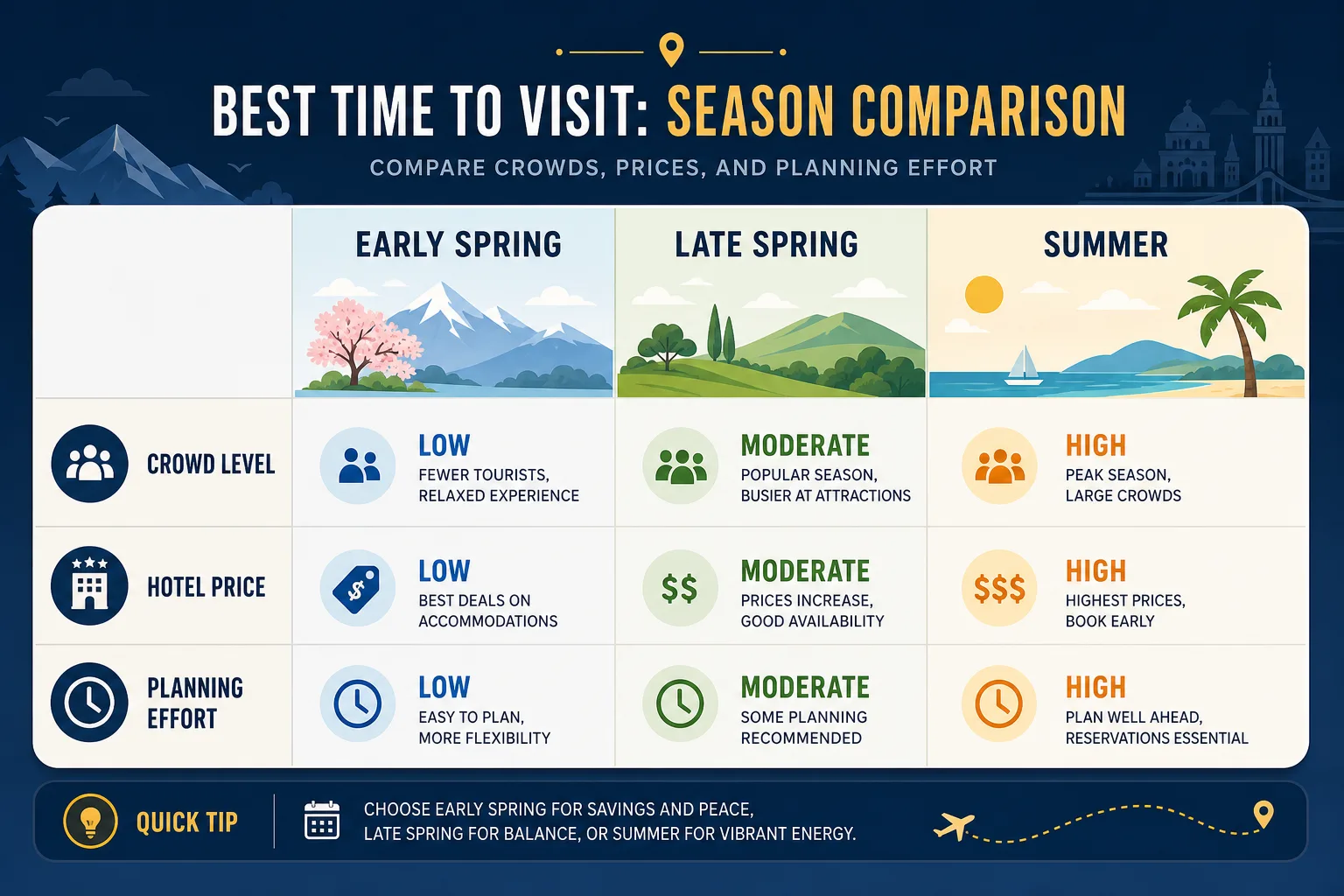 Editorial illustration: A simple comparison table or chart layout showing three columns labeled Early Spring.
Main Friction Problem
Four frictions decide whether spring actually solves your Vienna problem or just moves it around. None of them are solved automatically by picking a season; they require a specific choice within the season.
Crowds. Spring is quieter than summer at the city level, but "quieter than summer" is not the same as "quiet." The inner city around Stephansplatz and the Hofburg still draws tour groups on mild days, and the gap between March and late May is wider than people expect. Early spring is the genuinely low-crowd window. Late spring narrows that gap.
Hotel price spikes. The seasonal average is real and favorable to spring travelers, but averages hide spikes. A single trade fair, a long weekend, or a public holiday can push a specific week's rates close to summer levels even in April or May. Booking a "spring rate" without checking the specific dates against local events is the most common way travelers end up paying summer prices for a spring trip.
Overplanning. This is the friction spring travelers create for themselves. The whole appeal of the season is a slower pace, but a felt need to "make the most of" cheaper prices often leads to cramming in more sights per day than summer travelers attempt, which cancels out the low-stress benefit before the trip even starts.
Expectation mismatch. Travelers who picture Vienna from summer photography, string quartets in full swing, packed cafe terraces, golden-hour crowds at Schonbrunn, sometimes arrive in March or early April and feel like they got a lesser version of the city. It is not lesser. It is a different, calmer version, and the mismatch only hurts if you did not expect it going in.
Friction Table
The table below breaks the same four frictions down by the actual decision windows within "spring," rather than treating spring as one undifferentiated season.
| Friction | Early spring (Mar-early Apr) | Late spring (late Apr-May) | Summer (Jun-Aug) |
|---|---|---|---|
| Crowds | Low, most consistent | Moderate, rises near holidays | High, consistently |
| Hotel price spikes | Lowest average, few spikes | Low average, holiday-week spikes possible | High baseline, few discounts |
| Overplanning risk | Lower, natural slower pace | Moderate, more daylight tempts longer days | High, more open hours invite overbooking |
| Expectation mismatch | Higher if expecting summer scenery | Lower, closer to the "postcard" look | Lowest, matches most marketing imagery |
| Major venues open | Yes, full regular season | Yes, full regular season | No, Opera, Boys' Choir, and Spanish Riding School go dark |
| Weather predictability | Lower, cooler days possible | Moderate, mild but variable | Higher, but with heat risk (30-35C, limited AC) |
The pattern worth noticing: early spring wins on crowds and price, late spring wins on matching the visual expectation without full summer crowding, and summer only wins if venue schedules and guaranteed heat are what you actually want, which most crowd-sensitive travelers do not.
Who Will Feel It Most
Not every crowd-sensitive traveler experiences these frictions the same way. It depends on what specifically stresses you out.
- Low-stress planners who want a straightforward, businesslike trip with fewer scheduling gambles benefit most from early spring. Fewer people means fewer queue-related delays, which is often the actual source of stress, not the season itself.
- Budget-led travelers feel the price spike friction hardest if they book without checking specific dates against Vienna's event calendar. A traveler who books "spring" in the abstract can still land on an expensive week by accident.
- Atmosphere-first travelers who value mood over ticking off landmarks tend to do well in either early or late spring, since a quieter Josefstadt cafe or a walk through Leopoldstadt's Karmelitermarkt reads as pleasant rather than empty.
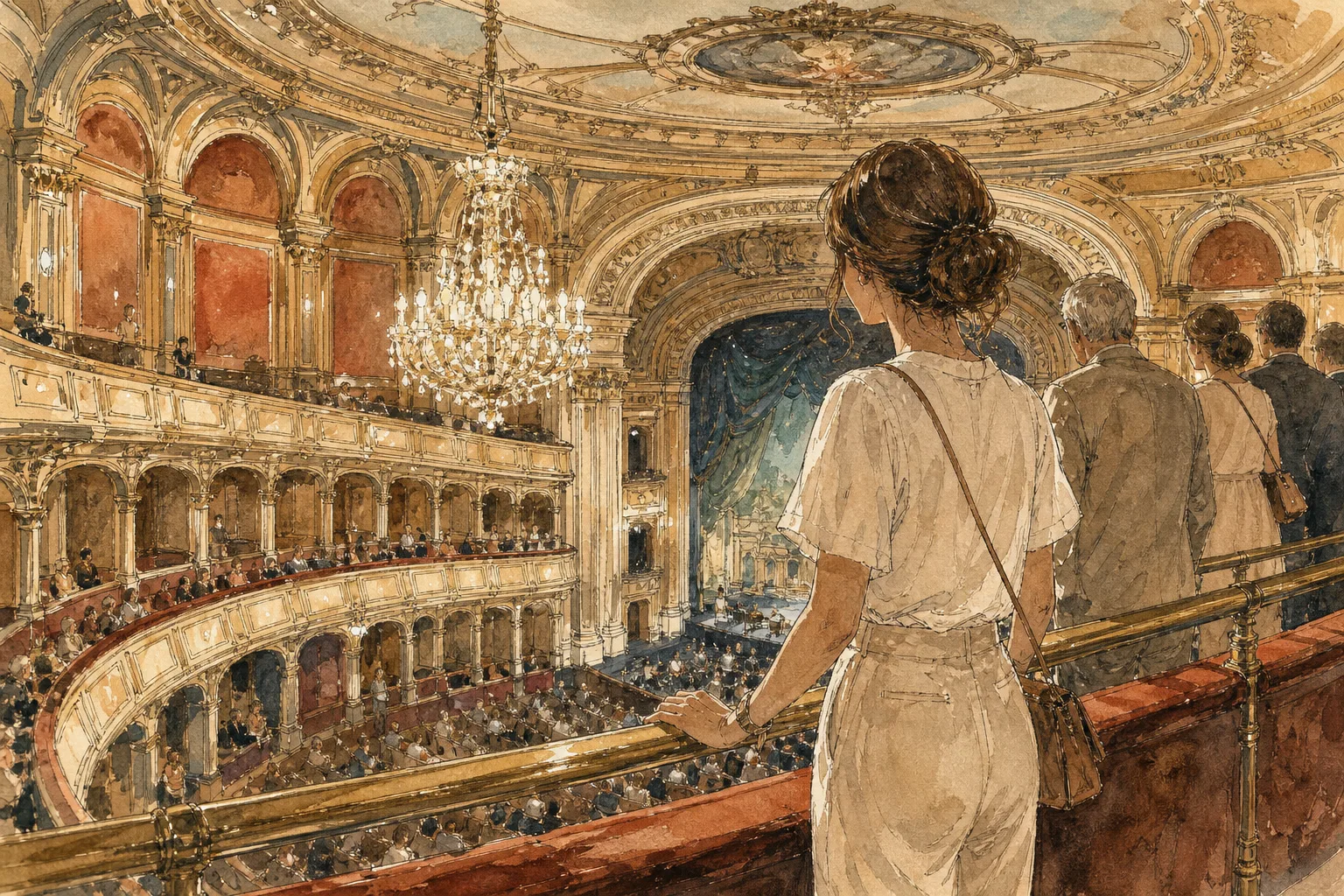
- First-time visitors who have one shot at Vienna and want the full performing-arts experience should avoid the temptation to shift into summer for warmer weather, since that trade costs them the Opera, the Boys' Choir, and the Spanish Riding School season, all closed in July and August.
- Travelers with strict fixed-week vacations that happen to land in late April or May around a school holiday will feel closer to summer-level crowding than the "spring is quiet" reputation promises, and should plan accordingly rather than being surprised.
How to Reduce the Friction
Each of the four frictions has a specific, practical fix rather than a general "just relax" answer.
- Crowds: Front-load your day. Arriving at Stephansplatz and walking the roughly 800 meters to the Hofburg in the first hour or two of opening hours avoids the midday tour-group wave that builds even in a quiet spring week.
- Hotel price spikes: Check the specific week against known event and holiday dates before booking, rather than trusting a general "spring is cheaper" assumption. A rate that looks like a deal in a search result can still be a spike relative to the surrounding weeks.
- Overplanning: Cap timed-entry bookings at one major slot per day. Schonbrunn Palace and the Belvedere both use fixed 15-minute entry windows, and stacking both in one day turns a relaxed spring itinerary into the same rushed schedule you were trying to avoid.
- Expectation mismatch: Decide in advance which version of Vienna you are visiting for. If it is the performing-arts season, spring delivers that fully. If it is warm-terrace, golden-light scenery, accept that spring gives you a milder, less saturated version of that image, not a lesser one.
Better Alternatives
If, after the friction table, spring still does not fit what you actually want, two other windows solve different priorities better.
- If your top priority is guaranteed warm weather and you can tolerate crowds and closed performance venues: summer is the more honest match, with the understanding that hotel rates run roughly 180 to 220 euros a night and daytime heat can reach 30 to 35 degrees Celsius in buildings that often lack air conditioning.
- If your top priority is the lowest possible crowd density and price, and performing-arts programming is not the draw: late autumn or early winter (excluding the Christmas market weeks, which spike both crowds and prices again) tends to undercut even early spring on both fronts, at the cost of shorter daylight and colder walking days.
- If you specifically want the performing-arts season plus lower crowds than spring's holiday weeks: early autumn, once the regular season resumes and before winter holiday demand builds, offers a similar profile to early spring with slightly more stable weather.
Spring remains the strongest single-season answer for a traveler who wants crowds and price handled at the same time without giving up venue access, which is why it is the default recommendation here rather than a compromise pick.
If quiet evenings matter as much as quiet daytime crowds, read Is Vienna Good for Travelers Who Want Quiet Nights? for a base-neighborhood breakdown that pairs well with a spring trip.
Decision Checklist
Use this before you book, not after.
- I have picked early spring (March to early April) if low crowds and low price are my top two priorities, not late spring
- I have checked my specific travel week against Vienna's holiday and event calendar, not just "spring" as a general label
- I do not need the Vienna State Opera, Vienna Boys' Choir, or Spanish Riding School to be dark, since none of them run their regular season in summer, which spring avoids
- I have limited myself to one major timed-entry attraction (Schonbrunn Palace or the Belvedere) per day, not both
- I have accounted for the 2026 transit fare changes, since the old 48-hour and 72-hour passes are gone and single or 24-hour digital tickets are now the standard option
- I have a backup plan for the Floridsdorf-Praterstern S-Bahn closure if my trip falls after September 7, 2026, since it affects S7 airport transfers and the City Airport Train
- I am mentally prepared for cooler or variable weather in exchange for lower prices and fewer people
- I have picked a quieter base neighborhood, such as Josefstadt or Leopoldstadt, if reducing daily crowd exposure matters more to me than staying directly in the tourist core
If you can check most of these boxes honestly, spring is very likely worth it for your specific version of crowd and price sensitivity.
FAQ
Is Vienna less crowded in spring than in summer? Generally yes, especially in March through mid-April. But late April through May overlaps with school holidays and peak tour-group season in some years, so early spring is the more reliable low-crowd window, not spring as a whole.
Are hotel prices actually lower in spring? Yes, on average. Mid-range 3-to-4-star hotels run roughly 100 to 140 euros a night in spring, compared to roughly 180 to 220 euros a night in summer. Prices still spike around specific holiday weekends and major events, so the average does not apply to every date.
Will I miss anything important by avoiding summer in Vienna? You will miss the regular season at the Vienna State Opera, the Vienna Boys' Choir, and the Spanish Riding School, since all three go dark in July and August. If those performances are the reason you want to visit, spring or another shoulder period is actually better for you, not worse.
What is the single biggest planning mistake for a spring Vienna trip? Overbooking the days with timed-entry attractions back to back. Schonbrunn Palace and the Belvedere both require fixed timed-entry slots, and stacking too many of them removes the slower, low-stress pace that is the main reason to choose spring in the first place.
Is early spring or late spring the better choice for a crowd-sensitive traveler? Early spring, roughly March into early April, is more consistently quiet and cheaper. Late spring is still calmer than summer but starts to narrow the gap on both crowds and price, so it suits travelers who want mild weather more than maximum quiet.