travel-decisions
Is Vienna Good for Travelers Who Want Quiet Nights?
A direct fit check for travelers who value rest over nightlife: where Vienna delivers calm evenings, where noise risk still exists, and which cities to pick instead if quiet isn't actually what you want.
Quick Verdict
Vienna is a strong fit for travelers who want quiet nights, on one condition: you pick the right neighborhood and avoid a short list of known noise pockets. This is not a city where quiet requires luck. It has enforced quiet hours (10:00 PM to 6:00 AM, fines up to 700 euros), restaurant kitchens that close by 10:00 PM, and nightlife concentrated into two mapped zones that are easy to avoid once you know their names.
Choose Vienna if you want predictable, low-drama evenings: a proper dinner that ends by 10 PM, a calm walk home, and a hotel room that stays quiet because the street outside is genuinely residential. Couples and low-stress planners who book outside the 1st District's entertainment corridor get exactly the rest-first evenings they came for.
Skip Vienna if your idea of a good night depends on late bars, a lively street scene after 11 PM on any night of the week, or grabbing food at midnight without planning for it. Vienna's default state after dinner is quiet, and travelers who need dependable late-night energy will find that gap real, not imagined. For that traveler, Berlin, Madrid, or Budapest are better matches, and the mismatch section below explains why.
Direct verdict: strong fit if you prioritize rest and are willing to check a hotel's exact street before booking. Weak fit if you need reliable late-night energy as a default part of the evening, not an occasional exception.
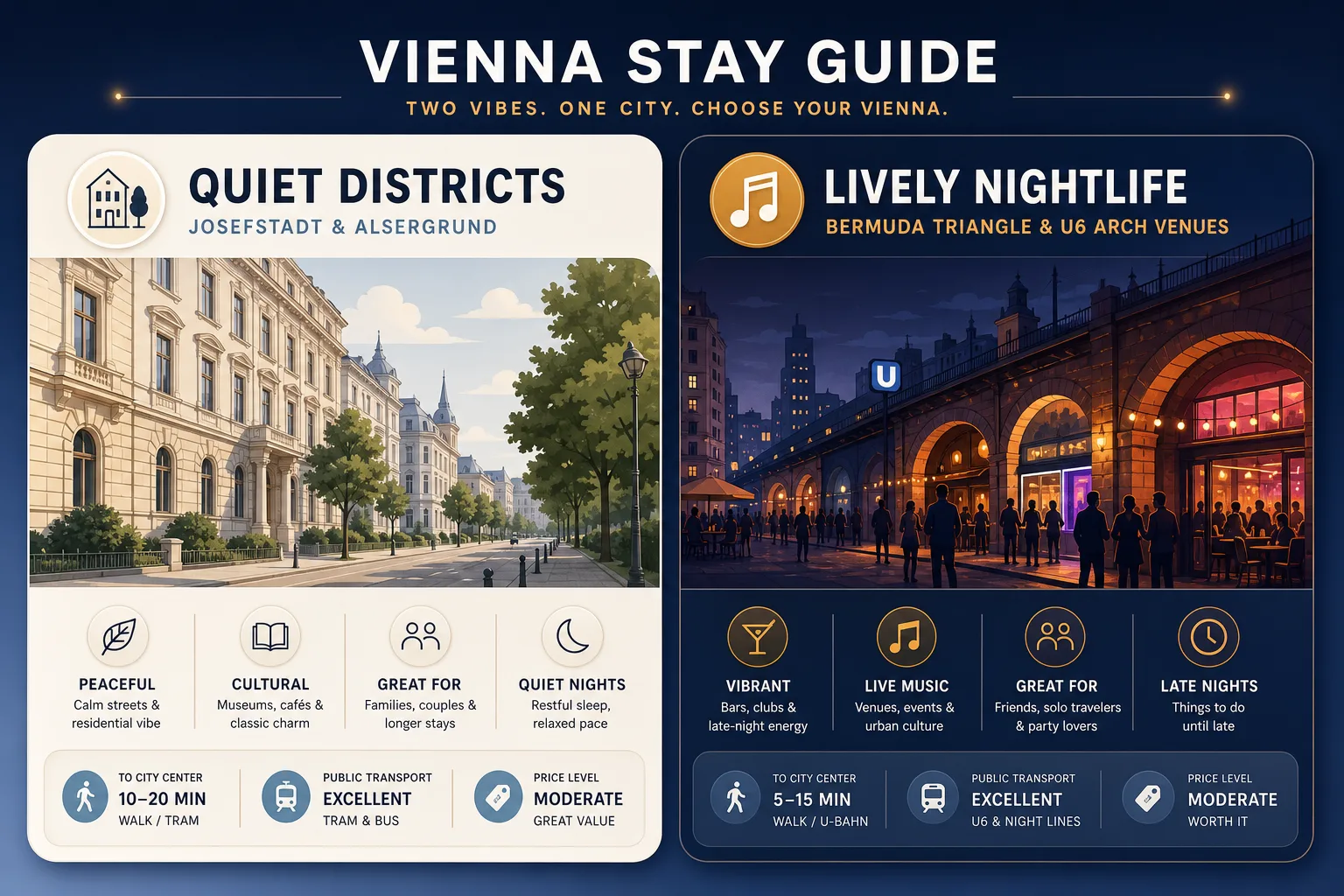 An infographic comparing Vienna's quiet districts and lively nightlife areas with photos and travel details for each.
Traveler Type Table
Vienna's quiet-night reputation is not evenly spread across the city. It depends on three variables: which district your hotel sits in, how you get home late at night, and how much a slower evening rhythm bothers you. This is where the fit actually comes from, not from a generic "Vienna is calm" claim.
| Traveler type | What they need most | Where Vienna delivers | Where the tradeoff shows up |
|---|---|---|---|
| Quiet-night travelers | A hotel street that is silent after 10 PM | Josefstadt and Alsergrund: residential, close to the center, outside both noise zones | Booking near the Bermuda Triangle or the U6 arch corridor undoes the entire plan |
| Couples | A relaxed dinner-to-bed routine with no noise decisions to manage | Enforced quiet hours and 10 PM kitchen closures set the pace automatically | Fewer late-night "one more drink" options than nightlife-forward cities |
| Low-stress planners | Predictability over spontaneity | Consistent shop and restaurant hours mean evenings rarely surprise you | Weeknight transit (U-Bahn stops near midnight, Nightline buses every 30 min after) needs slightly more planning than weekend nights |
The pattern is the same across all three types: Vienna rewards travelers who plan location and return trips in advance, and it punishes travelers who book on price alone and end up a block from a loud corner.
Best for First-Time Visitors
First-time visitors often assume any central Vienna hotel is a safe bet, since the city has a reputation for being orderly overall. That holds for most of the center, but not all of it. The 1st District contains both some of the quietest historic streets in the city and the Bermuda Triangle, a compact but genuinely loud nightlife cluster around Seitenstettengasse, Sterngasse, Judengasse, and Rabensteig.
For a quiet-night traveler on a first visit, treat "central" and "quiet" as two separate filters, not one. Josefstadt sits close enough to Stephansplatz (about 10 minutes by transit, 20 to 25 minutes on foot) to feel central without sitting inside a nightlife corridor. Couples on a first trip who want sightseeing convenience but calm evenings should filter hotel listings by street name, not district number, since the Bermuda Triangle is a small footprint inside a much larger, quieter district.
Low-stress planners on a first visit benefit from Vienna's early, predictable rhythm: shops closing by 6 or 7 PM on weekdays and kitchens by 10 PM remove the ambiguity of "what do we do tonight." The city is not asking you to find the party. It is telling you, by closing everything else early, where the party is not.
Best for Couples
Couples are Vienna's best-matched traveler type for a quiet-night trip, because the city's constraints line up with what most couples actually want from an evening: a good meal, a walk, and rest, with no nightlife plan to negotiate.
A typical Vienna evening for a couple looks like an early dinner reservation (kitchens close around 10 PM), a walk through a central district while shops are already shuttered, and a return to a hotel on a residential street where the 10 PM to 6 AM quiet hours are actually enforced. Low-stress planners will recognize this as a trip with very few open decisions after 8 PM, which is the point.
The friction to watch is hotel location risk. A couple who books a well-reviewed hotel without checking its exact street can end up a few hundred meters from the U6 arch venues near Thaliastrasse and Alserstrasse, or inside the Bermuda Triangle footprint, and the same city that promised quiet nights delivers the opposite. Checking the specific block, not just the neighborhood name, is the difference between the two outcomes.
Best for Slow Travelers
Slow travelers, who prefer fewer moves and more time absorbing a place over checklist sightseeing, do well in Vienna because the city does not push a late-night agenda on anyone. There is no pressure to "keep the night going," because the infrastructure for that (shops, casual late food, transit frequency) tapers off early on weeknights.
Quiet-night travelers who also move slowly will find Josefstadt and Alsergrund suit a walking pace of life: fewer things open late means fewer temptations to rush between activities. Couples traveling slowly get the same benefit, an evening that ends naturally instead of one that has to be cut off.
The one adjustment slow travelers should make is around weeknight transit. Because the U-Bahn stops running around midnight on Sunday through Thursday and hands off to Nightline buses every 30 minutes from 12:30 AM to 5:00 AM, a slow traveler who likes to linger after a late dinner should build in extra time for the return trip, or plan to be back before midnight on weeknights. Weekend nights remove this constraint entirely, since all five U-Bahn lines run 24 hours at 15-minute intervals on Friday and Saturday nights.
Best for Low-Stress Travelers
Low-stress planners are the traveler type most directly served by Vienna's structure, because the city removes decisions rather than adding them. Quiet hours are not a suggestion; they are enforced with fines reaching up to 700 euros, so the baseline expectation of a quiet night is backed by more than local custom.
For this traveler type, the main task is front-loading the planning: pick a hotel in a genuinely residential pocket (Josefstadt and Alsergrund are the clearest examples), confirm dinner plans account for a 10 PM kitchen close, and check whether a planned late return falls on a weeknight or a weekend, since the transit picture changes meaningfully between the two.
Couples and quiet-night travelers in this category also benefit from Vienna's cost structure being predictable. Typical 2026 nightly rates run 60 to 110 euros for budget hotels, 110 to 200 euros for mid-range, and 200 euros and up for luxury, with a 5% accommodation tax (Ortstaxe) applying from July 1, 2026. Knowing the tier in advance avoids surprise costs stacking on top of an already-quiet, already-planned trip.
Common Mismatches
The late-night traveler who wants "calm" but also wants options. The clearest mismatch is the traveler who wants a relaxed European city but also wants reliable late-night bars, food after 11 PM, or a lively street scene as part of the trip itself, not something to avoid. Vienna disappoints this traveler, because its default posture after 10 PM on weeknights is closed, not simply quiet. If that describes you, Berlin and Madrid both run a genuine late-night scene as their default, not an exception, with bars and food readily available well past 2 AM most nights of the week. Budapest sits in between: its ruin bar district runs later and louder than anything comparable in Vienna, at a lower cost, while still offering quieter residential pockets if you want both in one trip.
The price-first booker. A second mismatch pattern is the traveler who books a hotel by price or star rating alone and skips checking the street. Vienna's noise geography is unusually concentrated: the Bermuda Triangle and the U6 arch corridor between Thaliastrasse and Alserstrasse cover a small footprint, but a hotel inside or adjacent to either one feels like a different city at night compared to Josefstadt or Alsergrund. The disappointment is not that Vienna is loud. It is that a small, avoidable mistake in hotel selection undoes an otherwise strong fit.
The traveler who assumes every night behaves the same. A third mismatch is assuming Tuesday night transit works like Friday night transit. Someone planning a late Tuesday return expecting the 24-hour, 15-minute U-Bahn service that exists on weekends will instead find the U-Bahn closed and a Nightline bus running every 30 minutes, a slower and less convenient trip than expected. This is a planning gap, not a city flaw, but it catches low-stress planners off guard specifically because they assumed less variability than actually exists.
Final Match Recommendation
Choose Vienna if you are a quiet-night traveler, a couple, or a low-stress planner willing to spend a few extra minutes confirming hotel location before booking, and comfortable with an evening rhythm that ends by 10 or 11 PM most nights. Enforced quiet hours, early closing times, and a small number of clearly mapped noise zones make it one of the more dependable choices for rest-first travel, as long as the hotel search accounts for street-level detail rather than district-level assumptions.
Do not choose Vienna, or at minimum reset your expectations first, if your version of a good trip depends on consistent late-night options: bars, casual food, or an active street scene after 11 PM on a weeknight. That expectation mismatch is the most common source of disappointment, and it has nothing to do with picking the wrong hotel. If dependable late-night energy is the actual requirement, Berlin and Madrid deliver it as a baseline rather than an exception, and Budapest offers a middle ground with a genuine late-night bar scene alongside quieter neighborhoods. Picking one of those cities instead of Vienna is not a downgrade; it is matching the destination to what the evenings are actually for.
The direct verdict, restated: strong fit if you value rest, predictability, and are willing to check a hotel's exact street before booking. Weak fit if you need dependable late-night energy as part of the trip, not an occasional exception, in which case Berlin, Madrid, or Budapest will serve you better than Vienna.
FAQ
Is Vienna quiet at night compared to other European capitals? Yes, and by a wide margin outside a few pockets. Vienna enforces quiet hours from 10:00 PM to 6:00 AM with fines up to 700 euros for disturbances, and most restaurants close their kitchens by 10:00 PM. The exception is the Bermuda Triangle in the 1st District and the U6 arch corridor between Thaliastrasse and Alserstrasse, both of which stay loud well past midnight. Compared to cities built around late-night bar culture, such as Berlin or Madrid, Vienna is noticeably quieter almost everywhere else.
Which Vienna neighborhoods are best for a quiet hotel stay? Josefstadt (8th District) and Alsergrund (9th District) are the two reliable picks. Josefstadt is about a 10-minute transit ride or 20 to 25 minute walk from Stephansplatz, and Alsergrund is roughly 2.7 kilometers away, a 32-minute walk or a 4 to 7 minute U-Bahn ride. Both are genuinely residential and sit outside the Bermuda Triangle and U6 arch corridor, so you get central access without gambling on street-level noise.
Do I need to worry about late-night transit in Vienna? Only on weeknights, and only mildly. On Friday and Saturday nights, and nights before public holidays, all five U-Bahn lines run 24 hours at 15-minute intervals, so a late return is effortless. On Sunday through Thursday nights, the U-Bahn stops around midnight and Nightline buses take over every 30 minutes from 12:30 AM to 5:00 AM, which means a longer, less direct trip back to your hotel if you linger past midnight on a weeknight.
What should a quiet-night traveler do if they actually want some late-night energy too? Book one or two nights near the Bermuda Triangle deliberately, then move to Josefstadt or Alsergrund for the rest of the trip, or hold late-night plans for Friday or Saturday when 24-hour transit makes the return easy either way. Trying to get both a lively hotel street and a quiet one in the same booking is the actual mismatch, not the city itself.
If Vienna's quiet pace is not what I actually want, where should I go instead? If the trip depends on reliable late-night bars, food, and street energy after midnight on any night of the week, Berlin and Madrid both keep that scene running well past 2 AM as a default, not an exception. Budapest sits in between: livelier and cheaper nightlife than Vienna, with a ruin bar district that runs late most nights, but still with quieter residential options if you want to mix both. Choosing one of these over Vienna is not a downgrade, it is matching the city to what the trip is actually for.
Is Vienna a good match for couples who want a low-stress trip over nightlife? Yes, this is Vienna's strongest traveler fit. Enforced quiet hours, walkable central districts, predictable early closing times, and a small number of easily avoidable noise zones make it straightforward to build an evening routine around a good dinner and an early return, without needing to research nightlife avoidance in depth.
Quiet-night trip checklist
- Confirm your hotel street is outside the Bermuda Triangle (Seitenstettengasse, Sterngasse, Judengasse, Rabensteig) and outside the U6 arch corridor between Thaliastrasse and Alserstrasse
- Favor Josefstadt or Alsergrund for a residential, low-noise base within easy reach of Stephansplatz
- Book dinner with a 10:00 PM kitchen close in mind, not a late-night dining assumption
- Check whether your late return falls on a weeknight (U-Bahn stops near midnight, Nightline buses every 30 minutes) or a weekend (24-hour U-Bahn every 15 minutes)
- Budget for the accommodation tax increase to 5% starting July 1, 2026, on top of your nightly rate
- Plan grocery or errand stops before 6 to 7 PM on weekdays, since most shops close early and stay closed all Sunday
- If reliable late-night energy is non-negotiable, shortlist Berlin, Madrid, or Budapest instead of forcing the fit in Vienna