travel-decisions
Is Seville Too Tiring for Low-Walking Travelers?
A decision-led look at whether Seville's heat, cobblestones, and walking distances will overwhelm low-walking travelers, with friction fixes and clearer alternatives.
Quick Verdict
Seville is a strong fit for low-walking travelers only if you are willing to plan around heat, cobblestones, and short clustered outings. It is a weak fit if you expect to walk freely all day, cross the river often on foot, or visit in peak summer or during Feria de Abril.
Choose Seville if you can base yourself within a 10-minute walk of the Cathedral, accept that some streets are uneven stone, and are happy to taxi the longer legs. Skip Seville, or shorten the trip, if standing on hard surfaces for 20 minutes already hurts, if you refuse to break the day with a long indoor rest, or if your dates fall in July, August, or the Feria week.
This is not a "Seville is too hard, do not go" warning. It is a fit warning: the city is unusually rewarding at a slow pace, and unusually punishing if you try to power through it.
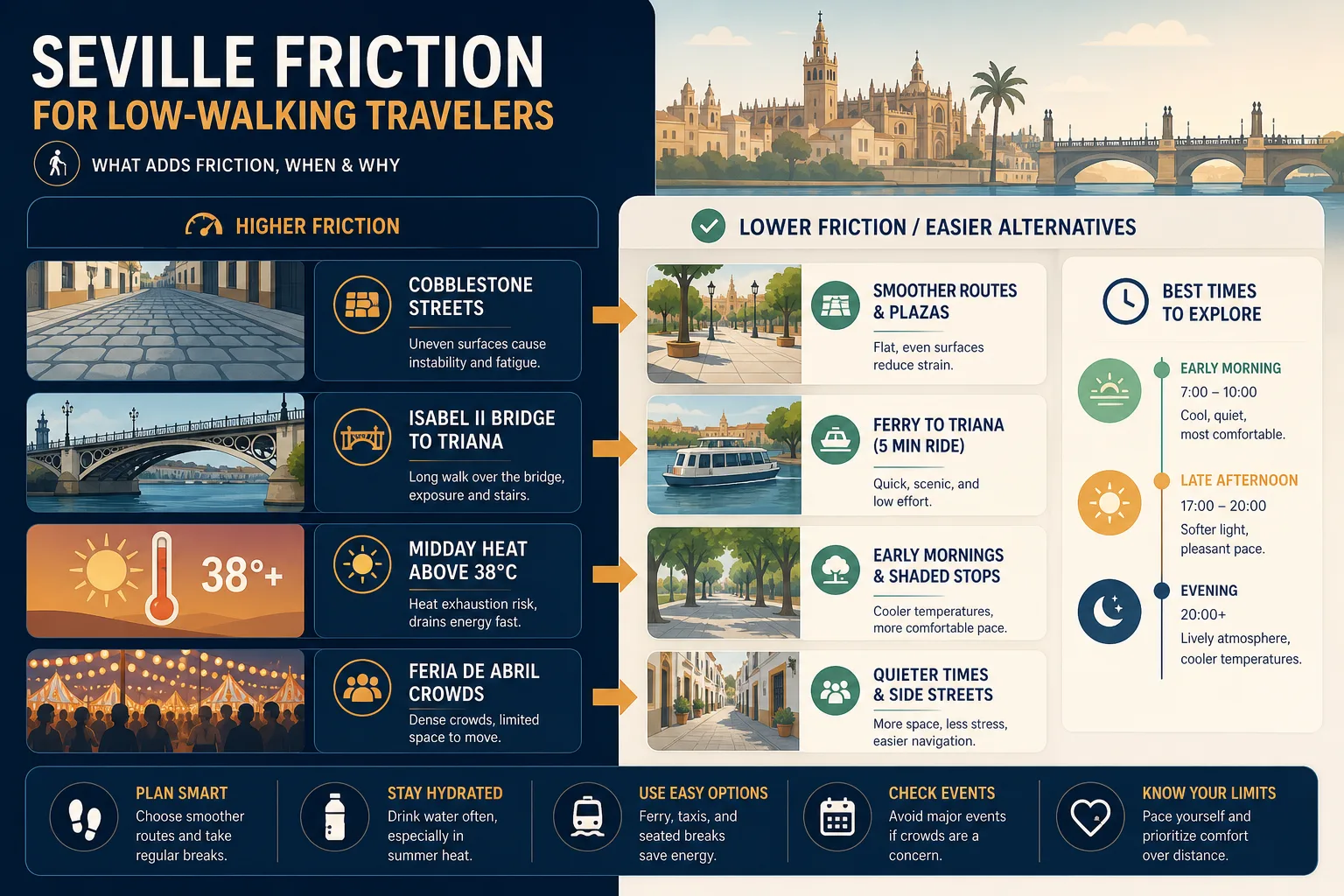 An infographic comparing high-friction travel factors in Seville with easier alternatives for low-walking tourists.
Main Friction Problem
The core problem in Seville is not distance. The historic center is compact, and the two headline sights, the Cathedral and the Alcazar, sit across the same small plaza, less than a 2-minute walk apart. The problem is what is under your feet, over your head, and around you.
Four frictions stack up for low-walking travelers:
- Walking fatigue from cobblestone and polished marble surfaces that are harder on joints than flat pavement, even over short distances.
- Stairs and bridges, especially if you want to cross to Triana over the Isabel II bridge, a roughly 30-minute walk round trip from the center with no shade.
- Crowd pressure in the cathedral area, on tapas streets at night, and during Feria de Abril, which can pull in up to 3 million attendees.
- Transit stress getting in and out. Santa Justa station sits 4.2 kilometers from the center, and while buses 28, 32, C1, C2, and the EA airport bus all serve it, hauling luggage on a hot afternoon is its own workout.
The good news: each of these has a concrete fix, which the later sections work through. The bad news: ignoring them is what turns a "magical" Seville trip into a "we were too tired to enjoy it" one.
Friction Table
The table below maps the real decision variables, not generic facts. Use it to see whether your personal limits line up with what Seville actually asks of you.
| Friction | What it really looks like | Why it hits low-walking travelers | Realistic fix |
|---|---|---|---|
| Cobblestones | Most of the old town, Santa Cruz, and side streets near the Cathedral | Uneven stone amplifies knee, hip, and foot pain even on short walks | Stay inside the old town so each outing is short; wear cushioned shoes |
| Cathedral to Alcazar | Under 2 minutes across Plaza del Triunfo | Easy in isolation, but the surrounding queues and sun add standing time | Pre-book timed entries; visit one in the morning, one in late afternoon |
| Alcazar to Plaza de Espana | About 1.5 km, 17 minutes walking | Open, sunny stretches with limited shade | Taxi one way for 4 to 6 euros, 7 minutes |
| Triana via Isabel II bridge | About 30 minutes walking from center | Long bridge, no shade, return trip doubles the load | Taxi over, walk back slowly only if cooler; or skip Triana |
| Santa Justa station transfer | 4.2 km from the center, plus 2.63 euro taxi surcharge | Luggage plus heat plus unfamiliar streets | Pre-book a taxi or use bus C1/C2; do not drag bags through cobblestones |
| Summer heat | July and August often above 38C, sometimes over 42C | Doubles perceived effort of any walk | Move only before 11am and after 7pm; book a hotel with strong A/C |
| Feria de Abril crowds | Up to 3 million attendees in spring | Slow shuffling, blocked sidewalks, scarce taxis | Avoid Feria week entirely if low-energy |
Who Will Feel It Most
Not every low-walking traveler will struggle equally. Seville fatigue concentrates around a few specific profiles.
You will feel it most if you fit any of these:
- Travelers who already cap comfortable walking at about 20 to 30 minutes total per outing.
- Older travelers managing knee, hip, or back issues, especially on uneven stone.
- Anyone using a cane, walker, or recovering from recent injury, where cobblestones become a real trip hazard.
- Heat-sensitive travelers, including those on medications that reduce heat tolerance, visiting in June through September.
- Travelers who refuse to nap or rest in the middle of the day and want a "morning to night" itinerary.
You will feel it less if you can do these:
- Accept two short outings per day with a 2 to 3 hour midday break in the room.
- Travel in March, early April outside Feria, October, or November when daytime walks are comfortable.
- Use taxis freely for any leg over about 10 minutes.
- Stay within a 10-minute slow walk of the Cathedral, so every outing has a short exit route.
The deciding question is not "can I walk in Seville." It is "am I willing to plan my day around heat and stone." If the honest answer is no, the friction will dominate the trip.
How to Reduce the Friction
If Seville still feels right, these are the levers that actually move the needle. None of them are luxury moves; they are the difference between a tired trip and a paced one.
Reduce walking fatigue:
- Stay inside the old town, ideally between the Cathedral, Alfalfa, and Puerta de Jerez. Every key sight then sits inside a 10-minute slow radius.
- Wear cushioned, closed-toe walking shoes for daytime stone. Save sandals for the hotel and evening tapas.
- Do one sight per outing, not three. Two outings a day is plenty.
Handle stairs and bridges:
- Use the Alcazar's accessible routes where available, and accept that you will skip some upper viewpoints in the Cathedral, including the Giralda climb.
- Treat the Triana bridge as a one-way taxi decision. If you want to see Triana, taxi over, eat, and taxi back.
Manage crowd pressure:
- Pre-book timed tickets for the Cathedral and Alcazar; standing in line on stone in the sun is the worst single experience for low-walking travelers.
- Eat tapas early, around 7pm, before the local crowd fills narrow streets at 9pm or later.
- Avoid Feria de Abril week unless the festival itself is your reason to come.
Cut transit stress:
- Airport to center: take a fixed-price taxi (23 to 25 euros daytime weekdays, 31 to 35 euros nights, weekends, and holidays). Save the EA bus for arrivals with light luggage only.
- Santa Justa transfer: add the 2.63 euro station surcharge into your taxi expectations so it does not feel like a scam at the door.
- Use the wheelchair-adapted taxis (about 9.2 percent of the fleet) when traveling with a walker, cane, or stroller; they are easier to load even if you do not use a wheelchair.
Time the trip:
- Cheapest hotel month is July (around 99 to 146 dollars per night), but it is also the most punishing for walking. Most expensive is April (198 to 426 dollars per night), partly driven by Feria and Holy Week.
- A low-walking sweet spot is mid-March, late October, and November, when daytime walks are comfortable and crowds are thinner.
Better Alternatives
If after the table and the fixes Seville still sounds like a fight, the honest move is to pick a city that asks less of you.
Consider these alternatives, with the reason each one is easier:
- Cordoba for a 2 to 3 day trip: smaller historic core, similar Andalusian atmosphere, less walking between sights, easier to do in cooler months.
- Granada with a hotel in the lower city: you can taxi up to the Alhambra and skip the worst uphill climbs, which is harder to avoid than Seville's heat.
- Madrid as a base: flatter sidewalks in central neighborhoods, strong metro, and plentiful taxis if you fade. Trade Andalusian atmosphere for easier underfoot.
- Lisbon only if you avoid the hill neighborhoods: Baixa and Belem are flatter; Alfama and Bairro Alto will be worse than Seville for stairs.
- A river cruise that stops in Seville for a single day: you get the headline sights without the multi-day cobblestone load.
Seville is not the only Andalusian or Iberian option. Choosing a softer base is not a downgrade; it is a fit decision.
Decision Checklist
Run through this before you book. If you cannot answer yes to most of these, treat that as a firm warning and either change dates, change base, or change city.
- I can comfortably walk 20 to 30 minutes on uneven stone with a short rest after.
- My dates avoid July, August, and Feria de Abril week.
- My hotel is within a 10-minute slow walk of the Cathedral or Alcazar.
- I am willing to take a 4 to 6 euro taxi for any leg over 10 minutes.
- I have pre-booked timed entries for the Cathedral and Alcazar.
- I have built in a 2 to 3 hour midday break every day.
- I know the fixed airport taxi fare (23 to 25 euros daytime, 31 to 35 euros nights and weekends) and the 2.63 euro Santa Justa surcharge so I am not negotiating tired.
- I am traveling with someone, or have a plan, who can taxi back early if I fade.
- I have shoes that handle cobblestones, not just airport sneakers.
- I accept that I may skip the Giralda climb and some upper viewpoints.
If most boxes are checked, Seville at a slow pace is genuinely rewarding, especially in the shoulder months. If most are unchecked, the friction will outweigh the charm, and a softer base is the better call.
FAQ
Can I see Seville's main sights without long walking days? Yes, if you stay near the Cathedral and Alcazar. The walk between them across Plaza del Triunfo takes under 2 minutes, and Plaza de Espana is about 1.5 kilometers (around 17 minutes on foot) or a 7-minute taxi for 4 to 6 euros. Cluster sights and taxi the long legs.
Is Seville walkable for older travelers with sore knees? It can be, but cobblestones, narrow sidewalks, and bridges like the Isabel II to Triana (about a 30-minute walk to and from the center) wear joints down. Plan two short outings a day with long midday breaks instead of one big loop.
How bad is the summer heat for low-stamina visitors? July and August often exceed 38C (100F) and can push past 42C (108F). For low-walking travelers this is the single biggest friction. Spring shoulder dates are far safer; if you must come in summer, treat 1pm to 6pm as indoor or hotel time.
Are taxis reliable enough to skip walking when tired? Yes. Taxis are cheap for short hops (4 to 6 euros across the old town), the airport fare is fixed at 23 to 25 euros daytime and 31 to 35 euros at night and weekends, and about 9.2 percent of the fleet is wheelchair-adapted, which also helps travelers using walkers or canes.
When should a low-walking traveler skip Seville entirely? Skip it if you cannot tolerate uneven stone underfoot, cannot avoid midday outings in summer, or are visiting during Feria de Abril, which draws up to 3 million attendees and turns the center into a slow crowd.