travel-decisions
Is Seoul Too Difficult for Strict Vegetarians and Vegans to Navigate Safely?
Seoul is not a plant-based city by default, but it is navigable with the right prep. Here is who handles the fish sauce, hidden broth, and language friction fine, and who should reconsider.

Quick Verdict
Seoul is not too difficult for strict vegetarians and vegans, but it is unforgiving of improvisation. The city rewards travelers who research and pre-select restaurants before they land, and it punishes travelers who plan to "wing it" and ask servers in English at random spots.
Choose Seoul with confidence if: you are willing to spend a few hours before the trip building a shortlist of confirmed vegan or vegetarian restaurants, you are comfortable using a translation app to double-check ingredients, and you can accept that some meals will be at dedicated plant-based restaurants rather than wherever looks interesting on a given street.
Reconsider Seoul, or plan around it carefully, if: you expect to eat safely at generic local restaurants without preparation, you have a severe allergy-level reaction to trace animal ingredients rather than a values-based preference, or you are traveling with religious dietary rules like halal or kosher that require certification, not just an absence of visible meat.
The friction is real and specific: it is not a shortage of vegan food, it is the risk of hidden fish sauce, anchovy broth, and unlabeled meat extracts in food that looks plant-based. That risk is manageable with preparation and unmanageable without it.
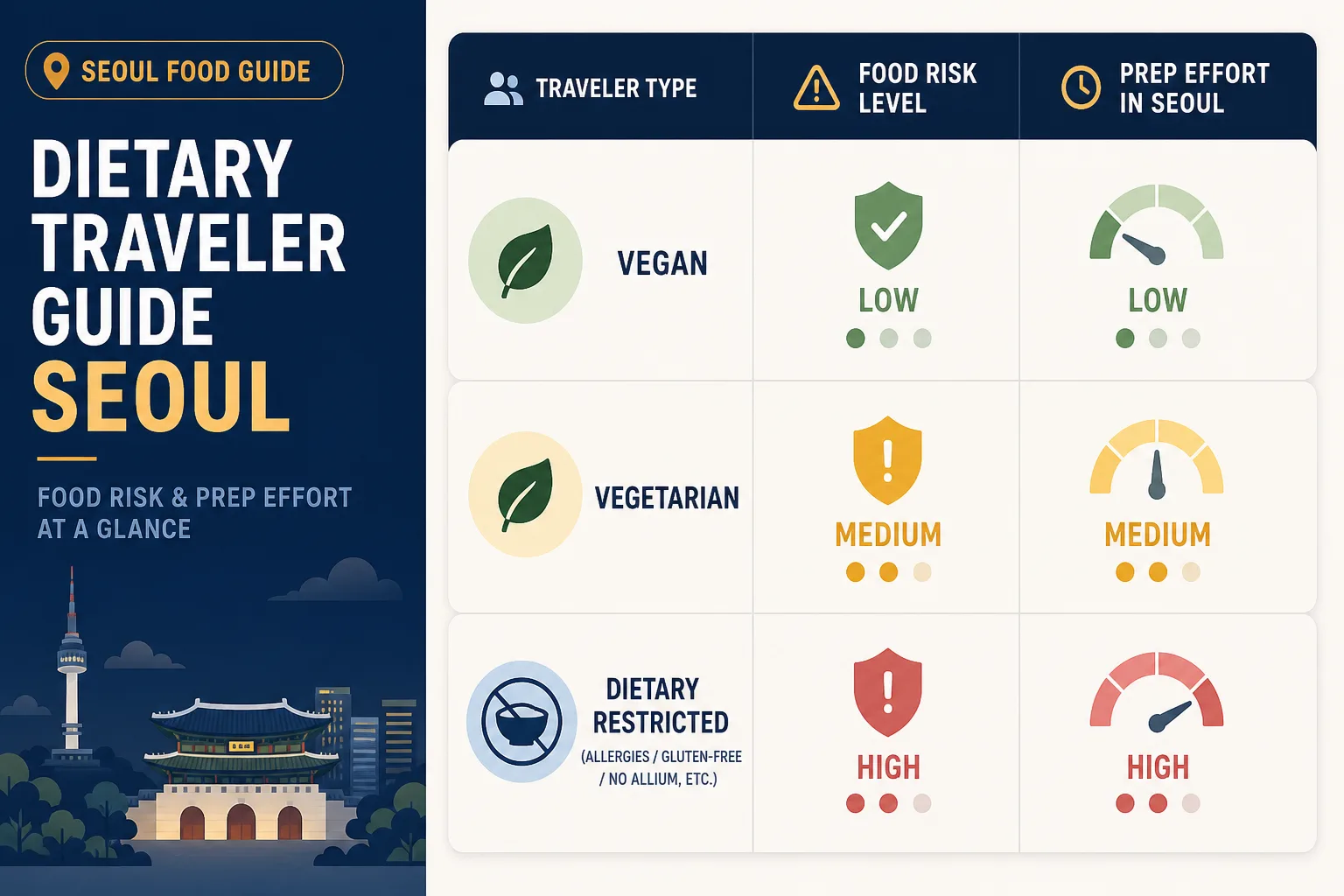 Editorial illustration: A simple table-style layout on paper or a tablet screen showing rows for vegan.
Traveler Type Table
The decision variables that actually matter here are not "does Seoul have vegan food" (it does) but how much prep effort each traveler type needs to put in, and how much risk they can tolerate if something slips through.
| Traveler type | Real risk in Seoul | What causes it | Prep effort needed |
|---|---|---|---|
| Vegans | Moderate to high without prep | Fish sauce, anchovy broth, and animal-derived seasonings hide in sauces and soups that look plant-based | High: build a venue shortlist before arrival |
| Vegetarians (eat dairy/egg, avoid meat and fish) | Moderate | Same hidden fish sauce and anchovy broth risk, since vegetarian in Korea is often interpreted loosely | Medium: confirm broth bases specifically, not just "no meat" |
| Dietary-restricted (halal, kosher, allergy-level) | High | Certification and cross-contamination standards go beyond what a vegan-friendly label guarantees | High: separate research track from general vegan resources |
The tradeoff underneath this table is simple: the more strictly your diet is defined by what must never touch your food (religious law, medical allergy) versus what you generally prefer to avoid (ethical vegetarianism), the more your Seoul trip needs to lean on confirmed, certified, or dedicated venues instead of general restaurants with a modified order.
Vegans get the most attention in vegan travel guides, but vegetarians are actually more exposed to a specific trap: assuming a dish without visible meat is safe, when the broth underneath it was never vegetarian to begin with. Dietary-restricted travelers following halal or kosher rules face a different problem entirely, since a restaurant can be fully vegan and still not meet religious certification standards for the kitchen itself.
Best for First-Time Visitors
First-time visitors to Seoul who are also vegan or vegetarian face a compounding problem: everything is new (the transit system, the layout, the language) at the same time as the food risk. This is the group most likely to default to convenience, and convenience is exactly what creates risk here.
For vegans on a first Seoul trip, the safest strategy is to anchor the first two days around known fully-vegan restaurants rather than exploring freely. Areas like Insadong cluster several such options within a short walk of each other, which reduces the cognitive load of a first-time visitor who is also adjusting to jet lag and a new subway map.
For vegetarians, the first-timer risk is subtler: it is easy to assume a vegetable-forward dish is safe because nothing on the plate looks like meat, when the cooking liquid was fish-based. First-time vegetarian visitors do best when they treat "no meat, no fish, no fish sauce" as one phrase to communicate every time, rather than assuming the first two cover the third.
For dietary-restricted travelers on a first visit, the honest advice is to lower general exploration ambitions for food specifically and raise them for everything else. A first Seoul trip is already a lot to absorb; adding real-time ingredient negotiation at unfamiliar restaurants is where regret concentrates.
Best for Couples
Couples where only one partner has dietary restrictions face a different dynamic than solo strict travelers: the unrestricted partner can scout ahead, order in Korean-language apps, or eat elsewhere occasionally, which meaningfully reduces pressure on the restricted partner.
For vegan travelers as part of a couple, this often means the couple can split into "shared vegan meal" and "one partner explores wider options" rather than both compromising every meal. That flexibility does not exist for solo vegan travelers, who must clear every meal against their own restriction alone.
For vegetarian couples, the friction is usually lower stakes: a vegetarian traveler with a non-vegetarian partner can often let the partner order and then ask what is safe to share, which functions as an informal ingredient check that a solo vegetarian traveler does not get.
For couples where one partner follows a religious dietary rule such as halal or kosher, the mismatch risk is highest when the other partner wants to prioritize food-forward exploration as a couple's activity. If food discovery is a shared bonding activity for the couple, a strict dietary restriction on one side can turn what should be a highlight into a source of tension unless both partners agree in advance to prioritize certified or dedicated venues over spontaneous discovery.
Best for Slow Travelers
Slow travelers, who prefer fewer stops and more time per neighborhood, are structurally well suited to Seoul's vegan food landscape, because the city's best plant-based options reward repeat visits to a small number of areas rather than one-off stops across the city.
A vegan slow traveler who bases themselves near a food-safe neighborhood for several days can return to a handful of confirmed restaurants, build familiarity with the menu, and reduce the research burden that a fast-moving itinerary would otherwise require every single day.
Vegetarian slow travelers benefit similarly, but with more freedom: because their restriction is less severe than full veganism, they can afford to experiment cautiously with a wider range of restaurants over a longer stay, using early days to identify safe local spots and later days to revisit them with confidence.
Dietary-restricted slow travelers following halal or kosher rules get the most value from this pace, since certified venues in Seoul are not evenly distributed across every neighborhood. A slower trip allows time to travel deliberately to certified restaurants rather than treating every meal as a spontaneous decision based on proximity.
Best for Low-Stress Travelers
Travelers who prioritize a calm, businesslike trip over spontaneous discovery are, somewhat counterintuitively, the best-matched traveler type for a strict vegan or vegetarian trip to Seoul, because the food-safety problem is solved by exactly the behavior this traveler already prefers: planning ahead and sticking to a shortlist.
For vegans in this category, low-stress travel means arriving with a pre-built list of five to eight restaurants near their accommodation and treating deviation from that list as the exception, not the norm. This removes the daily decision fatigue of evaluating unfamiliar menus in real time.
For vegetarians, low-stress travel in Seoul means accepting that a small number of go-to dishes (temple food set meals, certain vegetable-forward Korean dishes confirmed to use soy or vegetable-based broths) will repeat across the trip, rather than chasing novelty at every meal.
For dietary-restricted travelers, low-stress planning is close to mandatory rather than optional. Building the trip around certified or dedicated venues in advance is what converts Seoul from a high-anxiety food environment into a manageable one.
Common Mismatches
The travelers most likely to end up disappointed or anxious in Seoul share one trait: they expected the food culture to work the way it does in cities with widespread ingredient labeling and default vegetarian menu sections, and it does not.
A specific disappointment pattern: a vegan traveler orders a vegetable side dish or a soup that looks meat-free, eats it without asking, and later learns or suspects it was made with anchovy broth or salted shrimp paste, which are common in traditional Korean cooking. This is not rare or unusual behavior by the restaurant, it is standard technique, which is exactly why it catches unprepared travelers off guard.
Another mismatch: a traveler assumes a product labeled "plant-based" at a convenience store or supermarket is automatically safe, when South Korean packaging law does not require beef powder or pork extract to be disclosed as allergens the way some other countries mandate. This is a labeling gap, not a rare loophole, and it affects packaged snacks and instant foods more than restaurant meals.
A third mismatch is social rather than logistical: some vegan and vegetarian travelers underestimate the language barrier around ingredient questions and either avoid asking (leading to an unsafe meal) or over-rely on hand gestures and short phrases that do not cover fish sauce and broth bases specifically. This is where language barrier friction and food-options friction compound each other, since a traveler who is anxious about the language gap is also the traveler most likely to avoid asking the follow-up question that would have kept them safe.
Halal and kosher travelers face a distinct mismatch: assuming that a restaurant's vegan-friendly reputation substitutes for religious certification. It does not, and travelers who conflate the two risk eating at venues that do not actually meet their standard.
Final Match Recommendation
Choose Seoul without much hesitation if you are a vegan or vegetarian traveler willing to do focused pre-trip research, comfortable using a translation app for ingredient-specific questions (not just "no meat"), and open to building your food itinerary around a shortlist of confirmed restaurants rather than spontaneous discovery. Seoul's more than 100 fully vegan restaurants, plus a strong temple food tradition rooted in Buddhist vegetarian practice, give this traveler more than enough to work with.
Do not choose Seoul as a low-prep, improvisational food destination if you have a severe reaction to trace animal ingredients, if you are following halal or kosher rules that require certification rather than ingredient absence, or if you are unwilling to spend pre-trip time researching specific venues. For these travelers, the risk is not that Seoul lacks options, it is that the general food environment (unlabeled packaged goods, fish-based broths in dishes that look vegetarian) is not built around disclosure by default, and that gap has to be closed by the traveler's own preparation rather than by the city.
The realistic middle path, and where most strict vegetarian and vegan travelers should land: treat Seoul as a city that requires a food plan the same way a first-time visitor might treat a transit plan, then relax once that plan is in place. The friction is front-loaded into preparation, not spread evenly across the trip.
FAQ
Is Seoul actually dangerous for strict vegans, or just inconvenient? It is inconvenient rather than dangerous in the sense of overt hostility, but the risk is real: South Korean packaging law does not require meat or fish to be flagged as allergens, so a product marketed as plant-based can still contain beef powder or pork extract. The danger is silent cross-contamination through broth and seasoning, not a lack of vegan options.
Can I just say "no meat" in Korean and be safe? No. Saying you avoid meat does not cover fish sauce, anchovy broth, or salted shrimp paste, which are standard bases in many soups, stews, and even some vegetable side dishes. You need to specifically rule out fish and shellfish-derived seasonings, not just visible meat, and this is easiest at restaurants built around plant-based menus rather than general Korean kitchens.
Are there enough fully vegan restaurants to build a trip around? Yes. Seoul has more than 100 fully vegan restaurants, concentrated in areas like Insadong and Gangnam, plus temple food restaurants that are vegan by religious tradition. The constraint is not availability citywide, it is that spontaneous walk-in meals at random local kitchens remain high-risk, so the trip works best when planned around known-safe venues rather than improvised.
Does Seoul work for halal or kosher travelers the same way it works for vegans? Not identically. Vegan and halal or kosher restrictions overlap in avoiding certain animal products but differ in what counts as acceptable preparation and certification. This article focuses on vegan, vegetarian, and general dietary-restricted friction; halal and kosher travelers face additional certification and cross-contamination questions that a vegan-friendly label does not automatically resolve.
How much extra planning time should I budget for food in Seoul? Plan for meaningfully more research time than a typical trip, especially before arrival. Once you have a shortlist of five to eight confirmed venues near where you are staying, day-to-day friction drops close to zero. The heaviest planning load is front-loaded into research, not spread evenly across the trip.