travel-decisions
Is Seoul a Good First Trip for Travelers Who Want Easy Logistics?
A traveler-fit breakdown of whether Seoul suits first-time visitors, couples, and low-stress planners who want simple arrival, easy hotel choices, and predictable daily transit.
Quick Verdict
Seoul is a strong first-trip choice for travelers who can tolerate a short adjustment period around navigation apps, but who otherwise want predictable transit, a well-defined tourist core, and a low-decision-fatigue arrival.
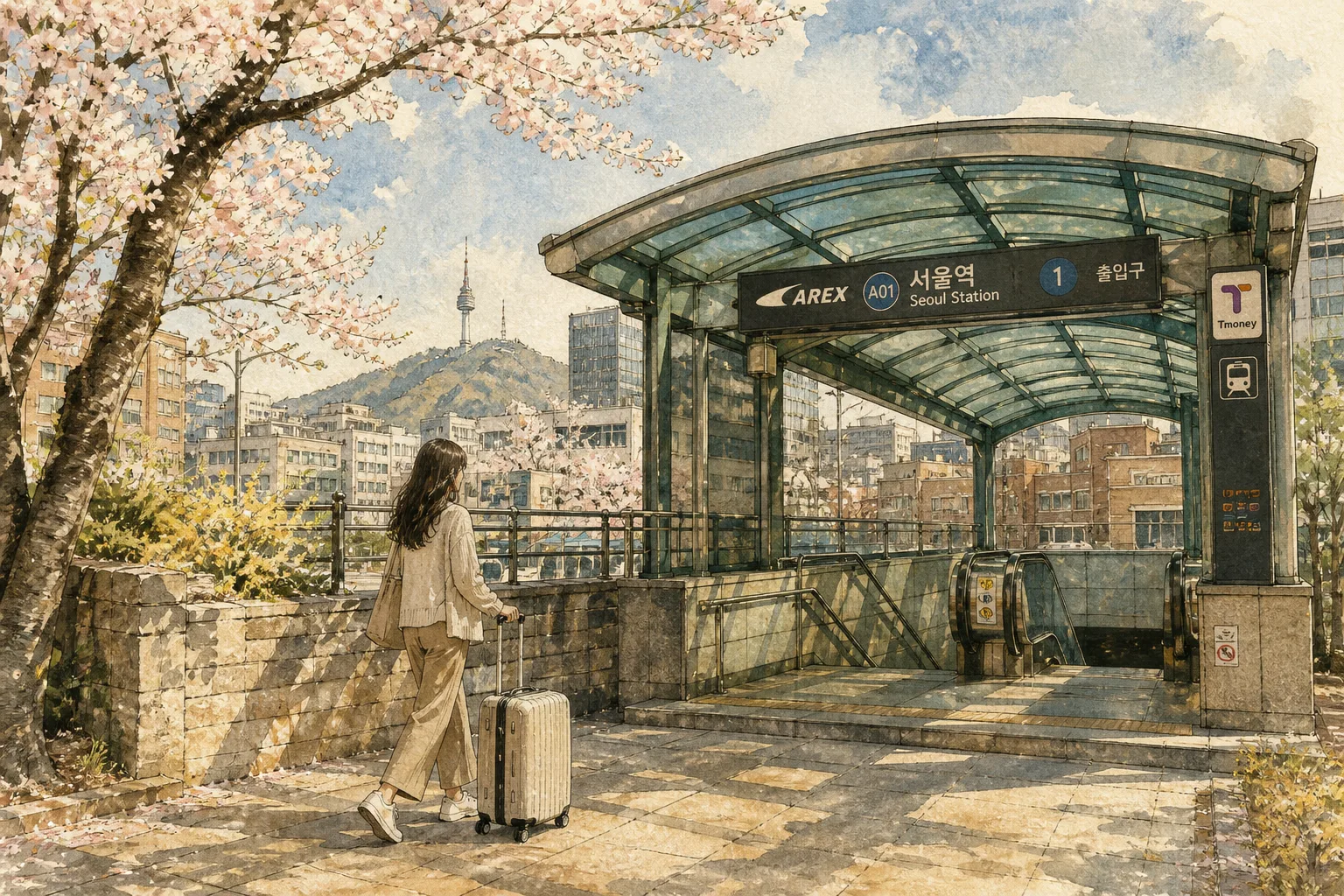
Choose Seoul as a first trip if you are willing to set up one or two apps before departure and are comfortable following signage and a transit card instead of Google Maps turn-by-turn directions. The train from the airport is a single, non-stop ride into the city center, the subway system is logically laid out, and the main hotel zones sit close to the sights most first-timers want to see.
Do not choose Seoul as a stress-free first trip if you refuse to touch a second app before you land, or if you expect every logistics layer, arrival card, ride-hailing, navigation, transit card, to work exactly like it does at home. The friction in Seoul is not that it is disorganized. It is that a few specific tools do not behave the way visitors from Google Maps-heavy countries expect.
Strong fit if: you will do 20 minutes of setup before departure (e-Arrival Card, Kakao T verification, a transit app) and pick a hotel north of the river. Weak fit if: you want zero pre-trip app setup and plan to navigate purely on instinct and Google Maps.
 Where Seoul fits and where it does not, broken down by traveler type.
Traveler Type Table
The real decision variables for Seoul are not "is it a nice city." They are: how much pre-trip setup you will tolerate, how far your hotel sits from the sights you actually want, and how much daily transit complexity you can absorb without it feeling like work.
| Traveler type | Arrival friction | Daily navigation | Hotel location risk | Overall fit |
|---|---|---|---|---|
| First-time visitors | Low, if e-Arrival Card and Kakao T are set up before landing | Moderate, requires switching off Google Maps habits | Moderate, easy to pick the wrong zone without guidance | Strong, with prep |
| Low-stress planners | Low, single non-stop AREX ride from either terminal | Low once T-Money or Climate Card is loaded | Low, if Myeongdong, Hongdae, or Mapo is chosen upfront | Strong |
| Couples | Low to moderate | Low, subway covers most couple-friendly districts directly | Low, walkable hotel zones exist without haggling over location | Strong |
| Slow travelers | Low | Low, fewer transfers needed if pace is unhurried | Low | Moderate to strong |
| Value-sensitive travelers wanting Gangnam nightlife | Low | Higher, 30 to 45 minute transfers to reach north-side sights daily | High, if Gangnam is chosen without knowing the tradeoff | Weak for sightseeing-focused trips |
The pattern across every strong-fit row is the same: friction drops sharply once a traveler does two things ahead of time, sets up the right apps, and picks a hotel zone north of the Han River. Skip either step and the same city that felt simple for one traveler will feel chaotic for another.
Best for First-Time Visitors
First-time visitors do best in Seoul when they treat the trip like a system with two setup steps, not a place to improvise navigation on arrival. The airport-to-city leg is intentionally simple: the AREX Express Train is a non-stop ride from either terminal to Seoul Station, so there is no transfer logic to figure out while jet-lagged. The tradeoff is cost versus time, the All-Stop train is roughly a third of the price for about 15 extra minutes, and neither requires research beyond picking one.
Where first-timers get tripped up is assuming their phone will behave the way it does at home. Google Maps does not give functional walking or transit directions in South Korea, so anyone who has never used a substitute navigation app will feel lost in the first hour, even though the subway itself is well signed. Low-stress planners and couples run into this same gap, but first-timers feel it hardest because they have no baseline for what "normal" Seoul navigation looks like.
The fix is not complicated: install a working transit app and set up Kakao T with SMS verification before leaving home, since verification frequently fails once a traveler switches to a Korean eSIM abroad. Do that, and the rest of the trip runs on rails, literally.
Best for Couples
Couples get a specific advantage in Seoul that solo first-timers and larger groups do not always get as easily: hotel zones that are both walkable and clustered near the sights people actually plan a first Seoul trip around. Myeongdong sits in the central tourist hub, with average 4-star rates around 110 to 160 dollars a night, putting palaces, markets, and easy subway access within a short walk or one transfer.
For couples watching budget more closely without wanting to sacrifice convenience, Hongdae, Mapo, and Gongdeok run 90 to 130 dollars a night at a similar quality level, with the added benefit of direct AREX All-Stop access to the airport, useful for couples who want to skip an extra transfer with luggage on both ends of the trip.
The mismatch to avoid as a couple is choosing a hotel based on nightlife reputation alone. A district can be lively and still add 30 to 45 minutes of transfer time to every sightseeing day if it sits far from the historic core. For couples who want easy logistics rather than a nightlife-first trip, that tradeoff is rarely worth it.
Best for Slow Travelers
Slow travelers, those who prefer fewer stops per day and more time absorbing a neighborhood, are arguably the best-suited traveler type for Seoul's logistics profile, because the friction points that bother first-timers mostly show up under time pressure. A slower pace means fewer subway transfers per day, more buffer time if a Kakao T ride takes a few extra minutes to book, and less reliance on perfect real-time navigation.
The Climate Card fits this traveler type well: unlimited subway and bus rides across 1, 2, 3, 5, or 7 day options mean a slow traveler is not doing per-ride cost math while deciding whether a neighborhood is worth a second visit. The catch is the card requires a separate 3,000 KRW physical card purchase and does not cover the AREX airport train or transit outside Seoul's municipal boundary, so it is a mid-trip convenience rather than an arrival-day solution.
Slow travelers should still avoid assuming an unhurried pace erases the need for setup. The e-Arrival Card and Kakao T steps apply regardless of trip pace, and skipping them creates the same arrival-day stress for a slow traveler as for anyone else.
Best for Low-Stress Travelers
Low-stress planners, people who want a businesslike trip with minimal decision fatigue, are the traveler type Seoul's infrastructure was effectively built for, provided the two setup steps happen before departure. A single non-stop train from the airport, a subway system that does not require guesswork once loaded onto a phone via a working app, and hotel zones that are pre-sorted by proximity to sights, all remove the kind of moment-to-moment decisions that create stress on a first trip.
The clearest sign that Seoul fits a low-stress planner: most of the friction points, arrival, transit, hotel zone, can be resolved once, before the trip starts, rather than re-decided every day. Compare that to destinations where hotel location, daily transit, and navigation all require constant judgment calls, and Seoul's structure looks less like an obstacle course and more like a checklist.
The one place low-stress travelers should not relax is payment setup. Loading a T-Money card or Climate Card on day one, rather than fumbling with single tickets each ride, is the difference between a calm daily routine and a small recurring hassle repeated across an entire trip.
Common Mismatches
The disappointment risk in Seoul is narrow but real, and it clusters around three patterns.
The traveler who refuses pre-trip app setup. Anyone expecting Google Maps to work the way it does in most of the world will spend the first day frustrated, not because Seoul is hard to navigate, but because the tool they are used to does not function there. This is a mismatch of expectation, not a flaw in the city.
The traveler who books Gangnam for a first sightseeing trip. Gangnam is not recommended for first-time sightseers because the major historical attractions sit north of the Han River, meaning 30 to 45 minute subway transfers most days. Travelers drawn there by nightlife or shopping reputation, without realizing the sightseeing tradeoff, often end up feeling like their trip is more commute than city.
The traveler who skips the e-Arrival Card timing. Starting January 1, 2026, the digital e-Arrival Card must be submitted within 72 hours before landing. A traveler who forgets this or submits it too early risks arrival friction that has nothing to do with Seoul itself and everything to do with missed prep.
None of these are Seoul being difficult. They are mismatches between traveler expectations and the two or three specific things Seoul does differently than other first-trip destinations.
Final Match Recommendation
Choose Seoul as a first trip if you are a first-time visitor, low-stress planner, or couple willing to spend roughly 20 minutes before departure setting up a working navigation app and Kakao T, and willing to book a hotel in a north-of-the-river zone like Myeongdong, Hongdae, or Mapo rather than choosing purely on nightlife reputation.
Do not choose Seoul, or at least reconsider the framing of "easy logistics," if you want a destination where you can arrive with zero pre-trip setup and rely entirely on default phone apps, or if your priority is a Gangnam-centered nightlife trip rather than sightseeing, since that tradeoff adds daily transfer time that undercuts the low-stress premise.
For the traveler types this article targets, first-timers, low-stress planners, and couples, the verdict holds: Seoul's logistics are genuinely simple once the small number of setup steps are handled ahead of time. The city rewards travelers who prepare a little and punishes, mildly, travelers who expect everything to work exactly like home with no adjustment at all.
FAQ
Is Seoul harder to navigate than other major Asian cities for first-timers? Not inherently, but the main friction is that Google Maps does not give reliable walking or transit directions in South Korea. Travelers who plan to lean on Google Maps the way they would in Europe or the US will hit a wall. Once you switch to a local transit app or Kakao T for navigation, the subway system itself is logical and well signed in English.
Do I need to arrange anything before landing in Seoul? Yes, two things matter most. Citizens of many countries, including the US, Canada, the UK, Australia, New Zealand, Singapore, and EU nations, are exempt from K-ETA through the end of 2026, so that step may not apply to you. But starting January 1, 2026, all foreign visitors must submit a free digital e-Arrival Card within 72 hours before landing, replacing the old paper form. Also set up Kakao T with SMS verification before you leave home, since verification often fails once you are on a Korean eSIM.
How much does it cost to get from Incheon Airport into central Seoul? The AREX Express Train runs non-stop from the airport to Seoul Station in 43 minutes from Terminal 1 or 51 minutes from Terminal 2, for a flat 13,000 KRW. The AREX All-Stop Train takes just under an hour and costs 4,150 to 4,750 KRW depending on terminal. Both are simple, single-line rides with no transfers required to reach central Seoul.
Is Gangnam a good base for a first Seoul trip? Generally no. Gangnam is not recommended for first-time sightseers because most major historical attractions sit north of the Han River, meaning 30 to 45 minute subway transfers most days. It can work for travelers whose trip is centered on shopping, nightlife, or business rather than palaces and old neighborhoods.
What is the easiest way to pay for subway rides without overthinking it? A reloadable T-Money card costs about 1,400 to 1,500 KRW per ride and works everywhere, including buses. If you plan to ride often over a short stay, the Climate Card offers unlimited subway and bus rides for a flat fee across 1, 2, 3, 5, or 7 day options, though it requires a separate 3,000 KRW physical card and does not cover the AREX airport train or transit outside Seoul's city limits.