travel-decisions
Is Seoul's Vintage and Thrifting Scene Worth the Walking Fatigue and Language Barrier for Casual Shoppers?
A traveler-fit breakdown of Seoul's vintage and thrifting scene, weighing Gwangjang, Dongmyo, and Seongsu against crowd fatigue, cash-only stalls, and no fitting rooms.
Quick Verdict
Seoul's vintage scene is worth it for shoppers who enjoy digging. It is not worth it for shoppers who want a curated, quick browse. The markets reward patience with crowds, cash, and no fitting rooms, and punish anyone expecting a tidy retail experience.
Choose Seoul's thrifting scene if you like slow, hands-in-the-pile browsing and treat the hunt itself as part of the fun. Skip it, or budget only an hour, if crowd density drains you fast or you need to try clothes on before buying. The core rubric question is simple: strong fit if you enjoy unstructured discovery, weak fit if you need predictable, low-friction shopping.
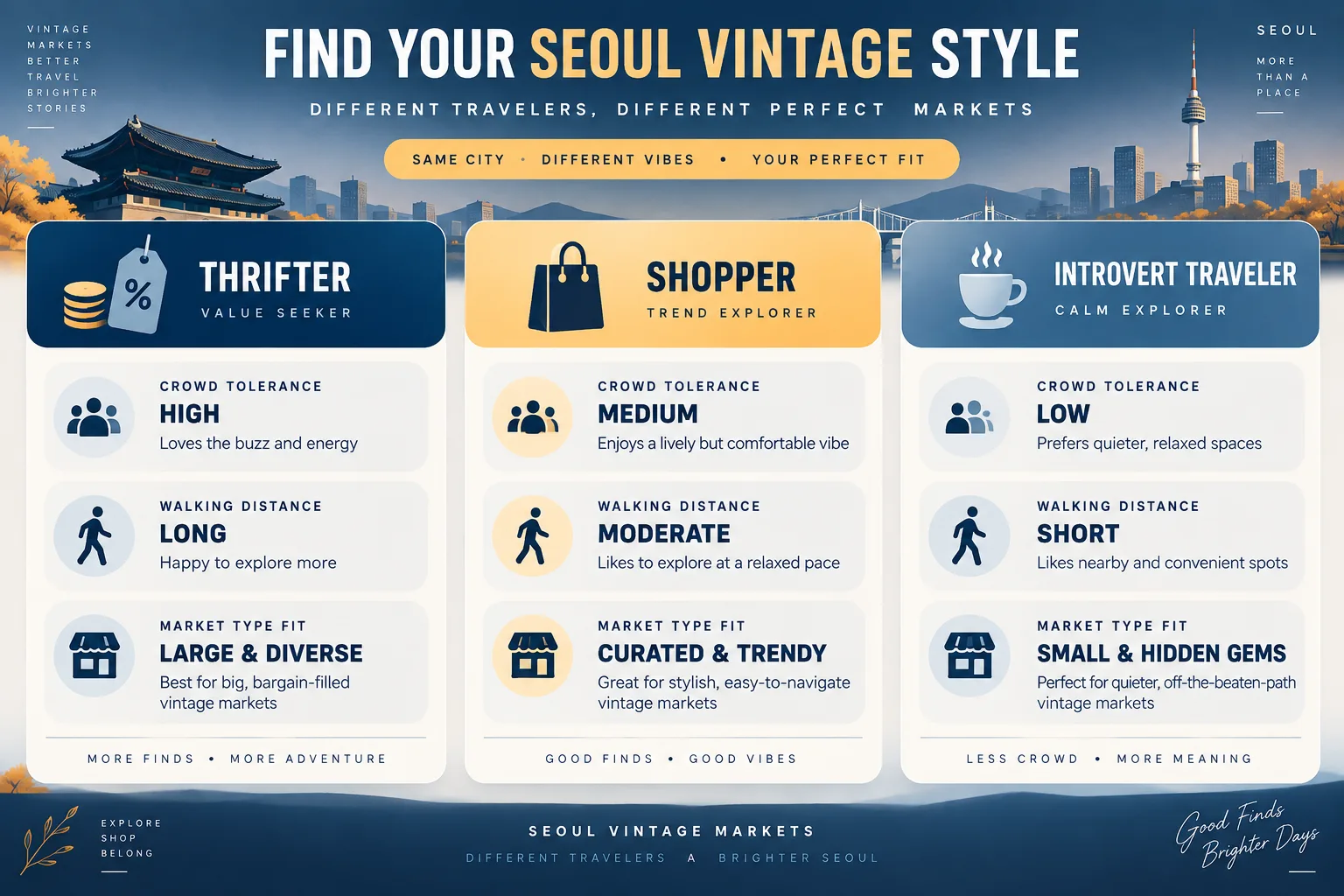 Editorial illustration: A simple flat comparison layout with three labeled columns for thrifter.
Traveler Type Table
The real decision variables here are not "Seoul vs. another city." They are crowd tolerance, cash readiness, and how much unstructured browsing you can handle before fatigue sets in. Below is how three common casual-shopper profiles actually fare.
| Traveler type | Crowd tolerance needed | Walking/standing load | Best market match | Main tradeoff |
|---|---|---|---|---|
| Thrifters (enjoy the hunt) | High | High, slow-paced browsing | Dongmyo Flea Market | Fixed low prices in pile areas mean no haggling, but also no guessing games |
| Shoppers (want specific pieces) | Medium | Medium | Gwangjang Market vintage stalls | Dozens of tiny imported-item stalls mean fast comparison shopping in a small footprint |
| Introverts (need lower stimulation) | Low | Low to medium | Seongsu unmanned thrift stores | Self-checkout kiosks remove social pressure but also remove local vendor guidance |
Thrifters get the most out of Dongmyo because the pile-digging format matches their patience. Shoppers do better at Gwangjang, where the stall count is high but the physical area is compact. Introverts often do best skipping the flea-market format entirely in favor of Seongsu's self-service model.
Best for First-Time Visitors
A first-time visitor to Seoul's vintage scene should start at Gwangjang Market. The vintage stalls sit inside a larger food market, so there is a built-in fallback plan if the shopping itself feels overwhelming. This lowers the risk of a wasted afternoon.
Thrifters visiting for the first time should still expect no fitting rooms and should bring their measurements in centimeters. Shoppers new to the format will appreciate that Gwangjang's stalls are small and independent, which makes comparing a handful of similar items fast rather than exhausting. Introverts on a first visit should plan a short session, thirty to forty-five minutes, before deciding whether to push further into Dongmyo.
Best for Couples
Couples do reasonably well at Gwangjang because the compact stall layout lets one partner browse while the other waits nearby without getting lost. Splitting attention is easier in a smaller footprint than in Dongmyo's sprawling flea market rows.
Thrifter couples who both enjoy digging can tackle Dongmyo together, since one person sorting through a pile while the other watches bags reduces the mental load of managing both shopping and security. Shopper couples do better sticking to Gwangjang for the same reason first-timers do. Introvert couples should treat Seongsu as the default, since its self-checkout kiosks mean neither partner has to manage a vendor interaction while the other is mid-browse.
Best for Slow Travelers
Slow travelers, who prefer mood over checklists, are the best-matched traveler type for this entire decision. Vintage markets in Seoul do not reward rushing. A slow traveler with a free morning or afternoon can treat Dongmyo as a destination in itself rather than a shopping errand.
Thrifters who already travel slowly will find Dongmyo's pace matches their instincts, since digging through piles takes time and cannot be rushed. Shoppers with a slow-travel mindset can extend their Gwangjang visit into the surrounding food stalls once the vintage browsing winds down. Introverts traveling slowly should still cap their flea-market time and use Seongsu's calmer, self-paced format to close out the day.
Best for Low-Stress Travelers
Low-stress travelers who want an easy, businesslike trip are the weakest match for Dongmyo and Gwangjang in their raw form. Both markets involve navigating crowds, carrying cash, and negotiating without fitting rooms, none of which reads as low-stress.
Thrifters who also want a low-stress trip should limit themselves to Gwangjang's compact stalls rather than Dongmyo's larger flea market footprint. Shoppers prioritizing low stress should go early in the day before crowds build. Introverts who want minimal friction should treat Seongsu's unmanned thrift stores as the primary stop and treat Dongmyo or Gwangjang as optional add-ons rather than the main plan.
Common Mismatches
The most common disappointment comes from travelers who picture a curated vintage boutique and instead find a wholesale-style market. Gwangjang's vintage section is dozens of tiny independent stalls focused on imported items, not a single browsable shop with organized racks. That expectation mismatch is the single biggest regret risk in this decision.
A second mismatch hits travelers who assume they can pay by card everywhere. Most flea market vendors are cash only, and showing up without Korean won at Dongmyo can end a shopping trip before it starts. A third mismatch involves fitting rooms: shoppers who need to try on clothes privately will find almost none of Seoul's vintage shops offer this, since keeping measurements in centimeters is the practical workaround, not a private booth.
Checklist to avoid these mismatches before you go:
- Bring Korean won in cash, since most vendors do not take cards
- Know your measurements in centimeters, since fitting rooms are rare
- Expect a wholesale-style stall layout at Gwangjang, not a boutique
- Do not attempt to haggle in Dongmyo's fixed-price pile areas
- Confirm Hwanghakdong is for accessories and decor, not clothes, before heading there for thrifting
Final Match Recommendation
Choose Seoul's vintage and thrifting scene if you are a thrifter or a patient shopper who treats crowd navigation as part of the experience rather than a cost. The scene rewards people who can browse without a plan and who do not mind cash-only, fitting-room-free conditions, plus a bit of improvised communication when needed. That combination makes the walking fatigue and mild language friction a fair trade for genuinely unique finds.
Skip it, or limit it to a single short visit, if you are an introvert who tires quickly in dense spaces or a casual shopper who wants a predictable retail experience. In that case, Seongsu's unmanned thrift stores are the better entry point, since they remove the crowd and vendor-interaction friction while still delivering a vintage find. The direct rubric answer: strong fit if you enjoy unstructured discovery and can handle crowds and cash, weak fit if you need curated browsing or low-stimulation shopping.
FAQ
Do I need to speak Korean to shop at Gwangjang or Dongmyo? No fluent Korean is required. Bring a translation app as backup for price negotiation, and treat the lack of fitting rooms, not language, as the bigger day-to-day obstacle.
Can I use a credit card at Seoul's flea markets? Rarely at Dongmyo or Gwangjang. Most vendors are cash only, so bring Korean won in small bills. Seongsu's unmanned thrift stores are the exception, since their self-checkout kiosks accept international payment methods.
How much walking should I expect at these markets? More than a typical shopping mall trip. Dongmyo and Gwangjang both involve narrow aisles, dense stalls, and slow foot traffic rather than long straight-line distances, so the fatigue comes from crowd navigation more than raw mileage.
Is it rude to try on clothes over my regular clothes in public? It is common and accepted, since almost no vintage shops have fitting rooms. Wearing a fitted base layer and knowing your measurements in centimeters solves this better than expecting private changing space.
Which market should a first-time visitor pick if they only have time for one? Gwangjang Market fits a single afternoon best, since its vintage stalls are compact and sit inside a larger food market, giving a fallback plan if the shopping itself feels overwhelming.