travel-decisions
Is Seoul a Bad Fit for Solo Foodies Who Want to Experience Traditional Korean Dining?
Solo travelers hit real friction ordering traditional Korean food in Seoul, from two-person minimums to quiet-table awkwardness. Here is who should still go, who should not, and how to fix the friction.
Strong Opening
If you are picturing a quiet counter seat, a steaming bowl of gukbap, and nobody looking at you twice, that part of solo dining in Seoul is real and easy to get. If you are picturing a full Korean BBQ spread grilled just for you at a normal price, that part takes more effort than most trip guides admit.
Seoul is a strong fit for solo foodies who are willing to adapt their dining format to their party size. It is a weak fit for solo foodies who expect every traditional restaurant, especially barbecue and group-style hanjeongsik places, to treat a single diner exactly like a couple or a group without any extra cost or extra planning. The friction is not really about hostility toward solo travelers. It is about restaurant business models built around shared meat portions and shared banchan spreads, and a solo diner has to work around that structure rather than expect it to bend.
The rest of this guide breaks down exactly where that friction shows up, what it costs in money and awkwardness, and what to do differently so a solo trip built around Korean food does not quietly disappoint you.
 Where solo dining is easy in Seoul, and where it still takes extra effort.
Quick Verdict
Choose Seoul as a solo food destination if:
- You are comfortable eating gukbap, noodles, bibimbap, or other single-serving traditional dishes most days, and treat BBQ as an occasional splurge rather than the main event.
- You do not mind ordering two portions of meat by yourself when you do want BBQ, and you have budgeted for that.
- You are willing to eat at a counter or a small table alone without expecting conversation or special accommodation from staff.
Skip it, or plan around it heavily, if:
- Communal Korean BBQ is the specific experience you are chasing, and you are not willing to either pay for two portions or seek out solo-grill restaurants.
- You want the shared, multi-dish hanjeongsik experience exactly as it is served to groups, at group per-person pricing.
- Sitting alone at a restaurant table in an unfamiliar country causes real anxiety you have not tested before on a lower-stakes trip.
This is a decision about matching your dining expectations to how Korean restaurants are actually built, not a verdict on whether Seoul is friendly to solo travelers in general. It is friendly. The menu structure is what pushes back.
Who Will Probably Love It
Solo foodies who are curious and flexible about format tend to do very well in Seoul. If your idea of a great food day includes a gukbap counter for lunch, a market stall snack in the afternoon, and a self-funded two-portion BBQ dinner as a planned treat, Seoul delivers constantly and cheaply. Single-serving traditional dishes are the default in most neighborhoods, not the exception, so a huge share of Korean cuisine is already solo-friendly by design.
This traveler type also tends to enjoy the anonymity of eating alone in Seoul. Counter seating is common at noodle shops and gukbap restaurants, nobody expects a solo diner to explain themselves, and turnover is often fast enough that lingering awkwardness rarely comes up. If you like efficient, unfussy meals where the food is the entertainment rather than the company, this rhythm suits solo travel well.
Foodies who plan a little in advance, rather than wandering and hoping, also do well. Knowing which few restaurants are built for solo grilling, and which neighborhoods cluster small traditional restaurants close together, turns a stressful search into a short walk between good options.
Who Might Regret It
Solo travelers whose main goal is the communal, celebratory feeling of a big Korean BBQ table, exactly as it looks in photos with several dishes and multiple grilling rounds, are the most likely to feel let down. That specific experience is built for groups, and recreating it alone either costs more per person or requires seeking out a niche of restaurants designed for single grillers.
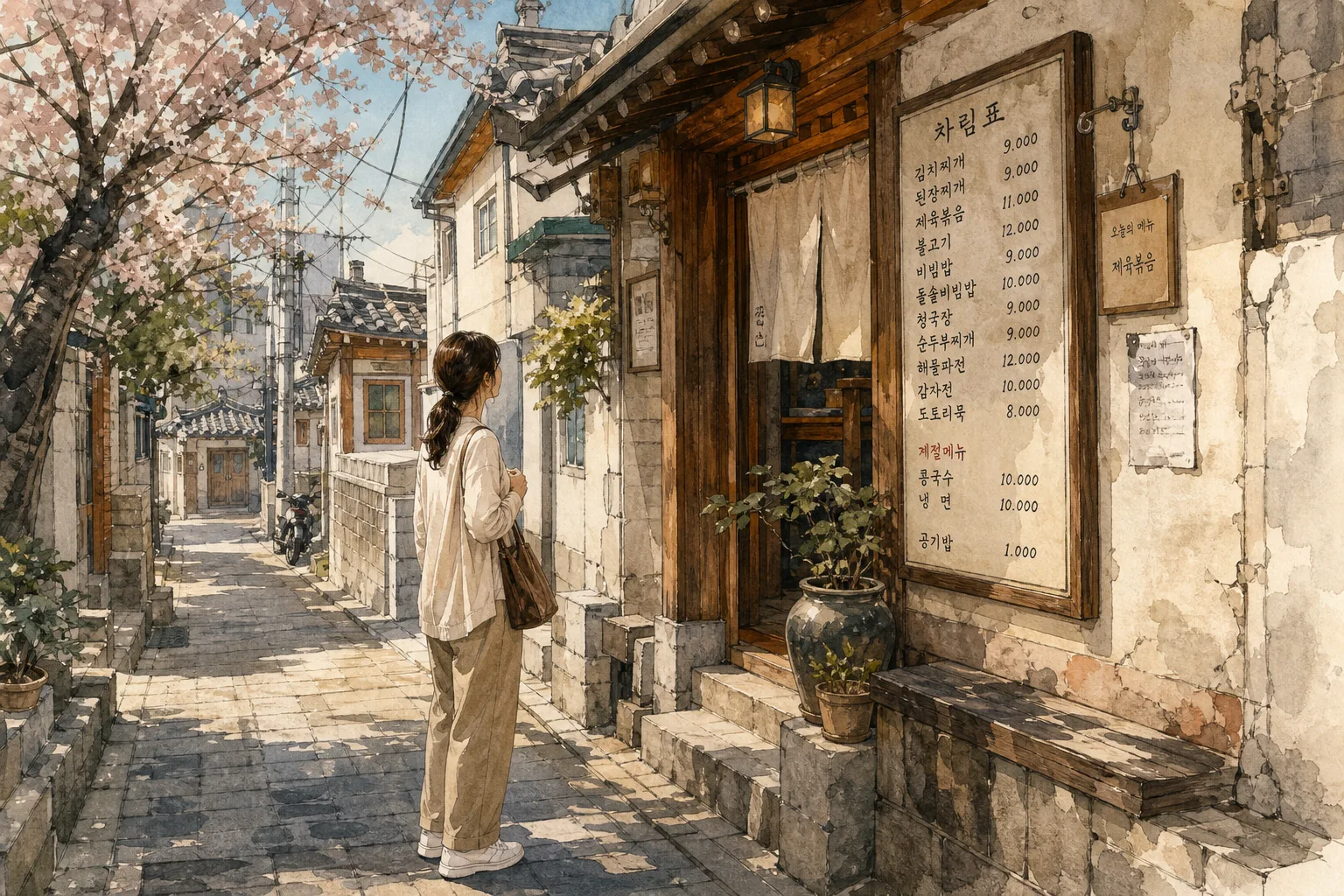
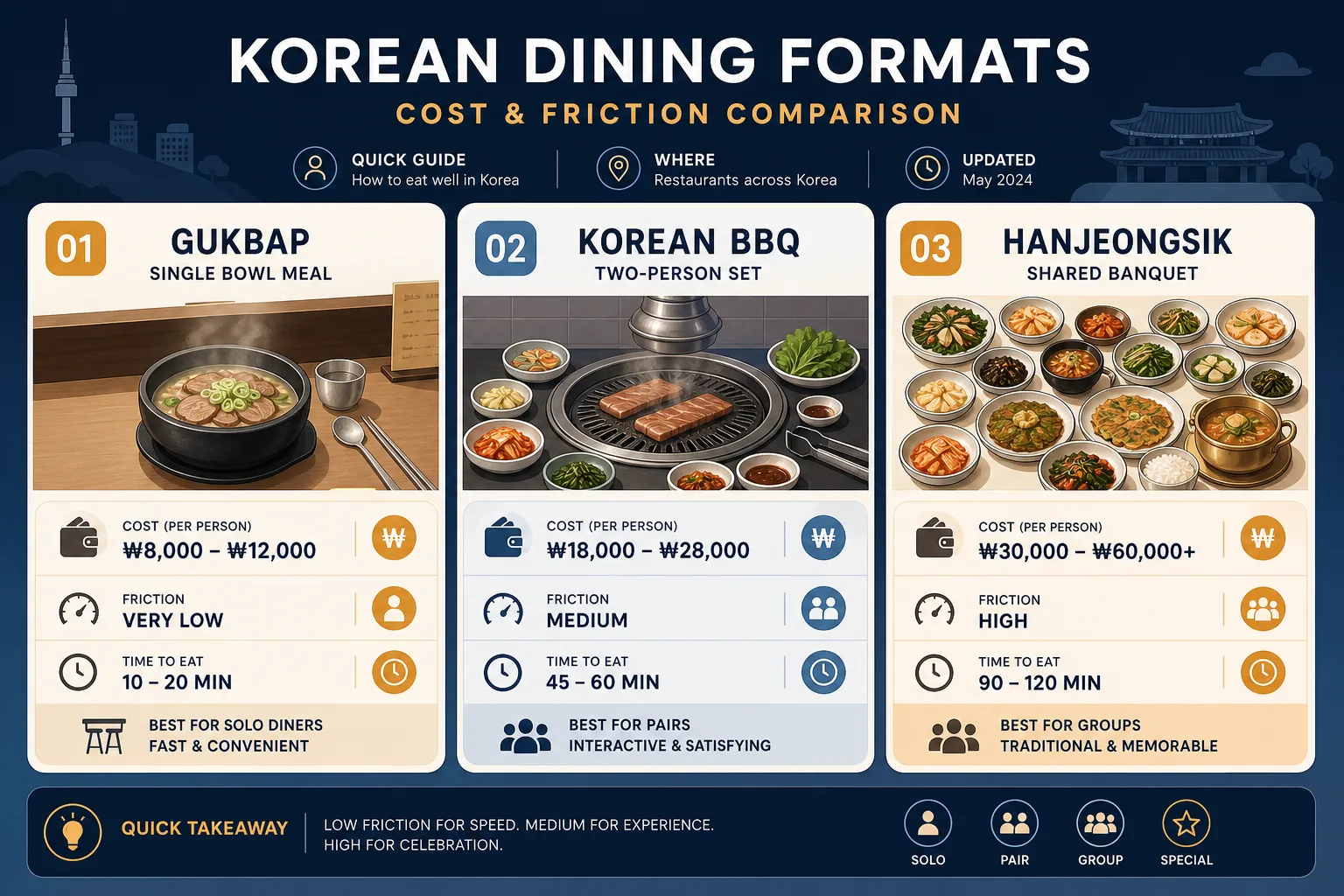
Travelers with a tight per-meal budget who have not planned for the two-portion reality of solo BBQ are also at risk. A mid-to-high traditional meal or a two-portion BBQ run can land between 15,000 and 40,000 KRW, meaningfully more than the 8,000 to 12,000 KRW a single traditional dish typically costs. If your budget was built around the lower number for every meal, BBQ nights will strain it.
Finally, first-time solo diners who have never eaten alone in a country where they do not speak the language may find the combination of new food, new etiquette, and being watched (even if only in their own head) more draining than expected. Seoul is not unusually harsh on solo diners compared to other major cities, but it is also not a place where every restaurant format was designed with a party of one in mind, and that mismatch can wear on someone testing solo travel for the first time.
Mistake / Consequence Table
| Decision variable | If you plan for it | If you do not |
|---|---|---|
| Korean BBQ as a solo diner | Budget for two meat portions or pre-identify a solo-grill restaurant; treat it as a planned splurge | Get turned away or awkwardly pressured at counter-service BBQ spots expecting a group, or overpay without realizing why |
| Daily meal budget | Plan most meals around 8,000 to 12,000 KRW single dishes, with occasional 15,000 to 40,000 KRW splurges | Underbudget by assuming every meal costs the same, then feel squeezed on BBQ nights |
| Hanjeongsik and shared-spread meals | Accept that per-person pricing may be higher solo, or look for single-set versions at smaller restaurants | Expect group pricing and portion variety alone, and end up paying more per dish than a group would |
| Neighborhood choice | Base yourself near Insadong or Ikseon-dong, both dense with small traditional restaurants and walkable to each other | Stay in a hotel far from a walkable food district and spend more time and money reaching decent solo-friendly options |
| Navigation | Use Naver Map or KakaoMap for walking directions between restaurants | Rely on Google Maps, which does not support walking directions in South Korea, and get lost or waste time |
Where solo friction actually differs by dining format:
image: body-01
Hidden Friction Points
Food options. The biggest hidden friction is not that Seoul lacks solo-friendly food, it is that the most photographed and hyped traditional format, Korean BBQ, is the one built least for solo diners by default. Many BBQ restaurants set a minimum order of two portions of meat per table, which is really a portion-size rule, not a rule against solo customers. You can still eat there alone, but you are paying for two portions either way. Hanjeongsik, the multi-dish banchan-style meal, is also traditionally a shared format, so a solo version may be smaller, pricier per person, or simply harder to find outside of restaurants that specifically offer single sets.
Social friction. Sitting alone at a table meant for two or four, in a restaurant where most other tables are full groups, can feel more noticeable than it actually is to staff and other diners. In practice, counter seating at gukbap and noodle restaurants removes most of this friction entirely, since counters are built around individual seats rather than shared tables. The friction concentrates specifically in group-oriented restaurants, not traditional dining as a whole.
Cost pressure. Because BBQ's two-portion minimum applies per table regardless of how many people are eating, a solo diner effectively pays a per-person premium that a group splits away. Over a multi-day trip, choosing BBQ every night as a solo traveler adds up fast compared to travelers who mix in single-serving dishes most days and treat BBQ as an occasional stop.
How to Make It Easier
Lean on single-serving traditional dishes for the bulk of your meals. Gukbap, various noodle dishes, and bibimbap are inexpensive, fast, quietly solo-normal, and genuinely traditional, not a compromise format. Treat these as your baseline, not your backup plan.
When you do want BBQ, decide in advance whether you are paying for two portions at a normal restaurant or seeking out a restaurant built for solo grilling. Hongo in Haebangchon offers single-person charcoal grills for around 39,000 KRW, a straightforward solo splurge with no ordering awkwardness. Hongojib, with locations in Myeongdong and Hongdae, offers individual tabletop grills with single-serving meat portions from about 10,000 to 15,000 KRW, a cheaper solo-BBQ option if the full charcoal experience is not the point.
Base your food days in a walkable traditional-dining district rather than treating each meal as a separate expedition. Insadong, centered near Anguk Station (Line 3, Exit 6), and Ikseon-dong Hanok Alley, just off Jongno 3-ga Station, sit about 5 to 7 minutes apart on foot and both cluster small traditional restaurants used to solo customers. Spending an afternoon moving between the two turns solo dining into a low-stress walk instead of a search.
Install Naver Map or KakaoMap before you land, since Google Maps does not provide walking directions in South Korea. Getting turned around while hungry and alone is a small thing that compounds the social friction unnecessarily.
Better Alternatives
If communal BBQ exactly as served to groups is the specific experience you want, and paying a solo premium or hunting down a niche solo-grill restaurant does not appeal to you, consider timing part of your trip around a food tour or a cooking class that includes a shared meal, rather than trying to recreate a group table alone. This gets you the format you actually want without fighting the restaurant's built-in assumptions.
If cost pressure from two-portion BBQ minimums is the main concern, prioritize the cheaper solo-BBQ format at Hongojib over the full solo-grill experience at places like Hongo, and reserve the pricier single-set solo grill for one memorable meal rather than a repeated habit.
If the social friction of sitting alone at group-style tables is the real issue rather than the food itself, shift your traditional dining toward counter-seat formats, gukbap houses and noodle counters, where solo seating is the norm rather than an accommodation. You still get traditional Korean food, just through a format that was never designed around groups in the first place.
Self-Checklist
Before committing to a food-focused solo trip to Seoul, check these:
- I am comfortable eating single-serving traditional dishes (gukbap, noodles, bibimbap) as my default, not just my backup.
- I have budgeted 15,000 to 40,000 KRW for BBQ meals, understanding this may cover two portions for one diner.
- I know at least one solo-friendly BBQ option (Hongo, Hongojib, or similar) if I want that format without ordering-counter awkwardness.
- I am staying within walking distance of a traditional-dining district like Insadong or Ikseon-dong, or I have a transit plan that does not eat into meal time.
- I have Naver Map or KakaoMap installed, not just Google Maps.
- I have tested eating alone in an unfamiliar setting before this trip, or I am comfortable doing it for the first time here.
- I understand this friction is about restaurant format and portion rules, not personal rejection, and I will not read a two-portion minimum as a comment on solo travelers.
FAQ
Will restaurants in Seoul actually refuse to serve one person? Some traditional Korean BBQ restaurants enforce a minimum order of two portions of meat, which functions as a de facto two-person rule at the table level, not a rejection of the customer. You can usually still eat there alone by ordering two portions yourself. Gukbap counters, noodle shops, and bibimbap restaurants almost never have this restriction.
Is Korean BBQ realistic for a solo traveler, or should I skip it? It is realistic if you accept ordering two portions of meat and paying for both, or if you seek out restaurants built for solo grilling. Hongo in Haebangchon offers single-person charcoal grills for about 39,000 KRW, and Hongojib in Myeongdong and Hongdae offers individual tabletop grills from about 10,000 to 15,000 KRW. Skip it only if the extra cost genuinely breaks your budget.
How much should I budget per meal as a solo diner in Seoul? A single traditional meal like gukbap, noodles, or bibimbap runs about 8,000 to 12,000 KRW. Mid-to-high traditional meals or a two-portion BBQ run typically land between 15,000 and 40,000 KRW. Budget closer to the top of that range if BBQ is a priority, since solo BBQ effectively means paying for two portions.
Which Seoul neighborhoods are easiest for solo traditional dining? Insadong, centered near Anguk Station (Line 3, Exit 6), and Ikseon-dong Hanok Alley, just off Jongno 3-ga Station, are both pedestrian-friendly and dense with small traditional restaurants used to single diners. The two areas are about a 5 to 7 minute walk apart, so you can treat them as one dining district for an afternoon.
Do I need to know Korean to eat alone at traditional restaurants? No, but you should expect limited English at smaller, older establishments, especially gukbap counters and family-run BBQ spots. Pointing at a menu photo or item on a neighbor's table works in most places. Bring Naver Map or KakaoMap rather than Google Maps, since Google Maps does not support walking directions in South Korea.