travel-decisions
Is Bukhansan National Park Worth the Logistical and Physical Stress for Moderate-Fitness Hikers?
A friction-first breakdown of Bukhansan National Park's bus transfers, granite scrambling, and weekend crowds, so moderate-fitness travelers can decide before they book.
Quick Verdict
Bukhansan National Park is worth it if you can commit to 4 to 6 hours of sustained walking, you are not afraid of using your hands on exposed granite, and you are willing to either start early or hike on a weekday. It is a genuinely demanding mountain, not a padded tourist attraction, and the difficulty other blogs downplay is real.
It is a weak fit if you have limited hiking stamina, get anxious on exposed heights, or you are trying to wedge the hike into a tightly scheduled single day alongside other major sightseeing. The park does not punish casual effort on its flat trail, but the signature Baegundae Peak route punishes poor planning, and poor planning, not low fitness, is the most common reason moderate-fitness travelers regret the day.
Strong fit if: you walk regularly at home, you can tolerate steep terrain and steel-cable sections without panic, and you can start hiking before mid-morning.
Weak fit if: you have joint pain, low walking stamina, a fear of heights, or you are stacking this hike onto a day that already includes other major sightseeing.
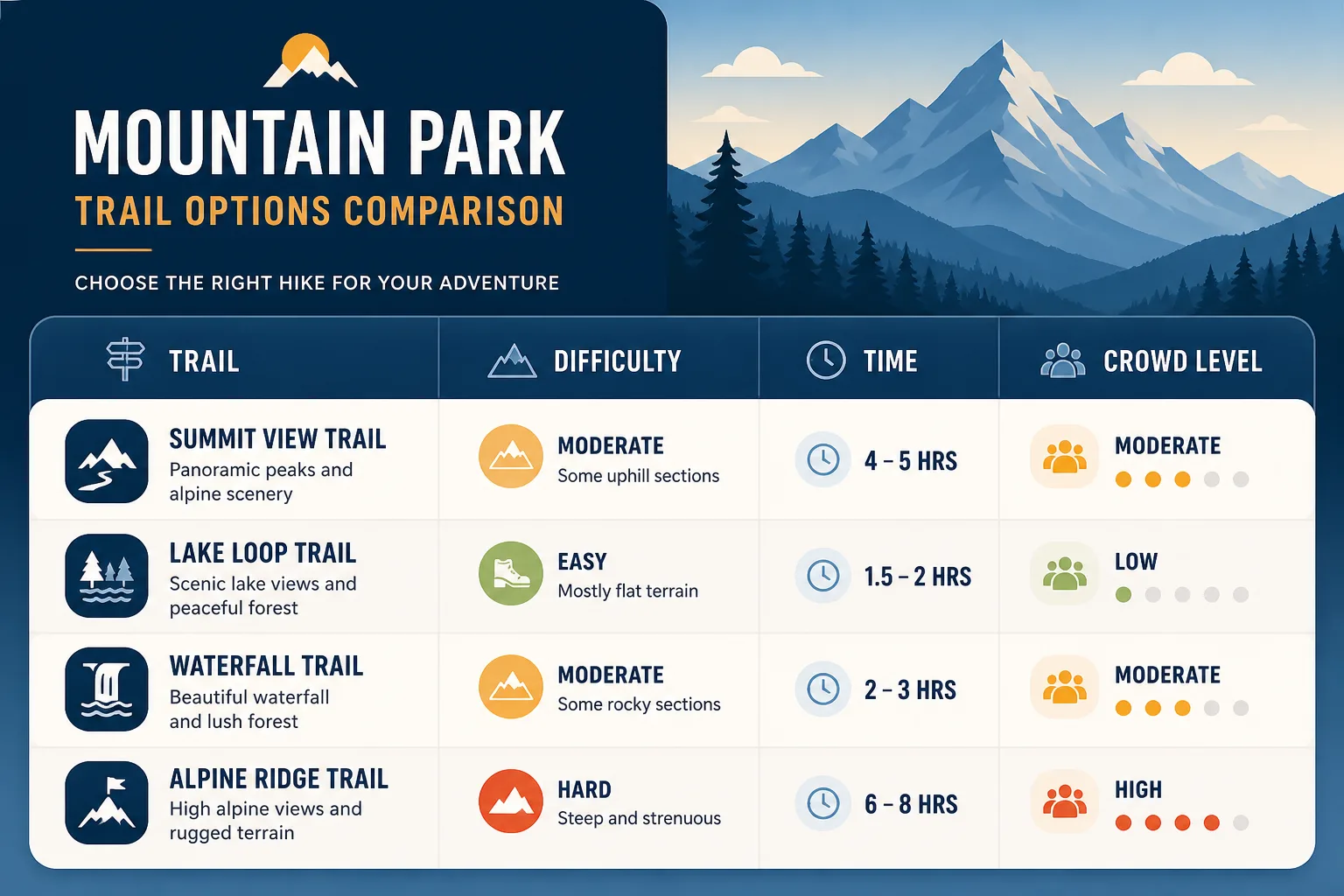 Editorial illustration: A simple decision table or comparison chart layout showing trail options for a mountain park labeled by difficulty.
Main Friction Problem
The gap between how Bukhansan gets described online ("a great day hike from Seoul") and how it actually feels for a moderate-fitness traveler comes down to four specific frictions, not vague difficulty.
Extreme physical fatigue. The round trip to Baegundae Peak runs 4.6 to 5.6 miles (7.4 to 9 km) and takes 4 to 6 hours of active hiking. That is a full physical commitment, not a two-hour stroll. If your usual travel walking is airport terminals and museum floors, this is a different category of exertion, and it affects the rest of your day and possibly the next one.
Complex bus transfers. Reaching the West Entrance means taking Subway Line 3 to Gupabal Station, exiting at Exit 1, transferring to Bus 704, 34, or 8772, riding to the Bukhansanseong stop, and walking another 10 to 15 minutes before the trail even starts. For a traveler without a Korean data SIM or transit app fluency, this multi-leg transfer is often more stressful than the hike itself.
Steep granite scrambling. The final 300 to 500 meters to Baegundae Peak is not a trail in the normal sense. It is bare granite rock requiring you to grip fixed steel cables, ropes, and iron handrails while placing your feet on angled stone. Fitness alone does not solve this. Comfort with exposure and hands-on-rock movement matters more here than cardio conditioning.
Weekend trail bottlenecks. On sunny weekends, the cable sections back up with 30 minutes or more of waiting, and photo turns at the summit can take 30 minutes to 2 hours. This is not a hypothetical crowd; it is a physical queue on a narrow rock face, adding real time and standing-around fatigue on top of the climb itself.
These four frictions are manageable individually. Stacked on a single unplanned Saturday, they are what turns a demanding-but-good hike into a day a moderate-fitness traveler regrets.
Friction Table
The honest tradeoffs come down to a small set of decision variables, not generic park facts. This is the specific set of choices that determines whether your day at Bukhansan goes well.
| Decision variable | Baegundae Peak route | Uiryeong-gil flat trail |
|---|---|---|
| Physical fatigue | High: 4 to 6 hours, 7.4 to 9 km round trip | Low to moderate: flat 6.8 km, no scrambling |
| Granite scrambling | Required for final 300 to 500m via steel cables | None; trail avoids the peak entirely |
| Bus/transit complexity | West Entrance needs subway plus bus transfer | Same regional access, but permit replaces queue risk |
| Weekend bottlenecks | 30 min to 2 hour waits at cables and summit | Capped at 1,000 visitors per day, so crowding is controlled |
| Planning required | Show up and start hiking | Reserve permit 1+ day ahead with physical ID |
| Cost | Free park admission | Free park admission, permit required |
The pattern: the peak route trades planning simplicity for physical and crowd risk, while the flat trail trades a small amount of upfront planning (the permit) for a much lower-stress day. Neither is objectively better. The right one depends on which kind of stress you would rather absorb: physical, or logistical.
Who Will Feel It Most
Not every moderate-fitness hiker feels this friction the same way. Two behavioral profiles, more than fitness level, predict who struggles.
- The unprepared impulse hiker. This is the traveler who adds Bukhansan to the itinerary the night before because a photo looked good, then shows up in flat sneakers with no water plan and no idea which entrance to use. Fitness is rarely the actual problem here; the problem is discovering the bus-transfer sequence and the granite scramble at the same time, mid-hike, with no buffer.
- The meticulous over-scheduler. This traveler plans the transit correctly but tries to fit Bukhansan into a day that also includes a palace, a market, and dinner reservations. The hike alone eats 4 to 6 hours plus transit, so something gets rushed, and rushing a granite scramble is exactly when fatigue turns into a slip or a bad fall risk.
- Travelers with any fear of heights. The steel-cable sections put you on exposed rock with a real drop nearby. Fitness does not fix this. If heights make you freeze on a ladder at home, expect the same reaction here, amplified by fatigue near the top.
- Solo travelers without a Korean SIM or offline map. The West Entrance bus sequence depends on reading Korean-language stop names correctly in real time. Boarding the wrong bus adds 30 to 60 minutes of confusion before the hike has even started.
Travelers who avoid both behavioral traps (researched the route, kept the day free) tend to report the hike as demanding but satisfying, not miserable, regardless of their exact fitness level.
How to Reduce the Friction
Each friction point has a specific, practical mitigation. None eliminate the difficulty, but they change it from an unplanned ordeal into a known, manageable challenge.
For extreme physical fatigue:
- Treat the hike as a single-activity day. Do not schedule museums or shopping afterward.
- Eat a real meal beforehand and carry more water than feels necessary; there are no shortcuts once you are mid-climb.
- If you are unsure of your stamina, choose the Uiryeong-gil flat trail for the forest experience without the multi-hour ascent.
For complex bus transfers:
- Save the exact transfer sequence (Line 3 to Gupabal Station Exit 1, then Bus 704, 34, or 8772 to the Bukhansanseong stop) as an offline note before leaving your hotel.
- Consider the East Entrance instead: it only requires a walk from Bukhansan Ui Station, and most hikers share a local taxi for about 1,000 won per person to skip the steep 2 km uphill approach, removing the bus-transfer risk entirely.
- Rent any gear you are missing at the Seoul Hiking Tourism Center, 300 meters from Bukhansan Ui Station Exit 2, where hiking shoes and jackets rent for roughly 2,200 won (about $1.45 to $2.00 USD) per item, so you are not carrying extra decisions on top of transit logistics.
For steep granite scrambling:
- Wear proper grip-soled hiking shoes, not sneakers; the granite is smooth and the steel cables assume a firm foothold.
- Move slowly at the cable sections and let faster hikers pass; there is no time pressure that justifies rushing an exposed scramble.
- If the first cable section feels genuinely frightening rather than just difficult, turn back. The peak view is not worth a fall, and this is a reasonable decision, not a failure.
For weekend trail bottlenecks:
- Start hiking before 8am, especially on Saturday or Sunday, to get ahead of the cable-section queue.
- If a weekday visit is possible at all, take it. The difference in wait time is not marginal; it can be the difference between a 5-hour day and a 7-hour day.
- Budget mental patience for the summit photo queue (30 minutes to 2 hours on busy days) as part of your schedule, not as an unexpected delay.
Better Alternatives
If the friction table above points toward a weak fit, Seoul has real mountain and hiking alternatives, not just consolation options.
If you want mountain scenery without the granite scramble: Ansan Jarak-gil is the closest direct substitute. It is a wooden-decked, fully accessible trail with a gentle grade and no exposed rock, so it removes the steel-cable risk entirely while still delivering forest and skyline views over the city. It is short enough to complete, including transit, in under half a day.
If you want a short summit with a small amount of rock but nothing like Baegundae: Inwangsan offers stairs and some rock scrambling near its distinctive summit boulders, but nothing close to a 300 to 500 meter exposed cable section. It is a reasonable middle step for a hiker who wants more than a flat path but is not ready for Bukhansan's peak route.
If you want the same park without the scramble: the Uiryeong-gil flat trail delivers Bukhansan's forest and ridge views without any granite climbing, at the cost of reserving a permit a day ahead. This is the most direct in-park substitute.
If you specifically wanted a hike as a bucket-list item: treat Bukhansan's peak route as its own anchor day early or late in the trip rather than squeezing it between other activities, so fatigue does not compound with an already packed schedule. The mountain rewards being the main event, not a side quest.
If mobility or joint concerns are a factor: none of Bukhansan's routes, including Uiryeong-gil, are a strong fit for significant joint pain given the distances involved. Ansan Jarak-gil's wooden decking is the better outdoor substitute in that case.
Decision Checklist
Use this before committing to a specific route and day:
- Can you sustain 4 to 6 hours of hiking, including a downhill return, without significant joint or knee pain?
- Are you comfortable gripping a steel cable while standing on angled granite, with a visible drop nearby?
- Have you decided between the West Entrance bus-transfer route and the East Entrance taxi-shortcut route, and written the exact steps down?
- Is your hike day a weekday, or if it must be a weekend, are you starting before 8am?
- Have you kept this day free of other major activities so fatigue does not stack?
- If choosing Uiryeong-gil instead, have you reserved the permit on the KNPS website at least one day ahead and packed physical ID?
- Are you hiking outside the wildfire closure windows (February 15 to May 15, and November 15 to December 15), when relevant trails may be shut?
- If hiking in winter (December through February), do you have metal crampons for the icy granite sections?
If you checked most of these confidently, Bukhansan's peak route is likely worth it. If several gave you pause, Uiryeong-gil, Ansan Jarak-gil, or Inwangsan will serve you better than forcing the harder route.
FAQ
Is the Bukhansan hike too hard for an average, moderately fit person? For the flat Uiryeong-gil trail, no. For Baegundae Peak, it depends on your comfort with exposed heights, not just your fitness. The route itself is a manageable 4 to 6 hour round trip for someone who walks regularly, but the final 300 to 500 meters involves steep granite sections with steel cables and iron handrails. If you have no fear of exposed scrambling and can handle a multi-hour hike, it is hard but doable. If heights or scrambling make you anxious, it will feel much harder than the distance suggests, regardless of how fit you are.
Do I need hiking experience to climb Baegundae Peak? You do not need technical climbing experience, but you do need basic comfort with using your hands on rock and gripping steel cables while your feet are on angled granite. First-time hikers do this climb regularly. The ones who regret it are usually not the unfit ones, but the unprepared impulse hikers who showed up in sneakers with no plan for the descent, not the ones who researched the route first.
What is the easiest way to avoid the worst crowds at Bukhansan? Start before 8am on any day, and avoid Saturday and Sunday entirely if you can hike on a weekday instead. On sunny weekends, the steel cable sections alone can add 30 minutes or more of waiting, and photo queues at the peak can run from 30 minutes to 2 hours. A weekday morning start removes most of this bottleneck without changing anything else about the hike.
Is there a version of Bukhansan that does not require scrambling? Yes. The Uiryeong-gil trail is a flat 6.8 km route that avoids the granite peak entirely, but it requires a permit reserved at least one day ahead on the KNPS website, is capped at 1,000 visitors daily, and requires physical ID at entry. This is the better choice for anyone who wants forest and mountain scenery without the physical risk of the peak scramble.
Which entrance should a moderate-fitness hiker use, West or East? The East Entrance near Doseonsa Temple involves a steep 2 km uphill walk from Bukhansan Ui Station before the marked trail even begins, though many hikers share a local taxi for about 1,000 won per person to skip it. The West Entrance requires a longer transit combination (subway to Gupabal Station, then a bus transfer to the Bukhansanseong stop, then a 10 to 15 minute walk) but starts hiking sooner on more gradual terrain. If bus transfers stress you out more than a short uphill walk does, the East Entrance plus a shared taxi is the lower-friction choice.
Are Inwangsan or Ansan Jarak-gil actually easier than Bukhansan, or just shorter? Both are genuinely lower-friction, not just shorter. Ansan Jarak-gil is built as a wooden-decked accessible trail with no scrambling and a gentle grade, so it removes the granite and steel-cable risk entirely. Inwangsan involves some rock and stairs near its summit rocks but nothing close to Baegundae's exposed 300 to 500 meter cable section, and the whole loop is short enough to finish in under half a day including transit.