travel-decisions
Is Rome Worth It for Travelers Who Want Neighborhood Wandering More Than Landmark Checklists?
A traveler-fit guide to deciding whether Rome rewards atmosphere-led, food-led, and slow travelers who would rather wander Monti and Testaccio than queue for the Colosseum.
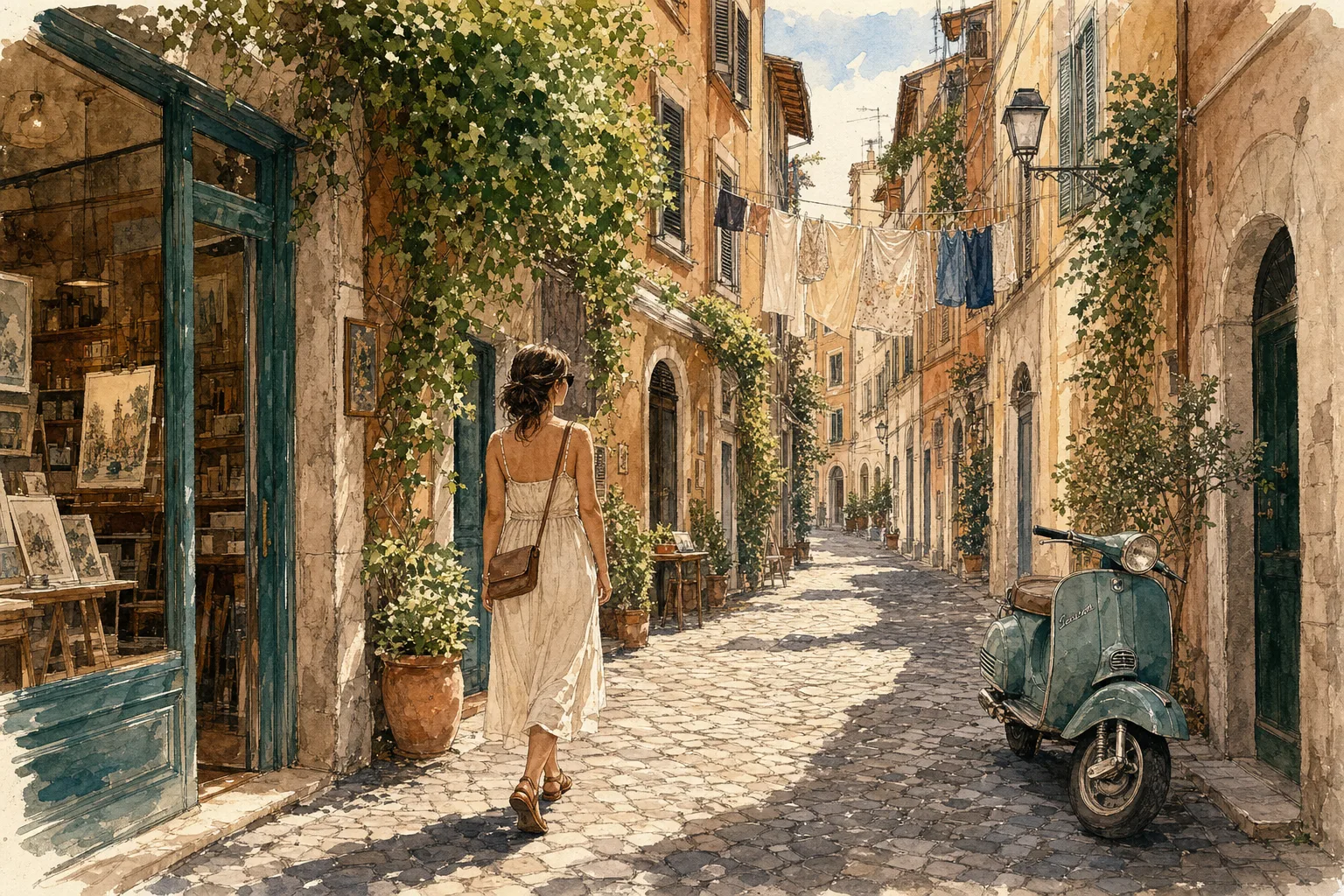
Rome is famous for a short list of monuments, but the neighborhood-wandering version of the city comes with a different kind of gravity. You are not just skipping the Colosseum or the Vatican. You are deciding whether you can enjoy Rome while those landmarks remain physically and psychologically close enough to tempt you all day. In some cities, wandering and sightseeing separate cleanly. In Rome, they overlap constantly.
That is why this question is harder than it looks. A traveler who wants neighborhood mood over checklists is not choosing between two separate Romes. They are choosing whether the city still feels rewarding when the headline attractions become background pressure rather than the main event.
Quick Verdict
Rome is worth it for atmosphere-first, food-led, and slow travelers who treat neighborhoods as the actual destination. The city stacks aperitivo culture, dense food neighborhoods, and walkable historic layers in a small central footprint, which rewards repetition more than coverage. If you measure a trip by the number of named landmarks you stood next to, deliberately skipping the Colosseum, Vatican, and Trevi Fountain will feel like you wasted the flight.
- Strong fit if: you want long lunches, repeat coffee bars, evening walks, and you are comfortable letting a neighborhood be the plan.
- Weak fit if: you need a clear list of accomplishments per day, you dislike uneven cobblestones, or you get anxious when other people in your life ask "but did you see the Colosseum?"
- Different city likely better if: you want this mood with less terrain stress and less landmark gravity. See the alternatives section below.
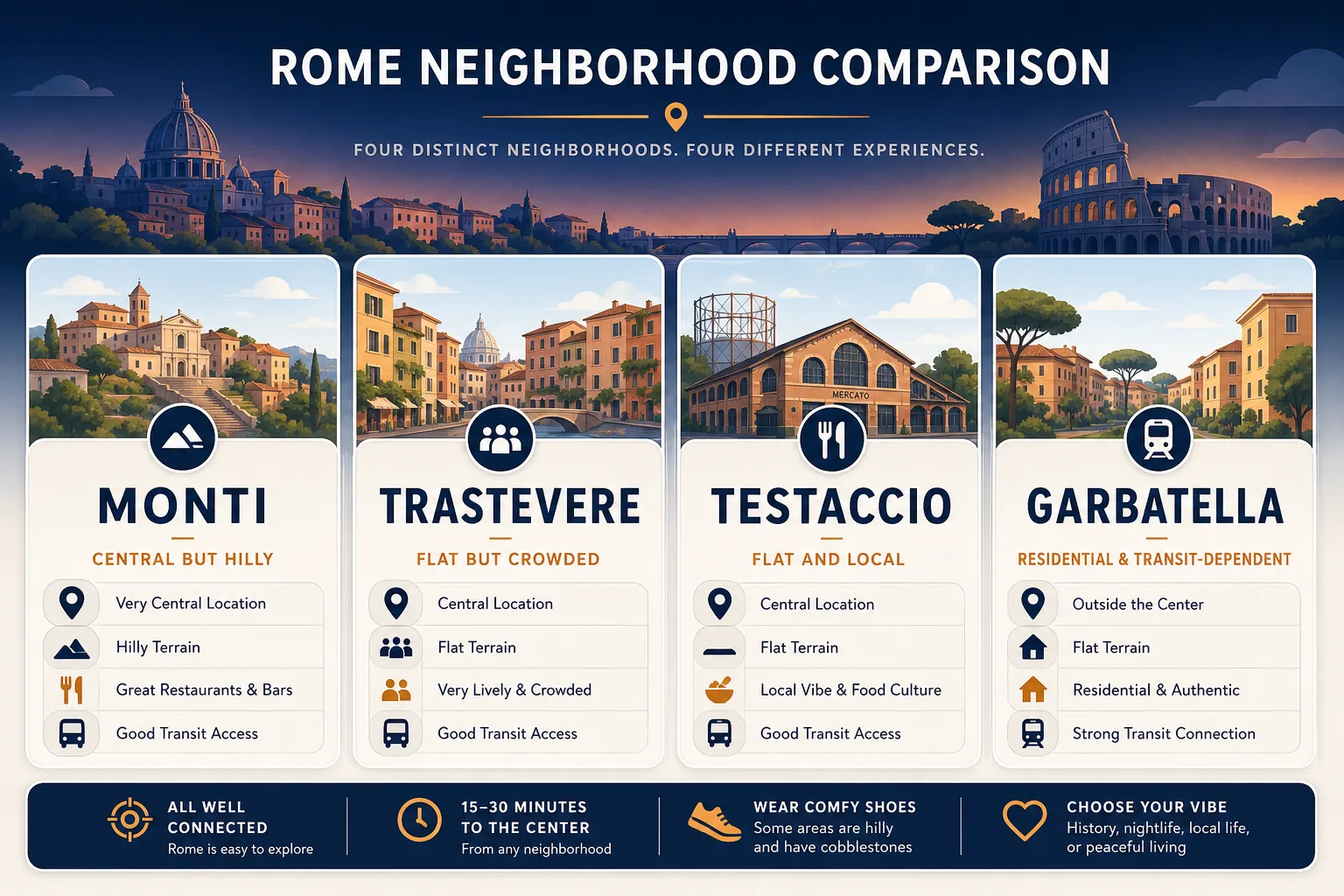 An infographic comparing four Rome neighborhoods—Monti, Trastevere, Testaccio, and Garbatella—detailing their location, terrain, vibe, and transit accessibility.
Best for First-Time Visitors
First-time visitors are the riskiest fit for this style of trip, because expectation mismatch is the loudest friction in Rome. The city's brand is the landmark checklist. If this is your first visit and you want to skip the major sights, give yourself permission to walk past them anyway. Monti sits roughly 5 to 10 minutes on foot from the Colosseum (about 500 meters to 1 kilometer), so you will see it from the outside whether you ticket it or not. The Pantheon from Trastevere is about 12 to 15 minutes across Ponte Sisto, a flat, pedestrian-friendly bridge.
What works for first-timers in this mode:
- Pick two neighborhoods, not five. Monti plus Testaccio is a strong pair.
- Plan one anchor meal per day and let the rest of the day form around it.
- Walk past the famous sites from the outside once, so the curiosity is settled.
Best for Couples
Couples tend to do well in Rome on a neighborhood-led plan because the city is built for shared, unhurried hours. The aperitivo culture rewards sitting still. Trastevere is the obvious romantic choice but is also the noisiest after dark, especially behind Piazza Santa Maria in Trastevere. Couples who want atmosphere without the bar crowd usually do better basing in Monti or Testaccio and walking into Trastevere for an early dinner, then leaving before the late-night density peaks.
Good signals you are the right couple for this trip:
- You both prefer a two-hour dinner to a packed sightseeing day.
- Neither of you will feel cheated by skipping a major site.
- You agree on walking pace and afternoon rest.
Best for Slow Travelers
Slow travelers are the clearest match. Rome opens up when you stop trying to optimize it. Garbatella, in the Ostiense quarter further south, is residential, layered, and almost entirely missed by short-trip itineraries because reaching the historic center comfortably requires public transit rather than a walk. That is exactly why slow travelers like it: it behaves like a real neighborhood, not a stage set.
If you are slow-traveling Rome, plan in half-days rather than morning-and-afternoon blocks. Use the heat as a reason to nap. Eat late. Walk the same street twice on different days. Cross the Tiber on foot from Testaccio to Trastevere (about 20 to 30 minutes, 2 to 3 kilometers) and notice how the city changes as you go.
Best for Low-Stress Travelers
Low-stress travelers can make this work, but only if the hotel choice does the heavy lifting. Rome's friction is mostly cobblestones, hills, and transit gaps, not danger or complexity. Monti is centrally located but physically demanding, with steep climbs on Via Cavour and Via Panisperna. Trastevere is mostly flat and easy with luggage, at the cost of crowd density and late-night noise. Testaccio is flat, calmer, and underrated for low-stress trips.
Low-stress travelers should also know:
- A single BIT ticket is 1.50 euros and covers 100 minutes of buses and trams plus one metro entry.
- ATAC's contactless Tap and Go caps fares at 8.50 euros after 6 taps in a 24-hour window.
- Tram Line 3 is convenient on paper but is periodically replaced by bus shuttles during ongoing track and depot works, so do not build tight evening returns around it.
Traveler Type Table
The fit question is really a neighborhood question. Where you sleep decides what kind of Rome you experience.
| Neighborhood | Terrain and walkability | Walk to nearest landmark anchor | Tourist density | Best traveler fit | Main tradeoff |
|---|---|---|---|---|---|
| Monti | Central, hilly, steep on Via Cavour and Via Panisperna, uneven stone | 5 to 10 min to the Colosseum | Moderate | Atmosphere-first walkers who like effort | Hills compound across a week |
| Trastevere | Flat, easy with luggage, coarser cobbles | 12 to 15 min to the Pantheon via Ponte Sisto | High, loud at night near Piazza Santa Maria | Couples wanting the postcard look | Overtourism and late-night bar noise |
| Testaccio | Flat, low density, anchored by the Testaccio Market and the Pyramid of Caius Cestius (12 BC) | 20 to 30 min on foot to Trastevere across the Tiber | Low | Food-led and slow travelers | Less obvious "Rome look" at first glance |
| Garbatella (Ostiense) | Flat-to-rolling, residential, further south | Transit ride to historic center | Very low | Slow travelers staying 5+ nights | Needs public transit for centro storico |
A neighborhood-led trip also shifts the budget math. A short-term rental in Testaccio is frequently several hundred euros cheaper per stay than an equivalent property in Trastevere. The municipal tourist tax still applies per person per night, capped at 10 consecutive nights (children under 10 exempt), at 6.00 euros for 3-star, 7.50 euros for 4-star, and 10.00 euros for 5-star hotels.
Common Mismatches
The Rome mismatch is usually not disliking neighborhoods. It is underestimating how hard it is to ignore landmark gravity in a city built around it.
- The quiet checklist traveler. They claim they do not care about landmarks, then feel hollow on day three when they realize they never went inside anything famous. If this might be you, ticket one site as insurance.
- The high-coverage traveler. They want to feel they "did Rome" and measure that by ground covered. Neighborhood wandering looks like under-using the trip to them.
- The mobility-sensitive traveler who chose Monti for the vibe. Cobblestones and uphill streets compound across a week. If knees or feet are a question, choose Testaccio or flat Trastevere over Monti.
The disappointment risk is rarely the city. It is the gap between how the traveler talks about the trip and how they actually want to feel at the end of each day.
If Rome Is Not the Right Fit, Consider
Some readers will recognize themselves as the wrong fit while reading the mismatch section. That is a useful outcome. Three substitutes hold up well for the same underlying desire (neighborhood mood over landmarks) with less friction:
- Lisbon, for walkable, postcard neighborhoods (Alfama, Graca, Principe Real) with milder landmark gravity than Rome. Hills are real but more steadily networked with trams and funiculars, and the expectation to "see the famous sites" is lighter.
- Seville, for flat, atmosphere-led streets in Santa Cruz, Alameda, and Triana. Cobbles are gentler, evenings are made for sitting outside, and the landmark list is short enough that skipping nothing feels normal.
- Lyon, for food-led travelers specifically. Neighborhood eating in Vieux Lyon, Croix-Rousse, and the Presqu'ile is the trip, not a side quest, and there is no single monument that anyone will quiz you on afterward.
- Bologna, if you want to stay in Italy. Porticoes shelter long walks, the food culture is denser per block than Rome's, and the city carries no Colosseum-level expectation.
Pick the substitute that matches your actual friction. If your block is hills and cobbles, choose Seville. If your block is feeling guilty about skipping landmarks, choose Lyon or Bologna.
Final Match Recommendation
Choose Rome on a neighborhood-led plan if:
- You are atmosphere-first, food-led, or a slow traveler.
- You will stay at least four nights, ideally five or six.
- You are willing to base in Testaccio or Monti instead of defaulting to the historic core.
- You are calm about walking past famous sites without entering them.
Reconsider, or build in one or two ticketed anchors, if:
- This is your only likely trip to Rome in the next decade.
- You travel with someone whose satisfaction is tied to named sights.
- You have significant walking fatigue or mobility concerns and were planning to base in a hilly area.
Rome is unusually generous to travelers who slow down. It is unusually punishing to travelers who try to skip its main sights while still moving at sightseeing speed. Pick a lane before you book the hotel.
FAQ
If Rome is not the right fit, which European city is closest in feel but easier to wander? Lisbon and Seville are the two closest substitutes. Lisbon keeps the layered, lived-in neighborhood feel but trades Rome's flat-versus-hilly patchwork for steadier, signposted hills with tram support. Seville is flatter and warmer, with atmosphere-led streets in Santa Cruz and Triana, fewer cobbles, and far less landmark pressure. For food-led travelers who specifically want neighborhood eating without a famous monument backdrop, Lyon is the strongest match in Europe.
How many days do I need in Rome for a slow, neighborhood-led trip? Four to six nights is the working minimum. Anything shorter pulls you back into landmark-sprint mode because you feel guilty skipping the famous sites. From the fourth day onward, you can give a single neighborhood a full half-day, take long lunches, rest in the afternoon heat, and still cross into Garbatella or Testaccio without padding.
Is Tram Line 3 reliable right now, or should I plan around the replacement buses? Plan around it. Tram Line 3 on paper connects Trastevere Station, Testaccio, Aventino, and the Colosseum, but service has been periodically run as replacement bus shuttles due to ongoing track and depot works. Treat it as a bus corridor with occasional tram service, not a tram you can rely on for timed transfers.
Are Monti's streets a problem if I have knee or foot issues but still want to stay central? Yes, often. Via Cavour and Via Panisperna are the main thoroughfares and both involve steep, sustained climbs on uneven stone, which compounds across a week. If you want central with less terrain stress, base in the lower edge of Monti near Via dei Serpenti, or shift to flat Testaccio and take the bus or tram corridor in. Trastevere is also flat but the cobbles themselves are coarser.
Will a neighborhood-led Rome trip actually save money compared to a landmark trip? Often yes, but not automatically. Skipping ticketed sites removes a meaningful per-person line item quickly. Staying in Testaccio instead of Trastevere is frequently several hundred euros cheaper per stay for an equivalent short-term rental. The municipal tourist tax still applies per person per night, capped at 10 consecutive nights, at 6.00 euros for 3-star, 7.50 for 4-star, and 10.00 for 5-star hotels.