travel-decisions
Is Rome a Good First Trip for Travelers Who Want Easy Logistics?
A calm, decision-focused look at whether Rome fits first-time visitors who want simple transfers, walkable days, and low navigation stress.

Rome has a reputation for being either overwhelming or effortless, depending entirely on who is describing it. This article looks at one specific decision: whether Rome fits a first-time traveler whose top priority is easy logistics, not ambitious sightseeing.
Quick Verdict
Rome is a strong fit for first-time travelers who want easy logistics, on one condition: you choose a hotel inside the historic core and accept walking as your primary transport. Airport transfers are simple, the city center is compact, and a contactless transit tap caps at 8.50 euros a day, so daily costs stay predictable.
Rome is a weak fit if you expect a metro-first city like Paris or London. The Historic Center has no direct metro access, and the most photogenic neighborhoods are reached on foot over cobblestones. If long walks or last-minute route decisions drain you, that friction will follow you for the whole trip.
Strong fit if: you value walkable days, want one central hotel, and can book major sites 30 days ahead. Weak fit if: you want frequent metro hops, avoid walking, or plan to decide each morning what to do.
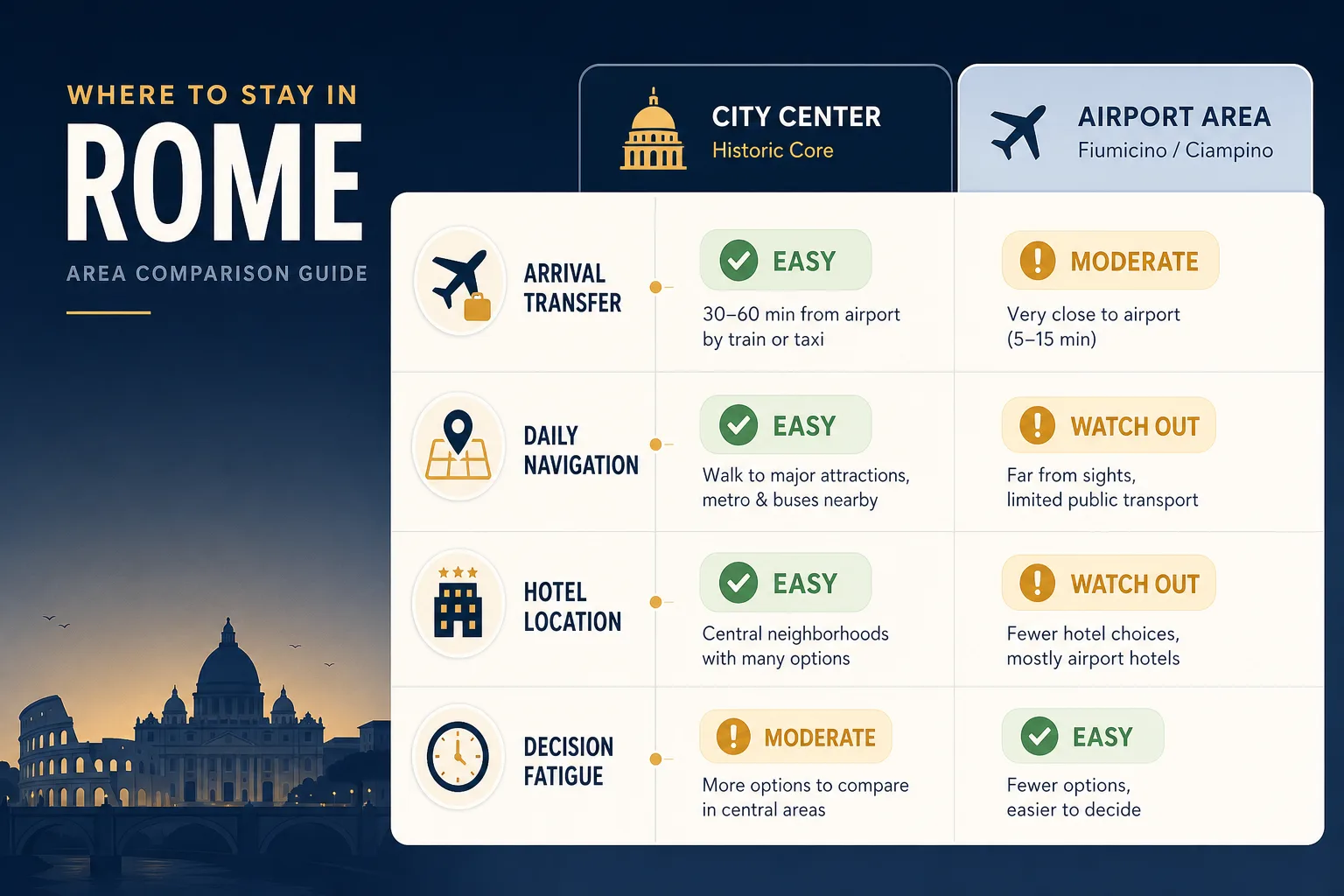 A comparison table comparing the logistics of staying in Rome's City Center versus the Airport Area.
Traveler Type Table
The table below reframes Rome around the friction points that actually decide whether a first trip feels easy, not the usual list of landmarks.
| Decision variable | First-time visitor | Low-stress planner | Couple |
|---|---|---|---|
| Arrival transfer (FCO) | Easy: Leonardo Express, 14 euros, 32 minutes | Easy: prebooked train or 55 euro flat taxi | Easy: 55 euro flat taxi splits well |
| Daily navigation | Walkable if hotel is central | Very manageable, few transit decisions | Romantic on foot, tiring in heat |
| Hotel location risk | High if booked by price alone | Medium: needs deliberate choice inside core | Medium: quiet streets vs walkability tradeoff |
| Decision fatigue | Moderate: many sites, timed tickets | Low if pre-booked in advance | Low if one person plans logistics |
| Transit complexity | Low in center, higher for day trips | Low: tap-and-go caps at 8.50 euros/day | Low: kids under 10 ride free if applicable |
| Expectation mismatch risk | Medium: layered history is dense | Low if trip is 4+ days | Low: mood-led travel suits the city |
The pattern is consistent. Rome rewards travelers who front-load decisions (hotel location, timed tickets, realistic pace) and quietly punishes travelers who plan to figure it out on arrival.
Best for First-Time Visitors
First-time visitors get more from Rome than almost any other European capital, because the highest-value sights are geographically close together. The Colosseum, Roman Forum, Trevi Fountain, Pantheon, and Piazza Navona all sit inside a walkable band roughly two to three kilometers wide. You are not choosing between neighborhoods; you are choosing between mornings.
The real first-timer risk is timed entries. Colosseum tickets are nominative, cost 18 to 24 euros, and release exactly 30 days ahead online. As of June 2026, on-site ticketing was consolidated to reduce reseller pressure, which means online booking is effectively required, not optional. First-timers who plan the trip four weeks out will move through Rome smoothly. First-timers who plan two weeks out will spend the trip working around sold-out slots.
Best for Couples
Couples do well in Rome because the city's default pace is slow evenings, long dinners, and walking between piazzas. There is no logistical pressure to split up or optimize. The flat 55 euro taxi from Fiumicino works out cheaper per person than two Leonardo Express tickets when there are two of you, and it removes the arrival-day navigation entirely.
The one friction couples underestimate is neighborhood noise. A romantic address near Campo de' Fiori is also a nightlife address. If you sleep lightly, prioritize streets a few blocks off the main squares, and check the tourist tax band on your hotel: rates range from 4 euros per person per night at 1-star properties to 10 euros at 5-star properties, capped at 10 consecutive nights.
Best for Slow Travelers
Rome suits slow travelers if you resist the itinerary reflex. The city rewards repetition: walking the same route in morning light and evening light, sitting in the same piazza twice, returning to a trattoria that worked. The shoulder seasons of April to June and September to October carry 58 percent of annual bookings, which tells you when the city is most alive but also when it is most crowded.
A slower trip of five to seven nights lets you use mornings for one landmark, afternoons for a neighborhood, and evenings for nothing planned. That rhythm matches how Rome is actually pleasant, and it dissolves most of the logistical stress that a compressed three-day trip creates.
Best for Low-Stress Travelers
This is the strongest fit category, provided you set the trip up correctly. Low-stress travelers should treat three decisions as non-negotiable:
- Book a hotel inside the historic center, even if it costs more per night.
- Pre-book the Colosseum, Vatican Museums, and any Borghese Gallery slots at least 30 days out.
- Use contactless tap-and-go on buses, trams, and metro; the 8.50 euro daily cap removes the need to think about ticket types.
With those in place, Rome becomes a low-decision trip. A standard single transit ticket is 1.50 euros and valid for 100 minutes across ATAC buses, trams, urban trains, and one metro ride, but most low-stress travelers will not need it: the tap cap handles everything automatically.
The December 2025 extension of the driverless Metro Line C directly into Colosseo-Fori Imperiali and Porta Metronia has quietly made central Rome more transit-connected than it was even a year ago, which reduces the historical downside of the Historic Center being off the metro grid.
Common Mismatches
Rome disappoints predictable traveler patterns. Watch for these:
- The metro-first traveler. If you expect Paris-style frequency, Rome will feel underserved. The historic core is designed around walking.
- The optimizer. Rome punishes travelers who try to see the maximum number of sites per day. The city is layered, not efficient.
- The late planner. Two-week lead times leave you with resold timed tickets, poor hotel locations, and inflated shoulder-season prices.
- The traveler who hates heat. Peak season overlaps with genuinely hot months. If humidity and sun drain you, either shift to April or October or accept a slower midday pace.
- The airport-anxious traveler who picks the cheapest transfer. The FL1 train is 8 euros but does not stop at Termini. If your hotel is near Termini, taking FL1 to save 6 euros creates an extra transfer with luggage.
Each of these mismatches is fixable at the planning stage, not the trip stage. That is why the front-loaded decision matters.
Final Match Recommendation
Choose Rome as your first trip if you want a walkable, atmosphere-led city where the main logistical decision (hotel location) is made once and then largely disappears. The airport transfer is a solved problem, the transit fare structure caps itself daily, and the core sightseeing sits in a compact area.
Do not choose Rome first if your definition of easy logistics means frequent metro service, no advance ticket booking, and cool weather. In that case, Amsterdam, Vienna, or Copenhagen better match what you are actually asking for.
For the specific persona in the brief (first-time, low-stress, easily worn down by transfers and navigation), Rome is a strong fit provided the hotel sits inside the historic core and the Colosseum ticket is booked 30 days ahead. Those two decisions carry roughly 80 percent of the trip's ease.
FAQ
Is Rome actually easy for a first international trip? Yes, with one caveat. Arrival is well-signposted, English is widely understood in tourist zones, and the historic center is walkable. The caveat is that the Historic Center itself has no direct metro access, so "easy" depends more on choosing a walkable hotel location than on mastering transit.
Should I take the Leonardo Express, the FL1 train, or a taxi from Fiumicino? Take the Leonardo Express at 14 euros and 32 minutes if your hotel is near Termini. Take the FL1 at 8 euros if you are staying near Trastevere, Ostiense, or Tiburtina, since the Leonardo Express does not stop there. Take the flat 55 euro taxi to the historic center if you are jet-lagged, arriving with heavy bags, or traveling as a couple splitting the fare.
How many days do first-timers actually need in Rome? Four full days is the low-stress sweet spot. Three days works but forces long back-to-back sightseeing blocks. Five days lets you keep mornings for major sites and afternoons for slow neighborhoods, which is closer to how Rome is actually enjoyable.
Do I need to book Colosseum tickets in advance? Yes. Standard individual tickets release exactly 30 days ahead online, and Parco Colosseo has been prioritizing online bookings. Tickets are nominative, so bring the matching passport or ID that you booked under. Do not plan to buy at the gate.
Where should first-time low-stress travelers stay? Anywhere you can walk to two or three major sights without needing transit. Monti, the area between the P