travel-decisions
Is Rome a Good Fit for Solo Women in Their 20s?
A practical traveler-fit guide for solo women in their 20s deciding whether Rome matches their style, safety comfort, and social energy.
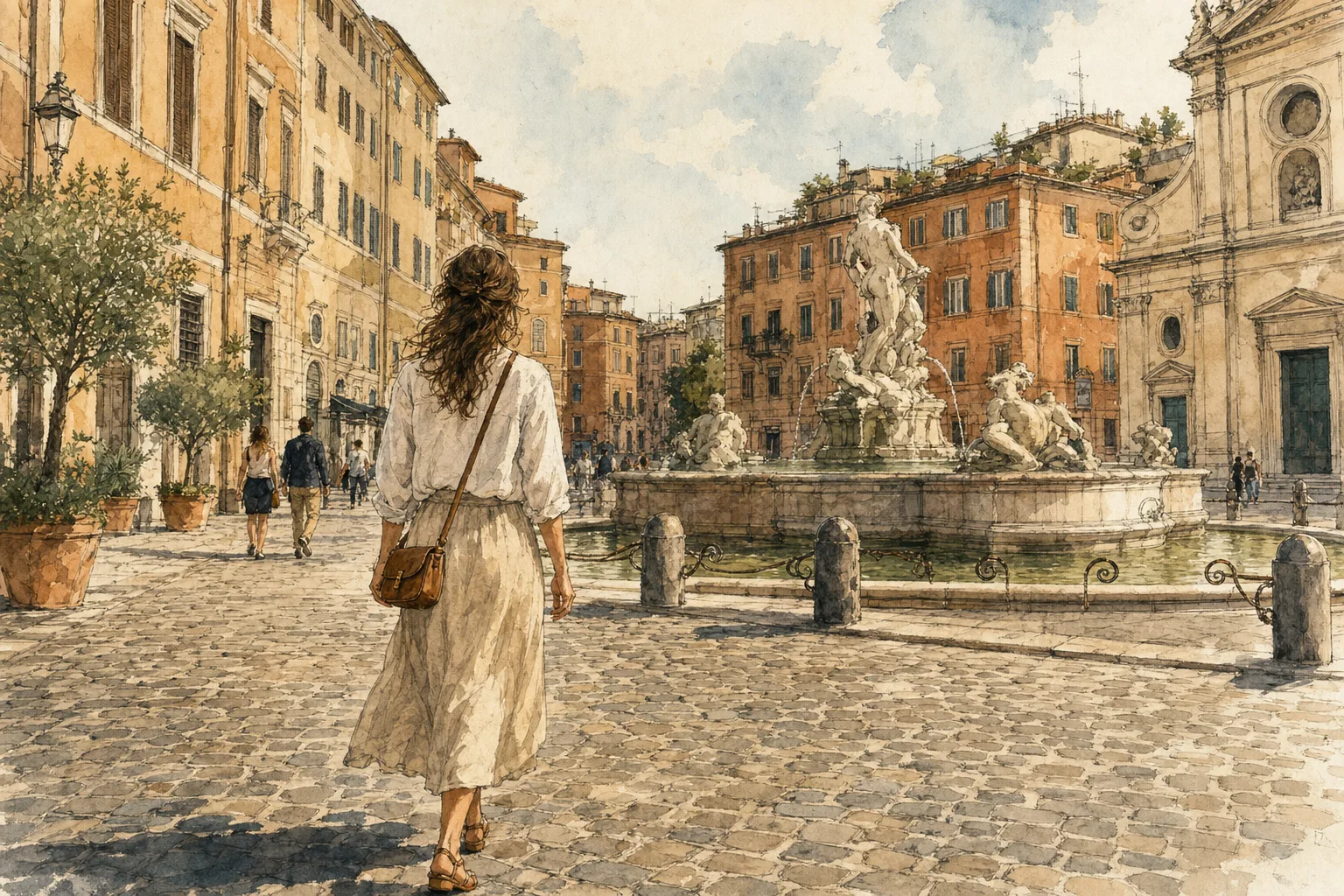
Rome sells itself as romantic, chaotic, and theatrical. For a solo woman in her 20s, the real question is narrower: does the city's energy match how you actually travel, or will it wear you out? This guide treats Rome as a fit decision, not a bucket-list checkbox.
Quick Verdict
Rome is a strong fit for solo women in their 20s who like walking for hours, eating at the bar of a wine shop, and reading a city through its streets rather than its checklists. It is a weak fit if you need quiet evenings, predictable infrastructure, and minimal street attention.
Strong fit if:
- You enjoy slow, unstructured days built around neighborhoods and meals.
- You are comfortable saying no firmly to street approaches and ignoring sales pressure near monuments.
- You are happy to be in bed by midnight in a well-chosen central area rather than crossing the city late.
Weak fit if:
- You want a "calm" capital where logistics just work. Rome is operational, not smooth.
- August heat above 30 C, crowds, and closed local spots would ruin your week.
- You wanted late-night freedom to walk anywhere without thinking about which street you are on.
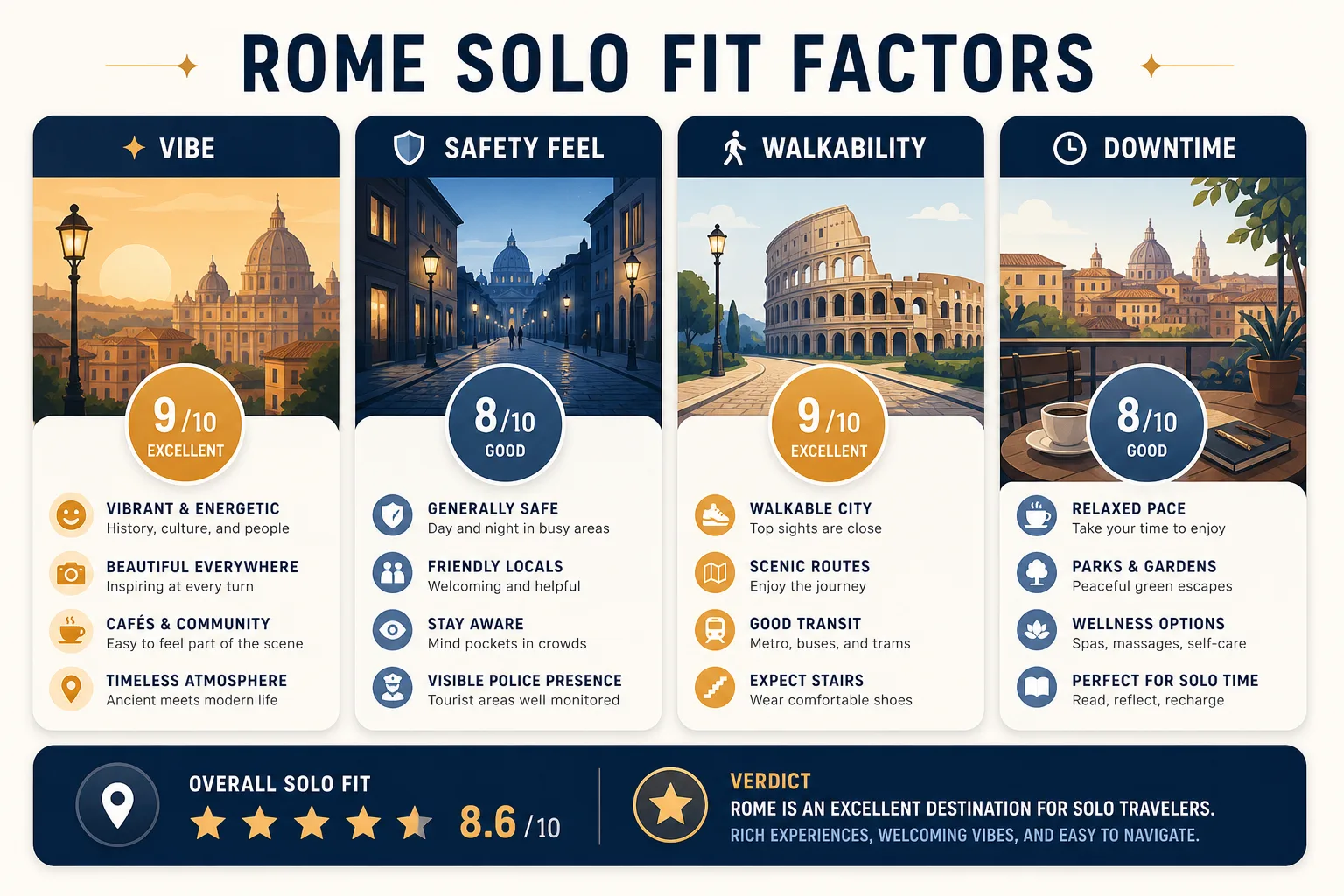 An infographic titled 'Rome Solo Fit Factors' analyzing vibe, safety, walkability, and downtime for solo travelers with an overall score of 8.6.
Best for First-Time Solo Travelers
For a first solo international trip, Rome has two strong advantages: the historic center is dense enough that you can walk between the Colosseum, Pantheon, and Trevi without needing transit confidence, and the cafe-and-piazza rhythm makes eating alone feel normal rather than exposed.
The friction for first-timers is mostly social. Expect frequent low-level street attention, especially near major monuments and at outdoor restaurant terraces where staff actively pull in passersby. None of this is dangerous on its own, but it is constant, and first-time solo travelers often underestimate how tiring "polite no, keep walking" becomes by day three.
A reasonable first-trip shape: 4 to 5 nights, base in Monti or Prati, two anchor sights per day, and one quiet block of downtime in the afternoon.
Best for Atmosphere-Led Travelers
If you travel for vibe more than itinerary, Rome rewards you generously. The decision-relevant detail is which neighborhood matches your version of atmosphere.
- Trastevere: highest social density, loudest evenings, easiest place to fall into a conversation. Walking from Trastevere to the Colosseum takes about 30 to 40 minutes across roughly 3.7 km, so it is central but not instant.
- Monti: a smaller, more curated version of the same energy, closer to ancient Rome.
- Testaccio: food-led, more local, quieter at night.
- Pigneto and San Lorenzo: younger and edgier, better for travelers who want to be near the bar scene more than the monuments.
Atmosphere-led travelers usually overstay in Trastevere by one night and regret the noise. If sleep matters, book a back-facing room or shift to Monti.
Best for Slow Travelers
Rome strongly rewards slow travel and punishes overpacked itineraries. The historic center is compact but the surface is brutal: cobblestones, hills, sun, and constant micro-decisions about which alley to take.
A slow-traveler version of Rome looks like one neighborhood per day, lunch as the main meal, an aperitivo block, and a single evening landmark. Reaching the Trevi Fountain from Termini, for example, is 20 to 30 minutes on foot or about 12 minutes via Metro Line A to Barberini, so even "moving across town" is a small commitment, not a tour.
For solo women specifically, slow travel also reduces friction: fewer transfers, fewer night journeys, fewer moments of standing on a map-lit corner looking lost.
Best for Low-Stress Travelers
This is where Rome's fit narrows. Rome is not a low-stress city. Traffic is assertive, signage is uneven, and tourist-zone hustle is constant. If your baseline preference is "everything should just work," Lisbon, Vienna, or Copenhagen are easier solo capitals.
That said, Rome can be made lower stress with structure:
- Stay within a 15-minute walk of your main sights so late evenings do not require transit.
- Use ATAC passes (8.50 euros for 24 hours, 15 for 48 hours, 22 for 72 hours, 29 for a week) to skip ticket decisions, or tap the same contactless card 6+ times in 24 hours to auto-cap at 8.50.
- Book Colosseum, Vatican, and now Trevi lower-basin tickets well ahead. From February 2, 2026, Trevi lower-basin access costs 2 euros with timed entry between 9:00 and 21:00.
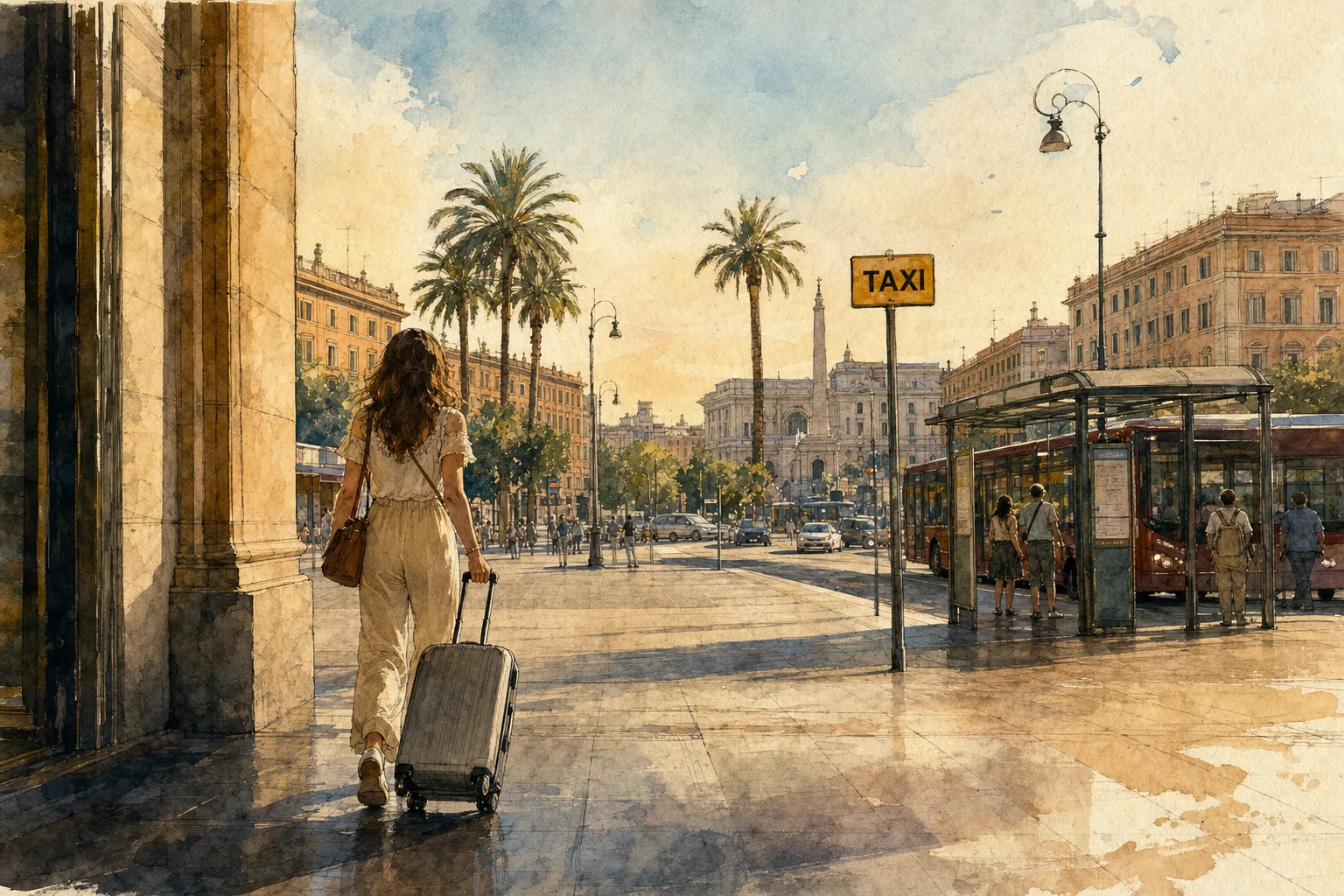
- Avoid arriving late at night at Termini. Metro runs 05:30 to 23:30 on weekdays and until 01:30 Friday and Saturday, so a late flight can mean a taxi.
Traveler Type Table
Use this to locate yourself honestly before committing.
| Traveler style | Rome fit | Why | Watch out for |
|---|---|---|---|
| Solo woman, 20s, atmosphere-led | Strong | Dense walkable center, easy solo dining, layered evening scenes in Monti and Trastevere | Constant street attention, late nights near Termini |
| First-time solo traveler | Good with structure | Compact core, English usable in tourism, easy day shape | Pickpocket pressure at monuments, hustle near restaurant terraces |
| Slow traveler | Strong | Neighborhood culture rewards lingering, lunch-first rhythm | Overplanning kills the trip; cap to 2 anchor sights per day |
| Low-stress traveler | Mixed | Walkable but operationally noisy and crowded | August heat, post-Jubilee crowds, transit gaps after 23:30 |
| Nightlife-first solo | Mixed | San Lorenzo and Pigneto deliver, but getting home late is the friction | Choose accommodation in or next to your nightlife area |
| Quiet, introverted traveler | Workable | Prati and Aventino offer real calm | Skip Trastevere base; protect mornings |
Common Mismatches
The clearest disappointment patterns for solo women in their 20s in Rome:
- Expecting a "safe everywhere, anytime" European capital. Rome is reasonably safe in central, populated areas, but the streets directly around and north of Termini can be poorly lit and tense after midnight, and solo women are specifically advised not to walk alone there late. Plan accommodation and arrival times around this.
- Booking near Termini for the price. The savings rarely beat the cost of taxis, anxiety, and a worse evening walk home.
- Treating Rome like Paris or Tokyo logistics. Buses run late, surface transit is unpredictable, and the Metro is limited. If you need precision, you will be annoyed daily.
- Going in August. Extreme heat, high prices, and local closures combine into the worst-fit month for solo women who want both atmosphere and comfort.
- Overpacking the itinerary. Three monuments a day in Roman heat on cobblestones is a recipe for a bad mood, not a good trip.
- Ignoring booking lead time. After the 2025 Jubilee, central Rome stays crowded; booking 90+ days ahead for stays and major attractions is now the realistic baseline.
Final Match Recommendation
Choose Rome as a solo trip in your 20s if you want a city that asks you to slow down, eat properly, and walk a lot, and you are willing to manage low-level street friction in exchange for one of the strongest atmospheres in Europe. Base in Monti for a balanced first trip, Trastevere if you want social density and accept the noise, or Prati if downtime matters more than buzz.
Skip Rome, or save it for later, if you want a clean, quiet, low-friction solo capital where you can walk anywhere at any hour without thinking. That is not what Rome is, and trying to force that fit is the most common source of disappointment.
A reasonable default shape: 5 nights, late April to early June or late September to October, central base within walking distance of dinner, attractions pre-booked, ATAC 72-hour pass in your wallet, and no plans after 23:00 that require crossing the city on foot.
FAQ
Is Rome safe enough for a first solo trip in your 20s? For daytime sightseeing and evenings in well-trafficked central areas, Rome is generally manageable for a first solo trip. The real friction is pickpocketing in tourist hotspots and tense, poorly lit streets directly around and north of Termini Station after midnight, which solo women are advised to avoid walking through alone late at night.
Which Rome neighborhood is best for a solo woman in her 20s? Monti and Trastevere tend to fit best. Monti is central, walkable, and has a steady evening crowd without feeling chaotic. Trastevere is more social and atmospheric but louder at night. Prati is quieter and feels residential, which suits travelers who want calmer downtime. Streets immediately around Termini are best avoided for accommodation.
How much should you budget per night for a comfortable solo stay? Highly rated social hostel dorms run roughly 35 to 75 euros, while private hostel rooms and budget B&Bs sit around 50 to 80 euros. Add the city tourist tax, which is 3.50 to 6.00 euros per night for hostels and B&Bs and up to 10 euros at 5-star hotels, charged for up to 10 consecutive nights.
Is August a bad time to visit Rome solo? It is the hardest month for most solo travelers. Temperatures often exceed 30 C, prices stay high, and some local restaurants and shops close. If you want Roman daily life rather than tourist-only Rome, late April to early June or late September to October is a stronger fit.
Do you need to book attractions far in advance? Yes. After the 2025 Jubilee Year, central Rome remains crowded, and booking accommodation and major attraction tickets 90 or more days ahead is recommended. From February 2, 2026 the lower basin of the Trevi Fountain also requires a 2 euro timed-entry ticket between 9:00 and 21:00.