travel-decisions
Is Rome Good for Travelers Who Want Quiet Nights?
A calm, decision-first look at whether Rome fits travelers who value quiet evenings, restful hotels, and low-stress nights over nightlife.
Quick Verdict
Rome can absolutely work for travelers who want quiet nights, but only if you choose the neighborhood and the room deliberately. It is a strong fit if you are willing to stay in a residential district like Aventino, upper Prati, or the quieter streets of Celio, and if you plan evenings that end before the metro cutoff. It is a weak fit if you assume any central hotel will be calm, if you book on Trastevere's main lanes, or if you expect big-city silence after dark.
The city rewards planners who care about pace. It punishes travelers who book by landmark proximity alone.
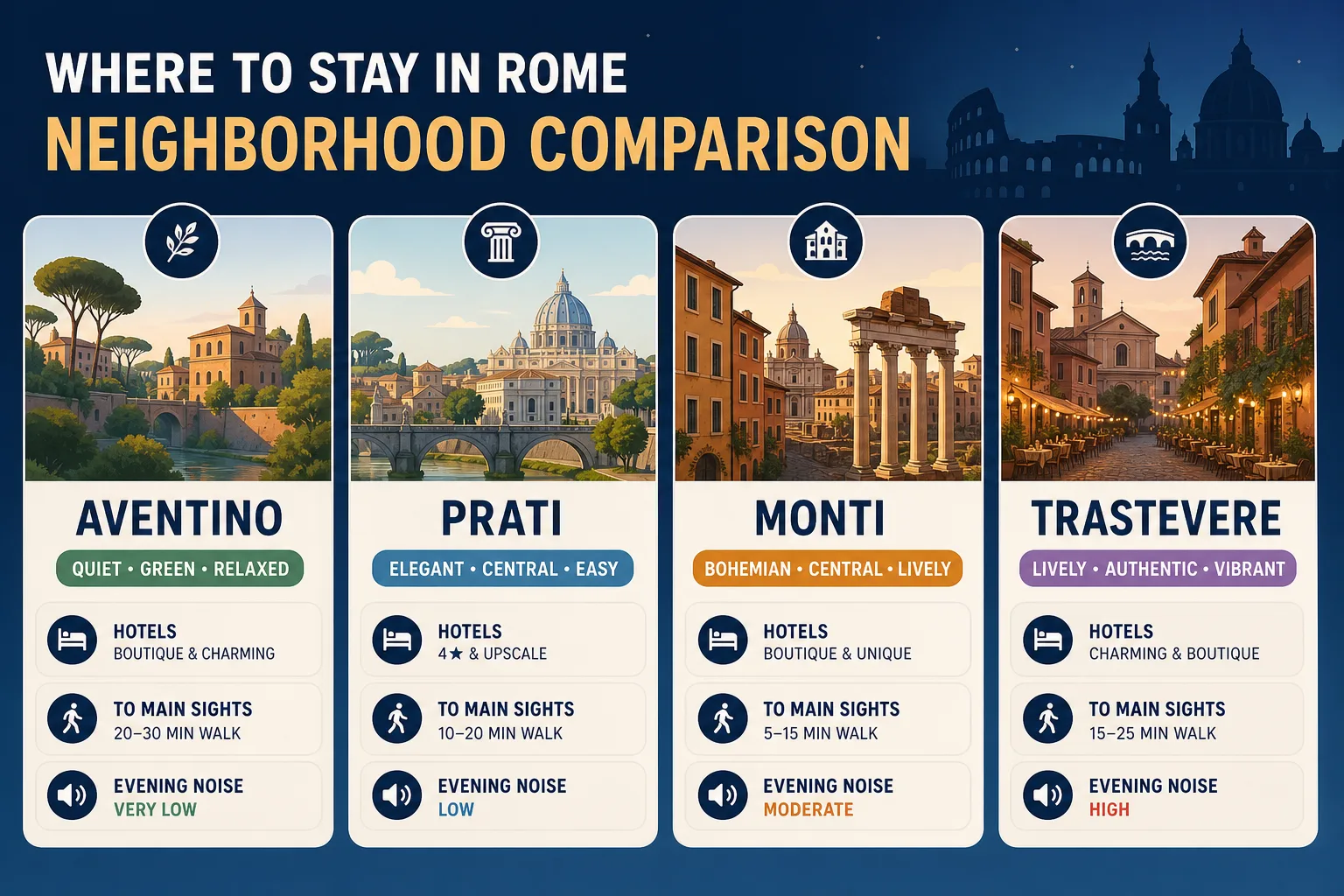 An infographic comparing four Rome neighborhoods across noise levels and local characteristics.
Traveler Type Table
The real decision variable is not "Rome or not Rome." It is which pocket of Rome you sleep in, and how you get back there at night.
| Traveler type | Best fit in Rome | Main friction | Evening pattern that works |
|---|---|---|---|
| Quiet-night travelers | Aventino, upper Prati, Via Capo d'Africa area in Celio | Street noise, scooters, late diners | Dinner near hotel, back by 22:30 |
| Couples wanting calm | Aventino, residential Monti side streets | Overbooked romantic-sounding areas | Slow dinner, short walk, no bar crawl |
| Low-stress planners | Prati near Metro Line A | Underestimating transit cutoffs | Metro back before 23:30 (01:30 Fri/Sat) |
| Slow travelers | Aventino, Celio | Feeling far from "the action" | One sight per day, long lunches |
| Nightlife-first travelers | Trastevere, Campo de Fiori | Not the target of this article | Not applicable |
Note the tourist tax adds up per person per night for the first 10 days: 6.00 Euros for 3-star hotels, B&Bs, and Airbnbs, 7.50 Euros for 4-star, and 10 Euros for 5-star. A quieter, slightly higher-category hotel is usually a small nightly premium, not a category jump.
Best for First-Time Visitors
First-time visitors who also want quiet nights are the most common mismatch case. The instinct is to book near the Colosseum or Piazza Navona so nothing is missed. The result is often a room over a delivery scooter route.
A better approach: pick a residential base within a 20 to 25 minute walk of one anchor sight, and use the metro for the rest. Prati sits about 1.8 km from Vatican City, roughly 21 minutes on foot or 4 minutes on Metro Line A for 2 Euros. Monti is about 1.9 km, or 22 minutes on foot, from the Trevi Fountain. You keep the "I can walk to something famous" feeling without the noise of the main tourist lanes.
First-timers who want quiet nights should also budget for the newer access rules. From February 1, 2026, the area close to the Trevi Fountain requires a 2 Euro fee during peak hours (9 AM to 9 PM), and five previously free city museums begin charging non-residents. The Pantheon already charges non-resident tourists 5 Euros. None of this changes noise levels, but it changes how you sequence a calm day: paid, timed entries early, quiet neighborhood evenings later.
Best for Couples
Couples who want quiet nights are usually chasing a mood, not a checklist. Rome delivers that mood best in Aventino, which is repeatedly noted as one of the quietest and safest residential areas in the city, and along the residential edges of Monti and Celio.
What works:
- A hotel on a side street, courtyard-facing room, upper floor.
- Dinner reservations at 20:00 rather than 21:30, so the walk home is calm.
- One evening ritual (a rooftop terrace, a slow gelato walk near the Aventine orange garden) instead of stacking three.
What quietly ruins the trip:
- Booking on a main Trastevere lane because it "sounds romantic."
- A ground-floor room facing a piazza in the historic center.
- Assuming the hotel description "central and lively" translates well after midnight.
Best for Slow Travelers
Slow travelers do well in Rome precisely because the city rewards short daily radius. Walking from Trastevere to the Colosseum is only about 2.9 to 4.2 km, roughly a 30 to 40 minute walk, which means most itineraries do not need multiple transit legs a day. If you stay in Aventino or Celio, you can spend a full morning at one site, a long lunch, and still be back for a rest before the evening.
For a slow-traveler quiet-night pattern, this rhythm holds up well:
- One anchor sight before 11:00, ideally with a pre-booked entry.
- Long lunch in a residential pocket, not on a main tourist axis.
- Afternoon rest at the hotel.
- Short evening walk in your own neighborhood.
The tradeoff is that you will see fewer marquee sights per day. That is the point.
Best for Low-Stress Travelers
Low-stress travelers should treat Rome's transit windows as a planning constraint, not a detail. The metro runs 5:30 AM to 11:30 PM daily, extended to 1:30 AM on Fridays and Saturdays. Night buses cover roughly 20 lines from 12:30 AM to 5:30 AM at about 30-minute intervals from Piazza dei Cinquecento and Piazza Venezia, but a 30-minute wait at 1 AM is not a calm evening.
A low-stress checklist for quiet nights in Rome:
- Hotel is within a 10-minute walk of a Metro Line A or B station.
- Dinner reservation ends before 22:30 on weekdays.
- Room is not on the ground floor and not facing a main street or piazza.
- You have confirmed which entrance to your neighborhood you use after dark.
- You are avoiding rush-hour transit (7:30 to 9:30 AM and 5:30 to 7:30 PM) for museum days.
- Your hotel category matches your tourist-tax expectation (4 Euros to 10 Euros per person per night for the first 10 days).
This is boring on paper. It is exactly what protects the evenings.
Common Mismatches
The travelers most likely to be disappointed are not the ones who dislike Rome. They are the ones who expected a specific kind of quiet the city does not offer, and the most common mistake is to avoid this decision entirely and book on landmark proximity alone.
Mismatch patterns to watch for:
- Expecting silence, not just calm. Even Aventino has scooters and church bells. It is quiet by Roman standards, not by countryside standards.
- Booking Trastevere for "authentic atmosphere" and being surprised by 1 AM voices in the alley.
- Choosing a cheaper central room over a slightly farther residential room, then paying the difference in sleep.
- Planning three late dinners in a row and expecting to feel rested.
- Assuming a 5-star tag means a quiet room. Location and orientation matter more than category.
If any of these describe your current plan, adjust the hotel before you adjust anything else.
Final Match Recommendation
Rome is a strong fit for quiet-night travelers who:
- Choose Aventino, upper Prati, or the residential edge of Celio as their base.
- Accept a short metro or 20-minute walk to major sights instead of front-row hotel location.
- Plan evenings that end before the metro cutoff, or on Friday and Saturday before 1:30 AM.
- Value a courtyard-facing room over a piazza view.
Rome is a weak fit for quiet-night travelers who:
- Insist on staying in the loudest central lanes and hope for silence.
- Refuse to use the metro and plan multiple late walks home.
- Expect small-town quiet from a capital city.
For that last group, a smaller Italian town, or a countryside stay with Rome as a day trip, is the honest recommendation. For everyone else, Rome quietly delivers.
FAQ
Is central Rome too noisy for light sleepers? Central Rome around Trastevere, Campo de Fiori, and much of the historic center stays lively well past midnight, especially on weekends. Light sleepers who insist on a central address should look at Aventino, upper Prati, or quiet side streets in Celio, and confirm the room faces a courtyard rather than the street.
Which Rome neighborhoods are actually quiet at night? Aventino is consistently described as one of the calmest residential areas in the city. The streets around Via Capo d'Africa in Celio stay quiet even though the Colosseum is close by, and much of Prati is residential once you step off the main shopping streets.
Can I still see major sights if I stay in a quiet neighborhood? Yes. Prati is about 1.8 km (around 21 minutes on foot) to Vatican City, or 4 minutes on Metro Line A for 2 Euros. Monti puts you about 1.9 km (roughly 22 minutes) from the Trevi Fountain. A quiet base does not mean a distant base.
How late does public transport run if I want a calm evening return? Rome's metro runs daily from 5:30 AM to 11:30 PM, extended to 1:30 AM on Fridays and Saturdays. After that, about 20 night bus lines run from 12:30 AM to 5:30 AM with roughly 30-minute departures from Piazza dei Cinquecento and Piazza Venezia. For a low-stress evening, plan to be back on the metro before the cutoff.
Is Rome the wrong choice if I really want silent nights? If your bar is monastic quiet, Rome will feel loud almost anywhere central, because of scooters, late diners, and stone streets that amplify sound. Travelers who need true silence usually do better in a smaller Italian town or a countryside stay, and treat Rome as a day-trip base.