travel-decisions
Is Madrid Too Tiring for Low-Walking Travelers?
A friction-first look at whether Madrid works for low-walking, older, or slow travelers, with concrete tradeoffs on hills, transit, and crowds.
Quick Verdict
Madrid is a strong fit for low-walking travelers who stay on the eastern, flatter side of the center (Prado, Retiro, Sol, Plaza Mayor) and treat the Metro and EMT buses as the default, not walking.
Madrid is a weak fit if you want to base your trip around the Royal Palace, Almudena Cathedral, and La Latina on foot, or if you plan to walk between major sights without using transit. That side of the center has steady inclines and is where most low-stamina travelers burn out by mid-afternoon.
Slow travelers and older travelers can almost always make Madrid work with the right hotel placement. Travelers who also dislike crowds, heat, and any uphill walking should look elsewhere.
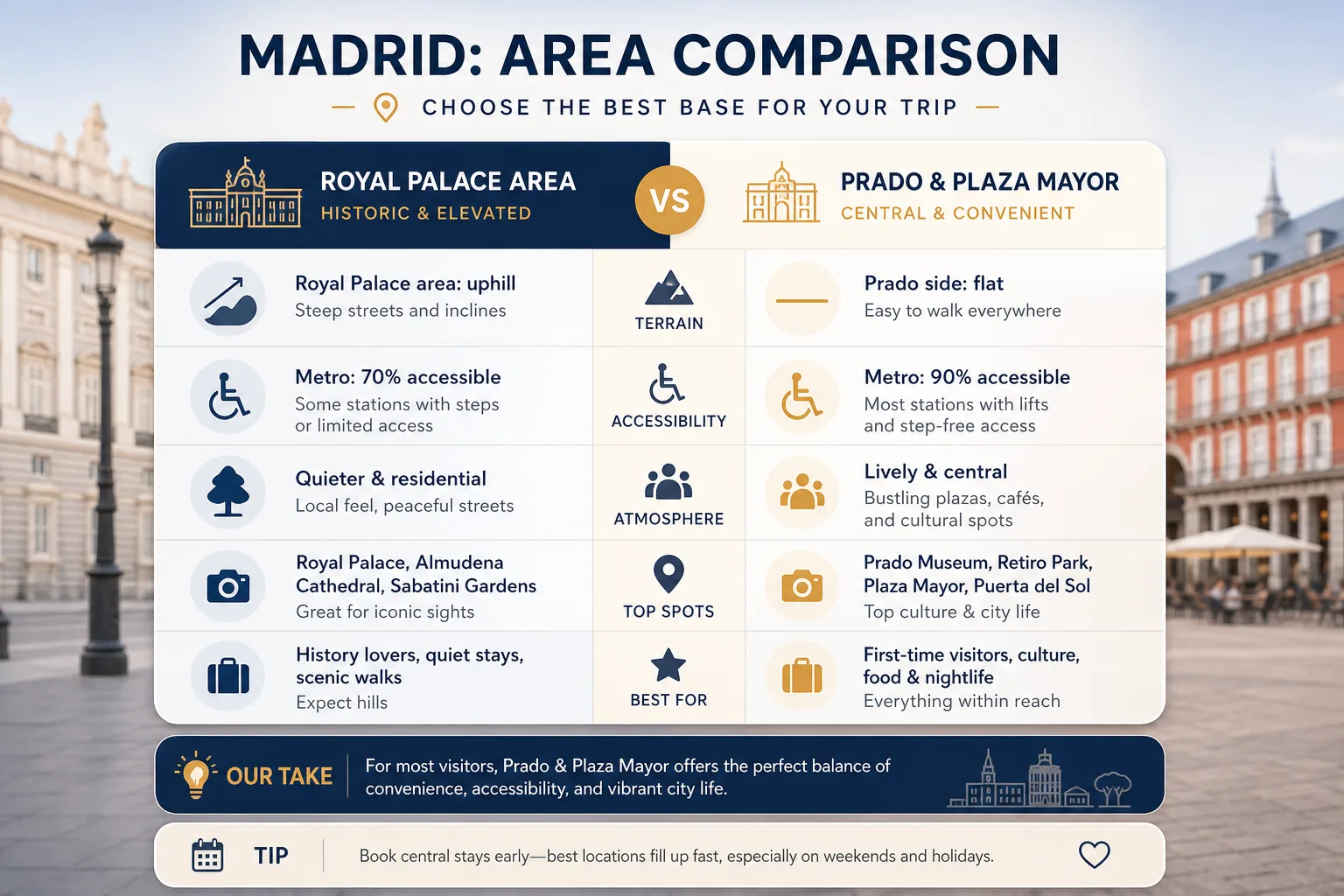 A comparison table infographic contrasting Madrid's Royal Palace and Prado areas on terrain and wheelchair accessibility.
The Real Friction Problem
Madrid is not Rome and it is not Lisbon. It does not have constant cobblestone hills or long stair sequences. But the central tourist zone is split unevenly: the eastern side around Paseo del Prado, the Prado Museum, and El Retiro Park is relatively flat, while the western edge (La Latina, the Royal Palace, Almudena Cathedral) sits on noticeably steep slopes and inclines.
That split is the core friction. Travelers who tire easily can have an easy day on one side of the city center and a brutal day on the other, with the same number of steps on the pedometer.
The other pressure points stack on top of that geography:
- Walking fatigue. The walk from the Royal Palace to the Prado Museum is about 2 kilometers (1.2 miles) and climbs steadily uphill when you go west. Going east toward the Prado is downhill and easier, which catches people off guard on the return leg.
- Stairs and level changes. Around 70% of Madrid's 276 Metro stations are fully accessible, with 571 lifts and over 1,700 escalators. That is good, but it still means roughly 3 in 10 stations involve stairs and may be the closest station to where you want to go.
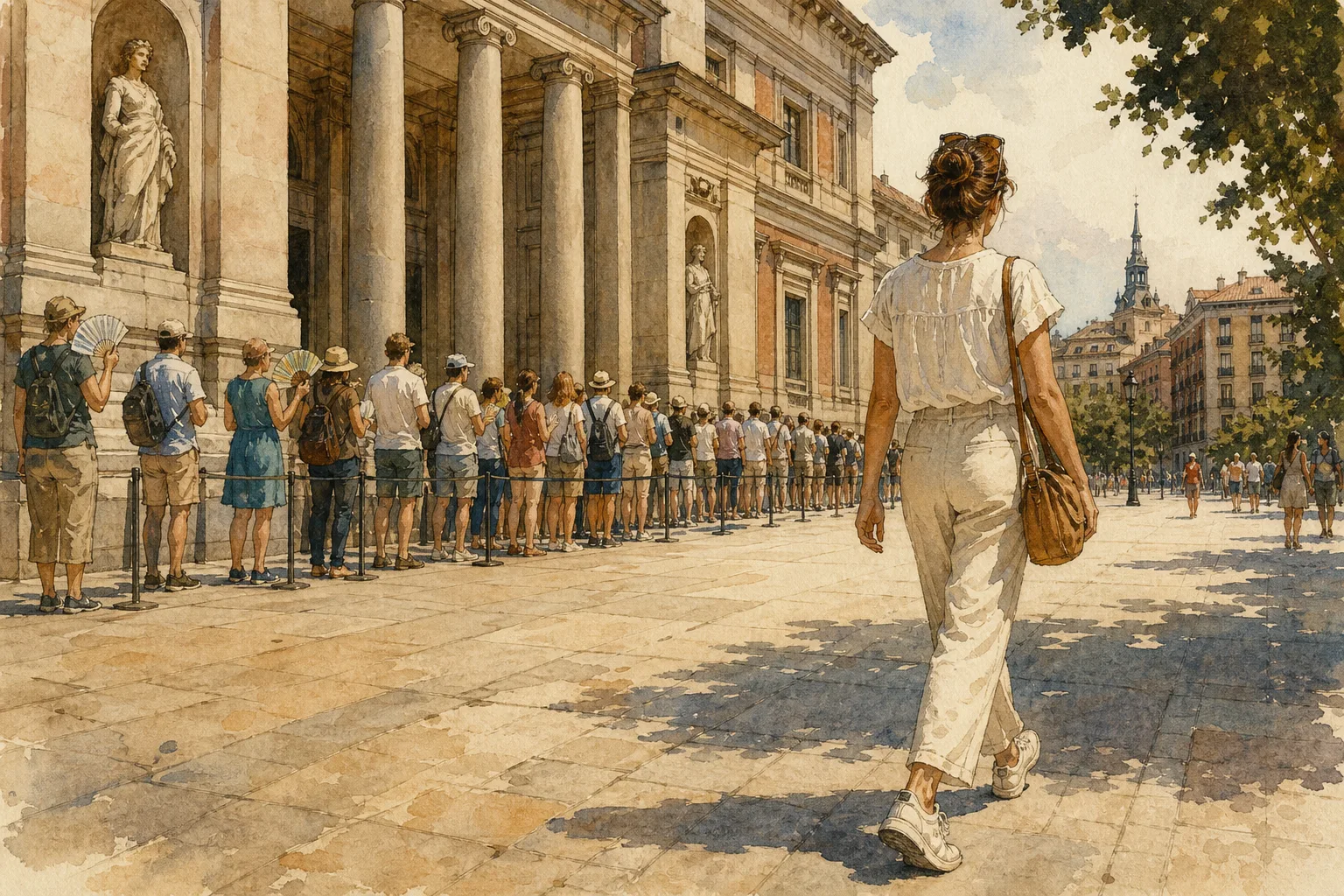
- Crowd pressure. The Prado's free-entry windows (Monday to Saturday 6 to 8 PM, Sunday 5 to 7 PM) routinely produce 60 to 90 minute queues. Standing in those lines is harder on low-stamina travelers than the walk into the museum.
- Transit stress. The Metro is dense and mostly accessible, but transfers can involve long corridors. From July 4, 2026 through late August 2026, Metro Line 10 is closed between Nuevos Ministerios and Plaza de Castilla, with a free EMT shuttle bus running the route. If you are visiting in that window, plan around it.
Friction Table
This is where Madrid actually wins or loses for low-walking travelers. The point is not the absolute distance, it is the slope and the surface.
| Route or activity | Distance / time | Terrain | Friction level for low-walking travelers |
|---|---|---|---|
| Puerta del Sol to Plaza Mayor | ~560 m, ~6 min | Flat, pedestrianized | Very low |
| Plaza Mayor to Royal Palace | 850 to 930 m, 10 to 12 min | Gradual downhill west | Low going out, moderate on return |
| Royal Palace to Prado Museum | ~2 km (1.2 mi) | Steady uphill if walking west, downhill east | High one way, moderate the other |
| Paseo del Prado / Retiro area | Variable | Flat, wide pavements | Very low |
| La Latina / Almudena Cathedral area | Variable | Steep slopes, inclines | High |
| Metro transfer at a non-accessible station | 5 to 10 min | Stairs, corridors | High |
| EMT city bus | Door-to-door | 100% low-floor, ramps | Very low |
| Prado free-entry queue | 60 to 90+ min standing | Outdoor, often hot | High |
| Prado paid weekday 2 to 4 PM | ~0 min queue | Indoor, climate controlled | Low |
The pattern is clear: stay east, use buses by default, and pay the 15 euro Prado ticket instead of standing in the free-entry line.
Who Will Feel It Most
Not every low-walking traveler will struggle with Madrid in the same way. The friction lands hardest on:
- Travelers who refuse to use transit. If you plan to walk everywhere because the map "looks small," the Royal Palace side will end your trip early.
- Travelers who want every major landmark. The Royal Palace, Almudena Cathedral, and the Templo de Debod sit on the sloped western edge. Doing all of them on foot in one day is a real strain.
- Summer visitors with joint pain. Madrid summers are hot and dry, and standing in a 90-minute outdoor queue at the Prado is harder than the walk to get there.
- Travelers staying outside the center to save money. The savings often disappear into Metro transfers with stairs, longer bus rides, and earlier exhaustion.
Slow travelers who are willing to do half-day plans, and older travelers who already pace themselves, generally do fine. The people who struggle are the ones treating Madrid like a 3-day landmark sprint.
How to Reduce the Friction
You do not need to give up sights. You need to change the order and the mode.
- Anchor your hotel on the east side. Around Sol, Gran Via, or near Paseo del Prado puts the flat zone, Retiro, and the major museums within short, level walks. Central 3-star hotels typically run $58 to $110 per night and 4-star hotels $103 to $181, and Madrid does not charge any tourist tax on overnight stays, so a better location rarely doubles your bill.
- Walk west, ride back. If you want to see the Royal Palace, start the day there fresh and take a bus or Metro back east. Do not try to walk back uphill in the afternoon.
- Default to the bus, not the Metro. EMT buses are 100% low-floor with retractable ramps, no stairs, no corridors. They are slower but kinder on tired legs.
- Skip the Prado free hours. Pay the 15 euro general admission and go on a weekday between 2 and 4 PM, which is the quietest window.
- Use the wider pavements. Madrid's accessibility plan (PEAUM 2022 to 2026) is upgrading pavements to a minimum of 1.80 meters wide with ramp gradients of 6% or less. Stick to upgraded main avenues over narrow side streets when possible.
- Check Line 10 dates. If your trip falls between July 4 and late August 2026, plan to use the free EMT shuttle between Nuevos Ministerios and Plaza de Castilla instead of the Metro.
Better Alternatives If Madrid Is the Wrong Fit
If, after reading the friction table, Madrid still sounds like too much, these are honest alternatives rather than upsells:
- Seville. Smaller historic center, more concentrated sights, easier to do in slow half-days. Heat is a bigger problem in summer, though.
- Valencia. Flatter overall, beach access, easier pacing, and the old town is compact.
- Lisbon, only with caveats. Often suggested as a Madrid alternative but is actually worse for low-walking travelers due to constant steep hills and cobblestones. Choose it only if you commit to using the trams and funiculars.
- A Madrid base trip with no day trips. If you love the idea of Madrid but worry about stamina, drop Toledo and Segovia from the plan. A 4-day Madrid-only trip on the east side is far easier than a 4-day trip with two day-trip transfers.
Decision Checklist
Run through this before you book. If you check three or more "no" answers, reconsider Madrid or restructure the trip.
- Can your hotel sit on the east side of the center (Sol, Gran Via, Prado area)?
- Are you willing to use EMT buses as your default transit?
- Can you accept paying 15 euros at the Prado instead of standing in the free-entry queue?
- Are you visiting outside the Line 10 closure window (July 4 to late August 2026), or have you mapped the shuttle?
- Are you okay skipping or busing to the Royal Palace and La Latina instead of walking there round trip?
- Can you cap walking at roughly 30 to 40 minutes at a stretch with sit-down breaks?
- Are you visiting outside peak afternoon heat for outdoor walking?
- Have you removed Toledo or Segovia day trips if your stamina is borderline?
FAQ
Is Madrid walkable for someone who tires after 30 to 40 minutes? Yes on the east side. The Paseo del Prado, Retiro, and the Sol to Plaza Mayor stretch (about 560 meters, 6 minutes, flat and pedestrianized) are easy. The Royal Palace and La Latina side involves steady uphill grades and is where most low-walking travelers run out of energy.
Can low-walking travelers rely on the Madrid Metro? Mostly. About 70% of the 276 Metro stations are fully accessible, with 571 lifts and over 1,700 escalators. The remaining 30% still require stairs, so check your specific station before you go, and consider the bus if your nearest station is not accessible.
Is the bus easier than the Metro for tired legs? Often yes. The entire EMT city bus fleet is 100% low-floor with retractable, wheelchair-accessible ramps. No stairs, no long corridors. The tradeoff is slower travel and more exposure to summer heat at the stops.
How crowded is the Prado, and does it tire people out? The free-entry windows (Monday to Saturday 6 to 8 PM and Sunday 5 to 7 PM) commonly produce queues of 60 to 90 minutes or more. For low-stamina travelers, paying the 15 euro general admission and visiting on a weekday between 2