travel-decisions
Should You Skip Madrid in Peak Season If You Hate Crowds?
Madrid in July and August means 40C heat, 3-hour ticket lines, and shuttered local restaurants. Here is how to decide whether to go, postpone, or reroute entirely.
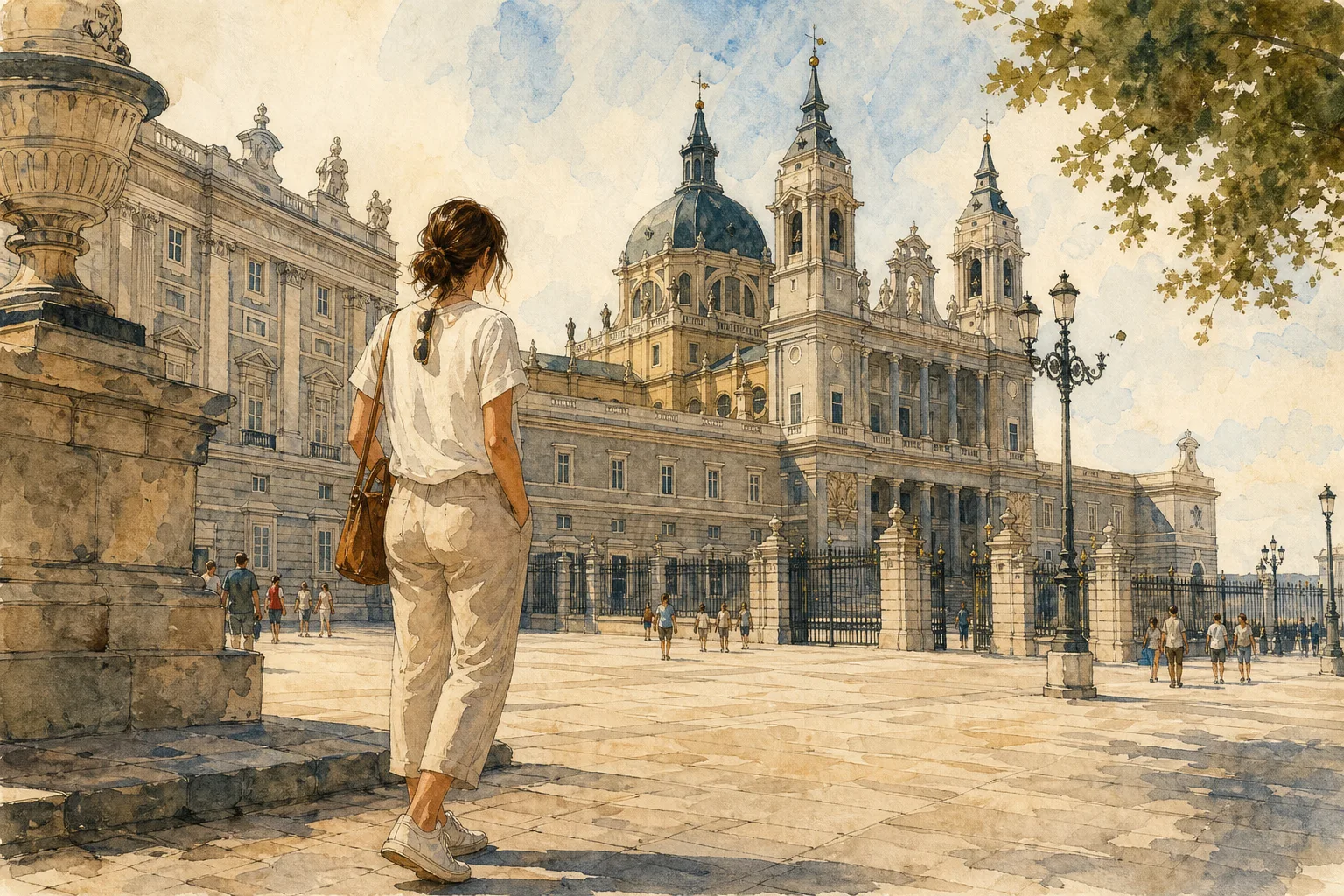
Madrid is one of Europe's most compelling cities. It is also one of the most physically punishing destinations you can choose if you are sensitive to crowds, heat, and queues -- and if you visit in July or August without a plan.
This article is not about whether Madrid is good. It is. The question is whether it is good for your specific situation, in peak season, given how you actually travel.
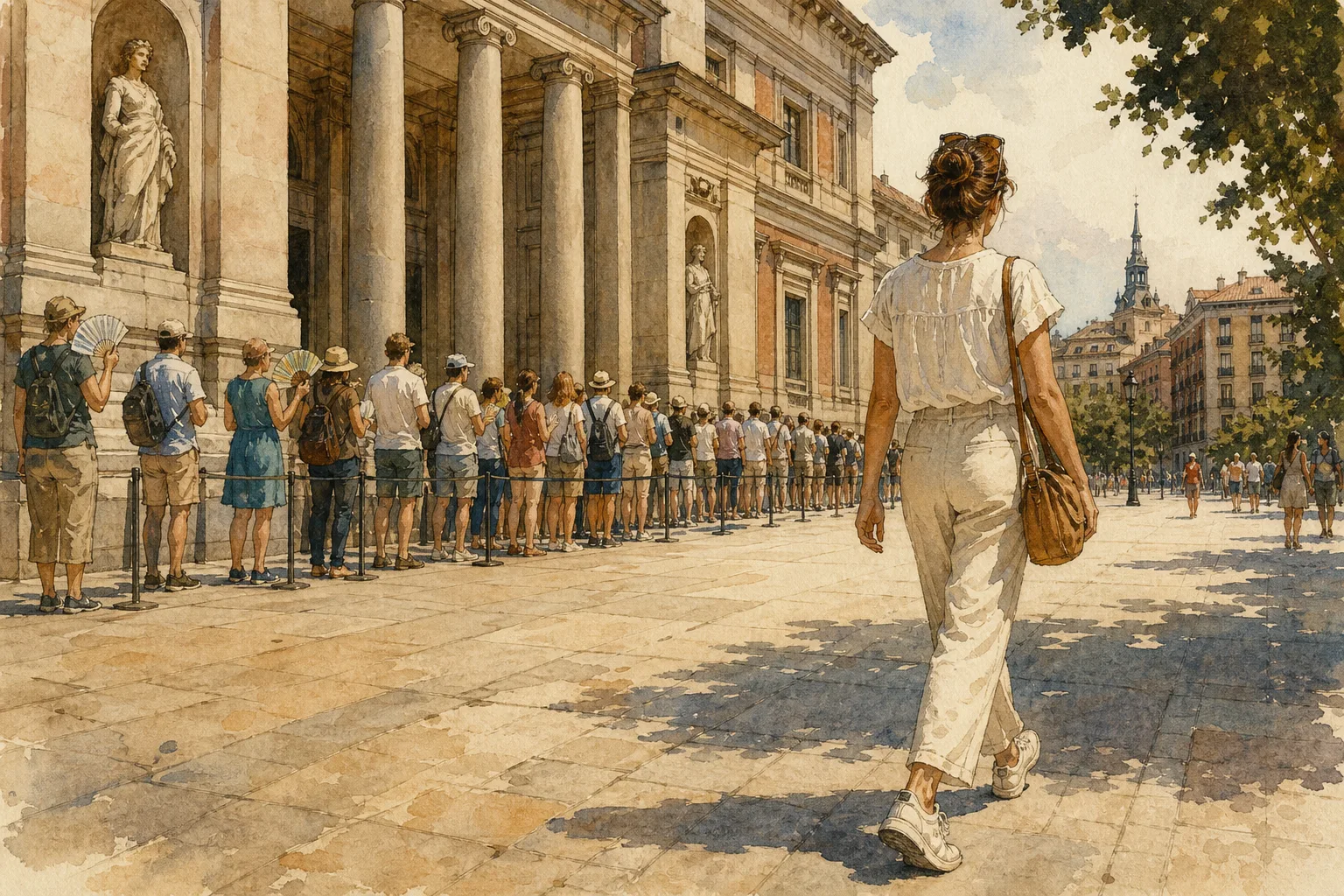
The tradeoffs here are concrete and measurable. Daily temperatures regularly climb past 40C. The Royal Palace ticket line can consume three hours. Free-entry queues at the Prado form before the museum even opens. And in August, many of the local restaurants and shops that give Madrid its character are simply closed.
None of that has to ruin a trip. But it will, if you arrive expecting low-friction sightseeing.
Quick Verdict
Skip peak season if: You dislike heat, have limited stamina, find long queues genuinely frustrating, or are hoping for an authentic local atmosphere. July and August stack all of those friction points simultaneously.
Stay in peak season if: Your travel dates are fixed, you are willing to pre-book every timed-entry ticket well in advance, and you can restructure your day around heat (early morning outdoors, midday in museums, late evening in plazas). Madrid at night in summer is genuinely alive, and some travelers find that alone worth the friction.
The cleaner choice for most crowd-sensitive travelers: Visit in spring (March to May) or early autumn (mid-September to November), when temperatures average 18C to 22C and the city runs at a more livable pace.
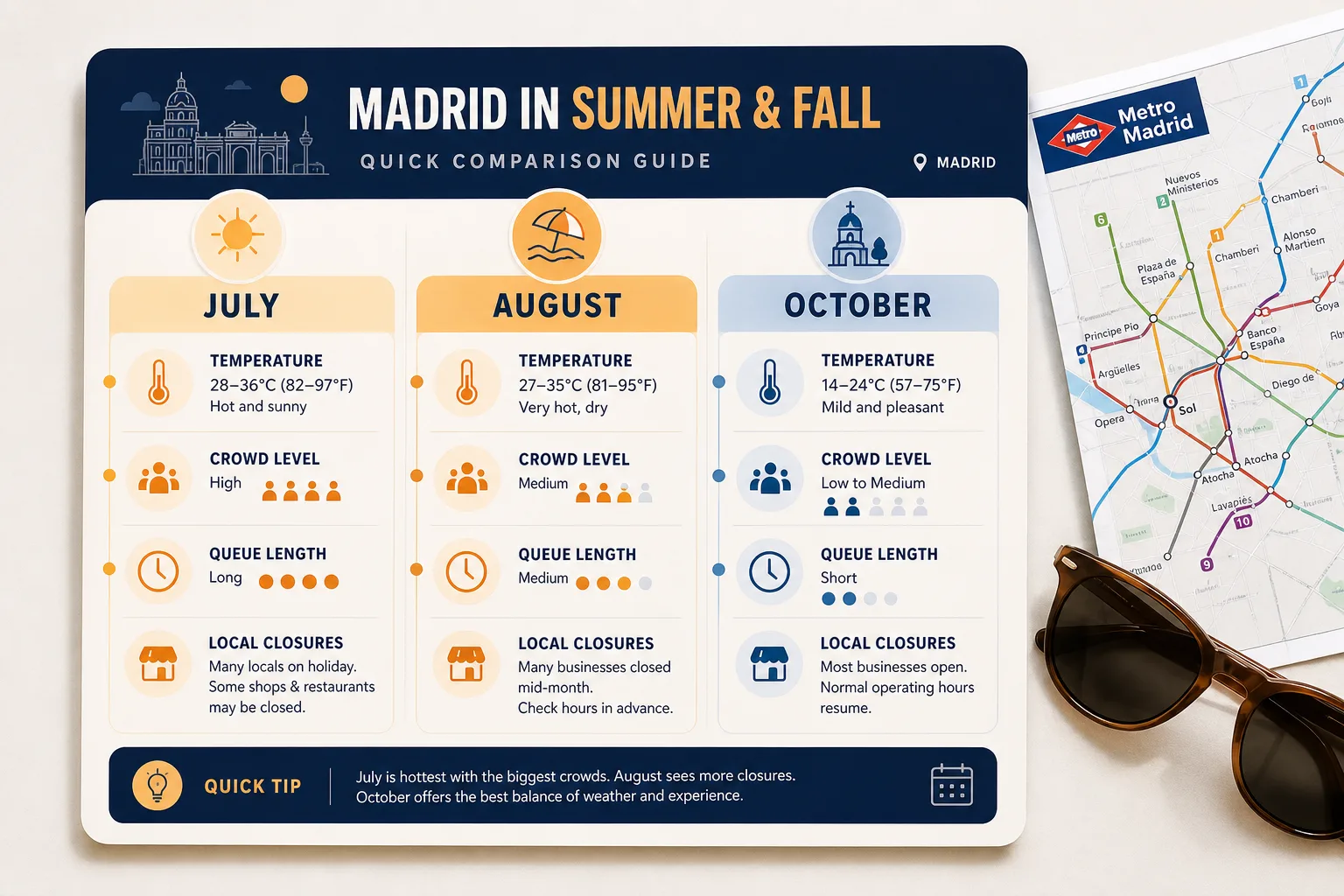 The tradeoffs are not subtle. Peak season stacks multiple friction points at once.
Who Will Probably Love Peak-Season Madrid
Not every traveler will suffer in summer. A specific type of visitor actually does well here.
- Night-culture travelers. Madrid's evening scene is real and extensive. Tapas bars fill after 9 PM, terraces open late, and the energy in neighborhoods like Malasana and La Latina is concentrated in the cooler hours. If you are oriented toward evening meals and late-night culture rather than daytime sightseeing marathons, summer plays to the city's strengths.
- Museum-focused visitors who book ahead. If you purchase timed-entry tickets for the Prado, the Reina Sofia, and the Royal Palace before you arrive, you sidestep most of the queue friction. Museums become your midday refuge from the heat. This approach works, but it requires planning.
- Travelers with fixed summer schedules who adjust expectations. If July or August is what you have, and you enter knowing the conditions, Madrid rewards structured preparation. The city does not close; it shifts.
- Solo travelers who travel light and move fast. Less coordination overhead means it is easier to shift timing, duck into air-conditioned spaces on demand, and navigate around friction in real time.
Who Might Regret It
The regret pattern is consistent. Travelers who show up to peak-season Madrid with a relaxed, exploratory mindset and no advance bookings tend to hit the same wall.
You are at higher regret risk if:
- You plan to see the Royal Palace, the Prado, and Templo de Debod as a cluster without pre-booked tickets. The Royal Palace alone can take three hours in an on-site queue. Templo de Debod allows only 10 people inside at a time, producing waits of one to three hours with no booking option.
- You are traveling with older family members, young children, or anyone with limited walking stamina. The walk from the Royal Palace to the Prado covers roughly 1.2 miles (2 km) and takes 25 to 30 minutes on foot -- exposed, in high summer heat.
- You were counting on small local restaurants and neighborhood shops for the authentic Madrid experience. In August, many of them are simply closed.
- You are sensitive to heat in a medical or physical sense. Temperatures frequently exceed 40C in July and August. That is not weather to push through on a long sightseeing day.
- You are depending on Metro Line 10 between Nuevos Ministerios and Plaza de Castilla. From July 4 through late August 2026, that segment is suspended, with a shuttle bus replacement adding transfer complexity.
Mistake and Consequence Table
The decisions that tend to generate regret are predictable. Most come down to timing and booking status.
| Mistake | What Actually Happens | Severity |
|---|---|---|
| Arriving at the Royal Palace without a ticket | On-site queue of up to 3 hours, often in direct sun | High |
| Visiting Templo de Debod without checking wait times | 1 to 3 hour wait for a 10-person capacity site, no booking option | High |
| Relying on free Prado entry hours | Queue forms 45 to 90 minutes before doors open; you wait outside longer than the money-saving gap is worth | Medium-High |
| Planning full outdoor sightseeing days in July/August | Heat peaks above 40C; fatigue compounds across multiple sites | High |
| Expecting local neighborhood life in August | Many local shops and family restaurants are closed; tourist-facing businesses stay open | Medium |
| Booking Metro Line 10 itineraries in summer 2026 | Line suspended Nuevos Ministerios to Plaza de Castilla July 4 to late August; adds shuttle transfer time | Medium |
| Walking between major sites without heat planning | Royal Palace to Prado is 25 to 30 minutes on foot; manageable in spring, genuinely taxing in 38C heat | Medium |
| Assuming weekday crowds are lighter | Prado weekday waits without pre-booking average 25 to 40 minutes; weekends reach 60 minutes | Medium |
Hidden Friction Points
Some of peak-season Madrid's friction is obvious from the numbers. Some is not.
The compounding heat problem. The numbers -- 31C to 33C average highs, spikes past 40C -- look manageable on paper. In practice, heat compounds across a day in ways that itinerary planning rarely accounts for. A morning museum visit, a 25-minute walk to the next site, a queue in the sun, lunch in an un-air-conditioned restaurant, and an afternoon plaza wander can produce a level of fatigue that shuts down an afternoon entirely. Crowd-sensitive travelers tend to also be fatigue-sensitive. Peak-season Madrid tests both at once.
The Templo de Debod ceiling. This site has no ticketing system that bypasses the in-person wait. The 10-person capacity cap is fixed. At peak times the wait runs one to three hours. Most travel planning accounts for busy attractions but assumes a ticketing workaround exists. For Templo de Debod, it does not.
The August local-closure blind spot. Visitors often read that Madrid is "open year-round" and do not register that "open" applies to major tourist infrastructure, not to the local food and shopping scene they actually wanted. The restaurants that show up in neighborhood guides -- the ones locals eat at -- are disproportionately the ones that close in August. What remains open is weighted toward tourist-facing establishments.
The free Prado hours trap. Free entry sounds like a win. In practice, queues form 45 to 90 minutes before the evening free window opens. The time cost of waiting in line outside often exceeds the cost of a standard admission ticket (EUR 15) for a pre-booked timed entry, which you can walk straight into.
Transit disruption in summer 2026. Metro Line 10 suspension between Nuevos Ministerios and Plaza de Castilla runs July 4 through late August 2026. The free shuttle bus replacement adds a transfer and slows a corridor that connects the north of the city to the center. Itineraries built around that line need to be rebuilt.
How to Make It Easier
If peak season is your window, these moves reduce friction in a measurable way.
Book timed-entry tickets before you land. The Prado (EUR 15 standard admission), the Royal Palace (EUR 18 standard), and the Reina Sofia all offer advance timed-entry. This is not optional for low-stress travel in peak season -- it is the difference between an hour wasted in a queue and walking straight in.
Restructure your day around temperature, not geography. The standard advice is to cluster sightseeing by neighborhood to reduce walking. In peak summer, that logic is secondary. Prioritize outdoor sites and walking between sites before 10 AM and after 7 PM. Use air-conditioned museums as your midday anchor, not as a morning warm-up.
Accept Templo de Debod on its own terms. If seeing it is important, arrive at opening time and treat the wait as the activity, not the obstacle. Do not stack it with adjacent queue-heavy sites on the same morning.
Skip the free Prado window and buy a timed ticket. The math does not favor waiting 45 to 90 minutes in summer heat to save EUR 15. Pay for a morning timed entry, arrive cool, and use the evening for a plaza or tapas crawl instead.
Use Plaza Mayor to Royal Palace proximity strategically. This 600-meter walk (5 to 10 minutes) is short enough to do in peak heat, unlike the longer Prado-to-Royal Palace corridor. Cluster these two sites in a single morning session before midday.
Check Line 10 status before finalizing any itinerary. If your hotel or planned route depends on the Nuevos Ministerios to Plaza de Castilla segment, budget extra transfer time or reroute via alternative lines.
Build in a rest hour daily. Fatigue is the compounding factor. A quiet midday stop -- hotel, a shaded terrace, an air-conditioned cafe -- extends what the rest of the day can realistically hold. Travelers who try to push through peak-summer Madrid on a full-day schedule tend to drop activities from the afternoon list anyway.
Better Alternatives
For travelers who have flexibility in their schedule, the case for shifting timing is strong.
Madrid in spring (March to May): Daily highs of 18C to 22C, manageable crowds, fully operational local businesses, and the same cultural infrastructure. This is the clearest upgrade for crowd-sensitive travelers. The Prado, Royal Palace, and Retiro Park all deliver at a significantly lower friction cost.
Madrid in early autumn (mid-September to November): Same temperature range as spring, and the city has recovered from August closures. Local restaurant scenes are back. This window is often described by repeat visitors as the most livable time to be in the city.
Bilbao or San Sebastian in summer: Both cities sit in the Basque Country in northern Spain, where summer temperatures are considerably milder. San Sebastian in particular runs a tight old town that is walkable, has strong food culture, and does not produce the same heat and crowd density as central Madrid in July.
Seville or Granada in spring instead of summer: These Andalusian cities are far hotter than Madrid in summer. But visiting them in March or April and saving Madrid for the autumn lets you structure an Iberia trip around each city's better season, rather than forcing both into a peak-summer window.
Portugal (Lisbon or Porto) in summer: Both cities handle summer crowds differently from Madrid. Porto in particular runs cooler due to Atlantic influence. Neither replaces Madrid, but for travelers on a first Iberia trip whose primary driver is low-stress city exploration, they offer a lower-friction entry point.
Before You Book: Self-Checklist
Run through this before committing to peak-season Madrid.
- My travel dates are fixed to July or August and I cannot shift them
- I am willing to pre-book timed-entry tickets for every major site before I arrive
- I have confirmed that Metro Line 10 closures (summer 2026) do not affect my planned routes
- I can restructure my daily schedule around heat: outdoors before 10 AM and after 7 PM
- I understand that Templo de Debod has a 10-person capacity cap with no booking option, and waits of 1 to 3 hours
- I am not depending on local neighborhood restaurants and shops, many of which close in August
- I or my travel companions can handle 25 to 30 minutes of walking in high heat between sites if needed
- I have budgeted for paid timed-entry tickets and will not rely on the free Prado evening window
- I have realistic stamina expectations and have built a rest period into each afternoon
- If I answered "no" to three or more of the above, I have considered whether spring or early autumn is a viable alternative
If most of your checkboxes are ticked, peak-season Madrid is workable. If several are not, the spring or autumn window will give you the same city with significantly less friction.
FAQ
What is the worst month to visit Madrid if you hate crowds and heat?
July and August are the hardest months for crowd-sensitive travelers. Daily highs regularly reach 31C to 33C and can spike past 40C. Major tourist sites run at full capacity, free-entry queues at the Prado form 45 to 90 minutes before the doors open, and Royal Palace ticket lines can stretch to three hours without advance booking.
Is Madrid actually empty in August because locals leave?
Partially. Many local shops and family-run restaurants do close in August as residents holiday elsewhere. But major museums, the Royal Palace, and popular tourist corridors remain open and busy with international visitors. You lose local atmosphere and gain concentrated tourist crowds in the same spots.
Can you do Madrid in peak season without long queues?
Yes, but only with deliberate booking. Pre-purchase timed-entry tickets for the Prado (EUR 15) and the Royal Palace (EUR 18) well in advance. Templo de Debod limits entry to 10 people at a time with waits of 1 to 3 hours -- there is no booking workaround for that site. Plan to visit outdoor landmarks early in the morning before heat peaks, and use museums as midday refuge.
Does the Madrid Metro run normally in summer 2026?
Not entirely. From July 4 through late August 2026, Metro Line 10 is suspended between Nuevos Ministerios and Plaza de Castilla. A free EMT shuttle bus replacement operates on that segment, but it adds transfer time and complexity. Check current line status before planning itineraries that depend on Line 10.
What is the best season to visit Madrid for low-stress travel?
Spring (March to May) and early autumn (mid-September to November) offer daily highs of 18C to 22C, manageable crowds, and fully operational local businesses. These windows are the clearest fit for travelers who are sensitive to heat, queues, and fatigue.
Is skipping Madrid in peak season the right call if I only have one chance to visit?
If your trip is non-negotiable in July or August, Madrid is still worth it with early bookings and adjusted expectations. If you have any scheduling flexibility, even a shift to late September cuts heat and crowds meaningfully. The regret risk is highest for travelers who show up unbooked, mid-July, expecting a relaxed cultural experience.