travel-decisions
Is Madrid a Bad Fit for Travelers Who Want to Sleep Early and Eat Dinner at 7pm?
Madrid's dinner clock starts at 9pm and nightlife peaks at 3am. Here is an honest fit verdict for early sleepers, jet-lagged arrivals, and families who eat at 7.
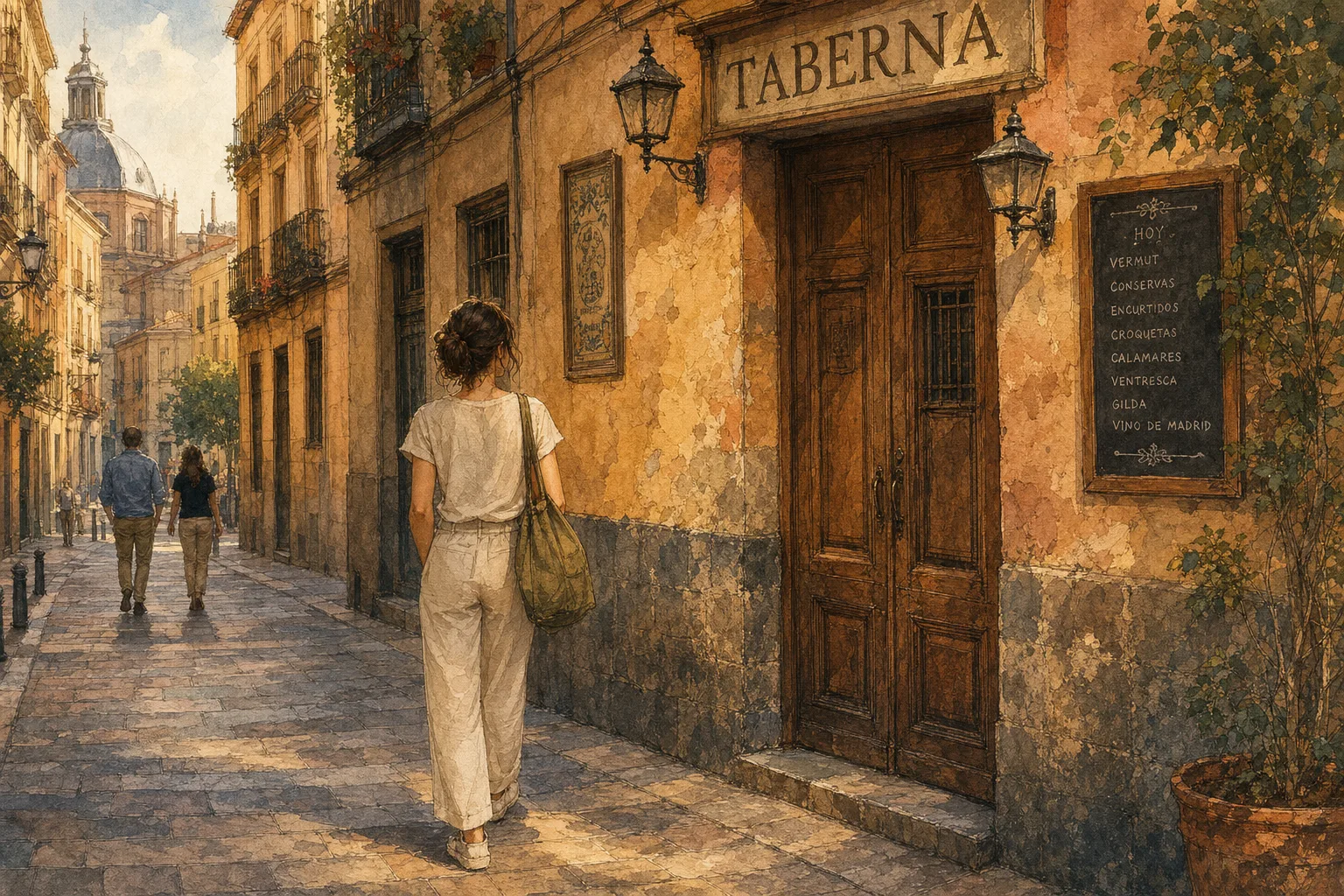
You land in Madrid hungry at 6pm, drop your bags, and walk out for dinner. Half the kitchens you pass are dark. The chalkboard menus say service starts at 8:30 or 9. The waiter at the one open place shrugs and points to the tapas counter. By the time real dinner finally arrives, you wanted to be asleep an hour ago.
That is the Madrid schedule gap in one paragraph. The honest verdict is not "Madrid is bad for you." It is more specific: Madrid is a strong fit if you are willing to shift one habit (lunch becomes the big meal) and pick the right neighborhood. Madrid is a weak fit if you insist on a 7pm sit-down dinner in a lively central area and an 11pm lights-out without earplugs.
Quick Verdict
Madrid is workable, not ideal, for travelers who want to eat at 7pm and sleep early. The city's rhythm runs four hours later than yours. You can make it fit with three moves: eat your main meal at lunch, choose Retiro, Salamanca, or an outlying residential neighborhood instead of Malasana or Huertas, and accept that 7pm dinner means tapas bars, tourist-facing restaurants, or a short list of all-day classics.
Choose Madrid if you care about museums (Prado, Reina Sofia, Thyssen), Spanish food culture, day trips to Toledo and Segovia, and you can flex your eating schedule. Skip Madrid if your trip is built around evening atmosphere at your normal hours, you need an authentic dinner at 7, and you cannot tolerate any street noise after 11pm.
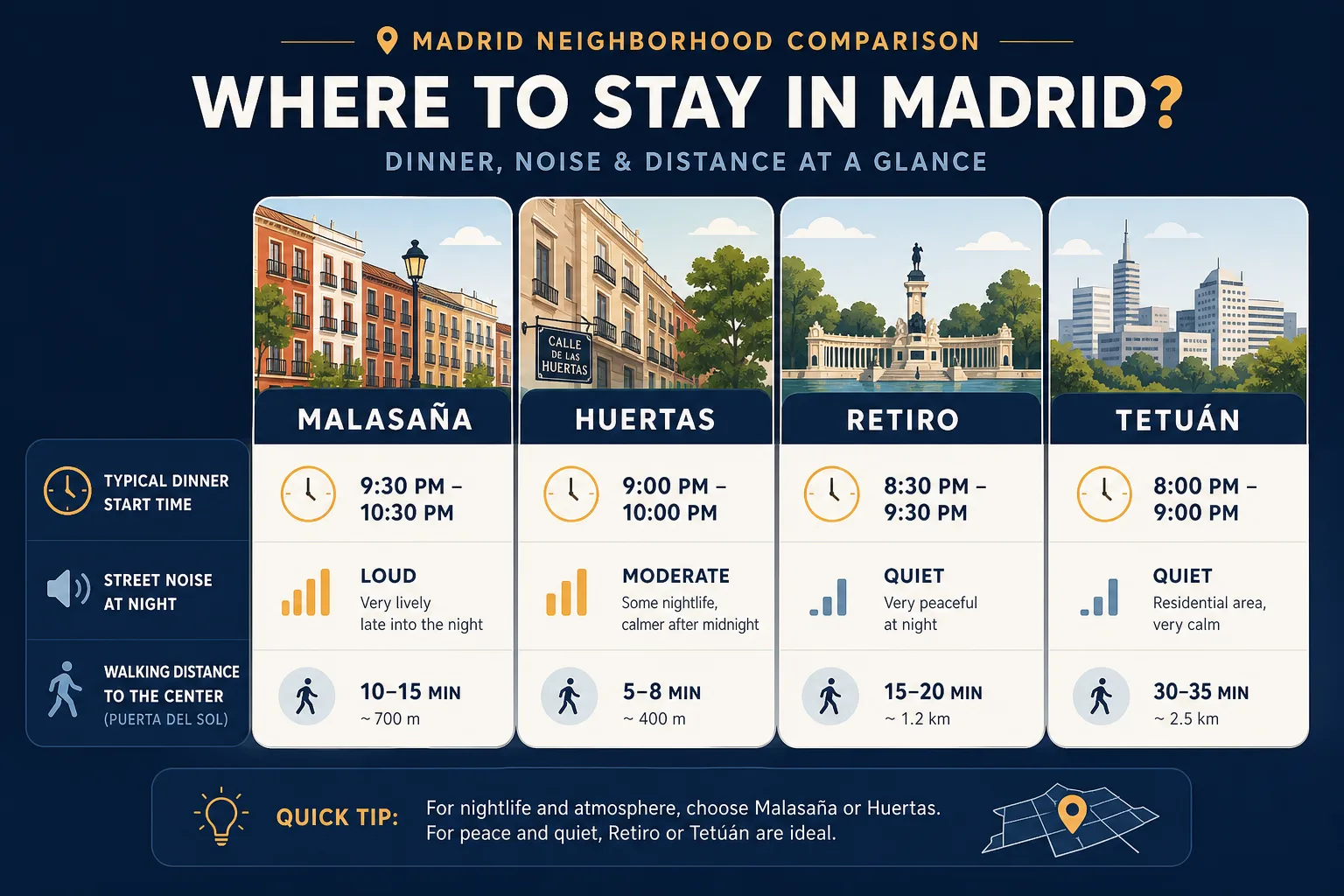 An infographic comparing dinner times, noise, and central distance across four Madrid neighborhoods.
Who Will Probably Love Madrid Anyway
Some early-sleepers thrive in Madrid because the city's daytime is genuinely excellent and the workaround (lunch as the main meal) is actually pleasant.
You will probably love it if:
- You enjoy long, slow lunches and can treat 2pm to 4pm as your main meal.
- You are coming from the Americas and your jet lag has you up at 6am, which lines up perfectly with Madrid mornings at the Prado and museums.
- You like tapas culture, which solves the 7pm problem because most tapas bars serve all afternoon.
- You are happy to swap "evening out" for "evening in" with a balcony, a glass of wine, and a 9:30pm bedtime.
- You are picking a residential or upscale residential neighborhood (Retiro, Salamanca, Chamberi) where the street quiets down by 10pm.
Who Might Regret It
The regret pattern is consistent and predictable. It almost always traces back to one of three mismatches.
You may regret Madrid if:
- You booked a "central" hotel in Malasana, Huertas, Sol, or Chueca expecting charm, and got nightlife noise instead. Malasana street noise can stay above 70 decibels for five hours nightly with peaks reaching 93 decibels. Huertas and Chueca peak between 1am and 4am.
- You are traveling with young kids on a strict 7pm dinner, 8pm bath, 8:30pm bed schedule, and you assumed restaurants would accommodate that hour the way they do at home.
- You are a light sleeper without earplugs, white noise, or a willingness to use them.
- You expected "Spanish dinner" to mean a 7pm tasting menu the way it would in Lisbon or Rome. Madrid runs later than both. Dinner typically happens 9pm to 10pm, with service starting 8:30pm to 11pm.
- You only have two nights and no flexibility to shift your body clock or your meal structure.
The specific disappointment is rarely the city itself. It is the gap between "I am ready for dinner" and "the city is ready to feed me," repeated three nights in a row.
Where the Fit Comes From: Mistake and Consequence
Most of the early-sleeper regret in Madrid is decided by two choices: neighborhood and meal structure. This table makes the tradeoff concrete.
| Decision | Wrong Move | What Actually Happens | Better Move |
|---|---|---|---|
| Neighborhood | Book Malasana or Huertas for "central vibe" | 70 to 93 decibel street noise for hours after midnight, broken sleep all trip | Book Retiro (around $247/night average), Salamanca, or Chamberi |
| Budget vs quiet | Pick the cheapest center hotel | Cheap rate, expensive earplugs, jet-lag spiral | Pick Tetuan or Usera, 30-minute commute, much lower price |
| Dinner timing | Insist on 7pm sit-down dinner downtown | Tourist-only menus or closed kitchens, every night | Eat lunch big at 2 to 4pm, light tapas at 7 to 8pm |
| Restaurant choice | Walk in blind at 7pm | Locked door, "we open at 9" sign | Pre-list all-day spots: Casa Mingo (noon to 11pm), Taberna Antonio Sanchez (opens 7pm), hotel rooftops |
| Transit assumption | "I need to be next to a metro for late nights" | You will not be out late; you paid a premium for nothing | Stay one or two stops out; metro runs until 1:30am anyway |
| Kid bedtime | Plan dinner out, then bath, then bed | Overstimulated kids, late dinners, meltdowns | Picnic dinner in the apartment, park time at Retiro before sunset |
Hidden Friction Points Most Guides Skip
The friction is not just "restaurants open late." Three less-obvious frictions stack up and produce more regret than the dinner hour itself.
Expectation mismatch. Travelers often pre-load Madrid as "like Rome but Spanish." Rome's dinner culture starts around 7:30pm. Madrid's does not. The first night feels like a misfire, the second night feels like a pattern, and by the third night you stop trusting your guide.
Fatigue stacking. If you sleep poorly because of street noise, you wake up under-rested, then walk a Madrid-sized day (museums plus old town plus Retiro park), then face a 9pm dinner. The fatigue compounds across days. It is rarely one bad night; it is four bad nights in a row.
Decision fatigue at 7pm. When the obvious "let us just walk to a restaurant" plan fails, you end up standing on a corner Googling "open now near me," scrolling, vetoing each other, and walking another ten minutes to a place that turns out to be a tourist trap. This is the moment most early sleepers decide they "do not like Madrid." They actually do not like deciding dinner three times.
How to Make a 7pm Dinner Work in Madrid
The fix is structural, not heroic. Decide these five things before you arrive and the schedule problem mostly disappears.
- Flip your meals. Eat lunch as the main meal, 2pm to 4pm, the way Spaniards do. By 7pm you only need something light.
- Pre-list your 7pm options. Confirm hours and walking distance before you leave the hotel. Tapas bars, all-day classics, and hotel restaurants are the reliable buckets.
- Book a quiet neighborhood. Retiro, Salamanca, Chamberi, or further out in Tetuan or Usera. Tetuan and Usera are within a 30-minute commute to the center and significantly cheaper.
- Pack earplugs and a white noise app. Cheap, light, fixes 80 percent of remaining sleep problems.
- Time your arrival day. Land in the morning if you can, treat the first night as a "tapas and crash" night, and start the real schedule on day two.
Bring two backup tactics for kids and very early sleepers: stock the apartment or hotel room with bread, cheese, fruit, and yogurt for a 6:30pm light dinner, and use the metro (runs 6am to 1:30am) to get back from any outing well before bedtime.
Better Alternatives if Madrid Still Sounds Wrong
If after all that, the schedule still sounds like a fight, the right answer may be a different city, not a harder workaround. The wrong-fit case usually points to one of these instead.
- Lisbon. Dinner culture starts closer to 7:30pm. Cheaper, walkable, and easier on light sleepers in residential areas like Principe Real.
- Seville or Granada. Same Spanish food culture, dinner still late but old-town neighborhoods are smaller and quieter; easier to escape nightlife noise.
- Porto. Strongly food-driven, smaller scale, dinner at 7:30pm is normal, prices well below Madrid.
- Bilbao or San Sebastian. Pintxos culture means you can eat well from 6:30pm onward, and the cities sleep earlier than Madrid.
- Barcelona, only if you choose Eixample or Gracia. Dinner still leans 9pm but Eixample blocks are quieter than central Madrid.
Madrid wins on museums, day trips, and Spanish-capital scale. If those are not your priority, one of the above will likely fit your sleep schedule with no compromise.
Self-Checklist Before You Book
Run this checklist before you confirm the trip. If you check fewer than five boxes, reconsider the dates, the neighborhood, or the city.
- I can shift my main meal to lunch (2pm to 4pm) for the length of the trip.
- My hotel is in Retiro, Salamanca, Chamberi, or an outlying residential area (not Malasana, Huertas, Sol, or Chueca).
- I have packed earplugs and have a white noise app installed.
- I have a written list of at least five 7pm-friendly restaurants near my hotel with confirmed hours.
- I have accepted that 7pm dinner will mean tapas, all-day classics, or hotel dining, not a 9pm-style sit-down.
- I have planned my arrival day as a low-stakes "tapas and sleep" night.
- If traveling with kids, I have stocked the room with light dinner supplies for at least two nights.
- I know the metro runs until 1:30am and night buses cover the rest, so a 9pm return is never a transit problem.
- I have priced quieter outlying neighborhoods (Tetuan, Usera) against central ones and chosen consciously.
- I have at least four nights, so a rough first night does not define the trip.
FAQ
Can I actually eat dinner in Madrid at 7pm? Yes, but your choice shrinks sharply. Most authentic Spanish restaurants start dinner service between 8:30pm and 11:00pm. At 7pm you are mostly looking at tourist-facing restaurants, tapas bars that serve all afternoon, hotel restaurants, and a few classic spots like Casa Mingo (nonstop noon to 11pm) or Taberna Antonio Sanchez (opens 7pm).
Is Madrid loud at night even if I am not going out? In the wrong neighborhood, yes. Street noise in Malasana can stay above 70 decibels for five hours nightly with peaks near 93 decibels, and Huertas and Chueca peak between 1am and 4am. If you sleep early, book in Retiro, Salamanca, or an outlying area like Tetuan or Usera.
Will jet lag fix the schedule problem for me? Partly. Travelers arriving from the Americas often wake early and feel hungry by 6pm, which fits Madrid's lunch leftovers and tapas window better than its dinner clock. But after two or three days your body adjusts, and the 9pm dinner culture becomes the real constraint again.
Is Madrid a bad idea for families with young kids who need a 7pm dinner? Not bad, but it requires planning. Eat the main meal at lunch (2pm to 4pm) Spanish-style, use tapas bars and menu del dia spots for an early light dinner, and pick a hotel in a residential area so bedtime is not negotiated against street noise.
What is the single biggest mistake early sleepers make in Madrid? Booking a hotel in Malasana, Huertas, Sol, or Chueca because it looks central, then discovering that the noise window starts after they want to be asleep. The fix is almost always a quieter neighborhood with a 10 to 25 minute metro ride.
Does the Madrid Metro run late enough to get back from an early dinner? Easily. The Madrid Metro runs from 6:00am to 1:30am with trains every 15 minutes after midnight, and night buses cover the gap from 11:55pm to 5:50am. A 7pm dinner and a 9pm return is never a transit problem.